So, after Twitter and Meta layoffs there will be around 15,000 people looking for the job. In one moment. With other layoffs it can be counted over 20,000 people IMHO.
Will this over flood the market and bring expectations and salaries down?
In the small central EU country where I live, that wouldn't even saturate the open programmer positions - just about 1/10 of it. I'd be very surprised if it saturated the US market in any measurable way.
If anything this just means these people will be working on more different products, and that means more opportunities for even more programmers in the future.
According to EU Commission's estimates whole EU needs ~600 000 more programmers, with Poland (where I'm from) needing 50 000. This seems conservative to me, everybody's hiring and salaries grow pretty quickly.
You'd be earning about 50 000 USD per year as a senior developer, but that's plenty enough to live a very good life here. Outside IT people earn about 10 000 USD per year, food and services are very cheap, and there's a comprehensive welfare state.
In Poland you'd be usually talking post-tax per month but I converted for American standards, so pre-tax per year. You can get more, mind you, that was just the average.
It’s usual to talk in “brut” in France, and it means mid-tax. 60k€ “brut” = 90k TCO = 45k€ in the pocket of the employee.
That’s already a good salary for a mature dev in France (Paris +20%), and going above requires being intrapreneur/team lead/low manager. Americans usually say it’s shit pay.
With the fact that you got the demand/offer law not in your favor, these salaries will definitely go down.
Impressed to hear that Poland pays well for developers compared to other jobs. 50k for a senior role would definitely be a good salary even in other EU countries
When you take into consideration taxes and social security; you will be taxed at an effective taxrate of around 40% for a salary of 40k euro. To get around taxes, you need to work as a contractor, and use some copyright law on the time you spend coding (you create something) which cuts the taxrate for that time in half.
Low Cost of living is true if you find a cheap enough place to live, but due to Russia's invasion, housing just isn't that cheap unless you know where to look for and are from Poland. I called 20 people just to be able to check a single apartment out.
50k isn't good for a senior role either; new grad salary in Germany in 2020 was around 60k gross.
> With the fact that you got the demand/offer law not in your favor, these salaries will definitely go down.
Doubt it. Everybody in my current team has several offers to change jobs with 5-15% increase in salary. Some from the same (American) company for which we work right now (but they don't know that cause we're hired through 2 subcontracting companies ;) ).
Not exactly, only the "living expenses" part of the salary can get this "equivalence multiple" applied. The rest of the salary should be counted 1:1 with the US because other purchases cost the same regardless of where you are (branded clothes, travelling, buying a laptop, buying a car, investing for retirement, stocks cost the same everywhere). So it's more like the first 20k are like getting paid 100k and the rest of the 80k will just be 80k, so more or less 200k equivalent.
It's very hard purely on cost of living to match a salary of 500k anywhere in the world, because at some point the extra items / investments all cost the same regardless of geography.
But you will probably stay there for life so you have the benefit for life. "investing for retirement, stocks" are cheaper as you also need 3 to 5 times less.
With 100K in Prague you can retire/never needing to work for money after 3 to 10 years Depending on your habits. Not sure how many Bay Area employees can do that staying there.
I am somewhere close and earn 300K which is about 30 times of what you need per year. One year of works covers all my expenses living like a local for the rest of my life in capital returns even at a modest 3.5% SWR.
I take that over 500K Job (of which over 30% goes to US Gov, while i pay max 10%) any time, heck I take it over a 1000K Job in SF/NY etc.
It's good to look at the whole picture like that. A lot of "cost of living calculators" tend to implicitly assume you're spending every take-home dollar on eggs or gasoline, which isn't true for highly-paid software engineers.
I'd propose that you should also calculate how many years of 300k in the Bay Area it'd take to retire in Prague vs years making 100k in Prague.
I ran these numbers a couple years ago, and it was costing me about ~$8000/month to live in the Bay Area. I estimated we could live in Tokyo or much of the USA at a similar quality of life for $4000/month. With $310k/year (taking home $190k) that meant I was able to save about $90k a year. In Tokyo, I could only get companies to offer about $140k at the time, and it was about the same for remote work in the USA. That meant I could save about $50k/year.
You can make a strong argument that saving $50k and living in one location is better than saving $90k in another, but it's good to have all the data at hand to make the best decision for yourself.
> But you will probably stay there for life so you have the benefit for life.
Hard to know this 30 years ahead of time. Maybe after 30 years in the Bay Area you retire to Hawaii? Or lower COL like Portland? Or even a town in Japan? You have tons of choice if you’ve been saving at 500k. If you’ve been saving at Eastern Europe salaries, your options narrow
Traveling is cheaper in EU simply because more interesting stuff is very close, flights are crazy cheap (usually you can find flights under 100 USD both-ways inside EU), and you can do it a lot while being paid (20-30 days of paid vacations per year in most countries).
Retirement/healthcare and education is paid by taxes already in most countries so there's less things to save for. Also cars are optional and distances are smaller.
I agree about the rest (but I wouldn't want to live in US anyway, no amount of money can buy you a walkable city or safety for your kids).
Not quite; an iPhone costs more in Prague, a Tesla much more, a laptop can be double the price. You don't purchase lots of iPhones, but the global goods generally have higher prices in Europe than EU, partly due to VAT, partly due to market conditions. Energy and gas are much more expensive in Prague.
Not really most contractors I know are just regular programmers, average in skill. Their rate is around 800eu/day, they all work in big bureaucratic enterprises. Hiring contractors is basically the only way a lot of those companies can get access to somewhat decent talent.
And it is not as expensive as it seems. If you live in a country with strong social safety nets hiring someone is crazy expensive.
The few contractors I know that work normal software jobs have lower rates, but they still make good money.
I don't know where you live, but 800 euro/day is not a standard rate for avg programmers in many parts of Europe. Is most probably half or sometimes less than that.
In the UK the rate is between 400 and 600 (450/650 euro) and is one of the market that pays the most in Europe. Many other countries are offer half that amount for a "react" guy
Nobody denies it. Again is the offer and demand law. Probably high delocalization brought new jobs which ended up and saturating the market and growing salaries to fight for the very same talent pool.
Something similar happened in Ukraine. I had friends in Europe that were running companies in there till when the wages became comparable to the original country. They still kept the Ukrainian office but eventually reduced the growth in favour of other locations
Yes, but your salary will be 1/2 of what you're used to.
My brother moved from FAANG to Atlanta to work for Home Depot. His comp went down from 400k to 140k. Which is still great for Atlanta, but there is no situation where a move from FAANG to any other company comes without wage deflation
Roof over your head. Seriously? In Europe if keep it modest you can keep a roof over your head by working in supermarket. I don't think this should be your aim honestly.
Depends where in Europe you live, though. And in recent years, even that is not enough for most countries with a strong Tourists sector, as rent goes up year on year (they increase rent during summer then lower it, but it's still higher than before). That's been going on for at least 15 years in some regions of Croatia. Not to mention everything (except salaries, od course) is being rounded up to Euros, so that's additionallt going to affect Croats.
Yeah, but that's still in the USA. The poster is talking about a totally different type of switch.
As an aside, you're talking about switching from a company that supposedly makes revenue selling ads but really is inflated with free money to one that makes revenue from selling hammers. People who made this switch before the free money are going to be fine. Now that 11,000+ people are going to try to make this switch, they're going to wish they had.
The other thing that happens with this is your job becomes much more practical and less oriented to whatever fads are sweeping SV and HN. Some like it, some don't.
High frequency trading pays better than FAANG if you got the right skills and can cope with the work environment (which is not as bad as it used to be from what I hear).
I don't think these people need either sympathy or pity. They will do fine. They're all smart. Most are also hard workers. People like that don't struggle for long.
The damaging wealth inequality is the hundred millionaire + class and the rest.
If prosperity distribution had kept track during the last 50 years (wealth has increased dramatically due to tech), the average salary would be 6 figures, so it’s actually better for wealth distribution to have tech folks making higher 6 figures to put pressure on the 8+ figure class.
High tech-sector salaries are the result of extreme wealth inequality, not the cause of it. The 0.1% are not Meta engineers hammering a check and fretting about RSUs. They are the ones investing in every half-baked TechCo and startup because they already own a few small countries and a Blackwater detail the size of the 82nd Airborne, and they can't think of anything else to do with their money. It's this desperation for anything approaching positive real returns that has inflated US tech salaries.
At German car manufacturers? Absolutely not. The maximum compensation that an IC can commend at BMW is just above 100k€ -- and that would require more than ten years of experience.
Compare that to a new grad at Google Germany making 130k€. Somebody with ten years of experience there would be making closer to 300k€.
But that typically old-school setup where there is only one way to make more money is move up the career ladder into management or in German “Führugskarriere”. I have no pity for these types of companies who don’t understand that a senior engineer is worth more than a young group leader. A few companies have started to change but Germany has along way to go to adapt from this mindset, but in reality there would be enough money just another distribution is necessary.
The GINI coefficient for Germany is about 32 vs 41 in the US with the global average being 38. That's not so far apart, and the US is skewed by have a chunk of the world's wealthiest people.
It's hard to take two numbers in isolation that we don't really use day to day and make any kind of sense of them. It's only when you graph a few countries together[0] that you see:
1. the US is somewhat of an outlier, while Germany is grouped together with other wealthy countries
2. the US' Gini has been steadily growing last few decades - implying inequality is getting worse
3. Germany's Gini is very slightly declining in the last few decades - implying it's staying roughly stable
I don't think higher-than-average is particularly good at all - you're in the neighbourhood of places like Qatar, Iran, DRC and Argentina. In fact the only way you'd use Gini to suggest the US has a ok level of wealth inequality is if you presented two countries Gini coefficients side-by-side to someone who doesn't normally think about Gini, presented them without any other context and said "look, they're kinda close"
What I'm getting at is that Germany isn't some paragon of equality, it's average. The US as I pointed out is skewed by the high number of staggeringly wealthy people and a trend of people moving from the lower to upper levels of what you might call middle class. In the US wealth held by people form 50% of the distribution up to 99% represents about $91T vs $18.2T for the top 0.1% and $4.4T for the bottom 50%. The coefficient really hides the vast middle and upper middle distribution in the US.
Also this obscures the fact that it is far better to be poor or working class in the US than somewhere with a similar Gini coefficient.
> The US as I pointed out is skewed by the high number of staggeringly wealthy people
I think you might want to lookup what Gini tries to measure. You used Gini as a way to suggest the USA isn't so bad, and now you're having to backpedal and say that actually Gini kinda sucks but the USA isn't so bad.
> You used Gini as a way to suggest the USA isn't so bad
No, I'm pointing out that at lot was being made of a small difference in a ratio that's really sensitive to marginal differences. I'm noting a marginal difference that makes the US look more different than other OCED nations than it is in fact and more like autocratic developing nations than it is in fact.
I'm also pointing out that it isn't a good measure at all. It's as coarse as GDP and more misleading.
Sure, that makes sense. It's just worth noting that the U.S. are not an outlier amongst developed nations when looking at wealth inequality -- which, IMO, is the much more important metric.
Not really. The US attracts wealthy people from around the world, has a gigantic internal market, and is friendly to financial business. If you don't consider the top 0.1% then the picture looks totally different. The VAST majority of wealth in the US is help by people in 50th to 99th percentile range. The Gini coefficient makes the US look superficially more like Qatar, which is obviously nonsense.
Some metrics aren't linear so w/o knowing more about Gini coefficient, my first thought is "I have no idea if the difference is significant or not". Can someone ELI5 this so that I can build an intuition for what "1 unit of Gini" means?
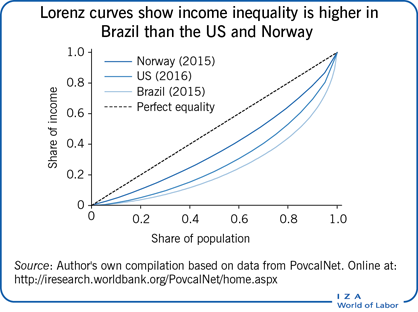
It's a curve reflecting income (not wealth) share of a population against a line of perfect equality, which is a 45 degree angle. A low disparity hugs the line and a high disparity hugs the X and Y axis. Gini = A/(A + B) where A is area over the curve and B is the area under the curve. So an increase of 0.1 in the gini number reflects a larger A.
It's not a very good way to measure what it is trying to measure[1].
I think the main problem is the lack of intuition of what "1 Gini means", except the "lower is better". Is difference between coefficient of 10 & 11 the same as difference between 30 and 31? The poster to which I responded said that "32 vs 41 is not far apart" - is it? Is difference between 10 and 19 the same as difference between 32 and 41 (delta is the same)? How about between 0 and 9?
That was me, and they aren't that far apart. Is 41% of the area under a lot more than 32%? Not really, see this example[1] Norway here has a coefficient of 27.5 and the US was at 41.2 but the graphs are barely different except that you can see that the US has a sharp bend on the far right hand side. The gini formula is really sensitive to that in a way that doesn't tell us much.
Wealth/income inequality is addressed by wealth/income taxes, or marginal consumption taxes. Controlling prices (limiting wages) would be a terrible way to go about it.
Use profit margins to determine what wages should be. I wouldn't be surprised if the wages are fine on that basis, actually. But let's draw the right conclusions for the right reasons.
Strong disagree with that one and this is a fairly unambitious take. Most companies and employees themselves in the EU buy their own kool-aid of "yeah we are ok with getting paid $40k because we got health insurance" (which does not work as efficiently in practice as one would like).
EU - esp. Germany and some other European countries - have abysmal salary compared to rest of the developed world and a poor wage growth over the last 10 years or so.
Heck, even countries like India have experienced faster growth: netto, a senior tech professional in India can earn more than what what they'd get in Germany. And that's not even accounting for 3-5x difference in cost of living.
Yes, but you get a social security which is without par. Including one year Arbeitslosgeld (in most situations), health insurance, the works. I always find it funny that we compare these things. In the USA the salaries are superhigh, but lo and behold if something happens to your crystal perfect life. And in life shit happens. A disease, an accident, an unwanted pregnancy. There is so much that might go off, you can literally drown in debts before you even know it.
Agreed, this is actually pretty scary for me (living in the US for a decade now) - bankruptcy is potentially one accident away (especially if it takes away the ability to continue doing the high-paying job).
In the USA in Meta like companies you have good healthcare insurance, one year paid maternity leave and a lot of other benefits. 4 months salary at layoff. And you make 2 to 3 times more than in Germany.
I thought about moving to Berlin and did some research. Median salary for a Senior Software Engineer is 86k EUR in Berlin according to Glassdoor. You will pay ~48% in taxes (depending on your Tax class), so it will be around 3700 net per month with an avg rent ~1500 EUR. So it's like 2200 EUR left, and you are supposed to have a life (and even make some savings) with that money. I don't know how this is fine to be honest. The only reasonable way to do it is to have this salary when you live in a more cheaper place with a better tax regime.
Nah. With 86K gross/year in Germany you get: around 4K for tax group 1 (single) and 4.7K for tax group 3 (married and your partner earns less than you).
Also, average rent in Berlin is among the cheapest (compared to other big cities like Hamburg, Dusseldorf and Munich). So, more like 1K/month for a decent apartment.
In any case, I agree with your overall statement: even if 86K/year puts you in the top 10% of earners in Germany, in reality it's hard to afford a decent house (not flat) with that salary (unless you wanna work until you're 67...)
For me it comes to an almost philosophical question: do you want to live like an average person in a developed country, or do you want to live better than average in a different place with a cheaper cost of living?
Thank you for the calc though, seems really helpful.
I have seen a previous manager at a company cannot compensate for FANG levels say for interview candidates "Don't put a high bar, besides we won't get that kind of talent because... you know... FANG".
But i don't see that being necessarily true and largely depends on type of software you build and the culture of the company. A lot of people are decent engineers and are not interviewing for FANG for a variety of reasons are for no reason in companies that may or may not deserve them. I think its hard to build street cred to get people to work for less, but interviews should always have a good bar.
One weird thing about the software industry is that the guys who design skyscrapers and the ones who put in drywall have the same job title
You don't need some Google genius to do a lot of this work, and sometimes a regular person will do a better job than some wonderkid who spends too much time and effort trying to automate it
Romania and Poland aren't exactly small by European standards, in fact they're some of the biggest by population and area. And Romania is not Central but Eastern European [1], so that's out.
Small and Central European would be Hungary, Slovakia, Czechia, Austria, Slovenia, Switzerland based on the most widely used definition of Central Europe [1]
Depends, Romania is either central, southern, or east european. Culturally is most definitely not eastern. Germany is by some considered central european. Austria and Switzerland see themselves as west european. Oh the delusion.
Every country changes their belonging to a region based on the perceived value bias of what is being discussed.
A user here humorously put it that Slovenians see themselves as Western European when it comes to how honest and hard they work, Southern European when it comes to weather and food, and Eastern European when it comes to drinking, partying and having fun.
But geographical location however is immutable, so let's stick to that instead of the other more biased definitions.
I think we are both talking now about the first chart in the section “Different views of Central Europe”. The one with the caption “Central Europe according to The World Factbook (2009),[1] Encyclopædia Britannica, and Brockhaus Enzyklopädie (1998). There are numerous other definitions and viewpoints.”
I would probably not classify Poland as small, especially noting how big of a population drop between Poland and Romania is. And if Poland were a US state, it would rank 2nd in terms of population, sightly over 1 million people less than California...
While it might not saturate the US job market as a whole, it will saturate the parts of the local programmer market that can come even close to matching the sorts of salaries these people where probably paid.
If they're willing to move to anywhere in the US and/or take a 50+% pay cut then they'll have no problem getting a job. If they all want to stay where they are and get paid within 20% of their current salary then lots of people will end up without a job.
It should also be noted that a person recalled from the home office already has a hidden 20% pay cut if she or he has to commute for about an hour in each direction.
EDIT: I mistakenly first wrote "each day" instead of "in each direction".
Definitely true normally but we’re in this weird world where a ton of people got to try a previously unavailable or unemphasized option. Full-time remote work used to be a bit unusual but a couple of years was enough for a lot of people to get used to the idea and now it feels like a cut to go back, even if they were used to being in the office in February 2020.
No, but commuting has other expenses: beyond the obvious cost of cars that often includes eating out more (often at pricier locations), extended childcare, wardrobe expenses, etc.
No, a FAANG employee probably isn’t suffering (although consider the pay outside of the prestige jobs) but everyone just got a multi-year reminder of those indirect costs.
I work at Stripe. I can’t throw a proverbial paper clip at this company without hitting someone who could be founding a company right now. There’s no way to lay off 14% of Stripe without setting free scores of future founders.
Starting a company is a risk vs reward calculation. If they were getting high salaries it wouldn't be unreasonable to want to minimize your risk by working on a project on the side while getting a bigger saving bank until a certain point. If you get fired the calculation is now whether you want to invest in job search or take the plunge and start the company
If you were that risk averse (that you didn’t act on your entrepreneurial instincts) when times were good, my money is that you’re more likely to double down in searching for safety.
I don’t know that there are any stats on this so in the end it is juts your and my opposing instincts :-)
Imagine thinking that starting a new company is a bad idea. It might not be easy, but the engine of progress is the birth of new firms, not the monopolization of markets through a handful of them. The vast majority of jobs are provided by small to medium-sized businesses, not companies like Twitter or Stripe. This is particularly true in Europe, but it's quite universal. We need new companies, even if some fail (or even most).
OP isn't saying it's "easy". They are pointing out that forming a startup is achievable by a small (scores = several 20s ~= 60-100) number of people impacted.
I feel exactly the same. I would love to run my own tiny company, but it looks very tough to bootstrap. Everytime I hear someone say it is easy, I cringe.
Not necessarily… a potential good startup founder is not necessarily a skill set that a FB needs right now. And many business ideas that aren’t “FB-scale ideas” can still be quite successful for a small founding crew.
That’s right—-any time you’re laying off thousands people at once, some of them will the “the wrong people”. There is no mechanism for mass layoffs that can accurately target only “low performers”. Even if these layoffs reflect good decisions, good decisions at corporate scale are not necessarily good decisions at the individual level.
This is a valid concern in a recession but there are different niches and business models. Facebook has been very profitable selling ads but that’s not the only option, and there are opportunities which might be a good fit for a small company which a big one is structurally incapable of finding. After the dotcom crash, I knew several people who found solid niches selling services to other businesses - it didn’t have the hypergrowth potential of something like an ad-supported social network but most of those fail, and there’s a lot of money in less sexy industries.
Clean tech also seems big - even if the Republicans did manage to gut federal support for renewables (I’m doubtful given e.g. how much money Texas wind farms are making) consumer trends are looking solid and a lot of state policies represent locked-in market.
Less competition, more available labor, the books start with a "this is hard" and get better when things get better (compare with starting when things are easy and then having it rough when times get hard)...
Only if you can start a company that's cashflow positive from essentially day one. Burn rate provided by suppressed interest rates and cashed up venture capitalists is quickly becoming a disappearing concept.
The first dotcom crash was good that way: people make worse decisions when they have piles of VC funny money and anyone with a real business has trouble standing out when the field is full of competitors burning bright but fast.
I’ve been here long enough to have seen the countless comments lamenting the current state of qualifications and ability in the industry. Here’s to hoping that meta and stripe laid off under achievers that would be wise to get into a different industry where they’ll perform better. Musks layoffs ignored since it seems clear that his were indiscriminate and hasty to the point of negligence.
Does the small EU country you are living in pay FAANG level salaries (200k and more) for their developers? Because in the small central EU country where I live, they always say skilled workers are in demand until you tell them your desired salary ;-)
“Oui mais vous avez des tickets resto” — Explanation: French people seem always very happy with low salaries as long as they have social benefits such as 4,60€ ticket for restaurant at lunch. And free healthcare, which they pay 800€ per month (for a 65k€ salary).
They really need some economy lessons. If I were a true capitalist, I’d teach them socialism for free.
I don't see it, I used to get a few emails from recruiters every day. The other day I got 1, and it made me realize it's been literally weeks since I had one. Lots of companies froze their hiring. The music is stopping, and there's a lot less chairs. Not everyone is going to find a new seat.
Well to be honest 1/10 was a little bit of overstatement, but yeah every year there's a governmental report about how this country is missing 150k programmers so it's about 1/8 or so.
> there's a governmental report about how this country is missing 150k programmers
You shouldn't take these governmental reports at face value. In my country, we see a lot of these reports too, and for all kinds of professions. Most of the time it just means that the corporate want more people willing to work for less.
The problem is this statistics contains jobs ads that are not viable:
If i put out a job ad: Need a software develioer with skills in COBOL, latest react and assembly, to lead a team of 10 for $30k
And I cant hire anyone
It will still end up in government statistics for shortage.
This is lile if we all put out ads on Gumtree/craiglist 'will buy a Toyota, brand new, for $1000", and someone counts thise ad and concludes there is a shortage of Toyotas.
In that example, you still want a Toyota though, right? Just because you don't want one all that badly doesn't mean your life wouldn't be better with one.
We have this too in Germany, but it's usually not based on open positions but some "we would need this to grow the GDP further industry is saying they miss these number of people" from some lobbying group like Bitkom. But Chapeau! for your country.
Keep in mind that government reports have a time lag. It's based on someone doing research some time ago. The time lag could easily be months. If it was 100% true at the time of research, the current situation may be very different.
Meta was hiring aggressively at the beginning of the year, as were many other companies.
Yeah, fly ‘em all to a “small central EU country” which shall henceforth be known as LuxemValley. As a bonus, ‘errbody working in LuxemValley shall be known as the SiliconBourg and be issued a mug, backpack and Chemin de Fer paddle. :D
Seriously, under current law, H1B workers will be even more locked-out of US jobs until these newly RIFed US workers land somewhere, but India doesn’t really depend on H1B contractor revenue like it did during the mass RIFs of the “Dot Com Bust.” No, now Indian citizens can work comfortably, efficiently and economically from India, like many of the far more expensive (and now RIFed) US workers had been doing from their US homes. For those RIFed US workers to compete with more economical India-based workers, they’re going to need to either get very small and crawl under the door to struggling US employers (by lower their salaries while abandoning remote work) or maybe they’ll need to cut expenses by moving to a “small central EU country” and get paid in Euros.
I hear you, but things will be different this time around. It would take me 20 minutes to explain, but gist is there is a HUGE diff between senior engineer and senior tech, there was no H1B phenom until 2001, almost no senior level engineers (cough) remaining in the biz until around 2006 (thanks to dot-com bust nuclear winter) and balance wasn't even restored until recently (very recently) because, you know, engineers with 10 years experience aren't half as confident as techs with 5 years experience. If you're a senior level engineer who can write operating systems, firmware and glance at a data center blueprint and see RF signaling issues as easily as you can look at a schematic and see DMA inefficiencies, are you going to pledge allegiance to a turd like company run into the ground by the spoiled Boomers or are you going to start your own company (or throw in with some hungrah folks you maybe met saving from the supremely over-confident senior technician crowd)? This time around, those Strange Conditions don't exist anymore and, much as it was in the 80s, you can't buy/refi a house in the US unless you can show significant ATR and lastly, with tightening credit (that comes with higher interest rates and, for now at least, higher home prices), you are going to need to be compensated in greenbacks (not stock) and show stability (not 1-3 years per gig)...all things that are harder in startup-land. For now, find another gig with a large company, go overseas (Europe not Middle Eassssst) if you have to. I will write a book, but they won't let me publish until the movie is done roflmao
> I'd be very surprised if it saturated the US market in any measurable way.
Most of meta enigneers won't be working for 120k midwest coding job if they can avoid it. So spread will be focused on similar pay positions vs distributed unifromly.
Going off the article it sounds like most of the layoffs are in business and recruiting so I suspect a small-ish fraction of the layoffs will be programmers
You're right but its not as if only Meta are firing or we're anywhere close to this recession ending. There's gonna be a bunch of pain to come still unfortunately.
I reckon 11k would pretty well fill all the available tech roles in Czech Republic (which fits the "small Central European" description). God knows where they'd live though, rents + prices would explode
I think the pay will go down its the meta and google etc that have been pushing up the salaries without the demand from them the pressure on salaries will bring them down.
The real problem to worry about is hiring practices, shitty HR people, algo-based auto rejecting and shitty fucking interviewers... THIS will have impact on these people suffering to find a new position....
So really what needs to happen is companies need to be reaching out URGENTLY to those have been kicked to the curb.
There is thousands of years of experience this population carries.
It does mean that a lot of folks will be looking for work, expecting really big salaries. Because they have become used to a very high standard of living, these salaries will actually be required.
MANGA companies pay ridiculously well.
I suspect a lot of "Reality sh*t sandwiches" will be in people's lunchboxes.
Similar here. Over the summer my country of 3m people, reached its yearly immigration quota in tech jobs of 16,000. And that doesn't include people moving inside the EU or refugees from Ukraine.
the effect this kind of thing has on the broader market is that it makes everyone else reconsider their hiring plans. I doubt there will be as many open positions after this announcement and it won't all be from hiring
True, but these aren't ordinary engineers who'll settle for ordinary salaries. These are the top paid engineers in the industry - there are practically no places that can hire all 20,000 of them at their current salaries.
Per last job report in US, there were two positions for every person finding normal jobs. For IT, I would think that ratio is twice. However, the biggest issue that people have to deal with: (1) Meta paid 2X to 4X higher than regular employers so that’s massive pay cuts for the folks, (2) they lost the unvested stock aka their hold out compensation of past 4 years they worked for.
So, this would be huge financial setback for impacted people akin to losing half of their wealth and cutting down their future income as well in half.
I think the parent comment is talking about your general 5-year vesting schedule. In other words, for each of the past 4 years you worked, you will have some unvested stock today.
Meta does pay higher (maybe not 2x higher) and the message in OP says employees will get their November 2022 vesting, which implies they won't get any future vested stock.
Yes, which is what the GP post said, they lose their unvested stock. By future vested I meant, stock that will vest after they are laid off. Could've been clearer I guess.
I remember the dot-com (and Y2K) bust, when all the people who got into tech for the money (and not the love of it) suddenly decided to switch career. I hope the same happens now.
I dont really care why you got into it so long as you remain excellent while you're here. the Problem is the (seeming) correlation between money driven motivation and apathetic (sub)mediocrity.
For me it’s about how CV-obsessed our industry has become, which you could say that is also caused by the money factor.
Basic things like the KISS principle have been thrown in the garbage can, almost all that matters is how the tech we’re now using can further increase our career prospects.
So you're implying only people who are passionate about tech should be allowed to work in tech? This does not hold water for almost any profession. Tech pays extremely well, and if you can do the work, who cares how you feel about it?
If you can do the work, awesome, no one cares how you feel about it. But that's the keyword: *IF* you can.
People who went into IT for the love of it are diligent by default (from my personal experience) and CAN do the work. Then you get people who enter IT for the money (nothing wrong with that) and not all of them can do the work.
Those are the show-stoppers usually which incur various debts (from tech-debt to actual financial debt) because you end up having to carry them.
Let's not pretend as if they don't exist, there's so many of them.
Absolutely, and it's hugely demoralizing to work with them.
A person like that was moved off of my team recently, and the general lift on the team from just having them gone has been astounding. Everything is up: velocity, stability, even just the vibe of technical planning sessions.
> We've known since the early sixties, but have never come to grips with the implications that there are net negative producing programmers (NNPPs) on almost all projects, who insert enough spoilage to exceed the value of their production. So, it is important to make the bold statement: Taking a poor performer off the team can often be more productive than adding a good one. [6, p. 208] Although important, it is difficult to deal with the NNPP. Most development managers do not handle negative aspects of their programming staff well. This paper discusses how to recognize NNPPs, and remedial actions necessary for project success.
The other most interesting part of the book (while certainly dated), is the citations to see what came before and more material on it.
    Weinberg, Gerald M. The Psychology of Computer Programming (New York: Van Nostrand Reinhold, 1971)
    Dunn, Robert H. Software Quality: Concepts and Plans (Englewood Cliffs: Prentice Hall, 1990)
    Christenson, D. A. et al, "Statistical Methods Applied to Software", collected in Schulmeyer, G. Gordon & McManus, James I. Total Quality Management for Software (New York: Van Nostrand Reinhold, 1992)
(and so on)
And while one can certainly debate the "is the advice given in something that is 30 or 50 years old still valid" - that debate itself is interesting in considering what was going on in the minds of managers back then and how they tried to solve these problems.
There is a certain lack of institutional knowledge and a desire to throw much of it away with the phrase "we're agile" or some other management buzzword of the day... and yet Brook's Law is still as valid today as it was nearly five decades ago (gotta keep an eye on that... I wonder if they'll do a third edition in 2025).
I once had to fire that person. I hated it, it was very hard to do because they guy was a personal friend of mine and he never talked to me again afterwards. However, it fixed the team and we went on to do a lot of very good work that we couldn't have done otherwise.
Bit of a tangent, but it's kind of harder to hire as well.
Years ago when interviewing people I didn't have to wonder as often how passionate the candidate actually is towards the field, or whether they're just looking for a high pay job.
These days I get those doubts a bit more. I think most people are still at least somewhat passionate though (bad/awkward programmer tooling which we've gotten used to are somehow great filters....)
It is more fun to work with people that love the work they are doing, who get jazzed up on covering all the corner cases and really good test suites and efficient use of a computer. People who will listen to tech talk for ten minutes and then act like they are thinking, “how will this get me director or VP by thirty” are less engaged and less fun.
During the dot-com days, you could get a job if you can fog a mirror and turn on a PC. Now you typically need to get a degree to get your foot in the door so at least there is a vested interest. (Not to say there aren’t talented people without degrees.) I think the OP is talking about getting rid of some of the dead weight. We’ve all worked with someone who coasts along and wonder how the hell they have a job in the first place.
Excitement about what you’re doing brings excitement to others too and many great ideas come from people tinkering with side projects and the like. We shouldn’t stop anyone from going into tech on anything but competency but yes, given the choice to hire someone passionate about it or someone who sees it as a droll 9-5 with roughly equivalent skill sets, I’d pick the passionate one.
My 2 cents is that it's going to be mostly recruiters, sales, customer success, and other misc operations folks. That's the pattern I've been observing since the post-covid layoffs have begun.
The submission itself is such a link. Did you even read it, or just dive straight into the comments?
> Recruiting will be disproportionately affected since we’re planning to hire fewer people next year. We’re also restructuring our business teams more substantially.
Add to that thousands of smaller companies laying of 10 people here, 100 people there. We will not hear about it, but it quickly adds up.
In addition, we go from a phase where people new in the job market (students etc) were being hired quickly to no one hiring them. So there are both laid off people and new entrants added to the pool.
> In addition, we go from a phase where people new in the job market (students etc) were being hired quickly to no one hiring them. So there are both laid off people and new entrants added to the pool.
I don’t think that’s necessarily true. Hiring students is much cheaper so companies may still hire them whilst letting go of other expensive employees at a cost of quality.
>Will this over flood the market and bring expectations and salaries down?
Well I predict two things:
One, the days of $200-500k TC being common and widespread are going to end. If you're in this bracket, or about to break into it, yeah be worried, it's probably going to evaporate.
Two, the CV value of Meta, Snap, Stripe, etc. is also going to end. I don't think they will command the same premium in the jobs market from now(ish) onward.
i would imagine other industries are going to suffer as well. my partner worked in fashion for a decade and realized it was horrendous and nothing was changing so she went to a bootcamp for UX design and got a job not too long ago. the pressure of the success of another industry would force bad industries to change certain ways of working for the better. when there is 0 competition, there is nothing stopping outdated and overworked industries from becoming any better. like it or not, the tech industry has helped elevate the broader market to a certain degree
Oh yeah you're right. I read it as "developers in the non-Bay Area"
Nonetheless, I don't think the point changes. One group getting less doesn't usually mean that it's going to transfer over and some other group will get less. Most likely, everyone is going to get less.
Rising tide lifts all ships as they say (and the opposite is true as well)
Not really. If anything junior engineers are not going to see comp like this going forward. But it's still incredibly hard to hire more senior folks even with big comp packages and they do command a premium.
Expect the median to go down, doubtful the top 25% will change much.
Its also worth noting: Its easy to get scared by a number like "11,000", but just pulling estimates out of my ass; engineering likely represented less than 20%, and the bias toward those let go in engineering is likely junior. Not asserting no one senior was let go; just proportionality.
Here's what I'd add: Its extremely difficult to hire really talented senior engineers. Its easy to look at layoffs as "great, we should be able to find senior talent now"; but the opposite may actually be true. Layoffs, at least in otherwise "fine" companies, will predominately not impact senior engineers, and they'll also be less likely to leave. Moreover, the industry is effectively building a wall to breach into seniority; the pathway from junior to senior is harder and harder, even going back a year or two, and many of these junior/normal devs were massively compensated at these roles.
My heart goes out to the junior devs right now; there really are two industries and job markets.
It was obvious that those days were going to end eventually, it was never going to be sustainable. A few people I knew were deciding between job offers at beginning of this year and I straight up said take the most comp, this shit isn’t gonna last forever…
on the face, it should be pretty easily sustainable based on the profit per employee these companies make. i guess we just really hate anyone but shareholders actually getting a piece of the pie.
I checked a few days ago and the revenue per employee at big tech is eerily similar to "Biglaw" and non retail banking (Jones day, >200k entry level, goldman is similar) at 1-2mil per employee. One could argue the market for IB/trading has been saturated by applicants for years but they pay is still well above norms ~>150k entry level. Pretty interesting.
I think the folks who rode the ride a couple years back got it good: somewhere around 2012-2019 was great time for someone who had worked at marquee tech companies, had massive stock options, and commanded premium on the job market when they moved on from their orgs.
I just can't really believe this at all, unless these companies entirely crumble. It's just not feasible for the majority of folks to live comfortably in the Bay Area with a family at less than $200k TC.
I make ~$300k/yr and could probably swing $200k/yr if I didn't save anything (I save ~$100k/yr currently). I just can't imagine it being reasonable with housing + other costs.
1. Housing costs are elevated here more than anywhere else in the world.
2. Cost of goods is drastically higher here than other parts. The (roughly) same amount of groceries from a local Sprouts here (we spend ~$100/wk), is almost always $30 less everytime we go back home for some durations of time to be with family.
3. Cost of services like daycare or anything else necesary to let the work happen take note and charge enormously.
As it stands, between housing + utilities, our spend is about $8000/mo (factoring in the odd things as well like car repairs over time). To accomodate that, I'd need $100k/yr after-tax, and that assumes that nothing drastic ever happens, and factors in no savings at all.
We could downsize and save $10k/yr, but that's not really making a substantial dent long-term.
$200k realistically feels like a minimum to keep any kind of young families in the area. I could definitely do with less salary if I could move, but companies are very wishy-washy about remote work.
Until that is solved, or the Bay Area calms down, these salaries aren't going anywhere. But if remote work is embraced even more, than returning to say $150k is completely reasonable.
The housing costs in the Bay Area are primarily caused by 300k salaries from companies in the area. It's not going to crumble immediately, but I can imagine that if the (to-be-)recession drags on, there's be a downward pressure on both salary and housing prices (and other costs of living). Nobody is going to cut your pay in half, but those 8k/month rents are just a function of the demand (of housing) and supply (of money) in the area, not really a law of nature..
It's not a given that everyone will be looking for a job immediately. They're getting a multi-month severance package. Some will look immediately - some will take a breather and start looking in a few months - some will take the time to switch careers or go back to school. Also, it is 15,000 people presumably located around the globe - not just 15,000 people in Menlo Park.
It says those will be “disproportionately affected”, but that could just mean that they represent (say) 10% of the layoffs even though they make up 5% of the team. It doesn't mean that the layoffs are mostly those folks.
Programmers don't make up more 10% of fb's employee base anyway (a guess) so if you assume that fraction at both fb and twitter you're looking at about 1500 additional people looking for jobs not 15000. Suspect this has little to no impact
If that’s the company-wide number, I imagine it’s even higher in the Family of Apps and Reality Labs groups (the ones affected by layoffs), because it doesn’t include cross-org functions like facilities or accounting.
It says about 12k are software engineers. Now it does say 40k total employees instead of the real number but I suspect software engineers are much more likely to be on linkedin. Still fairly confident that its closer to 10% than 33%.
Honestly, tech companies that were formed in the last decade have very little to show in terms of value creation. Majority are unprofitable. Most will never make profits in a recession AND tighter monetary environments.
At the end of the day, businesses have to generate profits. You can only defer that so long. And most tech companies have been deferring it for a decade now.
The US alone has over 12 million people in tech. This few workers, for a field that has incredibly low unemployment and lots of open positions, is not going to have a problem absorbing newly unemployed.
Well Meta severely downsizing their HR department shows you they're not gonna recruit much if at all. It's not a great sign for someone looking for a job...
These numbers are just the start of the avalanche... There have been a lot of pie-in-the-sky initiatives, especially as the result of the massive cash infusions during Covid.
Now all that easy money is going away.
The current numbers don't mean much, but they're just the start.
It will probably spill over into the rest of the economy. No matter how generous the severance, a fired worker isn't going to be buying new cars, buying houses, or taking expensive vacations.
Were you around the dot com crash? It was much worse than what is going on, layoffs happened left and right. But the future would have never been better for tech jobs. So no, incorrect to say anything for sure.
I've long argued that it was the "creative destruction" of the dot com crash that made so many of the FAANGs possible.
For instance, Amazon in Seattle benefited as thousands of engineers found themselves out of work in 2000 and 2001.
In addition, AWS was largely inspired by the fact that Sun Microsystems refused to cut their pricing. Amazon was using a lot of Oracle databases and Sun hardware, and when Sun wouldn't negotiate their prices down, Bezos began to figure out A Better Way.
Bezos was particularly irked because there was a flood of practically new Sun hardware available (due to the crash) but Sun wouldn't negotiate on price, despite the market being awash in high quality used hardware.
Basically Bezos didn't want to spend $80,000 on a new Sun server, but he also didn't want to run hardware that was used.
Comps will come down from the stratosphere but good devs will not be unemployed long. They may fall to less exciting roles at banks or other traditional tech, but there's still tons of demand.
The US has 2.7 million developers. Who knows? They may have to sully themselves and become “enterprise developers” like most of the other 2.7 million developers…
The difference here is that it is all at once, and those same companies are slowing hiring. Net effect is that there are loads more people with prominent names on their resumes competing for those jobs that the recruiters are canvasing en masse with. Right now if you replied to one of those positions they'd likely turn you down after a screening call because the calibre of candidates on the market is really high.
They are actually going down because of inflation and the lack of a full compensation for that. You get the same money but it's worth less.
As for unemployment figures; apparently they are very low right now. Which suggests companies actually need to offer more to be able to fill open vacancies. A few tens of thousands highly employable people leaving the fang companies is not going to change that.
salaries rarely and hardly ever go down. however inflation does exactly that in real terms. This is an interesting article about it: https://www.interfluidity.com/v2/9566.html
Will this saturate the market for all open programming/software engineering positions? No.
Will it disturb the market for engineers expecting to make $500k/yr 2 years out of school? Absolutely. But most tech stocks being down 50%+ YTD had already done that.
I think there's going to be a lot more layoffs announced from far more companies over the next 6-12 months. I think all of those people will be able to find jobs, but I think many of them will have to settle for significant pay cuts. The insane TCs driven by an inflated stock market that were seen in certain markets/from certain companies are certainly going away for a long while.
Personally, I wish that people in our industry would push for a larger base salary-based comp and less stock-based.
Also a lot of those people are going to take time off. A large number of high earners that have worked at a place for a decade and now have ~9 months paid vacation.
cost of living in those areas means these guys live at best above middle class unless you want engineers to essentially never have children and live in an apartment all their life, then even 200-300k in these areas isn't much.
As an engineer living in Europe and inside an apartment I can confirm.
Also wanted to add that when we want to feel less trapped we can very easily escape to many other nice places that surround us in the near vicinity, I usually go for bookstores and coffee-shops (from where I’m writing this comment), other people also choose parks, bike-rides, stuff like that. We manage.
Without those soulless entities who over hired by a large numbers those people may not have their job in the first place. So sympathize, but with perspective.
if reports are to be believed, large swaths of these layoffs were in business and recruiting units, much less so engineering, so not exactly 15k+ new applications coming in
They can try. But it would be a better time to build a team without the overhead of renting office space. I guess it depends on whether companies see an opportunity to wind back leverage from employees or to embrace new possibilities.


.svg)