Yes, but your salary will be 1/2 of what you're used to.
My brother moved from FAANG to Atlanta to work for Home Depot. His comp went down from 400k to 140k. Which is still great for Atlanta, but there is no situation where a move from FAANG to any other company comes without wage deflation
Roof over your head. Seriously? In Europe if keep it modest you can keep a roof over your head by working in supermarket. I don't think this should be your aim honestly.
Depends where in Europe you live, though. And in recent years, even that is not enough for most countries with a strong Tourists sector, as rent goes up year on year (they increase rent during summer then lower it, but it's still higher than before). That's been going on for at least 15 years in some regions of Croatia. Not to mention everything (except salaries, od course) is being rounded up to Euros, so that's additionallt going to affect Croats.
Yeah, but that's still in the USA. The poster is talking about a totally different type of switch.
As an aside, you're talking about switching from a company that supposedly makes revenue selling ads but really is inflated with free money to one that makes revenue from selling hammers. People who made this switch before the free money are going to be fine. Now that 11,000+ people are going to try to make this switch, they're going to wish they had.
The other thing that happens with this is your job becomes much more practical and less oriented to whatever fads are sweeping SV and HN. Some like it, some don't.
High frequency trading pays better than FAANG if you got the right skills and can cope with the work environment (which is not as bad as it used to be from what I hear).
I don't think these people need either sympathy or pity. They will do fine. They're all smart. Most are also hard workers. People like that don't struggle for long.
The damaging wealth inequality is the hundred millionaire + class and the rest.
If prosperity distribution had kept track during the last 50 years (wealth has increased dramatically due to tech), the average salary would be 6 figures, so it’s actually better for wealth distribution to have tech folks making higher 6 figures to put pressure on the 8+ figure class.
High tech-sector salaries are the result of extreme wealth inequality, not the cause of it. The 0.1% are not Meta engineers hammering a check and fretting about RSUs. They are the ones investing in every half-baked TechCo and startup because they already own a few small countries and a Blackwater detail the size of the 82nd Airborne, and they can't think of anything else to do with their money. It's this desperation for anything approaching positive real returns that has inflated US tech salaries.
At German car manufacturers? Absolutely not. The maximum compensation that an IC can commend at BMW is just above 100k€ -- and that would require more than ten years of experience.
Compare that to a new grad at Google Germany making 130k€. Somebody with ten years of experience there would be making closer to 300k€.
But that typically old-school setup where there is only one way to make more money is move up the career ladder into management or in German “Führugskarriere”. I have no pity for these types of companies who don’t understand that a senior engineer is worth more than a young group leader. A few companies have started to change but Germany has along way to go to adapt from this mindset, but in reality there would be enough money just another distribution is necessary.
The GINI coefficient for Germany is about 32 vs 41 in the US with the global average being 38. That's not so far apart, and the US is skewed by have a chunk of the world's wealthiest people.
It's hard to take two numbers in isolation that we don't really use day to day and make any kind of sense of them. It's only when you graph a few countries together[0] that you see:
1. the US is somewhat of an outlier, while Germany is grouped together with other wealthy countries
2. the US' Gini has been steadily growing last few decades - implying inequality is getting worse
3. Germany's Gini is very slightly declining in the last few decades - implying it's staying roughly stable
I don't think higher-than-average is particularly good at all - you're in the neighbourhood of places like Qatar, Iran, DRC and Argentina. In fact the only way you'd use Gini to suggest the US has a ok level of wealth inequality is if you presented two countries Gini coefficients side-by-side to someone who doesn't normally think about Gini, presented them without any other context and said "look, they're kinda close"
What I'm getting at is that Germany isn't some paragon of equality, it's average. The US as I pointed out is skewed by the high number of staggeringly wealthy people and a trend of people moving from the lower to upper levels of what you might call middle class. In the US wealth held by people form 50% of the distribution up to 99% represents about $91T vs $18.2T for the top 0.1% and $4.4T for the bottom 50%. The coefficient really hides the vast middle and upper middle distribution in the US.
Also this obscures the fact that it is far better to be poor or working class in the US than somewhere with a similar Gini coefficient.
> The US as I pointed out is skewed by the high number of staggeringly wealthy people
I think you might want to lookup what Gini tries to measure. You used Gini as a way to suggest the USA isn't so bad, and now you're having to backpedal and say that actually Gini kinda sucks but the USA isn't so bad.
> You used Gini as a way to suggest the USA isn't so bad
No, I'm pointing out that at lot was being made of a small difference in a ratio that's really sensitive to marginal differences. I'm noting a marginal difference that makes the US look more different than other OCED nations than it is in fact and more like autocratic developing nations than it is in fact.
I'm also pointing out that it isn't a good measure at all. It's as coarse as GDP and more misleading.
Sure, that makes sense. It's just worth noting that the U.S. are not an outlier amongst developed nations when looking at wealth inequality -- which, IMO, is the much more important metric.
Not really. The US attracts wealthy people from around the world, has a gigantic internal market, and is friendly to financial business. If you don't consider the top 0.1% then the picture looks totally different. The VAST majority of wealth in the US is help by people in 50th to 99th percentile range. The Gini coefficient makes the US look superficially more like Qatar, which is obviously nonsense.
Some metrics aren't linear so w/o knowing more about Gini coefficient, my first thought is "I have no idea if the difference is significant or not". Can someone ELI5 this so that I can build an intuition for what "1 unit of Gini" means?
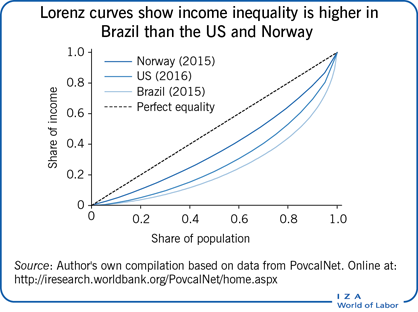
It's a curve reflecting income (not wealth) share of a population against a line of perfect equality, which is a 45 degree angle. A low disparity hugs the line and a high disparity hugs the X and Y axis. Gini = A/(A + B) where A is area over the curve and B is the area under the curve. So an increase of 0.1 in the gini number reflects a larger A.
It's not a very good way to measure what it is trying to measure[1].
I think the main problem is the lack of intuition of what "1 Gini means", except the "lower is better". Is difference between coefficient of 10 & 11 the same as difference between 30 and 31? The poster to which I responded said that "32 vs 41 is not far apart" - is it? Is difference between 10 and 19 the same as difference between 32 and 41 (delta is the same)? How about between 0 and 9?
That was me, and they aren't that far apart. Is 41% of the area under a lot more than 32%? Not really, see this example[1] Norway here has a coefficient of 27.5 and the US was at 41.2 but the graphs are barely different except that you can see that the US has a sharp bend on the far right hand side. The gini formula is really sensitive to that in a way that doesn't tell us much.
Wealth/income inequality is addressed by wealth/income taxes, or marginal consumption taxes. Controlling prices (limiting wages) would be a terrible way to go about it.
Use profit margins to determine what wages should be. I wouldn't be surprised if the wages are fine on that basis, actually. But let's draw the right conclusions for the right reasons.
Strong disagree with that one and this is a fairly unambitious take. Most companies and employees themselves in the EU buy their own kool-aid of "yeah we are ok with getting paid $40k because we got health insurance" (which does not work as efficiently in practice as one would like).
EU - esp. Germany and some other European countries - have abysmal salary compared to rest of the developed world and a poor wage growth over the last 10 years or so.
Heck, even countries like India have experienced faster growth: netto, a senior tech professional in India can earn more than what what they'd get in Germany. And that's not even accounting for 3-5x difference in cost of living.
Yes, but you get a social security which is without par. Including one year Arbeitslosgeld (in most situations), health insurance, the works. I always find it funny that we compare these things. In the USA the salaries are superhigh, but lo and behold if something happens to your crystal perfect life. And in life shit happens. A disease, an accident, an unwanted pregnancy. There is so much that might go off, you can literally drown in debts before you even know it.
Agreed, this is actually pretty scary for me (living in the US for a decade now) - bankruptcy is potentially one accident away (especially if it takes away the ability to continue doing the high-paying job).
In the USA in Meta like companies you have good healthcare insurance, one year paid maternity leave and a lot of other benefits. 4 months salary at layoff. And you make 2 to 3 times more than in Germany.
I thought about moving to Berlin and did some research. Median salary for a Senior Software Engineer is 86k EUR in Berlin according to Glassdoor. You will pay ~48% in taxes (depending on your Tax class), so it will be around 3700 net per month with an avg rent ~1500 EUR. So it's like 2200 EUR left, and you are supposed to have a life (and even make some savings) with that money. I don't know how this is fine to be honest. The only reasonable way to do it is to have this salary when you live in a more cheaper place with a better tax regime.
Nah. With 86K gross/year in Germany you get: around 4K for tax group 1 (single) and 4.7K for tax group 3 (married and your partner earns less than you).
Also, average rent in Berlin is among the cheapest (compared to other big cities like Hamburg, Dusseldorf and Munich). So, more like 1K/month for a decent apartment.
In any case, I agree with your overall statement: even if 86K/year puts you in the top 10% of earners in Germany, in reality it's hard to afford a decent house (not flat) with that salary (unless you wanna work until you're 67...)
For me it comes to an almost philosophical question: do you want to live like an average person in a developed country, or do you want to live better than average in a different place with a cheaper cost of living?
Thank you for the calc though, seems really helpful.
I have seen a previous manager at a company cannot compensate for FANG levels say for interview candidates "Don't put a high bar, besides we won't get that kind of talent because... you know... FANG".
But i don't see that being necessarily true and largely depends on type of software you build and the culture of the company. A lot of people are decent engineers and are not interviewing for FANG for a variety of reasons are for no reason in companies that may or may not deserve them. I think its hard to build street cred to get people to work for less, but interviews should always have a good bar.
One weird thing about the software industry is that the guys who design skyscrapers and the ones who put in drywall have the same job title
You don't need some Google genius to do a lot of this work, and sometimes a regular person will do a better job than some wonderkid who spends too much time and effort trying to automate it