Bitcoin's price at the first of November was $197. That's around a 250% increase over the course of two and a half weeks.
General question: if you expect the price of Bitcoin to continue this rate of growth, does the rational consumer have any reason to spend? I don't follow BTC too closely, but it feels as though there's an innate conflict between its role as a speculative investment and its role as a currency.
> but it feels as though there's an innate conflict between its role as a speculative investment and its role as a currency.
Exactly the reason a deflationary by nature currency isn't going to succeed as a currency. Bitcoin might want to be a currency, but it isn't a currency, it's a commodity like Gold and its deflationary nature dooms it to be.
You shall not crucify mankind upon a cross of ... err... bitcoin?
</snark>
Anyway, in all seriousness, Bryan's speech still holds true today. Currency's role is to facilitate the exchange of goods and services. The value created by doing something today decreases over time, such that a thousand years from now, it is a mere blip in history. A deflationary currency runs counter to this -- some nerds who decided to buy some video cards in 2013 end up with a measurable percent of global wealth in 2020? That bag of weed someone sold in 2011 is worth a house in 2020?
Good currencies aren't about divisibility or about holding value long term, they're about being useful for exchange. Being deflationary by nature makes Bitcoin a bad currency, but a good commodity (once it settles down). A good currency slowly inflates.
Bit of a chicken and egg problem, really; if you're selling something, you probably don't want to be using bitcoin unless you're either a True Believer, or your product has extremely high margins and you're confident that use of bitcoin won't cannibalise use of more stable payment options. If you make a 5% margin on your product, you don't want that to be erased by a currency shift.
The big non-True Believer users thus far have largely been either illegal materials, or ultra-high-margin things (reddit gold, Humble Indie Bundle etc).
"Convenient denominations" is not the problem of deflationary currencies, it's a red herring.
The problem with deflationary currencies is that there is a huge behavioral difference between currency having 1% annual deflation and 1% annual inflation - it greatly slows the money velocity, as people are not motivated to spend it or invest it in means of production, so there's less of demand for goods/services causing less income for everyone and even more less demand in a reinforcing feedback loop.
It is widely considered that a low rate of inflation brings a very significant positive impact on prosperity compared to a deflationary environment or a very high-inflation one.
If bitcoin is growing in value, and is expected to grow in value in the mid-future, then that is a disincentive to spend it -> then that means a disincentive to sell stuff or provide services for bitcoins (because buyers don't want to use it) -> then that means that it has lower liquidity and usability. In the extreme, 'everybody saves bitcoin, nobody buys pizzas with bitcoin' turns into 'the only way to get rid of bitcoin is to find someone else who wants to hold it for no good reason, but wants to pay you a lot'. A healthy currency, on the other hand, gets used to buy pizzas and services primarily, and gains value because of it's utility in buying stuff.
I think this all remains to be seen. Right now the currency is experiencing rapid growth due to network effects. This is an entirely new type of currency in an entirely new environment. Until initial growth reaches an equilibrium, we're not going to notice any deflationary issues with the currency.
I suspect that once we do reach the top, we'll discover that bitcoin deflates rather predictably and boringly. So much so that it will make the interest rate in your bank's savings account look interesting. You'll still want to invest for the same reasons you want to invest right now--greater returns.
I just don't see the doom and gloom here. Maybe if Bitcoin was the primary currency in use. But it's not, and I don't think it's in danger of becoming so anytime soon.
What remains to be seen, everything he said it well known economics.
> we're not going to notice any deflationary issues with the currency.
You're already seeing it. Who wants to spend a currency that keeps increasing in value... that _is deflation_.
> I suspect that once we do reach the top, we'll discover that bitcoin deflates rather predictably and boringly.
I don't think you understand deflation.
> I just don't see the doom and gloom here.
Because you don't appear to grok deflation. When the demand for a currency spikes, as bitcoin is now, and the supply is unable to increase to handle that demand, deflation occurs and the price of the currency sky-rockets. Deflation isn't just about the size of the money supply, it's about the size of the demand of the market in relation to the size of the money supply and if a currency can't expand supply to meet that demand then it'll deflate to meet it and that makes it a terrible currency because it punishes spending and rewards saving, exactly the opposite traits of a good medium of exchange.
USD <-> BTC Trade Volume is spiking, while BTC Transaction is staying the same.
If you believe that BTC is experiencing "rapid growth", can you post some statistics that back your claims? Currently, the charts I'm watching indicate that the only "growth" BTC has right now, is USD <-> BTC exchange volume... which indicates increased speculation.
> as people are not motivated to spend it or invest it in means of production
It also hits credit hard, because lending money is less attractive as you say, but also because taking on credit becomes a riskier proposition; your debt grows even if you pay the interest and some of the capital! It's extremely difficult to see how a modern capitalist economy could function under these constraints.
Er, Gold was a currency for a few thousand years. Deflation is a good thing in a currency since it increases it's value when you aren't spending it. I've heard some argue that that might be bad for the economy at a large enough scale, but at an individual level that is certainly a positive.
> Deflation is a good thing in a currency since it increases it's value when you aren't spending it.
Its a good thing in a store of value and a bad thing in a medium of exchange. Modern currency mostly tries to optimize for the medium of exchange use case, which encourages investment in other things -- like businesses, land, etc. -- for store of value of purposes.
Yes that could possibly have a slight impact on the economy, but as I said, from an individual perspective increasing value is definitely a good thing.
> Yes that could possibly have a slight impact on the economy
In the same wall that a concrete wall across a freeway could have a slight impact on traffic.
> from an individual perspective increasing value is definitely a good thing.
From an individual perspective, its only "definitely a good thing" if you ignore all of the effects of everyone else using it except the effect of providing you the opportunity to use it and actually causing the increase in value.
>>Yes that could possibly have a slight impact on the economy
>In the same wall that a concrete wall across a freeway could have a slight impact on traffic.
Well you'd have to have a significant percent of people invest in bitcoin instead of investing in something else. And even then I'm not certain how much an effect it would have as speculating on commodities is very common already and a necessary part of the economy. Also it's impossible to avoid if the supply of currency isn't finite. If so then whoever is increasing the supply is also going to significantly affect the economy. Like a tax from everyone that has money to the government or banks or gold miners or whoever.
And from an individual perspective, having slightly more money in your pocket or bank account everyday is definitely a good thing.
> If so then whoever is increasing the supply is also going to significantly affect the economy
Of course. This allows _control_. For instance, the UK currently has a rate of inflation that's a bit higher than optimum, and there are methods for the BoE to influence that downwards. The Eurozone has an uncomfortably low rate of inflation, and it's likely that there'll be intervention there (there has already been some in the recent surprise rate cut).
In a system where nobody controls the money supply (or in, say, Milton Friedman's automatic money printing system), if severe deflation or inflation threatens, there is very little that the authorities can do. This seems like a bad thing.
> And from an individual perspective, having slightly more money in your pocket or bank account everyday is definitely a good thing.
But that wouldn't actually happen for most people. Normal people would be paid less, and might lose their jobs as lack of investment and credit hit industry. Rich people would make less as their holdings in companies and so on performed worse (your modern rich person typically doesn't just have a big stack of money in the living room; it's mostly in use). It's hard to see who would actually benefit.
> Well you'd have to have a significant percent of people invest in bitcoin instead of investing in something else.
Right. Bitcoin is mostly harmless so long as its not a significant currency.
> And even then I'm not certain how much an effect it would have as speculating on commodities is very common already and a necessary part of the economy.
Speculation on commodities that are outputs of production/extraction provides a useful function in terms of signal for resource allocation in a market economy.
> And from an individual perspective, having slightly more money in your pocket or bank account everyday is definitely a good thing.
If you have a net positive position in a currency, sure; if you're a debtor, having the value of the currency in which your debt is denominated being slightly more valuable each day is definitely a bad thing. Deflationary currency basically serves as an continuous upward transfer of wealth.
>If you have a net positive position in a currency, sure; if you're a debtor, having the value of the currency in which your debt is denominated being slightly more valuable each day is definitely a bad thing. Deflationary currency basically serves as an continuous upward transfer of wealth.
Interest rates would go down to match the deflation rate for that reason, or people could always make contracts that adjust for deflation. Besides bitcoin is meant for trading over the internet which until now has been an extreme pain. Loans and contracts will continue to be made in their nations currency for the most part, even if it does become widely adopted. (The benefit of competing currencies.)
Also many people argue the same thing about printing money to cause inflation being a continuous upward transfer of wealth.
>Speculation on commodities that are outputs of production/extraction provides a useful function in terms of signal for resource allocation in a market economy.
It's more than that. Even for purely finite resources, someone buying a bunch of it up because they predict the price will go up, helps stabilize the price. They conserve the resource in the present for future buyers who value it more/are willing to pay more for it. And the speculator benefits of course.
The opportunity cost is that they could have invested in another resource/investment instead of that one. Instead someone with a lower time preference will buy that resource (ie someone who values using it in the short term more than the long term.) But is that objectively a bad thing? In this scenario the people with higher time preferences are better off because they make more profit off their investments. The people with lower interest rates are better off because all other resources become cheaper. Is anyone actually worse off?
> Interest rates would go down to match the deflation rate for that reason
Huh? Why? Look at it from the bank's perspective. Lending money would be more costly for them than it would be in a normal mildly inflationary economy, so they'd _further reduce_ their profit on lending money? In a transition to a deflationary economy, banks would likely have to raise consumer rates just to stay in the black.
> Also many people argue the same thing about printing money to cause inflation being a continuous upward transfer of wealth.
> Interest rates would go down to match the deflation rate for that reason
The market clearing interest rate would probably go down, sure, as would the quantity of money lent.
Demand for credit would drop (that is, the amount that people would be willing to borrow at any given interest rate would drop), because the real cost at any given interest rate would be higher.
Supply (the quantity of money lenders are willing to loan at any given interest rate) would not increase, though. It might naively seem they would at first because the value of the payments on a loan with a given principal and interest rates would seem to be more, but in relation to the value of just holding the money in cash there would be no difference, so nothing to drive an increased propensity to lend.
So, while interest rates would probably go down, it wouldn't be a source of benefit to lenders, it would be a consequence of the decreased attractiveness of borrowing.
> Also many people argue the same thing about printing money to cause inflation being a continuous upward transfer of wealth.
Inflation is a downward transfer of current wealth (more precisely, its a transfer of wealth from net creditors to net debtors.)
Insofar as inflation has a negative direct effect on the less wealthy, its because it decreases the real value of income streams of fixed (or pegged to some index that grows slower than inflation) income streams, and the less wealthy are more likely to be dependent on such streams.
OTOH, inflationary currency is a big part of what makes such streams (defined benefit pensions, etc.) possible in the first place; so a deflationary currency wouldn't actually make that situation any better.
> but at an individual level that is certainly a positive.
It could arguably be a good thing for an individual provided that (a) they are relatively wealthy, and thus have significant amounts of money sitting around to benefit from deflation and (b) that their wealth doesn't come from industry, which is fueled by investment and credit, both of which can be expected to suffer severely in a deflationary economy, and (c) that their wealth doesn't come from employment, where wages would be expected to drop, and which is of course also fueled by investment and credit.
Basically, it might make sense if you were a member of the pre-19th century landed gentry, but probably not otherwise.
Well no anyone that holds money would benefit from the value of their money increasing.
If the deflation was large enough then it might have an affect on investments but even then I'm not sure that's a negative thing. What's true of a finite currency is also true of any finite resource. Is the economy suffering because everyone is hoarding gold and oil and every other commodity rather than investing?
The reason it might not be a negative thing is because investments aren't inherently a good thing. That is people with a higher time preference take up resources at the expense of people with a lower time preference. E.g. if you build a factory you take a ton of steel and concrete and land out of the economy which all becomes more scarce/expensive for everyone else. Sure the factory might benefit them when it's finished in a few years, but if they cared about that they would have invested in it in the first place.
Anyways none of these things are true for bitcoin which is just for trading things online. It's not a replacement for national currencies, it's economy won't be that huge.
At some point in time it will reach an equilibrium price and it will only deflate as quickly as its economy is growing.
Also note that gold-backed currencies have a much longer track record historically than fiat currencies. The US economy grew significantly under the gold standard and prices were much more than today.
> and it will only deflate as quickly as its economy is growing.
Which is bad. Deflation is not good for a currency, people don't want to spend it, people hoard, liquidity dries up, vendors don't like lowering prices and won't as quickly as they'd raise them. End result, deflationary spiral as the feedback loop of hoarding ensues.
> Also note that gold-backed currencies have a much longer track record historically than fiat currencies.
Yes, a much worse one. Fiat currencies stabilized our economy and eliminated the continual severe boom/depression cycles that occurred under gold. Fiat currencies have a far better track record than gold, despite being a shorter one.
In addition to that, most semi-recent "gold economies" have been of a fairly fictional variety, not literally trading physical gold as the medium of exchange, but rather trading paper money that is theoretically backed by gold, with the theory supposed to be bolstered by the fact that it's exchangeable on demand for gold. But these economies depended on not too many people at once actually demanding the exchange for gold, which is why the American 19th century economy was littered with bank runs.
There hasn't been a real test of what a purely "hard money" gold-based economy would look like in centuries. Could turn out well, could not. I would guess not.
I agree and I'd say we know not; currencies need to be able to expand to match demand in growing markets, the idea that a fixed supply currency can work as a medium of exchange to represent wealth that is not fixed in supply simply doesn't make sense. A boom in wealth would cause severe depreciation and recession as the currency adjusted to the new amount of wealth it represents; that's just logically a terrible medium of exchange.
So who should get access to this newly minted currency? How about we just increase everyone's bank accounts and the price of all dollar denominated assets/goods by a factor of 10, would that solve your problem? Inflation for everybody.
Have you heard about the MMO Wakfu? They faced a problem a while back where their player base grew faster than the supply of virtual currency. And since the currency was not divisible (integer values only) all low value items were not being traded.
They solved this problem by increasing everyones supply and increasing all store prices by a factor of (10?), effectively moving the decimal point.
They could have solved it by giving a few players a massive supply of the currency which would have eventually spread out but they chose not to.
Good question! Yes you have a reason to spend. While it is true that bad money drives out good, in this case we are not comparing equivalent monies. The reason is that in order to buy drugs safely online you MUST spend bitcoin. So even if you are just converting temporarily to make the transaction happen, we don't get the liquidity freezes that most hard currencies had during scrip floods.
For example, Joe wants drugs, he takes $1000 to Frank for a bitcoin. Joe sends the bitcoin to Charlie's address for some cocaine. Charlie sells the bitcoin for $1000 in order to buy some cocaine from his importer. Its status as sole-use currency for certain transactions provides liquidity to the market.
If X works great as the short-term transfer medium, then it keeps/raises in value, and becomes good also as a long-term store of value.
If X starts to fail as the transfer medium, then the value collapses as well.
No matter if X is dollars, gold coins, bitcoin, cowrie shells or whatever - in practice the transactional usage is so much larger than 'store of value' that it dominates value/pricing.
> If X works great as the short-term transfer medium, then it keeps/raises in value, and becomes good also as a long-term store of value.
This seems very simplistic. Is there evidence that the value of a currency is directly related to transactional volume? It's obviously not the case that that is the sole factor. Even if that were true, your point is contradictory. As you say, 'If X starts to fail as the transfer medium, then the value collapses as well', and there's nothing that guarantees Bitcoin will become a serious transactional currency, or if it does, won't be supplanted by something else. Under no circumstances is this a place where you'd want to store substantial savings that weren't set aside for speculation.
1) please read ".. and becomes good also as a long-term store of value." as ".. and becomes good also as a long-term store of value while it lasts as a great short-term transfer medium".
2) I don't recall anything about a relation to pure transactional volume, but there is definitely very direct relation between the liquidity and ease of transactions and currency value; any significant changes in liquidity have a quick and lasting effect on value.
> If X works great as the short-term transfer medium, then it keeps/raises in value
Why? Currently, if you're using bitcoin as a token of exchange, the safest approach is to get rid of it as soon as you receive it (particularly if you're in a low-margin business, though few currently selling things for bit coins are in low-margin businesses).
Stable inflationary currencies also fail the everyman. If you're smart you protect wealth through investment and 'saving' back in to the fractional reserve banking system scheme. Reality check though... most people have very little savings and zero, or next to zero, investments... and why should they? With the exception of ensuring a good future quality of life with a pension (largely 'taken care of' by your employer) many people have no interest in such investment.
Velocity of money will certainly be lower under a deflationary currency in a highly speculative environment, but nothing gets around the fact that when I want a soda, or when I need to buy a house I'm going to do so, regardless of the 'price' of Bitcoin.
And long long term, why would I, in my day to day life, even care what the price of Bitcoin is against the Dollar any more than I care about the price of the Dollar against the Thai Baht?
Do people living in Eurozone countries still convert back to their pre-€ currencies to get a sense of value?
> With the exception of ensuring a good future quality of life with a pension (largely 'taken care of' by your employer) many people have no interest in such investment.
They may not know they do, but it's likely that their employer, say, is dependent on investment and/or cheap credit. They are also rather likely to have long-term debt (mortgages etc); that can get very ugly in a deflationary spiral, as wages drop but the debt remains.
The most common question I get every day when the topic of bitcoin comes up: "This is skyrocketing. Is it a good time to buy?"
The truth is, there is no right or wrong answer. Bitcoins could very well go to 6000/coin and we'll still be asking that same question. Bitcoins could also just as likely go down to $1/coin and everybody would be talking about how they could've sold at $650/coin. The beauty here is that BitCoins is not managed by anyone, its completely p2p, and its 100% opensourced. Nobody controls it, nobody has insider info, nobody knows what is going to happen.
I would personally throw in a few thousand just see what it becomes. If nothing comes of it, think of it as a very expensive speeding ticket.
It is not known who are making all the trades, wouldn't it be possible that a small group of large bit-coin holders are simply trading between each other in an effort to inflate the price... they have nothing to lose.
BTC to BTC transactions don't affect the exchange rate.
The exchange rate between BTC and USD is only affected by trades between the two currencies. Now the relative illiquidity of some of the major exchanges ( mtgox especially ) and the fact that it's relatively difficult to find counterparties definitely contributes to the volatility.
What I was alluding to was if you and I both held 100,000 BTC for example, and we wanted to push up the value of BTC so facilitate a sell off in the future... because of our large holding it shouldn't be too hard for us to accept a loss while we buy/sell large quantities as long as we push the price up higher.
If we were colluding to push the price up, we could both coordinate large buy/sell orders and dump them into the market adding volume and shifting the price a bit... people watching just see trades and see the price moving, thinking its credible trades...
I could be wrong, but if market buy orders take the lowest offered, and market sell orders take the highest offered I think it would work as I imagine.
This means those two parties now have a bunch of cash on hand and still hold a lot of BTC, they could now set a bot to continually put buy orders in at an escalating exchange rate. Also sell at an escalating exchange rate. Every now and then execute a large trade to push some volume into the market... it wouldn't work for every trade as normal people would jump in and buy or sell and take their cash/BTC... but on a long enough scale I think it would work.
I don't think BitStamp or MtGox allow such dark trades. When you put an offer on those exchanges it may match anything on the book. Basically if you want to push the price up you have to make that price available to the masses.
Hah, well that's one way of looking at it. In theory, though, speculation does play an important role with food, futures establishing scarcity or abundance over a long enough time period so that new crops can be planted, or new land brought into cultivation, to balance things out. Albeit, not sure about in practice.
Edits: replaced "supply" with "number of bitcoins" and "demand" with "mass adoption," which more accurately convey my thoughts. (Thanks for pointing that out, amalcon!)
Supply does not mean what you think it means, in an economic sense. Economically, supply is how willing people are to sell a commodity. In this sense, BTC supply is definitely not fixed (right now supply is determined mainly by the speculative activity).
The demand side of the equation can be debated, but do not pretend that the supply side doesn't exist.
I don't pretend to know anything about how bitcoin works but it seems to be very volatile. The stock market is bad enough, but this fluctuates wildly just on speculation and seemingly nothing more.
What really grinds my gears is that you have to assume that everyone who talks positively about it, just does so to make his bitcoins "worth" more. For that reason alone I hope that it will fail. Speculation and hype should not be rewarded.
Oh, but in this case, they really really should be rewarded. The point is that military might has floated fiat for millenia. Pulling that down will require a lot of mindshare, and it's going to be damn hard without a lot of hype and projection. Luckily we have that power.
One wonders why all this nostalgia for gold, as if it were in any way a better currency than fiat dollars. It's like they don't even acknowledge how terrible gold was as a currency before we finally smartened up and went fiat. The gold economy was a terrible boom/depression continual cycle time and time again; it took fiat currency to end that and stabilize the economy to mere boom/recession cycles that are far more mild.
Since fiat in the US, we have the two worst economic crashes (great depression and great recession). Under gold standard, recessions were more common and smaller in impact. To my layman eyes, it looks like we are just smaller, more frequent adjustments for fewer, bigger adjustments.
the fiat system allows the central bank to 'kick the can down the road' and hold off economic re-alignment for awhile, but it hasn't shown that it can completely eliminate boom/bust cycle.
> Since fiat in the US, we have the two worst economic crashes (great depression and great recession).
False. We we on the gold standard during and before the great depression. Bank runs, panics, and depressions were of the gold standard era and have been virtually eliminated by the introduction of fiat currency.
> Under gold standard, recessions were more common and smaller in impact.
Also false. They were more common and bigger in impact. Since fiat money has been introduced, recessions have been smaller and shorter.
Which part of the great depression occurred during the gold standard are you finding difficult to understand? No one said anything about another gold standard recession being greater than the great depression. The great depression was one of many depressions that occurred under the gold standard. How many depressions have there been since we went fiat: answer, none.
> How many financial institutions failed in 2007 - 2008? How much panic selling happened? I don't call that virtually eliminated.
Then you're not looking at the big picture. I didn't say eliminated, I said virtually eliminated, which means you look at total bank runs and panics while on the gold standard vs those while on fiat. Please stop this logic by anecdote argument style, it's fallacious and intellectually dishonest. Look at the history of recessions http://en.wikipedia.org/wiki/List_of_recessions_in_the_Unite...
> Since fiat in the US, we have the two worst economic crashes (great depression and great recession). Under gold standard, recessions were more common and smaller in impact.
The US -- and most of the world -- was still on the gold standard at the time of the Great Depression, and in fact some economists have blamed the length and depth of the depression on the gold standard.
So you are saying we should judge fiat currency in the US from 1972 and on?
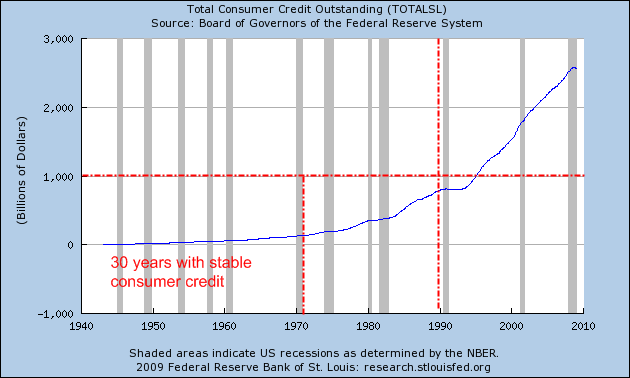
Well, explain how fiat currency is better for the median income family? Standard of living, wages, purchasing power, debt load, etc have all been terrible for the middle and lower class since 1972 (relative to the periods before).
I'd choose instability over a system that transfer wealth from lower to upper class (which debt based inflation does).
Who cares if the economy is more stable if it is not increasing the standard of living for the lower and middle class?
> Well, explain how fiat currency is better for the median income family? Standard of living, wages, purchasing power, debt load, etc have all been terrible for the middle and lower class since 1972 (relative to the periods before).
All as a fairly direct result of fiscal (and, more specifically, tax) policy. But nice post hoc ergo propter hoc there.
> I'd choose instability over a system that transfer wealth from lower to upper class (which debt based inflation does).
Deflationary currency transfers from debtors to creditors, whereas inflation transfers wealth from creditors to debtors. I think you've got which currency system represents an upward transfer of wealth backwards.
> Who cares if the economy is more stable if it is not increasing the standard of living for the lower and middle class?
The problem is that transferring from the current currency system to a deflationary one based on Bitcoin would not only make stability worse, but it would also increase the upward transfer of wealth.
I contend that creating debt money and giving it to tier 1 banks has a much larger wealth transfer effect than deflationary currency. My evidence is the wealth equality gap increasing from 1972 - current.
Inflation does not impact all people in the economy evenly. When new debt money is created it has its full purchasing power. As it works it way through the economy, it loses purchasing power and raises price levels. When the fed creates new money in its accounts, it transfers wealth from all currency holders to the receiver of the new funds.
The other mechanism that fiat credit currency increases inequality is fractional reserve lending. With fiat and a central bank (lender of last resort), fractional reserve banks lend a lot more than without fiat money (lower reserve ratio). Increased debt loads (especially debt for consumption) transfer wealth from debtor to creditor. Also, increased debt levels overall benefit creditors in general.
See total consumer debt, it started accelerating after 1972. http://www.mybudget360.com/wp-content/uploads/2009/02/debt.p...
> I contend that creating debt money and giving it to tier 1 banks has a much larger wealth transfer effect than deflationary currency. My evidence is the wealth equality gap increasing from 1972 - current.
I contend that the wealth equality gap increasing from 1972 to current is better explained as the direct result of fiscal policy, particularly tax policy changes which both reduced the (higher with increasing income) income tax and increased the regressive in part and flat in part payroll tax, and has nothing to do with change from the mostly fiat dollar of the late "gold standard" period to the pure fiat dollar of the post "gold standard" period.
> Inflation does not impact all people in the economy evenly.
Right, it transfers wealth from net creditors to net debtors through decrease in the value of assets denominated in the inflationary currency.
The gold reserve act of 1935[1] devalued the currency by 40% and outlawed the private possession of gold. I am not sure how you can say the period 1913-1972 to be under the gold standard when the US government could set the exchange rate to whatever it wanted.
I agree it was not a complete debt based fiat currency, but it's not accurate to call it gold standard. As soon as you create a central bank, you are not on a gold standard.
> The gold reserve act of 1935[1] devalued the currency by 40% and outlawed the private possession of gold. I am not sure how you can say the period 1913-1972 to be under the gold standard when the US government could set the exchange rate to whatever it wanted.
One defining feature of representational currency (which is what the currency based on a X standard, as opposed to direct use of commodity X as currency is) is that the currency is redeemable (possibly generally, possibly only for some defined set of holders) for the commodity it represents, which carries the risk that the issuer will alter the redemption rate. (This risk is somewhat mitigated -- but not eliminated -- in a full-reserve gold standard, where all the representational currency is fully backed by gold, but the fact that the issuing entity must have the theoretical capacity to redeem all currency doesn't mean that it will do so.)
You seem to be confusing the features of a currency baed on a particular commodity as a standard with the features of using that commodity directly as currency. They are related and overlapping (both are subject to volatility caused by supply shortages or gluts in the backing commodity, for instance), and often coexist (its not uncommon for a system with a gold or silver standard representational currency to also use gold or silver specie as currency with equivalent nominal value, though the effective market value may differ between representational notes and specie based on the factors of convenience and perceived risk associated with the government backing the representational currency.)
> As soon as you create a central bank, you are not on a gold standard.
The existence of a central bank is orthogonal to currency standards, though obviously a central bank has more tools at its disposal in a fiat system than in a gold standard system.
well, I have 1.something bitcoins which I once mined because it seemed like an interesting idea for "pseudonymous" online.payments. What it primarily has become utterly disgusts me. I always felt (yeah, it was uneducated) that bitcoin would be something opposed to our financial system with all its unsocial speculation, lies and deceit.
I have such a tiny holding of BTC that I don't have much of a monetary interest in seeing it explode like it has (I bought 1.5 BTC when it was trading at $200, and 1 more when it was trading at $516), but I do have an interest in seeing the old banking and finance model fail (I might like to see some of the banksters rotting in jail, also, but I'm unlikely to get that dream fulfilled).
So, I want BTC to succeed because the world would be a much better place without the old monetary middlemen. Without credit cards taking exorbitant fees from both vendors and consumers. Without banks charging fees to hold your money. Without banks socializing losses and privatizing profits. All of those things become a possibility (not a certainty, but a possibility) with an alternative worldwide currency like Bitcoin.
Hey, just yesterday it was the same price as a share of Apple stock, which is very stable! Now it's even higher, so, maybe think about converting those Standard Oil shares.
Clarkmoody is using "Mt. Gox", which is a well known exchange where it is damn near impossible to get your USD out of. Notice that other BTC exchanges (btc-e is more cannonical right now...) have prices closer to $550.
Keep in mind WHICH exchange these prices are coming from. Unlike more established currencies, there is very little arbitration going on between exchanges, and prices swing DRAMATICALLY between say... Mt. Gox and BTC-e.
Bitcoin is designed to be deflationary in nature. Many people here will see BTC's dramatic rise in price as a feature, not a bug. I personally am more concerned about the difficulties of BTC -> USD conversion... with exchanges going down and others getting hacked.
Speculators obviously love BTC's volatility. But surely, this is not a sign of a healthy "currency".
Bitcoin is indeed designed to be inherently deflationary, but the volatility is far too great to be explained by that; it's likely in a speculative bubble.
Here is what drove the Internet bubble: during the whole nineties, the stock market went upwards. People thought we had entered a New Economy without recessions. There were plenty of good reasons to believe this. For example, due to the end of the cold war, we could allocate resources to much more productive areas and gain a lot through globalization and increased international trade. This effect was also known as the peace dividend. Furthermore, the Internet promised to bring enormous productivity increases. The sentiment was that everything will be done online sooner or later and that whoever is first to occupy a particular niche in the Internet would dominate that market globally and forever. For example, the first to create an online shop for pets would have such an advantage that if executed well, competitors would never be able to catch up anymore. By buying a share of pets.com, you did not want to buy a share of a company without profits, you wanted to buy a share of the future before it was too late. People thought they would be buying the equivalent of a few square feet of future Manhatten. Domain names changed hands for crazy prices. It was very hard to resist the general sentiment as it was repeated over and over, for years. One of the few that resisted was Warren Buffet - and the media pitied him for not understanding the New Economy due to his advanced age.
not to add fuel to the fire: but if bitcoin is really un-hackable (can't guess individual keys held offline by private owners), untraceable, and all that goodness ...
... and there are only 21 million of them in the world ...
... then the value of each bitcoin could be $100,000 or more, assuming it can attract 1/4 of the interest that gold currently enjoys worldwide.
of course, as the value creeps up, it's use as a currency will diminish, and it becomes more of a store of value. eg, without bitcoin dimes and quarters, you'd have a hard time buying smaller items. but it is lighter than a pound of gold for sure.
Bitcoin isn't a company. It's not comparable to much that has existed before, actually. So, while I won't try to predict where BTC will end up, I think it's not a useful analogy to compare it to a company and discuss market share in those same terms.
That's an assertion I've heard, mostly from goldbugs who have a vested interest in gold remaining high and going higher. But, I haven't heard any useful evidence to support the thesis.
I've asked you why you think gold is a better currency than Bitcoin. You've answered, roughly, "There's a lot of it being hoarded by some people all over the world."
I think maybe I just don't understand you. Are you saying because gold is one popular store of value, it is a better currency than Bitcoin? That's kinda what I'm hearing, but that doesn't really make sense, so I assume I'm misinterpreting you.
From my perspective, the US currency (and most of the currencies found the world over) are not backed by gold or other precious metals. The idea of gold==money has been kind of dead since before I was born, and I'm not convinced there's a useful reason to return to it in the Internet age. Sending gold over a wire is not feasible, so I'd have to trust someone to hold my gold for me, were I to use it as a currency. That's not really appealing to me. The de-centralized nature of BTC is what makes it so disruptive.
It just feels like a really old-fashioned idea that we should return to gold for currency (and I've felt that way even way back when I was a card-carrying member of the LP and a subscriber to Reason and Liberty magazines).
The thing is, gold is a physical commodity that requires great expense to mine, process, and produce in a form that's useful. This limits the amount of gold that can be produced. That's why, historically speaking, it was used as a backing for currency, or as currency itself in some circles.
Worst case scenario, no matter what the price of gold is, you still have the gold itself, and it can be made into things. If Bitcoin collapses you have nothing, the currency is intrinsically worthless.
You can easily validate that someone owns a certain amount of gold, and you can be reasonably assured that, if you've put a gold brick in your safe, that barring someone physically breaking into your safe, that it'll still be there when you need it later.
Bitcoin, on the other hand, is digital, and comes with it all the risks of digital data. It can be stolen silently, invisibly, or your wallet can become corrupted, or you can lose your password, which renders it utterly worthless.
I'm not saying we should return to gold, but that gold is a commodity with more stability than Bitcoin.
Bitcoin could utterly collapse tomorrow and the impact on the markets wouldn't even register. If gold collapsed tomorrow the markets would crumble.
This is probably something we'll just have to agree to disagree on. To me, gold is a ridiculous thing to base money on. It serves the interests of an elite few at the expense of everyone else, it is impossible to transfer over the Internet without a trusted intermediary (presumably someone with a presence on both sides of the transfer and owning large quantities of gold) imposing high fees and inconvenience on all parties.
There's nothing, in my estimation, good about gold as a currency. It is, maybe, a useful store of value, if you're wealthy enough to store it safely. But, its value as a substance (should you decide to make it into things) is vastly lower than its trading value. So, you're still trading mostly on what everybody agrees the gold is worth, rather than its expected utility as a substance. Bitcoin just removes the fiction that it is "backed" by a useful substance.
In the past, there have been times when gold was fantastic as a store of value. When the Jews fled Poland, Germany, etc. during World War II, the lucky and the rich had some physical gold or silver reserves to take with them. That allowed them to rebuild in a new country, even after all of their Polish or German currency became worthless or was confiscated.
So, that's cool. Gold has a purpose. I understand that. When shit hits the fan in your home country and you need to rebuild, historically speaking, gold and silver were good to have. Why? Because they were accepted for trade the world over and had some kind of value. But, nonetheless, the fiat money economy is vastly larger than the gold economy...and Bitcoin is slightly more gold-like than fiat money, in this instance.
If, suddenly, my government became really oppressive and started spying on everyone all the time and I felt unsafe because the police had become militarized and equipped with drones and tanks and had placed cameras all over the city (umm...wait...that's sounding vaguely familiar...but, whatever, let's continue...) and I felt I needed to flee for the safety of myself and my family, I could take my Bitcoins with me. They'd be spendable or convertable to local currency in almost any locale on the planet. Even if there is no currency exchange operating in a given local currency, there may be individuals who will sell local currency for Bitcoins. And, that's happening more frequently every day, just as more local exchanges spring up.
"Bitcoin could utterly collapse tomorrow and the impact on the markets wouldn't even register. If gold collapsed tomorrow the markets would crumble."
Of course. Gold has had thousands of years to establish a vital position in the market. Give Bitcoin a little time. It's still a puppy.
> It serves the interests of an elite few at the expense of everyone else...
I think you've just described Bitcoin. The early adopters have benefitted enormously compared to everyone else.
I do know that when "the shit hits the fan" that I'll be able to trade junk gold for goods and services, but I have zero faith that Bitcoin will be worth anything in the future. It has zero fundamental value.
If you think you can "take your Bitcoins with you" I think you're mistaken. The whole apparatus could be disrupted and destroyed overnight by an organization like the NSA or China's equivalent. Also it's dependent on the Bitcoin infrastructure being operational.
The government can try to seize your gold, they can make it hard to move, but there's always a way. With Bitcoin there may be no-win scenarios no matter how hard you try. All you'll have is some cryptographic hash and a whole lot of tears.
> The whole apparatus could be disrupted and destroyed overnight by an organization like the NSA or China's equivalent.
Just for fun, how? And not just a one sentence quote of "the 51% attack", but how much computing power would be needed for that attack? (Forget electrical power for the moment, and money.)
depending on the market dynamics, it is quite often that "someone" can capture 1/4 of the market (it just may not be you).
if there are many perfect stores of digital value then bitcoin will be one of many, not that special, and unlikely to dominate. i am not familar with the alternatives. my post is a thought exercise on potential value of a digital currency.
with regards to bitcoin dimes and quarters - i stand corrected. although i confess to having a hard time imagining how folks will keep track of all this.
I hear a lot of people talking about the need to shift decimal points, but never really understood -- what's the benefit of this over just using SI prefixes? To me, it's clear how 1mBTC relates to 1BTC and 1µBTC.
I think people underestimate consumers. Before Decimal Day (1971), 1 British pound was worth 20 shillings, and 1 shilling was 12 pence[1]. As confusing as it seems to me, apparently that worked for awhile. Likewise, I think consumers could deal with SI prefixes in a decimal system (rather than needing to redefine how much 1 BTC is).
There is no benefit, it's just a technical possibility.
The other possibility is that the eventual client app on your smartphone just works in femtoBTC and handles the UI however people choose {BTC, satoshis, femtoBTC, USD, CNY, whatever}.
it may be un-hackable, yet not irreplaceable. One can imagine a government initiating a similar crypto-currency, controlling it through humongous server farms built somewhere where real estate and electricity is cheap, and accepting tax payments in that currency and blessing businesses to accept it as well.
people just need to have trust that government would accept the tax payment in that currency and at that rate to the other, paper, currency if it is still around - very low bar of trust for a government to meet and it would provide strong bottom line value for a currency. Especially if some deflatory (or limited inflatory) machinery is algorithmically built-in (bitcoin-style) so the government couldn't "print" the money faster than some limit.
Interesting variant would be a 2-tier system where government would accept only bitcoins "printed" by the government while allowing other bitcoins to be circulated as well.
My main point here is that whatever technology achieves is ultimately made to serve government as well (or sometimes almost exclusively).
I signed up with Coinbase (YC S12) today specifically to engage in gold rush type speculation. Much better odds than lottery tickets, and more convenient than driving to Vegas.
Coinbase is definitely the best if you're just looking for stable and easy to use. They also have great APIs / merchant tools. (If you want more detailed volume depth for "day trading" then other exchanges are better).
I look at it and think its a con. Coincidentally after a several massive thefts, the price suddenly raises? sounds like deliberate manipulation to dump stolen coins to me.
Wouldn't mind betting some syndicate took a huge upfront loss to drive up price, and are now recapitalising that loss with said stolen coins.
Not really. Bitcoin got its first mass mainstream exposure around February of this year when it broke its peak from mid-2011, IIRC. Definitely before this month, however.
That's true, but if memory serves that was a metaphorical 10th-page oped. The coverage we're seeing now, starting around the thefts, is 1st or 2nd page.
An obvious bubble but impossible to predict when it'll pop. It could easily go to $1k, $10k, $100k and beyond since supply is so limited and most of the coins are held tightly by folks who have already cashed out nicely.
I'm interested in it's psychologically limited factors related to price "per" bitcoin... or, in other terms, bitcoin's "exchange rate".
Owning 1 bitcoin, no matter what it's worth, psychologically makes you feel poor. It's an arbitrary habit and, really, meaningless but to the average person they can't stand trading $1000 for 1-2 bitcoins. When people look in their bank accounts, they want to see thousands... millions! Not 1 or 2. Right? I think people would more likely buy 10,000 of something they perceive as a currency instead of 1.0000 -- even if through a change of "terms" they were worth the exact same in USD. Am I selling the general public short in this assumption?
(Probably not pertinent note: I sold today and no longer hold any BTC.)
I've been seeing the bitcoin news hitting [more major] news outlets. Seeing an article like this http://finance.yahoo.com/blogs/michael-santoli/bitcoin-price... with a picture of physical coins worries me. Why? All the uninformed people that want to get in on this bitcoin action may be sold of physical coins by scammers like the coins in the pictures. I'm concerned for the technically illiterate.
Sadly, I worried about older folks. I bet you could get some metal "bit coins" like those in numerous pictures and go door to door selling them for several hundred dollars to some people. It'd be easy o come up with a story as to why you're selling them.
Man I really wish I had a handful of bitcoins right now.But I think that it is going to be rough for people either way if the price goes up you will have a bunch of depressed people not buying in and if it goes down a bunch of people are going to be REALLY depressed for obvious reasons
That graph is darn sexy, and I am talking about the object itself not the data. The most practical and useful "interactive chart" I have ever seen. Props to Clark Moody. Does anyone know how to use that type of chart to display information from other data sources?
You should ask a tax professional or your own tax lawyer for advice. But my own plan is to treat it as being equivalent to holding a foreign currency which, in the US is (more-or-less) taxed like capital gains that is always considered short-term regardless of how long you held it.
I bought a bit of BTC in October because I am interested in it. I've now sold off enough to cover my initial investment plus a bit extra, and now get to watch BTC with house money.
Check out prices at bitcoinity.org/markets, prices haven't gone down to $520, it's short term stabilized around $720 after the first round of congressional meeting.


General question: if you expect the price of Bitcoin to continue this rate of growth, does the rational consumer have any reason to spend? I don't follow BTC too closely, but it feels as though there's an innate conflict between its role as a speculative investment and its role as a currency.