I may be stating the blatantly obvious here, but :
1) Neither the US nor any European country, nor the middle east, nor the far east (Abeonomics or not) will ever stop rolling over their debts. Not just because they don't want to. Because they can't. This means interest payments rising at a rate faster than inflation a given.
2) "Real" expenditures (as demostrated by the US shutdown for example) take precedence over loan repayments. As they should.
3) This being blatantly obvious is not stopping a great many people from buying ridiculously bad government debt. The US, all of Europe (not just the EU), Japan and most of Asia with it, are trying to induce inflation by printing exponentially more money over time. It's not working, meaning none of those countries are getting any closer to paying back their debts, even if it was realistic.
1+2+3 = Every country on this planet, with few exceptions, will default on their debts. They may do it by hyperinflation (unlikely, as it will make all of the population very unhappy) or they may just outright default (just makes investors unhappy, and as Greece demonstrated[1], they have very few options left). But there is no way out of this situation that does not involve a large number of government defaults.
We've long since jumped from the plane. And what's this thing coming toward me very fast? So big and flat and round, it needs a big wide sounding name like 'Ow', 'Ownge', 'Round', 'Ground'! That's it! Ground! Ha! I wonder if it'll be friends with me? Hello, Ground!
It's entirely possible for a country to pay off its debts, gradually, if the politics lines up. The US was making plans for that eventuality under Clinton. Germany paid off large amounts of loans, even if it took them fifty years. Stop fighting so many wars, stop cutting taxes on the rich, and you'll get there.
The problem with taxing "the rich" is either there aren't as many of them as you think they are, or they aren't as rich as you think they are. Fiscal drag has seen to that, and inflation. You can be a higher-rate taxpayer in the South East (of England) and not be able to afford a house. Or you can live in a big house bought before the boom, but have basically no disposable income, indeed struggle to pay your council tax! Or there are the so-called super rich, well you can tax the crap out of them, assuming they all pay up rather than just leave, well the sums involved just don't add up, there aren't that many of them to start with!
Governments in general, and the UK in particular, can't tax themselves out of this hole. They have got to just spend less. Despite all the talk of austerity, this isn't happening right now.
People buy government debt in part because there's not anywhere safer to put the money. Banks fail, money under the mattresses can be stolen or destroyed, etc. Also, to a certain extent I think our current economic setup relies on the Government going into debt in order to support private-sector spending.
Because governments can always fund debt with new debt, the inevitable default can be postponed indefinitely. The main risk is that interest payments get out of control, which is what made Greece go bankrupt. Or, of course, that a country refuses to take on new debt to fund old debt, like the House is now threatening to do.
Of course threatening to default is also likely to make interest payments spiral out of control. But if the country pays its debts in a timely manner and keeps total interest under control, it can keep this up forever.
I think that if quantitative easings' current results prove anything, it's that it can't. Or at least it can't work if money is distributed through bank loans.
The US can't default on their promise to pay or there is a very high risk it will be lights out for them for world reserve which will be instant hyperinflation.
As world reserve they have had to spend into existence a metric craptonne more currency than their economy requires in order to lubricate world trade (google Triffins dilemma).
ie: For Turkey (say) to buy oil off Saudi, they need to sell something to the US in order to obtain USD first.
When world reserve status is lost, suddenly Turkey doesn't need USD in order to acquire oil. The rest of the world is holding USD for trading purposes and those USD currently never go home in order to claim something from the US economy.
Now lets turn the lights off on USD as world reserve: Those now useless trade dollars will try and find their way home to the US and start chasing things milk, eggs, cars...anything in the real world that has value as the currency devalues.
Meanwhile, the USGovt is having trouble acquiring its goods and services with its rapidly inflating USD and doubles down on printing under Executive Order 13603.
When this one blows, one doesn't want to be caught holding assets denominated in USD.
"paying back their debts" isn't a goal of any country, nor should it be. National debt as a % of GDP should go up and down depending on the economic situation, the current policy goals of the country, and so on. It's important not to let the debt grow too much, but having a zero debt doesn't make sense.
This scenario you describe will probably happen, but most likely not in the next few years... Our debt-to-GDP ratio simply isn't high enough yet.
However, when it does happen it will happen very suddenly and will be completely unexpected (when the US fails to find enough buyers in a round of debt sales) so the timing is hard to predict.


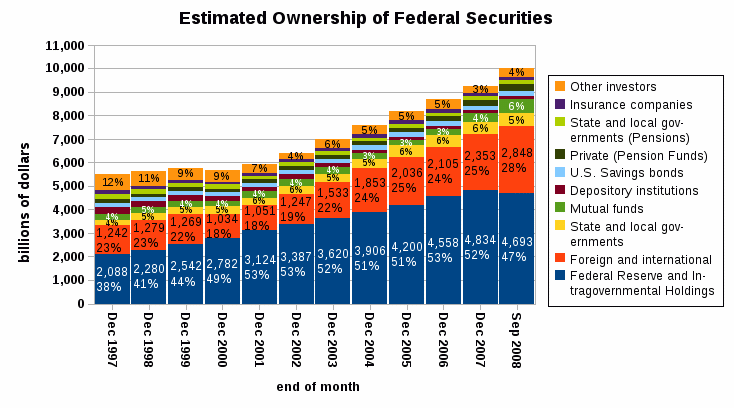
I may be stating the blatantly obvious here, but :
1) Neither the US nor any European country, nor the middle east, nor the far east (Abeonomics or not) will ever stop rolling over their debts. Not just because they don't want to. Because they can't. This means interest payments rising at a rate faster than inflation a given.
2) "Real" expenditures (as demostrated by the US shutdown for example) take precedence over loan repayments. As they should.
3) This being blatantly obvious is not stopping a great many people from buying ridiculously bad government debt. The US, all of Europe (not just the EU), Japan and most of Asia with it, are trying to induce inflation by printing exponentially more money over time. It's not working, meaning none of those countries are getting any closer to paying back their debts, even if it was realistic.
1+2+3 = Every country on this planet, with few exceptions, will default on their debts. They may do it by hyperinflation (unlikely, as it will make all of the population very unhappy) or they may just outright default (just makes investors unhappy, and as Greece demonstrated[1], they have very few options left). But there is no way out of this situation that does not involve a large number of government defaults.
We've long since jumped from the plane. And what's this thing coming toward me very fast? So big and flat and round, it needs a big wide sounding name like 'Ow', 'Ownge', 'Round', 'Ground'! That's it! Ground! Ha! I wonder if it'll be friends with me? Hello, Ground!
[1] http://www.tradingeconomics.com/greece/government-bond-yield