There is a part of me (I'm a UK resident) that looks at this and wants to see what would happen. As an outsider looking in (and having lived in the USA in the 80s), I don't see a country, I see corporation. A place where the rich really are rich and the poor can go f*ck themselves, but the poor don't seem to mind, y'know, cos America is awesome. Also they don't appear to have a voice.
Do I think the UK is in a better position? Possibly. I think the EU has probably helped to hold back on corporate dominance. Legislation is less about supporting corporations and more about supporting society. (I do think we have a free speech issue. Glenn Greenwald in an interview said he would fly to USA but not to the UK as he had better legal protection.)
The more interesting question most banks/countries must be asking themselves, "How do we get out of the USD?"
Be careful, the UK's total external debt has exceeded 10 trillion[0]. We have huge financial sector debt here and are worse exposed to financial shock from the banking system than almost all countries globally.
Agreed that getting out of the USD hegemony is inevitable. As to whether it will be an orderly transition, I'd say that is far from assured, especially in the UK.
I'm not sure that "external debt" is a great measure in this context - it seems to include international liabilities so if people invest/deposit their money in the UK (which seems like a good thing) that creates an external liability (i.e. whoever put the money here will want it back at some point).
Given the UK has a huge financial sector you would presumably expect a large external debt:
Trust me, no bank in the world right now is trying to trade in all their dollars for British pounds.
Also, if you factor in the high cost of living, which is a side effect of the UK system, being a poor person in the UK is a pretty shitty situation to be in, certainly not something to smugly celebrate.
> being a poor person in the UK is a pretty shitty situation to be in, certainly not something to smugly celebrate.
Being poor in the UK does suck. A home is not guaranteed. But I think I'd rather be poor in the UK than in many other countries. There is a possibility of housing (for a subset of the people who need housing); there is free health care for all who want it, including free medication for some of the people who need it (and low cost medication for the rest).
Funny, why is it then that there isn't a net migration into the UK from the US? Why are all these people voting with their feet and leaving the UK? Don't they know what's better for them?
Because the US is a better place to be the kind of person that qualifies for skilled migrant visas or is worth sponsoring as an employee? Very poor Americans might well be better off in the UK, but we obviously don't want them.
Always interesting to speculate about what would happen.
A default in the traditional sense probably won't happen this October but one day in our lifetime they are going to have to come up with a way to finance the 126 trillion unfunded liabilities:
http://www.usdebtclock.org/
One way to do that - without defaulting in a legal sense - is to work the printing press and call it stimulation or monetary easing. Nah, Quantitative easing! That's a nice term.
It's misleading to call those unfunded liabilities. Most of that is Social Security and Medicare projected expenditures. Unlike true liabilities, those are not legally guaranteed. The government can reduce eligibility for those programs, reduce payouts, etc, without being in default, unlike say a state pension plan.
Comparing them against current assets is equally misleading. Say you plan to spend $2k on rent for the indefinite future. That's $24k per year, $240k per decade, etc. Are you insolvent if you don't have all that in the bank now? No, of course not. Those are ongoing expenses paid out of ongoing income.
The Medicare trustee estimates the unfunded liability of Medicare at $40 trillion over 75 years (the $123 trillion figure includes a Medicare estimate of twice that). Projected GDP over that period is $907 trillion.
Finally, there is nothing wrong with quantitative easing. The people that'll be hurt by inflation are by and large the same ones whose fault the current financial mess is (older people own most u.s. assets). The government will probably encourage inflation at some point to reduce the value of these expenditures as a percentage of GDP without making nominal cuts. I don't see a problem with that readjustment.
The thing about quantitative easing is that it is not producing much if any inflation and that is because it is not the same thing as printing money as so many people like to call it and distributing it to everyone in the US.
This is mainly because all that money that is being injected into the banks is not going anywhere. They are not lending it out but keeping it in a vault.
To show a graphic of this here is a chart of bank excess reserves held which is the amount of money held over the reserve requirement.
Reuters "The Fed has no clue what will happen when it starts selling assets," IMF Chief Economist Olivier Blanchard told a meeting of the Institute of International Finance in Paris. "So it cannot make any commitments in term of quantities."
http://uk.reuters.com/article/2013/06/25/us-economy-imf-idUK...
And Medicare dominates Social Security, so what we're really talking about here is the unchecked growth in medical expenditures. Which is, in turn, subject to change by public policy.
Right. Out of that $123 trillion figure, $80 trillion is medicare. Not only is it subject to changes in policy, it's also much more susceptible to manipulation (upward and downward) to make the problem seem bigger or smaller than it really is, because of the uncertainty of medical expense growth going forward.
Whenever I see interesting events like this, my first thought is not "what would happen" but always "how could I profit from what would happen [or the uncertainty around it]".
Unfortunately I never know how to answer that question convincingly enough to put my money where my mouth is. Does anybody know if there's a place where people discuss these sorts of things, e.g. a "Hacker News for Financial Markets"? Any interesting ideas for coming out of this on top?
EDIT: Two answers have pointed to gold. Yup, I have already played with investing in gold ETFs, which generated a 20% return over the past 2 years, even after fees. However I was wondering if there were any more ideas specific to the present circumstances, and where, if anywhere, people discuss this sort of thing?
Decide what you think would replace assets in Central Bank balance sheets to allow world trade to continue - ie: what would settle world trade deficits.
Yuan, gold, silver or bitcoin?
Hint: Bitcoin and silver are not held by central banks as assets. Yuan's value is subject to the policy of China's politburo. Fool me once on the USD...
World trade does not need any central bank to continue. People only need freedom to do transactions without constant interference. If gov currencies are to collapse, there are only to choices: private IOUs in private banks backed or not by gold (either way, a huge amount of trust is needed to be placed in the banks, almost no one is going to move gold across the world all the time); or bitcoin - which enables world trade without necessary placing trust in intermediaries.
Gold doesn't need to move, only the name under which it is stored needs to change.
Bitcoin - a four year old currency invented by a pseudonym - is not going to be used to clear trades at a sovereign level.
Arabs are not going to ship oil in the ground for bitcoin.
If gold is not moved, it's as good as a promise of the vault owner that holds it for you. History shows that this promise was constantly broken before and after invention of central banking.
To own either bitcoin or gold you need to move it in your personal vault. But in case of bitcoin, it's many times cheaper to move it and have many vaults with extra protections.
Arabs will happily ship oil for bitcoin when both buyers and sellers of oil will no longer be able to use USD or trust banks standing in the way. And, of course, when they learn about bitcoin and we have better infrastructure to support secure storage and trade.
What I find interesting is that the economists tell us that country level borrowing isn't the same as household borrowing.
Which must be true otherwise why would governments be able to borrow more? Clearly they can devalue the currency and by extension the debt, however the money lenders will just factor that into their interest rates.
I like a country to be in debt, that way it will always be looking for efficiencies. The question is how much debt is acceptable?
Please keep in mind that this is being published by Bloomberg - not exactly a neutral party in the debate. They stand to lose a lot of money and even more clients if this were to happen.
Raise retirement to 70, go single-payer and name the price of all things medical, and put a little resistance on SSD claims and then there's no problem. That's because these "liabilities' are actually discretionary, unlike actual bonds.
The world can't afford a super power. The world needs to diversify it's interests and insist on total nuclear disarmament. Imagine a sidelined and flat broke USA with neo-cons at the helm, with access to the big red button. That scares me, and it should scare everyone.
If aliens were to arrive, they would probably ask our university professors why the economic system has a single point of failure.
And then after a while they would ask us why we are driving around in motor vehicles powered by a non-renewable resource.
And then after some more reflection they would ask us why we get our news and form our opinion of consensus reality based on a tiny number of sources, all of which generally agree with one another and which also happen to generally agree with the single point of failure in the first question.
And then we would hear a strange noise: alien laughter.
Speaking as someone who receives his income in dollars, I hope US defaults. Maybe then people in US will finally start to give a second thought on the US military expansion all over the world, and the trillions of dollars it's spending on weaponry. There are a lot of domestic programs are that very wasteful, too - not just the police militarization ones, but also social ones.
Maybe this will make them look at every program from sub 100,000 in funding to the hundreds of billions of dollars. Almost $4 trillion in spending a year with a little over $2 trillion a year as income is simply unsustainable, no matter how you cut it. I think everyone can see that. As others mention, the default will happen eventually. It's just a matter of time, and the more it's delayed, the bigger the impact will be.
What worries me most, though, is that if an imminent collapse of the dollar will happen in the future because countries start dropping the dollar, out of desperation, US will start becoming a lot more aggressive in its bullying, and possibly even take military action against them for "hurting their economy", or at the very least use NSA surveillance to blackmail them into not doing so (my guess is that's already happening, though), and it's part of their "diplomacy" with those countries.
It's unlikely that the US will ever really default in the near future. Why ? Well, the global economy is becoming more and more linked as time passes. A US default will trigger a collapse in the larger global financial markets. Do US creditors want this ? Nope. They'll just keep extending deadlines but of course this charade can only last for a certain amount of time. Personally, I think the collapse will not come from a US default but due to this bubble over extending itself and eventually popping in a Lehman'esque style.
An example of this is how last year India (a developing country, although with a rather large GDP) donated money to the European Union in the form of an economic stimulus, basically to prevent a default. The reason was simple, an unstable european market hurts growth prospects worldwide. There's a saying in India "When Wall Street sneezes the Indian markets catch a cold". An increasingly linked global economy puts economic stability at #1 on everyone's agenda. Of course, this is great for the US because they can wage wars, etc. etc. while taking on unlimited debt and no one wants to lift a finger (militarily, they can't - economically, they can't either because of the repercussions). Of course the bubble will pop at some point. We don't know when, though.
Just wondering what a crash of that magnitude would do to a city like Bangalore.
Big IT shops will shut down most of their operation. Several hundreds of thousands of people will lose jobs. They in turn will default on their loans. For those who don't know the real estate scenario in Bangalore, these days even mediocre 2BHK flats sell for >65 lacs. People who are in neck deep in debt, will default. Big real estate projects(which are a common place in Bangalore today) and even small time real estate builders will crash and burn. The lenders to those builders will in turn crash and burn.
A lot of bad blood will be eliminated and won't be able to come back for years.
But I think it will ultimately do good for IT community as a whole. The current scenario is full of super idiots powered by dirtiest form of politics climbing the corporate hierarchies and building their real estate wealth with that money and position.
I'll join you in the prayer too. But be very aware of the fact that once the investors and companies are off, even the bright ones around will have a tough time. IT(sic) would take a lot of time to stabilize in India.
My friend, it's not that easy. The guys who have already made it big (those in top management) have a great deal of financial security built up for themselves. The unfortunate ones would be the 'supposedly' good folks who have only been slogging while making those fat fellows richer. Now, again, much of the wealth and means of production is with the erstwhile PHBs. And now, they would have even better control on things as they won't have an organization to report to but can call shots by starting their own companies. And the 'good folks' will have nowhere to go but those firms, casue the other bigger/better ones are all gone by now. In such a situation, who do you think would still get jacked?
>>The guys who have already made it big (those in top management) have a great deal of financial security built up for themselves.
Not really, I agree for people at VP levels etc. But you could count these people in numbers of 10's.
Most people are neck deep in debt and lifestyle expenses. These are middle management layers. And I have no sympathy for them.
The most unfortunate ones will be guys who are not productive, who don't read or learn often and just don't have the appetite or the curiosity to work on difficult projects and build something of value. These are basically people who pick up programming because some one told them there is good money in it. And now the only way they can make it to the top is either by job hopping or doing all kinds of politics.
Either way with the growing start up community in Bangalore and what I have seen when it comes to meritocracy, its already becoming a trend that good people leave to either start up on their own, or help others.
By that standard, we should not just kill the military but :
1) social security
2) medicare
3) Obamacare (because it will merge with 2)
I don't think Obamacare is a bad idea, BTW, coming from Europe. I just want to point out that cutting the military, which arguably helps more people than social security, is not the solution.
Europe has the same problem. Social security simply can't be maintained, yet people won't give it up.
This is partly a problem of societal shift that has happened during the past decades. Some of the programs, like the retirement fund here in Germany were conceived with some measure of sustainable calculation.
After the war (WWII) there were few old people and life expectancy was generally much lower than now. So the social programs created back then (mostly talking about retirement funds) did make some economic sense, as most people did not reach that age. More people were paying than draining the fund. Now with time the number of old people became greater with prolonged peacetime and medical advances and the social programs left the funds empty and the shifted the burden on state budget.
Sadly there is no easy and morally acceptable solution for this, so we are just staying on track towards the inevitable wall.
One could always delete debt against debt. All those debts are connected. Germany owes France, France owes The Netherlands, The Netherlands owes Germany and this a thousand times over worldwide.
Sorry, but the idea that a failure to raise the debt ceiling "is most certainly going to happen" is laughable.
It might happen. It's highly unlikely, but not impossible.
If you're so certain, you should be shorting the whole market and laughing your way to the bank.
EDIT: Not to get too partisan, but the justification for not negotiating on the debt ceiling is to put a stop to the use of the debt ceiling as a form of political hostage taking.
To let this sort of thing go on gives Congress a de facto veto power over the executive branch that was never laid out in the constitution. Once you let Congress know that a majority (in a single chamber!) can get whatever they want simply by threatening to tank the whole economy, there's no going back.
That's why it's the rational policy to refuse to negotiate when a single house of a single branch of Congress starts threatening that sort of thing.
Speaking as someone who writes campaign slogans: no.
On the shutdown: The house can and will pass a clean CR (clean as in it won't defund the ACA) with Democratic votes. This will either happen when Boehner abandons the Hastert rule or through a process such as moderate R's abandoning their party to force a vote through a discharge petition (which has already begun circulating).
On the debt limit: Same as the above, except with more urgency.
EDIT: without writing a dissertation on the current fractures in the Republican Party, the Ted Cruz wing is currently very, very hated within the party, and everyone is looking for a way out.
Yes. The signers will be Republicans whose districts also went for Obama in 2012. Pete King in NY-2 would be an example.
Boehner has already defied the Hastert rule to pass the Violence Against Women Act and to pass emergency aid for hurricane Sandy victims. He will do it again.
I may be stating the blatantly obvious here, but :
1) Neither the US nor any European country, nor the middle east, nor the far east (Abeonomics or not) will ever stop rolling over their debts. Not just because they don't want to. Because they can't. This means interest payments rising at a rate faster than inflation a given.
2) "Real" expenditures (as demostrated by the US shutdown for example) take precedence over loan repayments. As they should.
3) This being blatantly obvious is not stopping a great many people from buying ridiculously bad government debt. The US, all of Europe (not just the EU), Japan and most of Asia with it, are trying to induce inflation by printing exponentially more money over time. It's not working, meaning none of those countries are getting any closer to paying back their debts, even if it was realistic.
1+2+3 = Every country on this planet, with few exceptions, will default on their debts. They may do it by hyperinflation (unlikely, as it will make all of the population very unhappy) or they may just outright default (just makes investors unhappy, and as Greece demonstrated[1], they have very few options left). But there is no way out of this situation that does not involve a large number of government defaults.
We've long since jumped from the plane. And what's this thing coming toward me very fast? So big and flat and round, it needs a big wide sounding name like 'Ow', 'Ownge', 'Round', 'Ground'! That's it! Ground! Ha! I wonder if it'll be friends with me? Hello, Ground!
It's entirely possible for a country to pay off its debts, gradually, if the politics lines up. The US was making plans for that eventuality under Clinton. Germany paid off large amounts of loans, even if it took them fifty years. Stop fighting so many wars, stop cutting taxes on the rich, and you'll get there.
The problem with taxing "the rich" is either there aren't as many of them as you think they are, or they aren't as rich as you think they are. Fiscal drag has seen to that, and inflation. You can be a higher-rate taxpayer in the South East (of England) and not be able to afford a house. Or you can live in a big house bought before the boom, but have basically no disposable income, indeed struggle to pay your council tax! Or there are the so-called super rich, well you can tax the crap out of them, assuming they all pay up rather than just leave, well the sums involved just don't add up, there aren't that many of them to start with!
Governments in general, and the UK in particular, can't tax themselves out of this hole. They have got to just spend less. Despite all the talk of austerity, this isn't happening right now.
People buy government debt in part because there's not anywhere safer to put the money. Banks fail, money under the mattresses can be stolen or destroyed, etc. Also, to a certain extent I think our current economic setup relies on the Government going into debt in order to support private-sector spending.
Because governments can always fund debt with new debt, the inevitable default can be postponed indefinitely. The main risk is that interest payments get out of control, which is what made Greece go bankrupt. Or, of course, that a country refuses to take on new debt to fund old debt, like the House is now threatening to do.
Of course threatening to default is also likely to make interest payments spiral out of control. But if the country pays its debts in a timely manner and keeps total interest under control, it can keep this up forever.
I think that if quantitative easings' current results prove anything, it's that it can't. Or at least it can't work if money is distributed through bank loans.
The US can't default on their promise to pay or there is a very high risk it will be lights out for them for world reserve which will be instant hyperinflation.
As world reserve they have had to spend into existence a metric craptonne more currency than their economy requires in order to lubricate world trade (google Triffins dilemma).
ie: For Turkey (say) to buy oil off Saudi, they need to sell something to the US in order to obtain USD first.
When world reserve status is lost, suddenly Turkey doesn't need USD in order to acquire oil. The rest of the world is holding USD for trading purposes and those USD currently never go home in order to claim something from the US economy.
Now lets turn the lights off on USD as world reserve: Those now useless trade dollars will try and find their way home to the US and start chasing things milk, eggs, cars...anything in the real world that has value as the currency devalues.
Meanwhile, the USGovt is having trouble acquiring its goods and services with its rapidly inflating USD and doubles down on printing under Executive Order 13603.
When this one blows, one doesn't want to be caught holding assets denominated in USD.
"paying back their debts" isn't a goal of any country, nor should it be. National debt as a % of GDP should go up and down depending on the economic situation, the current policy goals of the country, and so on. It's important not to let the debt grow too much, but having a zero debt doesn't make sense.
This scenario you describe will probably happen, but most likely not in the next few years... Our debt-to-GDP ratio simply isn't high enough yet.
However, when it does happen it will happen very suddenly and will be completely unexpected (when the US fails to find enough buyers in a round of debt sales) so the timing is hard to predict.


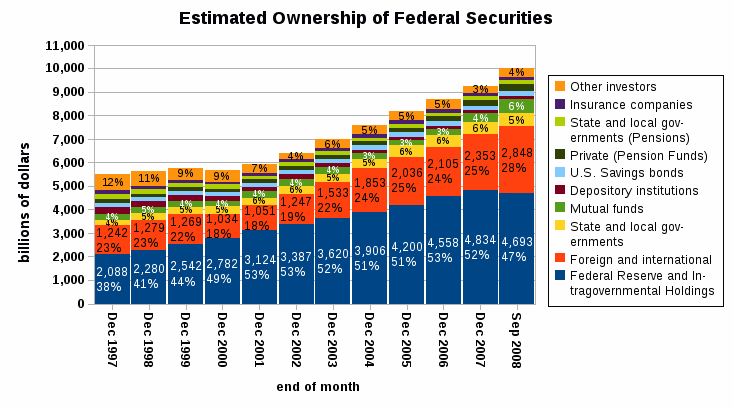
Do I think the UK is in a better position? Possibly. I think the EU has probably helped to hold back on corporate dominance. Legislation is less about supporting corporations and more about supporting society. (I do think we have a free speech issue. Glenn Greenwald in an interview said he would fly to USA but not to the UK as he had better legal protection.)
The more interesting question most banks/countries must be asking themselves, "How do we get out of the USD?"