The issue is that Epic doesn’t want to be Apple’s customer in the first place. They want to publish iOS apps. The fact that this requires them to be an Apple customer is the core problem.
Imagine if everyone wanting to publish a web app would have to be a customer of the respective browser vendors.
Everyone complains about Google and Mozilla and Safari and Edge. Luckily, that doesn’t prevent us from having our web apps running on those browsers.
> The issue is that Epic doesn’t want to be Apple’s customer in the first place. They want to publish iOS apps. The fact that this requires them to be an Apple customer is the core problem.
Indeed. It all boils down to: if I buy a product from company A, then want to use that product to do business with company B, why does company A have anything to say about it? Am I not the owner of my device?
Increasingly in this modern world, no, you are not the owner of the device. You're more like purchasing the right to use it for a time, in the way that the makers want you to use it. This applies across PCs, Macs, and Phones where Microsoft, Apple, and Google all try to up-sell you on their online services and now their "AI tools".
the problem with having consumers take action is that they are completely shortsighted and will take the path of least resistence - a path that the companies will have charted out to make this transition as smooth and painless _for the consumer_ as possible while retaining as much monopolistic power as possible.
There needs to be public institutions with the backing of the state to enforce property rights, including purchased devices.
To offer a modest counterweight here, every iPhone owner bought the product knowing damn well that Apple keeps the OS locked down. If you don’t want that, don’t buy an iPhone. There’s no confusion about what the product is and what you can do with it.
So how is a 3rd party going to give support to a customer with iPhone, if Apple will ban such 3rd party for whatever reason?
Let's say that given 3rd party is making a device, which can be controlled via Bluetooth from Windows, Android, MacOS and iOS. They don't make any money on any applications, but from the device.
You buy a car but now you move your TV in it. The car manufacturer prohibits you because you didn't buy their truck and sues you for it. This cannot be allowed to become the norm.
Publishing a Chrome browser extension more-or-less requires being a customer of the Chrome Web Store. There are plenty of other examples, folks tend to give Playstation/Xbox/Switch stores in these conversations as well.
> Publishing a Chrome browser extension more-or-less requires being a customer of the Chrome Web Store
Emphasis on more-or-less, though. You can use Chrome developer mode (which is NOT a paid option and doesn't require an account) to import extensions from files. You can't do that in iOS. That's Epic's point.
Yes, for user like me. I checked most of the extension I use. They directly come from github, and I generally don't update extension, so there is no fear of some sketchy website buying the extension company.
you don't need a developer account to sideload an app on ios, and it wouldn't change anything legally if you did (feature tiering is legal)
another classic example of android users who don't understand the things they're talking about. go on, tell me more about how "you can't copy and paste between applications in ios" or "there's not even a file browser" please.
(now, still not being able to figure out a calculator app on ipad? that's a fair one lol)
I didn't believe you so I looked it up, and this[0] is what I found
> AltStore then signs the application with your Apple ID so the app can run. You'll need to trust the developer certificate in your device settings, but when you do, any apps that you install through AltStore will work... for seven days. Apple has put several restrictions in place to make the process as difficult as possible, but the developer managed to work around those restrictions. As the clock nears closer to the end of the seven-day period, AltStore will refresh the signing key on the app so that you can get an extra seven days of usage. This can also run in the background.
> AltStore makes use of a feature Apple introduced that lets you install *up to three apps* for free using your Apple ID.
> However, AltStore relies on a computer on the same network running AltServer, so you'll need both iTunes and iCloud installed on that device. [...]
Is this seriously what you're talking about? Because after reading that I still don't believe you can install apps on iOS without Apples splash of iHoly Water TM.
I don’t quite understand why they happily subscribe to this model with Xbox PlayStation and Nintendo, but are adamant about getting their way with Google and Apple.
The arbitrary limitations on computers that are obviously general purpose is more clear than the arbitrary limitations on general purpose computers that are marketed as special purpose computers (gaming machines). In reality they're all equally bad.
Are you saying that the laws governing digital markets should vary based on a manufacturer's current marketing strategy?
What if they market it one way this month and a different way next month?
I wonder, would a Chromebook be considered a general purpose computer for the purposes of this argument? Should the rules change for the Xbox if Microsoft ever mentions that the Xbox is a great platform for browsing the web on a TV? You can plug a keyboard and mouse into it and Google Docs (among others) works perfectly.
Yes the rules should change. Otherwise it will increasingly go other way and what used to be general use devices will be turned into limited use computers that users wont own.
Apple has been heading in this direction with iOS, iPadOs and lately with MacOs too. I think their main reason though is to be able to force users to upgrade/trash otherwise perfectly fine devices using software. Computers are fast enough for most users already but then there is no reason to upgrade.
> Are you saying that the laws governing digital markets should vary based on a manufacturer's current marketing strategy?
Definitely not. Hence why I said:
> In reality they're all equally bad.
People who own a computer should have full control over their devices, full stop. I don't care if it's Apple, Google, Nintendo, whomever. They shouldn't have any say in what a computer can and can't do after they sold it.
To be fair though, Apple doesn't "have a say" in what you do with your computer after it's sold to you. You can do whatever you want with your computer hardware. Where they DO have a say is in what their software does, software which you don't own. You're merely granted a license to use it. It sucks, but that's how intellectual property works in today's world.
If you want to make an argument for requiring Apple (et al) to provide straightforward mechanisms for rejecting the supplied software and installing alternative operating systems (e.g. Asahi Linux) then I'll support it to the ends of the earth. I'd be your most vocal supporter. I'd be delighted if this was a legal requirement of all computer hardware, from mainframes to microwaves.
If you want to make an argument for software developers (operating system or otherwise) to be legally required to make their software do anything their customers demands it do (or what another billion dollar corporation like Epic Games demands) then I think that's utterly mad. What would be the self-limiting principle other than to only apply it to exceptionally successful products, with the threshold of success defined by lobbyists of competitors/opponents?
> You can do whatever you want with your computer hardware.
You can't swap the batteries between two iPhones that you purchased directly from Apple. It's probably true of other components too, but I am certain about the batteries.
> If you want to make an argument for software developers (operating system or otherwise) to be legally required to make their software do anything their customers demands it do (or what another billion dollar corporation like Epic Games demands) then I think that's utterly mad.
I think they should be legally required to not impose restrictions on what the user does with the software that is on the hardware that is sold to them. That means: Free Software all the way down. Obviously Apple shouldn't be legally obligated to do what people want them to do with their software. What I am saying is that it should be illegal for Apple to stop others from doing what others want with their software.
> You can't swap the batteries between two iPhones
You absolutely can. Whether the software likes it is another matter. If you don't want to be under the thumb of an operating system, don't use it.
> What I am saying is that it should be illegal for Apple to stop others from doing what others want with their software.
And that's where I simply disagree. I am an immense fan of the GPL (version 2 especially) and I recognise that the GPL license requires intellectual property rights in order to work. You want copyleft worth a damn? You need copyright. And that means you get copyright. Apple has intellectual property rights over their software and that doesn't give anyone else the right to "do whatever they want" with it.
If you want to cancel all intellectual property rights with respect to software, that's an interesting argument to make. But cancelling it under a few rare circumstances when some software irritates you seems like the height of absurdity.
> If you don't want to be under the thumb of an operating system, don't use it.
How do you do that without replacing the hardware?
> You want copyleft worth a damn?
I don't. I want a world without copyright, and I recognize that means taking copyleft with it.
> If you want to cancel all intellectual property rights with respect to software
My desire is more radical: I wish for a world without intellectual propery. Yes, that includes patents, trademarks, and creative copyright. Of course they all have different implications, but I really believe the world with be a better place without all of them. They each mainly serve to better their "owners" (almost exclusively not the creators) rather than better humanity.
> How do you do that without replacing the hardware?
As I said earlier—
If you want to make an argument for requiring Apple (et al) to provide straightforward mechanisms for rejecting the supplied software and installing alternative operating systems (e.g. Asahi Linux) then I'll support it to the ends of the earth. I'd be your most vocal supporter. I'd be delighted if this was a legal requirement of all computer hardware, from mainframes to microwaves.
> I wish for a world without intellectual propery.
Cool, but appreciate that this places you in an extreme minority position, and one which destroys your own argument. Without copyright, you don't get to assert any implied rights which normally come from "buying" software. Without copyright, you received nothing of value from Apple except the hardware. If Apple don't own the software that's on YOUR device, they cannot be held responsible for what it does.
iOS/iPadOS devices have never been marketed as general purpose computers though.
They have increasingly become that, and I’m not arguing that the limitations are good, but the limitations of the app store have always been core to the marketing of these devices.
The Mac product lines are the only “general purpose” devices.
To me, that ad underscores the point somewhat. Apple is marketing these devices as something other than a computer. Something that makes a computer unnecessary.
The underlying implication being: “You don’t need a computer”, and “our ecosystem is so good that the new generation won’t even know what a computer is”.
As a tech and Linux nerd since the early 2000s, I can understand why other tech savvy people could interpret this as “this is no different than a computer”, but I don’t think this is the right framing, and I don’t think we’re the intended audience.
Their claim has always been that this ecosystem makes general purpose computers unnecessary for a wide array of use cases, because “there’s an app for that”.
From the perspective of a layperson, I think the message is: “Computers are for tech people (and/or outdated). This is for the rest of us”.
The term “general purpose” means something very different to the HN crowd than it does for the majority of Apple customers.
I want to reiterate that I’m not endorsing their position, just trying to point out that their marketing has been consistent in trying to differentiate the i*OS products. The difference between “you don’t need a computer” and “this is a general purpose computer” is subtle but important I think.
I also don’t think it’s a good direction for tech in general, even though I value some of the benefits of the locked down ecosystem. I do most of my productive work on a Linux system and think it’s critically important to continue having this option.
I’m just not trying to use an iPad for this purpose.
From the EU point of view it may be simply one of scale. If any of those held the amount of market power Apple does, I suspect the EU would designate them Gatekeepers and we would be off to the races.
From the games publisher point of view, the console manufacturer is actually adding significant value and taking a fair (or not so fair) margin in exchage. Apple detracts value, contributes nothing and then charges a huge margin for it. I can see why Epic views it differently.
>the console manufacturer is actually adding significant value and taking a fair (or not so fair) margin in exchage.
I don't get this. What does a game console manufacturer do that Apple does not? Both provide hardware, system-level APIs, dev systems, developer support, customers. In the old days, game manufacturers didn't even provide a sales channel.
And when you say Apple provides nothing, my above list is pretty solid. In the old days, developer margins were way slimmer, with physical stores taking a 50% cut on top of the console licensing fees and physical manufacturing.
> What does a game console manufacturer do that Apple does not?
Take it to the other extreme: what does a PC manufacturer do that Apple does not? Why not let Windows close down and take 30% on any program installed on Windows? Or go along with its old plans to enforce only signed Windows Store apps to be installed on Windows 12?
It's ultimately just history and culture. We consider general purpose computing to be open and specialized computing to be closed. Apple wants to keep claiming it's just a phone when in reality it's basically a PC. They even unified their hardware so that Mac and IOS run on the same architecture; hardware and software wise there isn't much a mac can do that an iPhone can't do.
> Take it to the other extreme: what does a PC manufacturer do that Apple does not? Why not let Windows close down and take 30% on any program installed on Windows?
I mean, why not? They did so in the past (Windows 10 S).
I think it turned out to be a terrible business move on Microsoft's part that didn't pan out, but why would it be regulated against now?
>I mean, why not? They did so in the past (Windows 10 S).
probably because they don't want to bring up old wounds regarding antitrust. 10 S was trying to go around it by more or less making a mobile device with some desktop functionality. Worked out about as well as Windows 10 mobile.
>but why would it be regulated against now?
well, IOS is being regulated against now, so there's your reason.
They create dedicated hardware designed to excel at gaming and then sell it at or near cost. In a very real sense they create the market that games producers sell into, and the business model is explicitly centered around those software sales. They participate in marketing, branding, etc. There's a genuine holistic value exchange that happens. Apple's value exchange is almost negative. They invest nothing in gaming as an industry, charge a premium for the hardware and then add burdensome restrictions on how the software is delivered. And then they try to take the same cut that authentic gaming ecosystem players have as their whole revenue source.
> They create dedicated hardware designed to excel at gaming and then sell it at or near cost. In a very real sense they create the market that games producers sell into, and the business model is explicitly centered around those software sales.
So like Apple releasing the iPhone, increasing graphics performance by double-digit percentages consistently year after year?
> They participate in marketing, branding, etc. There's a genuine holistic value exchange that happens.
You would need to give me examples for non-AAA games of console makers providing exceptional value here. My understanding is that this is primarily the role of the publisher, not the console maker.
Apple does showcase _certain_ apps on stage at keynotes, during commercials, with prime placement on the App Store, promoting special events, and so on. This is the level of promotion that I'm used to with game consoles as well.
> Apple's value exchange is almost negative. They invest nothing in gaming as an industry, charge a premium for the hardware and then add burdensome restrictions on how the software is delivered.
What is Playstation's big investment into gaming as an industry, if not for the hardware and the platform creating an ecosystem for games the same way iPhone/iOS have?
Microsoft created DirectX the same way Apple created and promoted Metal. Could you elaborate on the differences?
> And then they try to take the same cut that authentic gaming ecosystem players have as their whole revenue source.
Yes, could you elaborate on what additional work console makers have done here to justify their cut that Apple hasn't?
Kind of... Windows itself actually has zero native support for Vulkan, it's all implemented through backdoor APIs exposed by the three major graphics drivers. In practice that works well enough in Win32, but it doesn't work at all in the UWP sandbox, so if UWP had succeeded in the way Microsoft wanted it to then Vulkan would be locked out. Luckily UWP was a complete flop.
Apple make a huge profit on the iPhone, they make back R&D costs and then some, just from hardware sale. The same cannot be said for the game console industry. Don't be disingenuous.
Other than cultivating a base of iOS users spending 7x more than Android users on apps[1]. That sounds like significant value to me and not dissimilar to what the console manufacturers pitch to developers.
Epic doesn't want those users. It is not asking for any placement in the app store. It just wants it's own users who have iPhones to be able to access its software which it will funnel to them through their own channel. Apple contributes nothing to cultivate the gaming market overall. No marketing, no investment, no PR, no subsidation of the hardware etc. Apple simply gets in the way, making it harder, adding restrictions, invading Epic's customers privacy and then to add insult to injury takes a huge slice of the profits.
> Other than cultivating a base of iOS users spending 7x more than Android users on apps[1].
Those iOS users certainly aren't spending 7x more on AppleTV and iTunes albums. It's because of third-parties that Apple can convince users to spend money in the first place.
> That sounds like significant value to me and not dissimilar to what the console manufacturers pitch to developers.
If console manufacturers had the hardware margins Apple did, they wouldn't be console manufacturers anymore.
Right, but looked from the other angle, if Apple didn’t provide an easy enough experience for developing apps, less 3rd party developers would develop and they wouldn’t have access to a luxurious market. It’s a two way relationship, these things don’t exist in a vacuum.
If Apple didn't provide an easy experience for developing software, nobody would want to buy an iPhone. That's why the web browser portion was essential from the start - Apple needs third-parties in order to sell their hardware.
that’s not entirely true. there was no 3rd party software in the first year and people still bought it. On another note they managed to create a luxurious market although the other platform also allows 3rd party apps. What I’m trying to say is, yeah it’s undeniable that 3rd party devs bring something on the table, but so does Apple
There absolutely was third-party content and software on iPhone, at launch. The web browser was one of the biggest selling-points when it was announced, alongside the phone and music-player functionality.
> On another note they managed to create a luxurious market although the other platform also allows 3rd party apps.
Many proven monopolies seemingly "improve" their user experience to get users to defend it. Famously, Bell Telephones had imposed a severely-limiting monopoly on phone hardware, but made long-distance calling free as a consolation to users. Bell's new "luxurious market" didn't excuse their prior market abuses, though.
> it’s undeniable that 3rd party devs bring something on the table, but so does Apple
I'm trying to say the opposite. If Apple was providing first-class support to any of their hardware-products, then they wouldn't need to impose anticompetitive limitations on third-parties. What Apple brings to the table is deliberately gimped to manipulate software margins and reduce user choice as a consequence. Third party devs are the only ones bringing things to the table; Apple is charging them for the privilege.
Again - if you want to test this, ask around and see how many people would buy an iPhone with just first-party content. Nobody would, and the clear and eminent reason is that Apple does not provide a superior experience by removing user choice.
> There absolutely was third-party content and software on iPhone, at launch. The web browser was one of the biggest selling-points when it was announced, alongside the phone and music-player functionality.
That point is quite moot. If there were only first party content on the phone today, there would still be a browser. Also, this content is not specific to the Apple platforms, you can access all of them from Android too, so it’s not the kind of content that would make an iPhone particularly interesting.
> Many proven monopolies seemingly "improve" their user experience to get users to defend it. Famously, Bell Telephones had imposed a severely-limiting monopoly on phone hardware, but made long-distance calling free as a consolation to users. Bell's new "luxurious market" didn't excuse their prior market abuses, though.
I don’t see how Apple is a monopoly with less than 30% of market share in the EU, so this comparison is not apt. Even the DMA talks about gatekeepers not monopolies. I’m of the opinion that kind of dynamics do not apply here - especially because you can switch platforms and go to the other side quite easily nowadays.
> I'm trying to say the opposite. If Apple was providing first-class support to any of their hardware products, then they wouldn't need to impose anticompetitive limitations on third-parties. What Apple brings to the table is deliberately gimped to manipulate software margins and reduce user choice as a consequence. Third party devs are the only ones bringing things to the table; Apple is charging them for the privilege.
It’s the hardware and the conscious decisions that were made along the way by Apple that partly played a role in creating this lucrative market and it doesn’t seem very out of place to me for a business to charge for a market that they partly enabled. I don’t see what’s wrong here. Third parties still come and try to make a buck, so it also seems to be working for them. The third party creates apps to make money, which in turn makes the platform more attractive and hence increases the amount of customers. Apple continues investing in the hardware and software stack that takes advantage of even better technologies and capabilities each year, enabling people to come up with even better apps and experiences. They also consciously make it a closed platform, the opposite of the other platform that has much more market share, to give a choice to customers who prefer this kind of product. Two sides in this relationship feed each other, one wouldn’t be better off without the other.
> Again, if you want to test this, ask around and see how many people would buy an iPhone with just first-party content. Nobody would, and the clear and eminent reason is that Apple does not provide a superior experience by removing user choice.
Again, you’re assuming things are in a vacuum. If only Apple had first party apps and all the other platforms still exist as they are today - sure, there would be much less people buying iPhones, although I believe some still would. But that’s not a fair comparison: if we assumed all other platforms also had only first party apps and nothing else, then I’m sure people would still buy iPhones in droves. But this is still not a very apt comparison, and the reason is the App Store and third party aspect is part of the product, and it has been for a long time. It’s not a separate entity, it’s a core part of the value proposition of an iPhone for the consumer. It’s akin to asking “how many people would buy a car if cars didn’t have engines” so trying to draw conclusions from assuming they didn’t exist shifts the discussion to be something else. The question is how much this relationship between Apple and third parties feed each other - and to me it doesn’t seem like only one side is doing all the work without getting something from the other side in return.
Also, let’s not forget, the sides who are fighting here are both greedy companies and they try to improve their bottom lines at the end of the day. It’s not like Epic is fighting this just for the common good, also it’s not like Apple is obligated to do charity work for free.
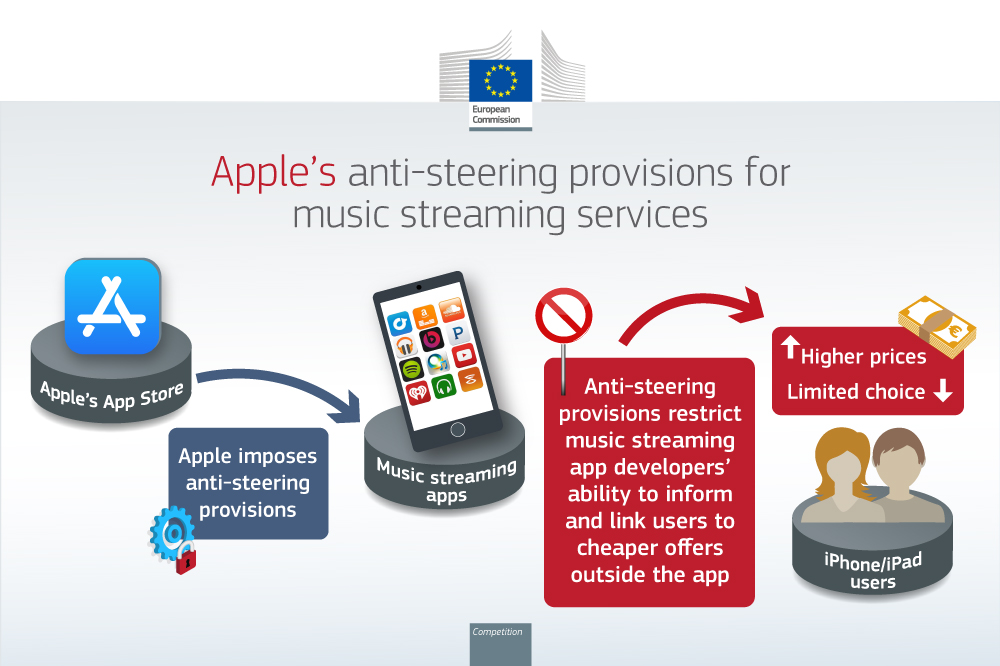
Are you starting to see what's wrong here? Apple is the regulator of their own internal market, and they haven't made their closed platform a competitive ecosystem. They are directly responsible for ensuring that third-parties are offered fair terms to compete on, and they do not: https://ec.europa.eu/commission/presscorner/api/image/conten...
> and to me it doesn’t seem like only one side is doing all the work without getting something from the other side in return.
"All the work" in this case, meaning creating an anticompetitive platform where they gimp their competitors? Again, looping back around to Ma Bell - you cannot excuse an exploitative system with it's benefits. Apple must first remediate the issues with their internal market if they intend to keep shipping iPhones in Europe. I don't see what's wrong here.
> the sides who are fighting here are both greedy companies
Which stage of grief is bartering, again?
You don't need to desperately appeal to us by comparing Epic and Apple. We know they're both greedy opportunists, but this time Epic is right. Apple is operating on a double-standard that will tear their company apart if they fight it.
> also it’s not like Apple is obligated to do charity work for free.
Here's an incomplete list of times Apple did charity work to support the whims of another market regulator:
lol Tim Cook yeah. I mean thanks for the links and the discussion, but I'm trying to argue respectfully without name calling. I have things to say but I don't think it's going in a productive direction when you are assuming that I'm somewhat grieving or have a skin in this at all. Anyway, thanks for the respectful parts of your message, not so much for the others. Have a good day.
Game developers and console makers tend to have a much cosier relationship because they actually care about each other. Console makers will engage in co-marketing deals or other things to entice and make good on their relationship.
> Game developers and console makers tend to have a much cosier relationship because they actually care about each other.
lmao, in what world? Apple used to bring Epic games on stage during it presentations.
The difference between a gaming console and a phone is that your phone is in your pocket and the console isn't. Both provide libraries and tools for development, both provide support, both provide distribution channel, both provide free marketing, both provide and cultivate user base.
The main difference is: console makers have publishing divisions (that btw put even worse restrictions sometimes) and as of very recently started buying every developer they can afford.
The difference is that people buy a phone because you need a phone to function in the modern world and then play games on it because might as well. Whereas people buy a console specifically to play games. That means the gamedevs have more leverage in the latter scenario.
Well, duh. How different it is between publishing on PC? IMO, more useful synergy comes from developers have a good relationship with Nvidia/AMD than with publishers.
I'm not arguing about that. I'm saying that "carrying about each other" is a stretch.
Apple used to bring Epic games on stage during it presentations.
That seems to be the full extent of their collaboration. No specific deals, no specific adjustments, just having them at PR events and nothing more.
The weirdest thing to me is they couldn't even come up with a deal with Microsoft and the Xbox streaming app when historically MS saved Apple's bacon at the most crucial time.
Logistically speaking: By the time the dust settles on such lawsuits, the next generation is here while the companies can use whatever loopholes to stall out for another generation. Consoles are so ephemeral in the grand scheme of things, and lawsuits take so long, that it's not worth it.
Meanwhile, mobile OS's have been around for 15+ years and seem to be there for the long run. Playing the long game makes sense.
----
Emotionally speaking: Tim Sweeny is a game dev at heart and probably respects dedicated console gaming (despite coming to notoriety via PC gaming). They sell consoles at a loss to make gaming more accessible which is many devs' goals at the end of the day. IOS and Android are closer to a PC than a dedicated console, so closing down those environments make no sense. Android inherently isn't closed but Google was strong arming 3rd parties behind the scnes (which Epic won in court over). Apple... well, many people reading this probably know that history.
That's not really what I'm talking about. Nintendo doesn't have a "Nintendo OS" it updates for 40 years. It effectively makes a new OS each time. Any restrictions added to the Switch OS can be worked around with the Switch 2 OS.
The longest lasting console would in fact be the switch with 8 years behind it. And given how Sony is already making plans for the PS6, I don't think that will change soon. the epic/apple lawsuits took over 4 years, so any resolution would come mid-way into the lifetime of a console. Is 4 years of burning a bridge worth potentially 4 relevant years of having an epic store on the Switch? Probably not.
Apple provides a general purpose computing device. Their big mistake was offering an App Store that allows developers nearly every type of app for nearly every use case (except for the ones Apple doesn't like, but Apple can ignore them and not lose money).
If Apple had run it more like MS or Sony, the only way to get on the platform would be for developers to spend millions of dollars making their case that they deserve to be on the platform. This is obviously very limiting.
One difference is that most (all?) consoles are sold at a loss and they survive on profits from games. Apple would do perfectly fine with no income from games while Xbox and PlayStation would be DOA.
Strictly my opinion, but I also believe that where Sony sends engineers to help developers that struggle (case in point, Helldivers 2 mass influx of gamers after it became a social media darling causing the servers to bog down), Apple would be more likely to use their massive data from iPhones to launch a direct competitor to any app that became a big hit rather than help them out (case in point, Spotify Vs. Apple Music and the other apps Apple tried to buy, and when denied, cloned).
Getting a console game published is just not the same as a mobile app. Say what you will about the specific value but the process is much more involved and exclusive for consoles. Everything published to a console is of much higher quality than the app stores despite the mobile approval process. In this way its much easier for the console platform owners to argue that they are providing clear value.
Mobile app store approval is really a joke by comparison. Its easier to argue that mobile app approval's main purpose is to provide market control.
That said, its just about what is easier to argue in court and where to start. Epic would probably ask opt to put the store on consoles if they were given the chance.
I'm wondering how you're thinking this distinction should apply in the real world. Would you say that if a game console is ever sold at a profit, the rules should change for that console platform?
I don't. I barely have a need to print to begin with but just enough that I have a printer. Printers aren't continually iterating in what and how they can print so I can survive on 10+ year old printers.
Everyone who publishes software that runs on iOS devices is an Apple customer, though. This isn’t the same thing as a browser — apps running on iOS devices consume APIs on the device, utilize Apple services, etc.
Also, when it comes to web apps, in most cases, the developers are also customers of the browser vendors -- from using browser developer tools and SDKs, for example, https://www.google.com/chrome/dev/ , https://www.mozilla.org/en-US/firefox/developer/ , and https://developer.microsoft.com/en-us/microsoft-edge/?form=M... to name three. Safari’s dev tools etc. you get with your Apple Dev subscription.
And those browser vendors, like Apple, also provide developer training, developer support services, early access to upcoming product versions, opportunities to provide input into future product designs and features, etc.
In other words, this is not a problem, much less the “core problem”. This is normal industry practice. In fact, on some platforms, there are royalty fees due for the SDK runtime components that are required to run the software a third party developer provides. Just look at mainframes — you might buy XYZ Accounting system from them, and have to pay an additional annual license payment for the cobol runtime it requires.
That fact, by the way, is what the half a Euro per ‘download’ technology fee is about. Part of the DMA requires separation of the “app store fee” from the fee for using iOS services.
It’s also important to note, when people talk about the 30% app store fee as being high — the app store is essentially the same thing as a retail store. Back in the days when you bought software in a physical store, rather than downloading it, the margin at the retail level ranged between 30% and 50%. E.g., we would pay the distributor $25 and sell it for $49.99. The distributor in turn would buy the software in bulk from the manufacturer, for somewhere around $20-$22.
Software developers get a lot bigger share of what the consumer pays in the current model. Some, however, are greedier than others, and leverage governments to their advantage. Epic Games doesn’t want any competition - they want to be the sole retailer of Fortnite on all platforms so that they can raise the price to whatever they want.
>The issue is that Epic doesn’t want to be Apple’s customer in the first place. They want to publish iOS apps. The fact that this requires them to be an Apple customer is the core problem.
The issue is that General Mills doesn't want to be Costco's customer in the first place. They want to sell to Costco shoppers. The fact that this requires them to be a Costco customer is the core problem.
To be fair, Apple isn't killing Epic's business by denying them to bypass the app store, or even by kicking them off the app store. Epic's doing just fine without apple.
Which is also wrong, especially given how most modern consoles are basically PCs. Just see what all you can do with Steam Deck in comparison to the locked down consoles.
>especially given how most modern consoles are basically PCs.
people always obsess over the hardware in these arguments when the value is in the software. You probably can eventually run windows on a PS5, but that's not what people buy a PS5 for. They don't advertise it as being able to install whatever OS you want (they made that mistake on PS3, took it back, and then got fined for taking it back), and the value for most customers is playing PS5 games. The onyl non-gaming thing you can do these days on a PS5 is watch streaming services. So at best it's a media center
Just because you can install doom on a pregnancy test doesn't mean a pregnancy test is a general purpose computer.
Still as long as you buy the hardware, you should not be prevented from running whatever you like on it.
A case of this is the Nintendo Switch, which does not even have a Web Browser (possibly due to Nintendo being scared to death of JIT exploits breaking their walled garden). Want to look up a game guide from the Internet, on a device perfectly able of doing so ? Fat chance, need another device for that!
You mentioned consoles supporting some streaming services - why should the manufacturer of the hardware be in business of deciding what streaming services you can use ?
>as long as you buy the hardware, you should not be prevented from running whatever you like on it.
Nothing is stopping you from gutting a switch and putting steam deck components in it to run Windows. You can do all that without bypassing Nintendo OS encryption.
>Want to look up a game guide from the Internet, on a device perfectly able of doing so ? Fat chance, need another device for that!
But that's a software problem, not a hardware one. If you want a browser on the Nintendo OS you either need some exploit on how it renders web pages (legal) or a way to install an app that goes around the Nintendo store (dubious, depending on how you approach it).
>why should the manufacturer of the hardware be in business of deciding what streaming services you can use ?
To be fair, Nintendo does allow streaming services. If your favorite one isn't on Switch, it's a business issue, not a store regulation issue. No different from a game you want not having a switch port.
Netflix wants market capture so it's everywhere. Hulu, not so much. Disney probably would have gotten on it if it didn't launch a few years after the Switch.
I was wondering around a local store, MediaMarkt I think, and I saw a random handheld games console — two sticks, a D-pad, XYAB buttons — with the well-known video game Microsoft Excel pre-installed and visible on (I think, I'm not a Windows person) the start menu.
As a consumer I want and like the tight restrictions apple puts on the App Store.
It’s not like users can’t purchase stuff without paying the 30% premium added by developers to offset the apple tax. Just go to the website and buy there. And save the 30%.
My parents who are older use iPhone. They don’t have to wade through trash like android play store. Most apps are good in the iOS store.
If epic wants kids to buy more stuff have their parents pay the 30% premium. If your kid is glued to the phone I’m sure you enabled that and can continue enabling it. Sorry not sorry.
The number of bad faith arguments here is impressive.
> Don’t like it? Don’t publish to it.
That's not how laws work, Epic have a perfectly valid complaint against Apple because Apple isn't complying with EU law. As far as valid outcomes go, Apple can either comply, face fines, or leave the EU market.
> As a consumer I want and like the tight restrictions apple puts on the App Store.
That's great, but it causes demonstrable harm to the proper functioning of our supposed "free market", so we've outlawed them.
> It’s not like users can’t purchase stuff without paying the 30% premium added by developers to offset the apple tax. Just go to the website and buy there. And save the 30%.
Except they ban you from even mentioning that this alternative exist. More harm to the free market.
> My parents who are older use iPhone. They don’t have to wade through trash like android play store. Most apps are good in the iOS store.
Nobody is forcing them to wade through alternative app stores. If most good apps are indeed on iOS, and Apple's fees are indeed reasonable, then those apps will stay in the iOS App Store. Nothing to worry about!
> If epic wants kids to buy more stuff have their parents pay the 30% premium. If your kid is glued to the phone I’m sure you enabled that and can continue enabling it. Sorry not sorry.
This legislation benefits everyone, not just Epic.
Ah yes, the classic "Think of the innocent children and grandmas" . Sorry, that isn't an argument anymore. It never was convincing before and isn't now either.
>Don’t like it? Don’t publish to it.
Yeah, why protest at all? Just leave the country. Why fight corruption? Just go somewhere else where there is less of it. Really, why complain at all?


Imagine if everyone wanting to publish a web app would have to be a customer of the respective browser vendors.
Everyone complains about Google and Mozilla and Safari and Edge. Luckily, that doesn’t prevent us from having our web apps running on those browsers.