Right, but looked from the other angle, if Apple didn’t provide an easy enough experience for developing apps, less 3rd party developers would develop and they wouldn’t have access to a luxurious market. It’s a two way relationship, these things don’t exist in a vacuum.
If Apple didn't provide an easy experience for developing software, nobody would want to buy an iPhone. That's why the web browser portion was essential from the start - Apple needs third-parties in order to sell their hardware.
that’s not entirely true. there was no 3rd party software in the first year and people still bought it. On another note they managed to create a luxurious market although the other platform also allows 3rd party apps. What I’m trying to say is, yeah it’s undeniable that 3rd party devs bring something on the table, but so does Apple
There absolutely was third-party content and software on iPhone, at launch. The web browser was one of the biggest selling-points when it was announced, alongside the phone and music-player functionality.
> On another note they managed to create a luxurious market although the other platform also allows 3rd party apps.
Many proven monopolies seemingly "improve" their user experience to get users to defend it. Famously, Bell Telephones had imposed a severely-limiting monopoly on phone hardware, but made long-distance calling free as a consolation to users. Bell's new "luxurious market" didn't excuse their prior market abuses, though.
> it’s undeniable that 3rd party devs bring something on the table, but so does Apple
I'm trying to say the opposite. If Apple was providing first-class support to any of their hardware-products, then they wouldn't need to impose anticompetitive limitations on third-parties. What Apple brings to the table is deliberately gimped to manipulate software margins and reduce user choice as a consequence. Third party devs are the only ones bringing things to the table; Apple is charging them for the privilege.
Again - if you want to test this, ask around and see how many people would buy an iPhone with just first-party content. Nobody would, and the clear and eminent reason is that Apple does not provide a superior experience by removing user choice.
> There absolutely was third-party content and software on iPhone, at launch. The web browser was one of the biggest selling-points when it was announced, alongside the phone and music-player functionality.
That point is quite moot. If there were only first party content on the phone today, there would still be a browser. Also, this content is not specific to the Apple platforms, you can access all of them from Android too, so it’s not the kind of content that would make an iPhone particularly interesting.
> Many proven monopolies seemingly "improve" their user experience to get users to defend it. Famously, Bell Telephones had imposed a severely-limiting monopoly on phone hardware, but made long-distance calling free as a consolation to users. Bell's new "luxurious market" didn't excuse their prior market abuses, though.
I don’t see how Apple is a monopoly with less than 30% of market share in the EU, so this comparison is not apt. Even the DMA talks about gatekeepers not monopolies. I’m of the opinion that kind of dynamics do not apply here - especially because you can switch platforms and go to the other side quite easily nowadays.
> I'm trying to say the opposite. If Apple was providing first-class support to any of their hardware products, then they wouldn't need to impose anticompetitive limitations on third-parties. What Apple brings to the table is deliberately gimped to manipulate software margins and reduce user choice as a consequence. Third party devs are the only ones bringing things to the table; Apple is charging them for the privilege.
It’s the hardware and the conscious decisions that were made along the way by Apple that partly played a role in creating this lucrative market and it doesn’t seem very out of place to me for a business to charge for a market that they partly enabled. I don’t see what’s wrong here. Third parties still come and try to make a buck, so it also seems to be working for them. The third party creates apps to make money, which in turn makes the platform more attractive and hence increases the amount of customers. Apple continues investing in the hardware and software stack that takes advantage of even better technologies and capabilities each year, enabling people to come up with even better apps and experiences. They also consciously make it a closed platform, the opposite of the other platform that has much more market share, to give a choice to customers who prefer this kind of product. Two sides in this relationship feed each other, one wouldn’t be better off without the other.
> Again, if you want to test this, ask around and see how many people would buy an iPhone with just first-party content. Nobody would, and the clear and eminent reason is that Apple does not provide a superior experience by removing user choice.
Again, you’re assuming things are in a vacuum. If only Apple had first party apps and all the other platforms still exist as they are today - sure, there would be much less people buying iPhones, although I believe some still would. But that’s not a fair comparison: if we assumed all other platforms also had only first party apps and nothing else, then I’m sure people would still buy iPhones in droves. But this is still not a very apt comparison, and the reason is the App Store and third party aspect is part of the product, and it has been for a long time. It’s not a separate entity, it’s a core part of the value proposition of an iPhone for the consumer. It’s akin to asking “how many people would buy a car if cars didn’t have engines” so trying to draw conclusions from assuming they didn’t exist shifts the discussion to be something else. The question is how much this relationship between Apple and third parties feed each other - and to me it doesn’t seem like only one side is doing all the work without getting something from the other side in return.
Also, let’s not forget, the sides who are fighting here are both greedy companies and they try to improve their bottom lines at the end of the day. It’s not like Epic is fighting this just for the common good, also it’s not like Apple is obligated to do charity work for free.
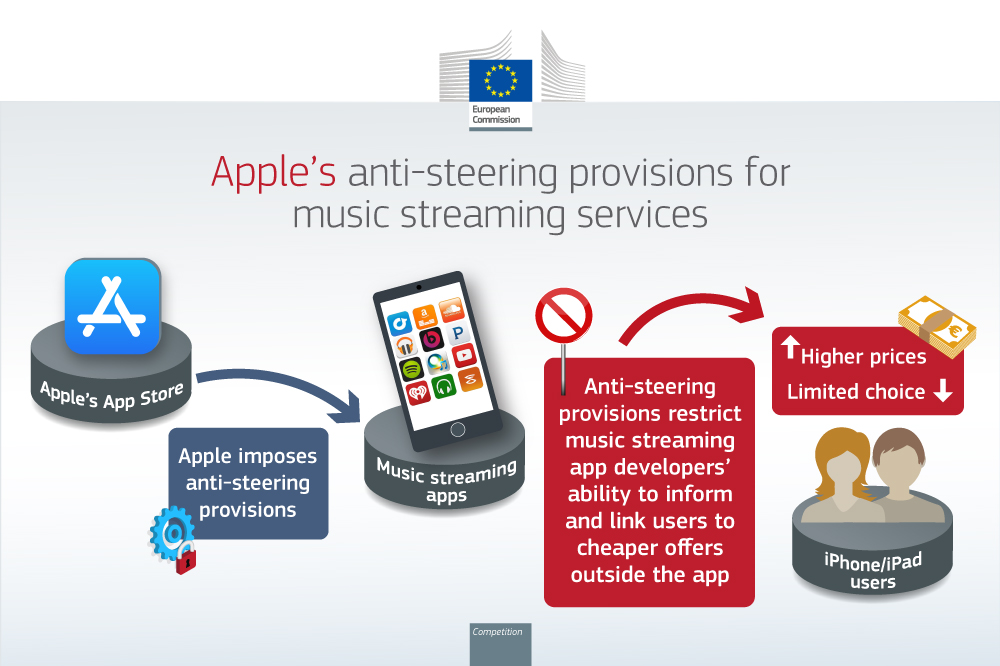
Are you starting to see what's wrong here? Apple is the regulator of their own internal market, and they haven't made their closed platform a competitive ecosystem. They are directly responsible for ensuring that third-parties are offered fair terms to compete on, and they do not: https://ec.europa.eu/commission/presscorner/api/image/conten...
> and to me it doesn’t seem like only one side is doing all the work without getting something from the other side in return.
"All the work" in this case, meaning creating an anticompetitive platform where they gimp their competitors? Again, looping back around to Ma Bell - you cannot excuse an exploitative system with it's benefits. Apple must first remediate the issues with their internal market if they intend to keep shipping iPhones in Europe. I don't see what's wrong here.
> the sides who are fighting here are both greedy companies
Which stage of grief is bartering, again?
You don't need to desperately appeal to us by comparing Epic and Apple. We know they're both greedy opportunists, but this time Epic is right. Apple is operating on a double-standard that will tear their company apart if they fight it.
> also it’s not like Apple is obligated to do charity work for free.
Here's an incomplete list of times Apple did charity work to support the whims of another market regulator:
lol Tim Cook yeah. I mean thanks for the links and the discussion, but I'm trying to argue respectfully without name calling. I have things to say but I don't think it's going in a productive direction when you are assuming that I'm somewhat grieving or have a skin in this at all. Anyway, thanks for the respectful parts of your message, not so much for the others. Have a good day.