I understand the criticism but to be fair high speed trains are better in many cases:
Paris - Lyon by airplane: 1h15 plus travel to and from airport, plus security, boarding etc
Paris - Lyon by train: 2h30, city center to city center, no security checks. This might actually be faster!
Personally when traveling between London and Paris I choose the high speed train. It's usually more expensive but just the fact it removes traveling to and from airports (especially in London!) adds so much comfort that you realize the extra £50-70 are totally worth it. The overall travel time is also comparable.
That’s correct if everyone traveled from city center to city center, but in my case, the airport is easier to get than the hsr station, has more long time parking options, and sometimes the destination is a layover, so I would have to go from the center of paris to the airport equally. I Would love to travel a lot more by train, or less by plane, but right now and at least in my case, it’s not a very good option.
Laws should not be decided just based on what is good for you in particular, but in considering what is the most efficient in average.
Sure, you may have an easy access to the airport outside the city centre, but people in the city centre, which constitute a bigger number, have a worst access. And people who are not in the city centre but on the other side also have a worst access to the airport than the city centre.
The comment you answer to is still very relevant: it is true that in average using the train is not as disastrous as one could think (so the disadvantages are compensated by the advantage with regard to environment). The fact that it is not advantageous for every one is trivial and not really relevant.
Presumably if trains truly were better, there should be no need for a law. Perhaps they should focus their efforts on making trains an obviously superior service.
What do you mean by "better"? Planes are faster and more convenient, but they are polluting more, which has long term negative impact. If you want to know what is "better", you need to put everything in the balance. And the weight of each thing will also depend on subjective opinion (is it better to see 5 old people die 5 year earlier than otherwise or see 10% less investment from foreign investors?).
Also, this should not be decided by the "market", because the market is crap as evaluating mid- or long-term consequences.
If you don't think "the market" (aka people) should get to decide then you have probably have some authoritarian leanings. My argument is make the train service better so people want to use it instead of forcing them to do so.
Surely you're aware of the market distortions that are a result of negative externalities. Markets aren't perfect and recognizing that governments exist to correct market distortions is hardly authoritarian.
In this case France could alternatively levy a hefty tax so that your air travel costs fully reflect the environmental damage it causes. Would that be your preference?
How do you measure the externalities? In particular, how do you measure the environmental damage of air travel? Note that you must do it, as it is absolutely crucial for your entire argument. Otherwise, it might as well turn out that it is rail travel that’s more environmentally damaging, and we should tax it and promote air travel instead.
My suspicion is that you actually have not given any thought to this, have no idea about the actual cost of the externalities, and you don’t really care about that either. Instead, you just want to push your personal preference for trains over planes, while clothing this as if you were just appealing to objective facts and principles.
If the market decides the planet/climate goes sideways.
'Better' doesn't make people want to use something if they can save money. The main reason airlines like EasyJet and RyanAir thrive is because they're cheaper, not better.
Traveling by train vs. via one of those planes with minimal legroom and non-relciming seats?
Always better for short haul.
But the prices of trains (or rather: the subsidizing of air travel) make this a non option for many people in Europe. It is literally twice as expensive.
For example, Berlin--Munich. This is a one hour flight. Average price when booking in time is less than $90, I'd say.
The solution to climate change is actually attacking the problem head on - not just making everyone poor and forcing them to use crappy government services and ultimately switching to communism.
Right now solving the problem means natural gas, nuclear and carbon capture.
Seriously. I tried to take a train this summer for my European vacation after landing on my direct flight from the US in lieu of a connection. 12 hours and 3 delayed / canceled trains later we were at our hotel which was a mere 189 miles from where we landed and they were both major cities...
If I would have just hung out in the airport for 4 hours and caught the 50 minute connection it would have been a much more pleasant experience.
Unfortunately public transport and esp. railway transport is not a 100% free market, there are a lot of natural monopolies in this space that need to be regulated. For example what stops Eurostar from pricing their tickets by looking at airline ones (it's what they are apparently doing)? Nothing because Eurostar is a monopolist for some important destination pairs like Paris - London.
It costs me around 60€ to go from France to Switzerland by plane. It costs me way more than 60€ to go from France to Switzerland by train. This why people are taking the plane, because it's less expensive that high speed rail, nothing more. Make high speed rail less expensive and people will take the train.
Government induced free market distortion under pretense of ecology concerns is just what it is, bullshit, and a bad French habit.
edit: I know France Switzerland trips aren't affected by these laws, it's just an example.
Just taking a simple example like Lausanne (Switzerland) to Paris (France)¹ shows comparable ticket prices. For an arbitrary date a few months away like April 21st, that gives me a single train ticket for €65 on a direct connection to Gare du Nord, or a train ride to Genève-Aéroport (€8) plus a plane ticket for around €65 to Orly. Cheaper plane tickets exist, but not if you have even a single backpack.
In terms of time, the train is a direct TGV that takes 3¾ hours, while the plane route means taking a train for ¾ hours, waiting at the airport for at least an hour because of security, flying for 1¼ hour, wait for another half hour at least to get out of the airport, and then spend at least half an hour getting to where you actually want to be in Paris. It takes just as long, but probably longer if you want a decent safety margin on the airport.
And that excludes the simple fact that we all have a responsibility in reducing our carbon footprint, and that for most us who have the means to travel taking a route that may be (but isn't in this case) slightly more expensive and take slightly longer is the least we can do if it is the greener alternative by far.
1: Just an example of a journey I took myself, by train.
That's a difficult personal choice to push on people when the super rich are traveling by private jets, fuel for international air travel isn't taxed (because bought in duty free zone technically), etc...
People want legislation for all, not just fake moral that only applies to the middle class and lower. I believe the fact that this law will affect private jet trips is a reflection that politicians are aware of this and starting to feel the pressure.
Perhaps there should be a hefty aviation fuel tax that works inversely: basically, the more you buy at once (per plane), the lower the tax is, by a very large amount.
So, if you're refueling an A380 super-jumbo or a 777, your fuel tax is very low, because those planes need a LOT of fuel. If you're refueling a 737, it'll be significantly higher, to penalize short routes. If you're refueling a small private jet, it'll be huge.
Basically, big jets that carry hundreds of passengers will get the lowest fuel tax this way, and airlines will be forced to prioritize moving people as efficiently as possible.
That's not feasible. You can't cross oceans in any reasonable timeframe without an airplane. Even long land trips don't really make sense by train, over I'm guessing 1000km.
My whole point here was to devise a taxation strategy to discourage passengers and airlines from flying short routes, and leave those to trains instead, reserving airplanes for the much longer routes where they're much less avoidable, and also to encourage more centralization of air travel from large cities and their airports, so that larger numbers of passengers are funneled onto a smaller number of very large jets for those intercontinental trips. Passengers would then just have to take trains to/from the smaller cities. Larger planes are far more efficient in terms of fuel per passenger per mile; much of the fuel burned in a flight is used on take-off and getting to altitude anyway, so maximizing distance and plane size means minimizing fuel per passenger-mile.
Well, then don't cross oceans then. Travel long distances rarely. It's not a human right to get cheaply to the other side of the globe. And with recent breakthroughs in electronic communications, we don't have much need for vast majority of travelling. Close-but-living-far-away relatives dying or getting married happens only so rarely.
If we want to fight pollution big time, ultimately we have to reduce amount of traveling. At least till we get nuclear fission working and batteries with good energy density. Entirely new ways to make trains and planes themselves.
Sure, we'll just all go back to medieval ways of living! That sounds like a great idea! Why travel when you can just stay at home and play video games all day!
Not flying long distance does not mean staying home. Unless you live on a 500m radius island in the middle of an ocean with next land mass thousands of kilometers away.
Air traveling (and traveling in general) is not some sort of human rights where everyone MUST afford to travel. It is a scarce resource, especially with air traveling pollution. And high taxation is a good way allocate a very scarce resource.
Why is train so much more expensive? Surely jets that cost $100s of millions, supported
by massive airports, are more expensive? Seems like the market distortions are subsidies to airlines of some sort.
Rail lines are massively subsidized and the French government is regularly bailing out SNCF (the national rail company). So imho it not clear that the global market distortion is in the favor of plane.
Just like cars are heavily subsidised through motorway building. Every form of transport receives subsidies as a public good, even in countries where transport infrastructure is nominally privatised. This is one area where letting the free market decide invariably ends in disaster.
I suspect in case of the Eurostar high speed train they simply follow the airline ticket pricing for the same destinations and add their "convenience tax" on top of it, usually around £50. Saying this because I've noticed that their prices fluctuate together with airline ones, and they fluctuate wildly.
Yes, despite being state-owned, Eurostar operates like a classic price-maximizing monopoly. Thalys is much cheaper, I wonder what will happen now the two are merging. Hopefully Renfe will launch its competing service soon on the London to Paris route.
Do trains in France use the same sort of demand-driven pricing scheme airlines use? People tend to estimate airline pricing based on the cheapest price they see, which is often a fraction of the cost when demand changes.
Forgive me, but your comment drops below any reasonable threshold of HN guidelines and I am forced to use strong language like “absurd” and “clownish” to describe what you’re asserting …
The overriding market distortion, which trumps every other variable here, is the zero value given to any environmental externalities coming from air travel.
In addition, both CH and FR have massive governmental subsidies for their national carriers and the operation of their airports.
Which is to say:
you’re swimming in free market distortions so deeply you’ll never come up for air … and you’re decrying this one ?
> Yes, the evil government is propping up BIG TRAIN because they hate planes!!!
Dude, instead of mocking me and sounding like an ass, learn your history. 20 years ago in that country, it was impossible to go from Region to region by bus, you had to take the train. You couldn't do Le Mans Paris by bus because bus operators were not allowed to sell inter regional trips. It's the EU that forced France to allow these. You're damn right the french government is once again rigging the game in favor of the SNCF.
You know how these buses are casually named right? Yes, indeed, it's the same Macron as the current one in charge of the government. Not sure where you get your news intake from to believe for a second that the French government is favoring the national railway company over its competitors in any way.
This instance is just a weak law intended for greenwashing purpose, nothing else.
> This why people are taking the plane, because it's less expensive that high speed rail, nothing more.
This is often true. But - not always. Depends on which endpoints. Sometimes it's speed, sometimes convenience, sometime price.
> free market distortion
1. Markets are not free. They are based on violent coercion of private ownership of land, factories, service providing corporations etc.
2. Markets are always "distorted", in the sense that they don't just occur naturally.
3. I can't say for certain whether this specific measure is appropriate or well-intentioned, but - emissions need to be reduced drastically over the next several years; and not just in one sector of the economy. So in _some_ way, people do need to change their habits in favor of using more carbon-frugal modes of travel.
Agree, in France train is usually way more convenient. There are still issues though, for example Rennes-Toulouse is 1h30 by plane, and 7 (!) hours by train. I really hope this gets fixed, until then train is just not an option in this case.
If it’s better to travel by train, then no need to ban short flights, because people wouldn’t use them much. Empirically, since people ARE taking short flights instead of trains, the people who are doing so believe that flights are better for them.
Meanwhile the entire world, France included for Nice-Paris, study flying taxis and "cars"... Oh, but such moves are not made to push some cohort of peoples out of traveling while pushing others to do so...
> Paris - Lyon by airplane: 1h15 plus travel to and from airport, plus security, boarding etc
Reminds of when someone says "this recipe only takes 20 minutes to make!" and they fail to mention you have to spend whole day shopping for ingredients, do some prep the day before and then spend half a day cleaning the kitchen afterwards... oh and then if you actually cook it for 20 minutes, chances are it will be barely safe to eat and would need much longer time.
>Reminds of when someone says "this recipe only takes 20 minutes to make!" and they fail to mention....
Or, keep essential ingredients for good and favorite recipes on hand generally, clean pots and utensils in the middle of cooking (usually very possible during pauses and wait times) and cook properly. Most foods can indeed be cooked perfectly in 20 minutes and with a bit of practice it's easy to create great 20-30 minute meals without any of the hassles you describe,unless you're one of those people who barely bothers to ever cook or keep a thing at home and even scrambled eggs with toast require a trip to the grocery store and bakery first.
Huh? How? Living by the airport (not recommended btw) is a whole huge question of moving house and home to a specific location. Having a few essentials at home and learning a few basics for cooking on the fly and really crafting 20-30 minute recipes requires a pretty minimal investment of time and effort. The two don't compare at all.
Only when you can plan ahead by a few weeks. Typically, flying is still cheaper than the train. Tried to book a trip from London to home for boxing day. Eurostar was double
I have found that flying is often cheaper for many close-ish and middle-ish distances where I want to go. Why is this? These are the cases where I would most like to take the train, and it is hard to justify by ticket price.
This seems like making headlines for little real impact.
If they did want to do something for the environment and fairer competition between transport modes they should tax aviation fuel and airline tickets. Regardless of distance and destination.
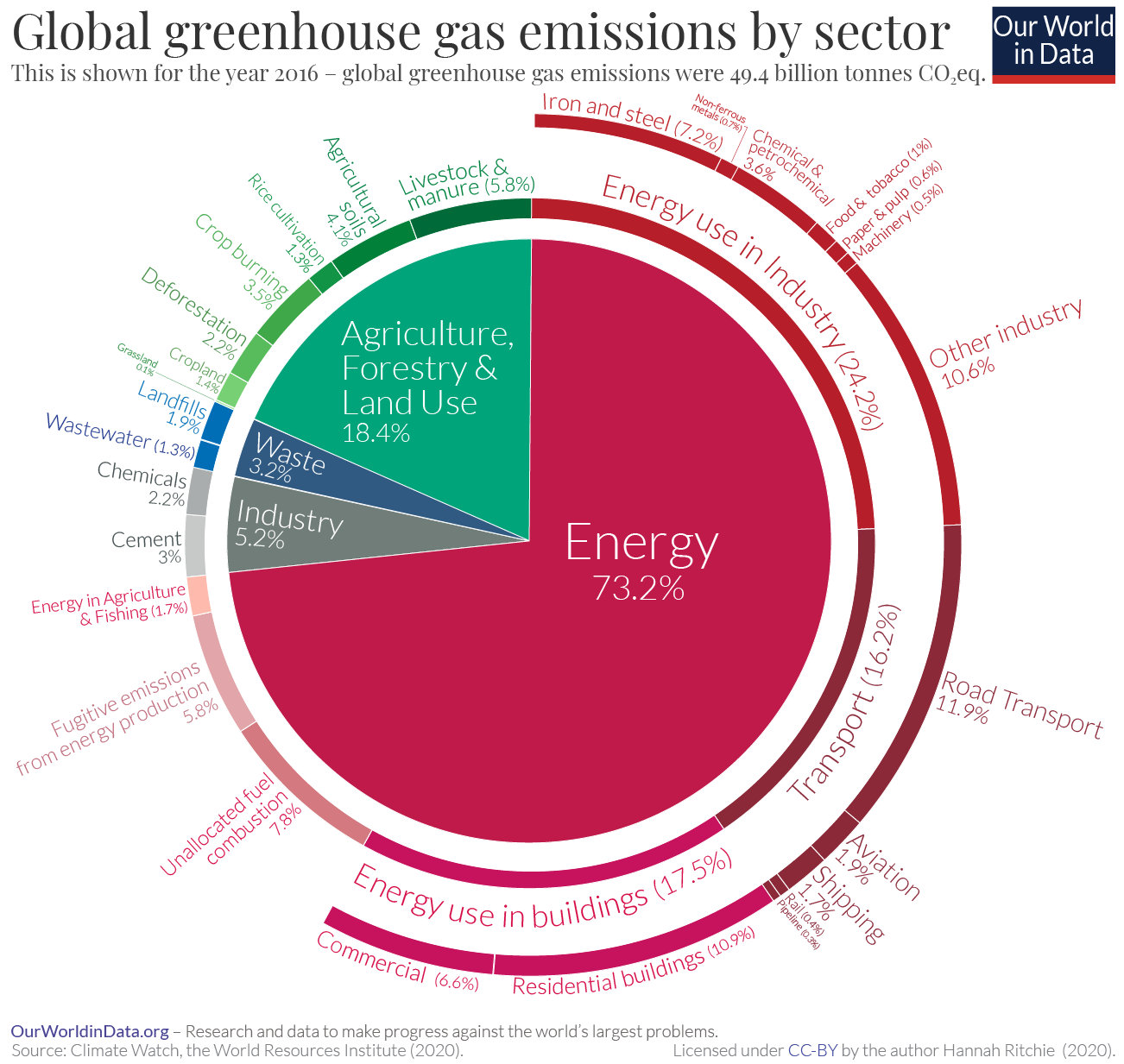
Aviation emissions are 1.9% of global emissions. [0] I certainly don't disagree with a jet fuel tax (which is obscenely tax free in most of the world).
However, if we want to be impactful then we need to start building massive storage infrastructure and grow renewable sources so that we can curb down emissions from energy production using coal and gas.
Everything else is a drop in a bucket comparatively speaking (even ICE to EV transition is relatively small in comparison with Electricity related emissions). More so if EVs are charged up from Coal/Gas Electricity sources.
This is one of the problems with hiring non-technical politicians. They have zero background in science and base everything on current trends and analogies. It is a real problem in many western democracies - people who are only capable of getting a political science degree run for office because that is the only job they can get. Capable people end up doing other jobs because politics doesn't pay until you are in a position to corrupt things and capable people usually aren't interested in corruption. Politics needs to pay far more in order to attract capable/competent people.
100%, most for the climate rules in the Eu are just for show.
they pick the most miniscule and most visible / inconveniencing regulations so that they look like they care about the environment, while actually doing nothing.
You could basically say that about any climate initiative. Cheap carbon-based fuels form the entire foundation of our society. Changing that is going to be a long, hard fight. You have to start somewhere.
As a personal anecdote. My family decided to drive instead of fly over Thanksgiving. We saved about 1200 kg of CO2 even though we had to drive 12 hours. Clearly some savings can be made by forcing alternate means of transportation.
The U.S. has seemingly done the opposite. Nonstop flights have all but vanished completely. What used to be a few hours on a cross-country nonstop flight has now become two to four connecting regional flights that start to approach international flight times in total.
Does anyone know what's going on with no nonstop flights anymore?
20 years ago, there were many more airlines in the US [1]. Many of these airlines, while 'national,' were mostly regional, and serviced particular routes. As the airlines have merged, not only have costs gone up, but routes have gone down because the big players aren't competing with each other. In fact, they were found guilty of price collusion with the whole 'capacity discipline' scandal.
Another thing to consider is the airports themselves. It's impossible for new carriers to introduce new routes in many instances because the airports cannot accommodate any more planes. Air traffic has gone from around 2B travelers per year in 2004 to 4.7B in 2019 [2]. I'm willing to bet terminals, gates, and runways have not gone up 250% in the same time period (it's likely air traffic has increased more in developing nations relative to the US, but I'm sure the US still accounts for a fair amount of this growth).
Personally speaking, I have never had more than 1 connection each way to anywhere in the US. I only fly major carriers and live near a decent sized international airport. I also travel any day or time, depending on which flights I like best, not necessarily the cheapest flights. It might be a worse experience if you're always shopping for the cheapest flight.
That is not my experience at all. I fly non-stop between major US cities all the time. For smaller cities I may need to make a single connection.
I live on the east coast and within 45 minutes of 2 major airports. I just did some quick checking. Following are examples of the number of daily non-stops available from them:
San Francisco - 11
Las Angeles - 13
Dallas - 17
Seattle - 9
Portland - 4
Chicago - 33
St Louis - 9
Denver - 14
I fly to Little Rock, AR a couple of times a year. There are no non-stop flights but a quick search showed over 40 1-stop options from just the airport closest to me. Not all of those are going to be combinations most people want to do or are cost effective but if you throw away 1/2 if them that is still over 20 options. I also fly into Albuquerque, NM a couple of times a year. From my closest airport there are 58 1-stop options. If I drive 75 minutes to a further airport there are 4 non-stop flights to Albuquerque per week.
If you live in or near a smaller city served only by regional flights and are flying to another smaller city served only by regional flights than 2 stops will be necessary but 4 seems excessive.
Anecdotally, the reverse is not true. West to East non-stop flights have been scarce as of late to many major cities, even from a major hub, compared to a few years ago. Some flights in the same direction have sometimes been faster via Canada than staying the US.
Having had to do that quite frequently in the US, flights from West to East in my experience are much more likely to be non-stop hub to hub, or entirely unavailable.
The time difference and regional/hopper flights catering to "commuters" who need to fly early morning and late evening doesn't play well with the time zone changes, so you can either have a bunch of hopper flights with full day layovers at each airport, or you can catch an early morning long haul flight from a major hub airport to another major hub airport.
In fact I think I just saw an article (can't find the source) that talked about post pandemic the US domestic flights were much more focused on large volume hub-to-hub flights as a way of serving pre-pandemic customer levels despite understaffing.
An even quicker check showed 7 daily non-stop from San Francisco to my area and 4 non-stop from Portland. All of the Portland flights were red eye flights. I stopped counting but there were at least 30 1 stop flights from Portland with a layoff around an hour.
Well your experience contradicts both mine and my family's, the both of us living in two of the most major cities in the U.S. And there has absolutely been a dropoff of nonstop flights. Several used to exist and now literally none between areas I used to fly.
No experience with the US market, but I thought that thanks to planes like A350 the opposite was happening: new routes between smaller cities thanks to fuel efficiency.
It's possible that in the US you're seeing that as a consequence of few available pilots and their resistance to change (hub and spoke has been around forever in the region)
The regional operator of the spoke flight from my local airport to the hub tried to change it to have a stopover at another airport, changing a ~1 hour flight to like 2.5 hours, with an hour sitting on the ground. The airport managed to reject the change.
I took that flight several times earlier in the year and it was always pretty close to capacity, so sort of hard to understand. I guess the most likely thing is that they were trying to eliminate the direct flight to the middle airport while maintaining service there, but screwing over the majority of your customers seems like a bad way to go about that.
Flying is more expensive than it used to be, demand has dropped.
At least for me, the additional COVID security theater, as well as frustratingly high rental car prices has made it a no brainer. I'll just drive. At least the covid theater is going away, it seems. Airlines are losing money if a plane is empty. Until demand for those nonstop routes pick up, those routes will not be revived.
Same sentiment. Airports are a pain to get to, security is a pain, taking time to account for the variable length of the security line is a pain, checking your baggage is a pain, dealing with the race for the overhead bin space is a pain, the inevitable delays that will ruin your whole itinerary are a pain, the lack of legroom is a pain... For destinations on the east coast (where Amtrak is actually reliable) I've begun taking trains to the exclusion of flying. Slower, but more comfortable, and I can get work done or just relax without being crammed into a sardine can.
I wish I knew. Nothing worse than a red-eye from CA to DC with a forced multi hour layover in Atlanta or Charlotte at 4am (before many dining options are open).
Read between the lines: this has nothing to do with ecology. I don’t really understand the French government and culture enough to guess what the ulterior motive is; perhaps something with keeping non-French companies from running cheap airlines in the country?
Absolutely this. Also, in political threads, I always read the grey-ish/dead comments because they are the ones with a glimpse of common sense. I think that this forum should stick strictly to technology as it simply can't handle political news, and it causes more harm that good. A false consensus, an echo chamber, whatever you want to call it.
So this is another measure to widen the gap between the rich and the pleb - when the pleb's travel gets restricted further, the rich can enjoy private jet hopping undisturbed - which gives them advantage over the pleb as they can get to places even quicker.
If we are serious about climate, then there should be no exceptions for the rich, in fact they should be leading by example.
” France is also cracking down on the use of private jets for short journeys in a bid to make transport greener and fairer for the population.”
”Transport minister Clément Beaune said the country could no longer tolerate the super rich using private planes while the public are making cutbacks to deal with the energy crisis and climate change.”
I don't think we (assuming you are also US american) have a leg to stand on until we raise our taxes. France iirc has a solidarity tax and from what I hear people don't go bankrupt due to routine medical care.
Back to the topic though, a ban on short flights doesn't sound right to me. I'd feel better if the flights were made more expensive with higher taxes or perhaps even a new tax altogether
Don't see any mentioning of electric planes :/ - I'd assume they should be encouraged. Today they probably won't cover all distances for 2.5 hours flight, but they still can be used on shorter distances.
Bet : How long until this completely absurd measure shows its first detrimental unexpected side effect ?
We french are really kings for disturbing markets because of ideology. used to be socialism, now it’s eco-bullshit ()
() eco bullshit looks just like environmental activism, except it makes 0 environmental impact, is 100% about politics and can destroy economies in less than 10 years.
Well, then there's an easier way to shutdown this traffic, and let the market do its job : stop financing those airports with public money if they're not profitable. And let the ones that manage to actually create an effective business model survive.
But that's not how we french like do it, because it sounds too much like "laisser faire". Politicians want to show that they've acted, they like to spend money and regulate, it makes them feel warm and fuzzy inside.
Your comment is high on inflamatory polemics but lacking in substance. If you'd listed _what_ side effects you do foresee, that would have been a much more interesting comment.
We've had numerous examples now of how pseudo-environmental policies destroyed economies and energy infrastructure in europe (germany becoming super dependant on gaz and coal, and france leaving its nuclear infrastructure to rust), with absolutely 0 effect on climate, (and 0 is a generous number, if anything those policies did worst for climate change than just doing nothin).
I believe it is now time for citizen to ask a little more than just a "it's good for the environment" slogan, whenever state are starting to highly regulate and destroy parts of our economies. Such as serious scientific assessment on the real, numbered impact expected. Hint: it's not going to happen, because this airplane traffic obviously is totally negligible compared to the country CO2 emissions.
My man, you still haven't told me what this regulation is going to affect. What are the side effects? I'm not talking about energy infrastructure in Europe, nor am I interested in a wider discussion about 'eco-bullshit' or 'pseudo-environmental policies'. I'd just like to see your take on the unintended consequences of this policy that you are able to foresee. Furthermore, if the airplane traffic is indeed this negligible, then why does it even bother you in the first place?
I'm a bit sensitive myself, and apologies if I sound harsh, but HN has a permanent anti-regulation erection and seems to attract know-nothings who love to argue that all regulation is bullshit and the free market will fix everything, every time an article on a government intervention or policy is posted. It drives me bananas.
If you're going to be dismissing well-meaning political actions with hand-waving and vague insinuations that it's ecobullshit, one would hope you could do better than just a shrug and a "beats me".
> We've had numerous examples now of how pseudo-environmental policies destroyed economies and energy infrastructure in europe ... france leaving its nuclear infrastructure to rust
I'm the first one to criticize pseudo-environmental policies, and Germany was indeed a mess due to pseudo-environmental policies.
But the state of french nuclear infrastructure is not due to ecologists, it is very stupid to think it is, because it does not make any sense.
The different french government were all way more pro-nuclear than than in other countries, and french nuclear technology was always considered by them as a source of pride. The state of the nuclear infrastructure is a mix of plenty of things: short-term vision from the french politicians (as usual: results of investment take time and they will not be in power when they will come, so what's the point), overconfidence ("we have the best tech, I'm sure it will still be the case in 10 years, let's invest in other stuffs instead"), privatization (the picture would not be as it is today if EDF was not struggling economically because of the shoe-horned privatization that forced them to sell at loss), loss of know-how, ...
One example of how ridiculous it is to blame it on ecologists is when we talk about running nuclear plants. Their situation is very dire. Yet, how can it be the results of ecologists? If they were able to influence the decisions regarding the power plant, they would close it, not pass laws that say "let's decrease checks, let stuffs get corroded, let make the worker condition even worse". Obviously, if the ecologists were able to influence things that led to the situation of running power plants, they would have done things totally differently in order to reach their goal way faster.
it's a very famous fact that the fesseinhem nucleae power plant, for example, was an electoral deal between socialist party and the green one.
But more importantly, the idea that the "renewable energies" had to be pushed forward aggressively, despite all data showing it couldn't replace nuclear or fossile, is a general gospel spread by green activists throughout the world.
Political parties saw that the population were becoming brainwashed by this ideology and adapted, as a way to gain election.
Fessenheim is the proof that the state of the other nuclear plants is not the result of the greens: Fessenheim only does not explain why the other nuclear plants are in disarray.
The situation for Fessenheim is in fact more complicated (the condition to close Fessenheim was to open Flamanville, proof that the government was pushing to maintain nuclear and was not at all anti-nuclear).
Well, you seem to not know the data. I'm a pro-nuclear, and yet, nowadays, nuclear is just too expensive (you cannot do a small project, you can only invest very huge amount for project that will take years) and is sometimes not the solution (increasing the nuclear share is really the exception in scientific studies, not because of "green brainwashing", just because nuclear is just way more complicated to put in place than solar and wind. Solar and wind have the problem of variability of production, but this problem is not as big as other pragmatical problem with nuclear). Not all the decisions that imply choosing something else than nuclear means it's "pseudo-environmental policies", sometimes, it's just the result of science. I also remember that in France, pseudo-science and incorrect data was used to pretend that solar was bad for nuclear. These data were bullshit at the time, but now are even less credible as the facts demonstrate it was not the case.
There are stupidity in the side of the greens, but trust me, brainwashing is as important from the pro-nuclear who just refuse every scientific facts that don't go their way. And there is pro-nuclear brainwashed people in France for a long time, as long as the brainwashed greens. It's very sad to see those people thinking they are smarter when they are just as stupid and bad for the environment.
I'm not sure how you can justify destroying our existingworking nuclear infrastructure with science.
Solar and wind projects were made interesting only through a high level of market-rigging legislation, forcing edf to buy back electricity produced at a much higher cost than nuclear.
Our current abysmal state of energy infrastructure is the result of very politically oriented policies. not science. Hard facts never showed one could replace nuclear power plants with anything else. We actively made ourselves a net importer of electricity.
> I'm not sure how you can justify destroying our existing working nuclear infrastructure with science.
The working nuclear infrastructure was destroyed, but not because of the Greens.
In the case of Fessenheim, the closing was part of a reshuffle of the system to replace it with the more efficient Flamanville (which failed because Flamanville is having big delays, which is one aspect of the failing of the french nuclear infrastructure, still not due to the Greens). You have to understand that the electricity grid is a complex puzzle: you cannot just add an important power plant in the middle without closing other plants (if you supply more electricity than the demand, you have a blackout). I don't agree with the choice of closing Fessenheim, but the arguments behind it are way smarter than the brainwashed "it's the evil Greens". For example, when you build a new nuclear power (which costs A LOT), you need to prove it will makes profit. If at the same time, someone says "Fessenheim, planned to run for 40 years (and therefore close in 2010) will, surprise, run for more years, and will supply the electricity to the same region", then the investors of Flamanville realize that their margin will drop, and the project itself can end up being cancelled.
Closing Fessenheim was both a good politic move to calm down the Greens and the anti-nuclear population while also helping the nuclear sector by boosting the chance of success of Flamanville (removing the old tech of Fessenheim to replace it by Flamanville is a clear gain for the sector). And it was also very good for the brainwashing of the pro-nuclear who were able to pretend that they were victim of the Greens.
> Solar and wind projects were made interesting only through a high level of market-rigging legislation,
Except that nuclear is even more heavily subsidized and that there are a lot of market-rigging legislation to support a market that, normally, should fail. The nuclear market is really crazy: you need to put a lot of money based on predictions of how the electricity will look like in 10 years, crossing your fingers that all the very sensitive elements have no defect, and that you will find competent workers by then (it's not the case for renewable, which does not need huge initial investment, very sensitive elements, high training). This is basically just flipping a coin. No one wants to invest in nuclear, it's just not a good market, and it was able to exist in France only because the government was distorting the market.
> forcing edf to buy back electricity produced at a much higher cost than nuclear.
And again, this is certainly not because of the Greens. The reason is because the pro-nuclear but also pro-private sector french government decided to privatize the electricity sector in France. EDF, while public, had a lot of strong asset, so the government distorted the market by kick-starting possible competitors with this kind of non-sense. The french government idea was that if it's a free market, private competitors will magically stop draining the government money. Except that the nuclear market is way less attractive that they thought it was, and at the same time, the renewable energy market was also very unattractive in France, because the government was so pro-nuclear. So France had the worst of the two sides: no new nuclear, not much new renewable, still having to pay a lot to maintain the sector, and the owner of the nuclear power plant, EDF, now losing a ton of money and not being able to invest to maintain the quality of nuclear.
But, yeah, "it's all the Greens fault". It would be funny if such stupidity was not coming with brainwashed militants who do all they can to stop rational decisions.
TL;DR: clueless German anti-nuclear ideology following the Chernobyl disaster further pushing the industry to gas due to German corrupt leadership meeting Russian gas bribes which further pushed the anti-nuclear propaganda in Germany.
"the gray building in the northeastern German city of Schwerin looks innocuous enough — and so does its tenant, the Foundation for the Protection of the Climate and Environment.
Yet this regional foundation, created 23 months ago by the local state government, has done little for the climate. Instead, it served as a conduit for at least 165 million euros from the Kremlin-owned energy company Gazprom to build one of the world’s most contested gas pipelines: Nord Stream 2."[1]
How is this "completely absurd"? Using the train instead of the plane if you can do it in less than 2h30 doesn't seem absurd to me. Honestly if I saw that I could go somewhere in 2h30, it would not even cross my mind to check plane transits. Like really, I would not even think of it. I think I would start considering the plane starting at maybe 4 hours transits.
nonsense. cars, buses, and SUVs (odd distinction, but ok. also why buses?!) account for ~10-15% of global emissions (depending on how you cut it). see https://ourworldindata.org/emissions-by-sector.
it doesn’t refute it, and it wasn’t my intention to do so. i was trying to point out that such an “extreme” position might not be sensible for such a fractionally small amount of CO2 emissions.
What is sensible, about banning a particular journey type for a transport sector that produces even smaller CO2 emissions, and has better fuel economy per passenger seat than (for example) buses and SUVs?
I find this disconcerting. 1) everyone has different reasons for taking flights over trains. Markets should decide the economics of it. Government shouldnt.
2) There is no clear impact thesis on carbon on the environment of France. It is probably close to zero. If not negligible. 3). Not for you but for them. I dont see elites, powerful politicians taking the train. All the reasons will be given. Teams need to move, security, time constraints, nearness to the airport etc. 4) private jets while being attacked in France will never be banned. In fact because of this ban on flights I would expect an increase in private use/lease/ownership. 5) These kind of measures hurt the poor. When you have no competing options, prices go up.


Paris - Lyon by airplane: 1h15 plus travel to and from airport, plus security, boarding etc
Paris - Lyon by train: 2h30, city center to city center, no security checks. This might actually be faster!
Personally when traveling between London and Paris I choose the high speed train. It's usually more expensive but just the fact it removes traveling to and from airports (especially in London!) adds so much comfort that you realize the extra £50-70 are totally worth it. The overall travel time is also comparable.