From my (very limited) perspective, this seems to be mostly publicly clarifying the roles they were already effectively serving in their ad hoc division of labor for a while.
Larry has been the most involved in the technology details, Sergey has been the most involved in the blue-sky new projects, and Eric has been the most involved in the interaction between Google and other entities (as well as very high level direction.)
Agreed. It seems like it may just be a PR move... Larry doesn't have Eric's growing reputation for slight creepiness. People might like the idea (whether it's true or not) that he's the one making all the calls.
But on the other side of the coin, this makes it a bit harder for Good Czar Larry to hide behind nasty old Eric Schmidt whenever Google does something inept or morally questionable.
I like both of them, I think they are both usually right or at least I'm confident that they've thought about things thoroughly. Larry though in general is much less guarded when he speaks. He talks a lot more like an engineer, which I think contributes substantially to his likability.
He might say things that are controversial, but he's curt enough that he's not going to be misunderstood. If people disagree with him, they're a lot more likely to be disagreeing with what he actually believes rather than how the he's been sound-bited.
From a programmer nerd, Schmidt has the most enviable resume.
The entrepreneurs admire Jobs and Gates, but Schmidt worked his way through Bell labs, PARC, managed the release of Java, was CTO of Sun, CEO of Novell, and brought google from a well executed grad school project to dominate the internet. He turned down a job with the Obama administration to be the governments CTO.
He also did all that as an academic, after getting a Ph.D. from Berkeley.
He has gotten some bad press doing PR for google recently, but the man has been kicking ass in enviable positions since I was a toddler.
After all that, yeah, good on him. Take some time off.
This tweet brought to mind Sergei and Larry arriving at the unveiling of the G1 in Rollerblades and helmets, grinning like mischievous 12-year-olds only two years ago (they were running late)...
Bell Labs, Xerox PARC, Sun (CTO), Novell (CEO), Google (CEO)... Quite impressive.
As indicated by page 29 of Google's 2004 S-1 Filing Eric Schmidt, Page, and Brin run Google as a triumvirate. Eric Schmidt possesses the legal responsibilities typically assigned to the CEO of a public company and focuses on management of the vice presidents and the sales organization. (http://en.wikipedia.org/wiki/Eric_Schmidt)
Google was always a different company. And we should not evaluate this move as if HP's CEO is stepping down, or IBM's etc. After all this time, I believe Larry can make it. Interesting times.
Most underrated executive of all time? Google's been incredible under his tenure, blown away the wildest projects, and yet Schmidt's press has been kind of neutral to bad... actually, that doubly sucks because it seems like people get upset when he says true-but-uncomfortable things instead of just giving politically correct non-answers.
I think as time passes, his reputation's going to grow even more... that was one of the greatest decades of any company ever.
Hmm, I feel differently. My basic perception is that under his rule, Google somehow lost its focus and transitioned from the indispensable service to just a product company. Put another way, currently it is easier to live without Google that it was 10 years ago (but to be fair, I can't say if that is due or despite Schmidt's leadership).
Isn't Search pretty much the only thing Google was known for before Schmidt's tenure? Everything from Gmail to Android to Chrome to Maps to Self-driving cars has been developed whilst Schmidt was CEO.
When Schmidt joined, Google was a search company. A damn good search company, but still just search. Now they're a phenomenally influential technology company, who's products affect billions of lives every day. The fact that they didn't just sit on piles of cash but have used it to revolutionize field after field of endeavour is a striking achievement in diversification.
I agree with what you say, and I also don't want to play down Google's achievement. I just wanted to say that imho currently Google doesn't own any technology that would be truly indispensable - for any of their product, I can use competitor product without losing that much value.
Yes, 10 years ago they were "still just search," because that was the indispensable way to navigate the internet, it was a core technology. During the last five years, the focus has shifted so "just search" is not that important anymore, but Google somehow didn't evolve, but instead has been developing new and new products. And while some of them are very good, in the future they all can be replaced by the competition. Google is just not essential for the Internet anymore, or at least that's my feeling.
And it's a good thing for us that this is the case. Every time we say we wish a company dominated a field (like many of us say regarding Apple or Google) we basically say we wish it to be a monopoly, or close to it. For the most part, Google has grown in search, maybe not as fast as it did in it's beginnings, but grown none-the-less. It's competitors have grown as well, and maybe that's one of the reasons it doesn't seem like it's doing such a good job : competition is stronger and the difference between search results is not the way it used to be. Again, for me, this is a good thing, and we should be so lucky, to have globally, 5 or 10 companies duking it out in each major technology field, where we currently have 2 or 3 evolving incrementally.
That's pretty interesting. Do you have a cite? Android (the company) was essentially designed as something to sell to Google. I wonder if the guys at Android bypassed Schmidt because they knew he'd be a tougher sell.
He said it during a press event in New York. There were ppl live blogging in the room but somehow nobody picked up that part of what he said, but I remember at least one person tweeting it.
He said it in passing, while talking about the Google mobile strategy (the summary of what he said was "we sort of fell into this business, nobody really understands it just yet (mobile ads) or how big the opportunity will be")
I agree Android was setting itself up for an acquisition, same as what happen with Danger. They were probably aiming for a carrier or large non-Apple manufacturer.
So there was press, lots of live-blogging witnesses, and what would be an incredibly interesting statement by Eric Schmidt, and you can't find any record of it?
I'm sorry, but the most likely theory in this case seems to me to be that you're misremembering things, than somehow a whole room of other people were simultaneously rendered incapable of recording or publishing a very interesting quote from Eric.
This meme is based on a few isolated and misinterpreted quotations. Let's take an earnings call, where we would expect him to be showing his true colors as someone who purportedly doesn't care about privacy:
Q: How does Google think generally about leveraging user data, both to better target ads and how to stay competitive with those like Facebook and Microsoft and Yahoo that are leveraging data possibly more so than what Google is today? And I think this is particularly relevant for using search data for your display business but, would love to get your thoughts on that.
Eric Schmidt: "We have a pretty strong opinion that we're not going to do very much of it. The reason is that we take our end-user data privacy incredibly seriously and the trust that people have with respect to giving us that information, both their search histories as well as other pieces of information, they get very upset, very, very quickly if we, in their view, misuse it.
"So, what we typically tell people is we're not going to do the kinds of things that you could do with this, in particular use it to generate sort of strange ads against your history and things like that, without your explicit permission. And we probably, in many cases, won't do it forever."
"... And we probably, in many cases, won't do it forever."
You will have to excuse me for not being terribly excited about the words "probably" and "in many cases".
He sounds to me like someone who is saying exactly what he thinks people want him to say, and then throwing in a couple of qualifiers that pretty much leave the company open to doing whatever they decide to do in the future. If someone calls Him on it, well he did say "probably", and "in many cases"
Now I don't know Eric Schmidt from Adam, but I did watch the interview where he said "If you have something that you don't want anyone to know, maybe you shouldn't be doing it in the first place." (yes, I listened to it in context, the quote is not the only part I heard). While that quote perhaps does not mean all that people have made it out to mean, I still find it deeply disturbing -- especially coming from the (now "former") CEO of a company which is in such a great position to abuse their collected information if they decide to.
Yes, perhaps Schmidt was only trying to cover the company's collective rear end for when federal laws require them to disclose information, but if so, He has done an extremely poor job of convincing me (and obviously many others in the world) that such was his intention.
> You will have to excuse me for not being terribly excited about the words "probably" and "in many cases".
He said categorically that it would not happen without the user's permission. And then went on to further say that it probably would not happen at all (even with the user's permission). The last sentence was further limiting the scope of what Google will do, not expanding it.
> He sounds to me like someone who is saying exactly what he thinks people want him to say
He is talking to investors, not privacy advocates. He is saying the opposite of what investors want to hear. Investors would want him to say "we are sitting on a high-value treasure trove of marketing information, and of course we will use it to enhance the value of our ads products whenever we can." Instead he is saying exactly the opposite of what would increase Google's perceived value.
> Yes, perhaps Schmidt was only trying to cover the company's collective rear end for when federal laws require them to disclose information, but if so, He has done an extremely poor job of convincing me (and obviously many others in the world) that such was his intention.
What about the fact that his very next sentence was: "If you really need that kind of privacy, the reality is that search engines -- including Google -- do retain this information for some time and it's important, for example, that we are all subject in the United States to the Patriot Act and it is possible that all that information could be made available to the authorities."
Google is not the only search engine that keeps logs, and any US company that keeps logs is subject to government subpoenas. This is reality. If Eric or any other search engine CEO told you differently, they'd be lying to you.
> > You will have to excuse me for not being terribly excited about the words "probably" and "in many cases".
> He said categorically that it would not happen without the user's permission. And then went on to further say that it probably would not happen at all (even with the user's permission). The last sentence was further limiting the scope of what Google will do, not expanding it.
That totally depends on how you read that entire (2 short paragraph) response -- you can take it with an optimists viewpoint and say he really is saying they have no intention of ever abusing that information. But I'm sorry, if that truly was his intent he chose his words very poorly. "And we probably, in many cases, won't do it forever." can easily be taken to be applied to his entire comment, and that doesn't inspire confidence in me that I can take his comments for what I perceive he wants me to take them to mean.
Yeah, I'd like to live in a world where I can take the word of business executives at face value, and never be concerned that what they appear to be saying may not be what they are actually saying. However, life experience has shown that the world I live in is not such a world.
> > He sounds to me like someone who is saying exactly what he thinks people want him to say
> He is talking to investors, not privacy advocates. He is saying the opposite of what investors want to hear. Investors would want him to say "we are sitting on a high-value treasure trove of marketing information, and of course we will use it to enhance the value of our ads products whenever we can." Instead he is saying exactly the opposite of what would increase Google's perceived value.
Regardless of the audience that was immediately before him, Schmidt knows his words will be out in public view. I was not arguing that he was telling investors what they wanted to hear, I was arguing that he could be telling users of Google's search engine what they want to hear. If you are trying to project the message that Google won't abuse data they've collected about you regarding your browsing habits, as a Google executive, you will try to make it sound like that is true no matter what forum you are in -- if there is significant chance that the public will hear about it. I still say there is a decent chance of Schmidt wanting to have it both ways here -- wanting the public to believe Google won't abuse the data, but still leaving the possibility that they can change their policy in the future (while, of course, intending the public to believe that that will never ever happen).
> > Yes, perhaps Schmidt was only trying to cover the company's collective rear end for when federal laws require them to disclose information, but if so, He has done an extremely poor job of convincing me (and obviously many others in the world) that such was his intention.
> What about the fact that his very next sentence was: "If you really need that kind of privacy, the reality is that search engines -- including Google -- do retain this information for some time and it's important, for example, that we are all subject in the United States to the Patriot Act and it is possible that all that information could be made available to the authorities."
I think you misunderstood what I was trying to say here. I wasn't arguing that Schmidt was not trying to cover Google's legal responsibilities (in fact, I totally agree that he was trying to do that). I was arguing that he has not convinced me that covering said responsibilities was the only thing he was trying to do (I put the "only" in the first part of the first sentence, I should have also said "only intention" at the end of the second sentence). Bottom line is I am not convinced that Schmidt has zero intentions of allowing Google to exploit data gathered about individual's use of Google's search engine (and anything they can tie that use to) for financial gain.
Hold on a minute, you think that asking for, let's say a public data retention policy is just a meme?
For a big company, "we take our end-user data privacy incredibly seriously..." is generally the mandatory first sentence in a 30 pages document. This is not just about ads.
The difference is that Google will be run by a founder (again). That's not the case with Apple, where no matter how its spun, Jobs leave is generally perceived as a negative. Given the way the Apple announcement was handled, it would not surprise me if their timing was in part to steal Google's thunder.
I wonder if this was in the plan all along. Schmidt acting as front-man until one of the founders has learned enough and garnered enough respect to credibly take over.
I'm sorry, but this is not "publicly clarifying" anything. This new is huge. My guess at the real reason is this: Google created and continues to dominate the global market for low-priced ads - but it isn't doing enough to retain that dominance by either innovating in search, developing content networks (like Facebook or Amazon) or by taking control of new platforms (which is hard to do).
They took control of the Youtube content network. They serve the ads for most of the world's biggest websites, and they have a solid foothold in mobile. I don't think Google is in any trouble.
They really just need to make a compelling social product that appeals to the masses, not just tech geeks.
I suspect Schmidt dropped the ball on buying Twitter at some point, and Buzz, Wave, etc. were all duds. He's great at selling ads, so they've put him in charge of that while the cofounders work on future product development.
I just think it's funny that they probably wanted Sergey to pick a standard big company management title for the press release, like "President of Products" or similar. He went with "Co-Founder".
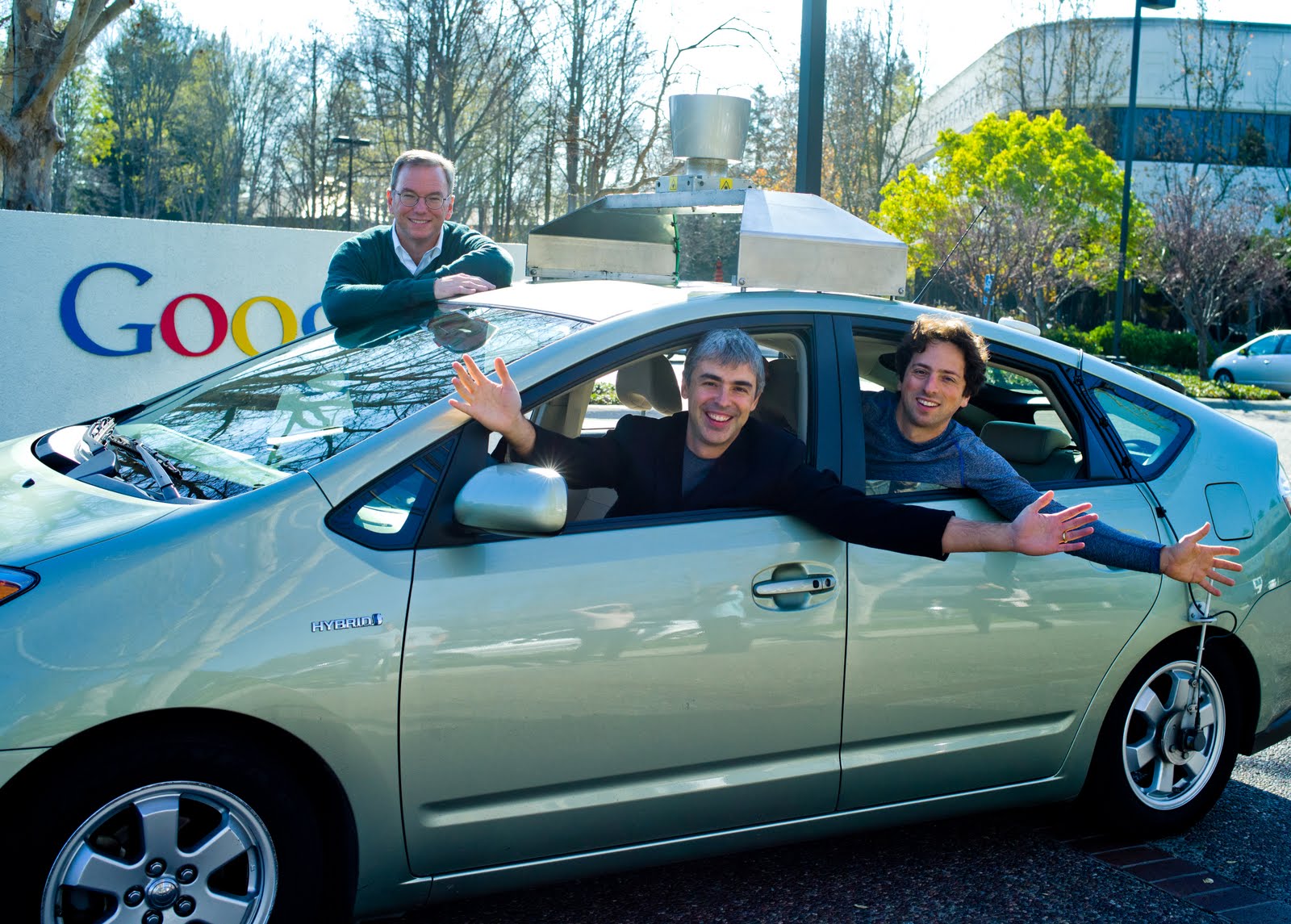
Despite the cordial collaborative tone of the blog post, it seems the picture, taken today, tells it's own story.
Forget for a moment who is who and just consider the picture.
There are two dudes in the 'self driving car', sitting in-sync with arms wide open. There is also another guy with crossed arms who is next to, but not in, the 'self driving car'.
Can you guess where Eric is in the picture?
Review the picture again and make your own conclusions..
After I posted this comment, the New Yorker came out with an article quoting an insider who agrees with me. It's a pretty straightforward thing... happens all the time.
He's not leaving Google, or at least there's no indication that's the case. They're just refocusing on their strengths. Also, why on Earth would Jobs want that? That'd be like grooming Gates to take over for him when Scully fired him.
Jobs will find a product guy to take over, and that's not Schmidt.
Schmidt was previously an Apple board member and had to resign due to conflict of interest but he is capable of restoring stockholder confidence once Steve Jobs steps down.
He would still have to resign from Google if he took the position (which his current statement doesn't support) but I don't expect an equally capable product guy to replace Steve. Schmidt could also help facilitate strategic relationships between the two companies again.
He's an interesting dark horse candidate, but I don't think they'd pick an outside candidate. Apple's like FC Barcelona--they're so successful doing it their way that it's better to promote from within than to teach an outsider how to do it their way.
Interesting speculation, though without basis in information gathered. There's no reason to downvote you though, it is a speculation. It would really be interesting to see Schmidt in that role.
Eric Schmidt has been CEO of google for ten years. In that time it's gone from (maybe) a $200 million company to a $200 billion company. I think any bad decisions he might have made along the way can be forgiven.
While true there might be a slight portion of outcome bias -- the tendency to judge a decision by its eventual outcome instead of based on the quality of the decision at the time it was made (source: List of cognitive biases, Wikipedia) -- involved in that analysis.
I don't know about bad business decisions, but he certainly had a bad year for putting his foot in his mouth.
And there's certainly no shortage of unpopular, not-classically-Google-like decisions (though thoroughly defensible business-wise) in the recent past: Buzz Privacy, StreetView WiFi debacle, Net Neutrality reversal, the WebM reversal, the Scan-First-Ask-Later library project and settlement process, etc.
If we put any weight into the rumors that the entire triumvirate didn't see eye to eye on all those things, mixed in with publicly-recognized conflicts (such as the way that Sergey clearly trusted Schmidt on the China deal, which backfired spectacularly) I think you can make a pretty good argument for "Schmidt Messed Up".
"the Scan-First-Ask-Later library project and settlement process" that move was pure genius in my book. Evil genius maybe but asking for permission in these type of things leads to stalemate. Google to a huge risk but a calculated one. I think it's defensible more than just business-wise. At the end of the day, publishers have always tried to put sticks in the wheels of anything new in the book world. Google's move is good for man kind in a way and I think it was also helpful to groups like the Internet Archive.
Leading a decade of mediocre home-grown products (save for Gmail)?
EDIT: Name one hit Google product Schmidt oversaw (again, save for Gmail) that wasn't an acquisition. This is supposed to be a company of innovation.
EDIT 2: I regret the use of mediocre. I'm sure the technology, like everything that comes out of Google, was top notch. Certain products though, like Buzz, Wave, and TV, and the bizarrely bifurcated-from-Android Chrome OS, lacked a degree of oversight and discipline before launch that ended up hurting their brand in the space of consumer products. I also think something to consider is that this culture of acquisition has to be very bad for their employee turnover rate.
Being able to execute upon acquisitions and bring them to Google-scale is nothing to scoff at. Example, Android. Despite the Gruber's of the world thinking it is an iPhone rip off, Google made the acquisition (of a very small company--the Android we know today was quite simply built by Google) in 2005.
Update: Also, thought of a few... Translate, Chrome, Talk, and Reader. I'm sure there are more, definitely if you include ones based on acquisitions (Analytics, Earth, Apps, etc).
And WebKit is based on KHTML. I fail to see your point, Chrome is most certainly not an Apple product or an acquisition. It's a hit product that Google made and is not Gmail.
Yeah I think you're grossly underestimating the success of Android, and confusing the genius of the two separate operating systems with bifurcation. Android was a BRILLIANTLY timed play that stopped an Apple monopoly in modern smartphones in its tracks. Just think for a second what the current mobile landscape would look like had android not come out exactly within the quarter that it did.
While we have yet to see the effects of ChromeOS, its release will no doubt be massively disruptive, and the ability to recognize the different functionality both operating systems serve and launch both consecutively despite the fact that it looks like a very odd play to the naive masses, takes balls and isn't something I would say ANY other company even a twentieth the size of Google would attempt, and I predict this will pay off in the end.
I also disagree that Wave, TV and Buzz lacked discipline and oversight. Not everything a company can do is going to be a revolutionary success. A lot of times markets just need to be probed or explored, and if there's a hit great but if not there's no huge loss of resources and returns will still be made in some form or another (eg. wave code being reused in Docs or buzz maybe showing up as part of another social product in the future). For Google TV in particular, it really hasn't been outperformed significantly by competitors, and really the world just isn't ready for that type of media. But when it is Google will be there.
I mean, I don't know Shcmidt's exact role in all these products but sometimes I think people are too quick to dismiss the Google products that don't live up to the expectations of Gmail, Maps, etc, when really they are minuscule investments by the company among many others, and even if one in ten is the next Gmail then that's a damn solid business model.
It would have been very easy for Google to cave to criticism about Chrome OS and Android. Instead, they're letting things play out. Having used both, I think it's going to turn out to be a pretty smart bet. At the very least, you have to applaud that they're willing to take risks like this.
The executive chairman is not part of the corporate leadership. In the United States, the CEO is the singular head of the corporate, accountable to only the majority vote of the board. The Executive Chairman position is quite often, a polite way of keeping someone associated with a company (and all the travel, influence perks) without putting them in the management chain. Quite often seen during (friendly) mergers and takeovers.
Nobody is confused as to what the responsibilities, and authority Larry and Eric will have after April 4th.
EDIT, Context being tech: Hastings, Ellison, Bezos, Zuckerberg, Jobs, Gates. I'd say Google was a company in the spirit of these before WorldCom, Enron and Countrywide Financial.
Bravo on conjuring a list of relevant counterexamples. Surely boards on product companies will look to the Enron scandal when assessing whether a founder has the competence or vision to lead a company.
They are criminally liable to do the due diligence assessments to make sure the books aren't being cooked, so yes I would hope at minimum the board is actively trying to prevent an Enron.
No, what was pertinent to the discussion was whether vision outweighs direct experience in this industry, which is not entirely obvious. I would say that vision is a trait that is generalizable to technology startup founders. Your counterexamples reference accounting fraud, the proclivity of which is not tied or correlated in a significant way to being a founder. A valid counterexample would reference the need for experience trumping vision in a startup founder's performance as CEO.
You took what I said out of context and used cases of criminal accounting fraud as counterexamples. That's totally missing my point, which was pointing to character traits that founders have that outsiders with more traditional experience lack. The discussion of experience versus vision in tech leadership is critically important and worth exploring in a deep way.
You weren't pointing to traits specific to founders when you replied. You took a very broad interpretation of what I was saying and provided a counter to that broad interpretation. There's nothing particularly insightful or relevant in doing that.
My guess is this is aimed at stopping Google from hemorrhaging engineers in Facebook's general direction. "Look, we've got a programmer in charge again!"
He doesn't come across to me that way, but I see what you're getting at. He's not overtly charismatic or a gifted orator, but he has so much substance that he can demand the patience and consideration of his listeners - and I think this gives him important leverage in conversations with financial analysts on earnings calls, and suchlike. In recent years the concept of leadership seems to have become constricted into a narrow spectrum with motivational speakers at one end and General Patton at the other.
Good link in other respects too: an insightful look into his priorities, motivations, and thinking patterns. The insight and ideas that he inherited from his father are particularly interesting, and worthwhile. While visions of a better world over the long term have to be tempered by present promises to shareholders, I think it's important to be able to articulate the purpose and goals of a firm beyond simply maximizing quarterly growth.
On a related note, here's a 2001 Charlie Rose interview where Larry Page & Sergey Brin discuss what it's like to run a search engine that handles 100m queries per day, and more importantly why they had just brought Eric Schmidt on board. http://www.charlierose.com/view/content/3017
I guess Google is going to be more focused on PR (and lobbying) and will be way more aggressive than ever before - in simple lingo , they wont take anymore bullshit (from all sort of heavy weight and nasty competitors) and even more than that they will stop them even before they think to do anything against google ...
Don't be Evil to Customers and Shareholders !!!
But be as Evil as possible if (and Only if) someone tries to screw you !!!
i would appreciate courtesy if you explain your reasoning for downvoting me .... Eric Schmidt now a dedicated resource, he will be strong force for external PR also he will see that no one gets Evil to Google and their vision (which is not to be evil to other) provided everyone plays a fair game ...
I've always wondered when a change in the "triumvirate" would happen and what impact it would have on public perception of Google, but somehow I also imagined it would be one of the co-founders leaving the company first.
Sometimes people switch out from being CEO to being chairman because it's just more fun being the globe-trotting-jet-setting-lunching-with-Obama guy schmoozing and closing deals and partnerships than being the tedious micromanager.
Just saying.
But it's also fun to fantasize, speculate, and gossip about really rich and important people.
Eric is still around and filling an important role (basically doing what he used to mostly do, he just doesn't have to sit in on earnings calls anymore):
Eric Schmidt will assume the role of Executive Chairman, focusing externally on deals, partnerships, customers and broader business relationships, government outreach and technology thought leadership--all of which are increasingly important given Google's global reach. Internally, he will continue to act as an advisor to Larry and Sergey.
"... Eric is still around and filling an important role ..."
I think this could be a bigger adjustment than you think. Google under Schmidt has not gained ground on social search and in effect dropped the ball. An important lesson running a product on the open Internet. Google with the massive financial and technical lead can loose ground and revenue to competitors.
then why is he selling stock today then? please upvote me with the same aggressiveness you downvoted me with. thanks. He may not be going to Oracle "today", but in the next year you will see.
Larry becoming CEO sounds like the same path that Bill Gates had.
Found a company and become it's CEO.
When it's time for the company to "grow up", bring in a well respected CEO who can structure the company for growth and stability while teaching the young founder.
When the founder has learned the ropes he takes over again as CEO.
Gates was CEO from the beginning of Microsoft until he became Chief Software Architect prior to his retirement. Ballmer became CEO after Gates. There was never a gap between founding and CSA where someone else was CEO of MS.
For most of us, yes. If Google wants to do an April fools joke on April 4th, all they need to do is edit the index so that the top result returned for "April fools date" claims that April fools' day is April 4th.
They do have a tradition of making hard-to-believe announcements on April 1. Like the ridiculous announcement that they were starting a free email service that would give everybody a 1 GB storage quota.


Larry has been the most involved in the technology details, Sergey has been the most involved in the blue-sky new projects, and Eric has been the most involved in the interaction between Google and other entities (as well as very high level direction.)