Social media's ills, rising wealth and income inequality, rising sea levels, mass extinction event, crumbling roads, shit wages, corruption in government and industry, governments overwhelmingly filled with representatives of other generations with different priorities...there is a huge list of reasons to be pessimistic and they are constantly thrown in our faces online.
Police state and mass surveillance are top of my list. Higher than global warming, higher than wealth inequality, higher than incompetent and corrupt governments.
Why? Concretely, how do you see the police state and mass surveillance impacting your life in a way that is more profound than the effects of global warming etc?
It’s really hard to take that seriously. If social media is causing you heartburn then back away from it or delete your accounts. I deleted my Facebook account nearly a decade ago and deleted my Reddit account last year. Nobody is forcing you to be a drug addict slave of online media.
Some of your list looks like entitled anxiety desperately in search of sympathy. For example you mention rising sea levels. Do you own ocean front property or did you just list that for some abstract reason? In most countries corruption is at record low levels. Wages are also at record high levels.
>For example you mention rising sea levels. Do you own ocean front property or did you just list that for some abstract reason?
I agree that we need balance in everything, but it's not too far fetched to think climate change will lead to mass refugee movements and result in a pretty turbulent world.
I agree with the general sentiment of getting off social media, but I really doubt that wages (adjusted mind you) are at record high levels.
As for the rising sea level, thus far not mentioned in this whole branch of the comment tree is the fact that it's going to cost us all money. There have been billions of dollars deployed/invested in port infrastructure. It wouldn't even have to end up being submerged, to become unusable by some number/type of ships. That in turn either requires modifying/rebuilding/relocating (costs money), or reducing/rerouting/cutting off flows of goods (raises prices, costs money).
Not that that's a reason to get particularly depressed; the alienation is mostly what's doing that. But the economic precarity doesn't help matters.
I completely agree, but my decisions on the subject would vary in proximity to the immediate distress of the subject and would in no way feature social media.
So much the better. You know the more I think about this, social media might be largely responsible both for the alienation that I mentioned, and for exaggerating the seeming proximity and urgency of every crisis (not just the big ones we should care about, but also the little ones that probably have no real effect on us other than as spectators).
Both of those (social isolation and a steady stream of bad news imbued with a desperate urgency and importance) would tend to discourage and depress normal human beings!
I find it sad that things like rising sea levels and mass extinction do not worry you. Should someone only care about things that affect their own personal life? Rising sea levels are going to affect a large amount of people negatively, and mass extinction means we are losing a lot of biodiversity that we needn't be. Your viewpoint seems to lack empathy for other people and other species.
Before you question a person’s empathy, honestly, what are you doing about those subjects yourself specifically? A key difference between empathy and sympathy, in all common definitions, is objectivity. Sitting around feeling sad on social media is sympathetic, not empathetic.
> Do you own ocean front property or did you just list that for some abstract reason?
For one thing, "rising sea levels" is often used as a symbol, representing all the varied consequences of global warming, the most depressing of which may be global ecological turmoil, so you might consider taking it less literally.
For another, rising see levels are going to wipe some island countries off the map and displace a quarter of the Bangladeshi population, among other things. It doesn't seem unreasonable to be dismayed by the social unrest that will surely accompany those events.
> For one thing, "rising sea levels" is often used as a symbol, representing all the varied consequences of global warming, the most depressing of which may be global ecological turmoil, so you might consider taking it less literally.
Fascinating. It's good to see someone like you admit the lying.
Or maybe you slipped and let your guard down. This is probably a relatively safe place to do so. Average people don't read HN, so they'll never find out.
The problem with lying is that there are only two explanations: either your claims can't withstand honest scrutiny, or everyone's too stupid to understand the truth, so you have to fool them. History is littered with atrocities committed by those who believed the latter.
Lying to get into office and pursuing legislation that is supported only by moneyed special interests are probably both corrupt things a politician can do, and they certainly erode trust in the government. But the don't get tallied up in the same way quid-pro-quo bribes do.
In many places and times, governments have been pervasively corrupt, so that for example, in practice you will never get a drivers license or a building permit unless you first bribe the inspector or officer who needs to award the permit. This type of corruption is on the decline in almost every country. To my (limited) knowledge it has been relatively rare in the USA throughout its history.
Not everybody is that self-aware, I would argue that the majority isn't.
You have to look at it from a statistical angle. What percentage of population is capable of not falling prey to sophisticated machine learning algorithms which optimize for engagement rather than the user's well-being?
You are still commenting here for some reason. Does this bring any value to your life?
And it's terrifying (or should be) to even those who are only self interested. Displacement of millions means mass migration and destabilization of larger parts of the world. The climate change and warming that cause it mean crop failures, novel diseases, and weather changes that will have the potential of affecting everyone.
Yes, that is bad. How bad though? To be both objective and realistic you would need to break that down as a cost increase, per capita, in portion to percentage increase of annual cost of living. There are real numbers to these things, and I suspect they are large, but I really don’t know. Objectively speaking until such numbers are simulated we are all just making things up and that is most depressing of all.
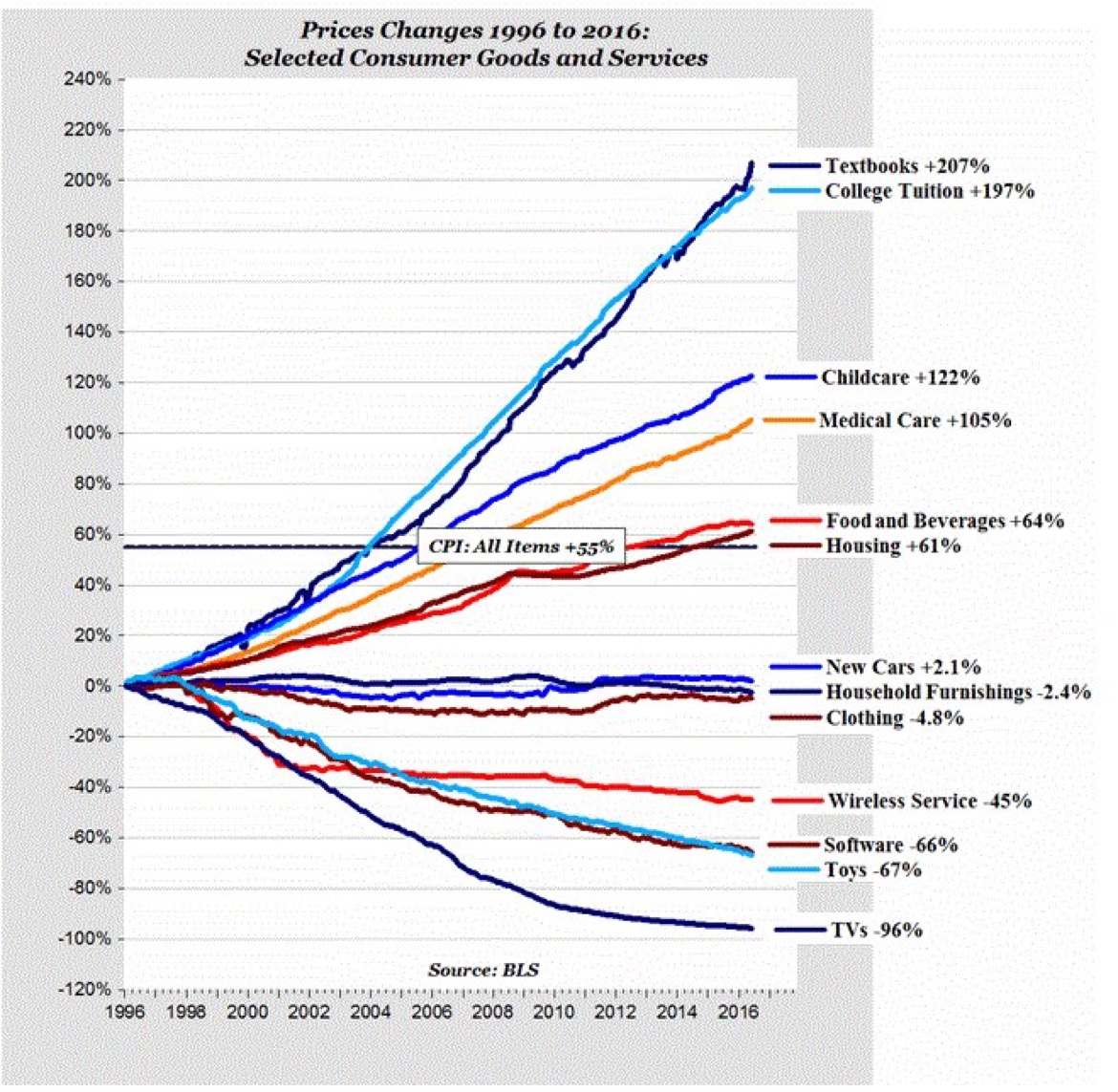
I think the fundamental component is house prices. Our ancestors had much cheaper housing as a multiple of the median wage, and could mostly afford to buy based on the paid labor of the father alone.
Those same ancestors are still sticking around, living in those houses, and demanding tribute in the form of medicare and welfare payments (2/3rds of the federal budget).
I'm only saying this to spark and extend discussion: but a society in which Euthanasia is mandatory at age 80, with housing and monetary resources freed up for younger generations, is likely to be a happier and better place to live.
Alternatively we greatly limit immigration (including cross-border) - to only the most skilled and intelligent immigrants - and we create some kind of huge carrot/stick to get older people out of big houses and into smaller, managed apartments. A comprehensive land value tax, with discounts for families with children under 16, could solve this.
Why do the young generation have any more a right to these houses than those that have worked all their life to afford one? ( coming from a young person )
Don't think it's any kind of "right". All I will say is that we've paid high interest student loans for over 8 years now and equivalent to the cost of small home. We also both worked jobs in college.
Constantly hitting records for economic highs. Lowest unemployment rate for blacks and Hispanics in the history of recorded unemployment rates. Rising wages. Just took a huge step in eradicating HIV in the US by securing free treatment for 200k poor people every year. Between the technological advances in solar/wind/batter, renewed interest in nuclear, and shrinking CO2 it seems climate change is well on its way to being solved. Significant prison reform which should be great for young people, especially minorities. Marijuana is well on its way to becoming legal. Gay marriage was recently made legal across the nation.
I'm on the older end of the Millennial generation, and everywhere I look things are heading pretty rapidly in the right direction. Sure, millennials aren't the top political priority, but that age range isn't ever the top priority, so it can't be the cause of this wide spread pessimism.
I mostly agree with you about social media, but I would add news and how news interacts with social media. Once the news figured out how to get the most views by really ramping up the hate/anger/fear, and were able to track that to the extreme, it really destroyed the way people get information. Every day is just more rage-bait fueled by this news/social media cohort.
> it seems climate change is well on its way to being solved
This is laughable untrue.
EMISSIONS may have peaked (I'm not certain that's the case long-term), there's still plenty of carbon in the atmosphere and continuing to be added. The effects of carbon emissions will continue to compound on themselves[0]. We are still well on our way to >2 degree global warming where island nations will be eaten up by the sea, we will struggle to produce food for the population. Much of earth will become unlivable[1].
The effects of carbon emissions on global climate are not linear. They're exponential. Once the changes start they are impossible to stop.
If you think we've got climate change figured out, I really encourage you to read into the subject a little more. It's incredibly serious. We have already started seeing the effects. It's not too late to do something about it, but sitting back and assuming someone else has it figured out it fantastically irresponsible right now.
The world is building and deploying solar panels at break-neck speeds. Electric cars and other pollution reduction measures are coming online.
I'm well aware of the risks from existing coal burning plants, new plants being built in China/India/etc, shipping, feedback loops with stored CO2 in the ocean, all of it.
It's nice to imagine that the world can turn on a dime, but it can't. The global "situation" is going to get worse before it gets better, but the proverbial ball is rolling in the right direction.
> The world is building and deploying solar panels at break-neck speeds.
It doesn't matter how many solar panels are deployed[1] What matters is how many gasoline cars, coal plants, and gas plants are going dark.
Net-over-net, they aren't.
[1] And this decade of break-neck speeds got us to... 2% solar deployment. We may hit 5% in another decade - and we need to get emissions to net zero in six years, if we want to avoid catastrophe.
Some amount of catastrophe is baked in. Coal is bad, but there's a lot of places in the world where coal + global warming is better than no coal without global warming. And some of those simultaneously have precarious economic situations and nuclear weapons. We're only going to nudge them so hard. Honestly, I'm impressed with how well it's going. I suppose we have a different perspective on what we think is actually achievable from a geopolitical standpoint.
> Between the technological advances in solar/wind/batter, renewed interest in nuclear, and shrinking CO2 it seems climate change is well on its way to being solved
Do you realize that the most optimistic projections in climate change papers already assume massive improvements in these technologies? They also assume massive carbon extraction technologies working at global scale that don't exist yet. Even these optimistic scenarios have dire consequences, and we're not on track to hitting these at all.
If it were a matter of "small improvements in over time", the tech would be sufficient, but it's more like we need to reduce double digit % of CO2 emissions year over year for the next several decades. https://twitter.com/robbie_andrew/status/1129667484527804418
Some countries do have declining CO2 emissions, but the ones that matter: China, India do not. Unless dramatic action is taken, we're still a long ways away from a global peak in CO2 emissions.
I saw some of the most recent projections for global GDP impacts due to climate change and it was a fraction of US GDP. That's unfortunate, but much better than I thought. We will make it.
US CO2 emissions peaked in around 2007. Per capita CO2 in the US is the lowest it's been in 50 years. We're behind the EU in CO2 reduction, but it is going down.
India and China are worrisome, but China is making solar panels as fast is it possibly can. Political priority of millennials was mentioned in this context too. I haven't seen it, is there wide-spread support among Millennials for the trade war with China or other aggressive measures which will move manufacturing to countries with better CO2 regulations?
> I saw some of the most recent projections for global GDP impacts due to climate change and it was a fraction of US GDP. That's unfortunate, but much better than I thought. We will make it.
Read the assumptions behind those projections and get back to me. They are very, very conservative and should be read as a "best case scenario".
Ex:
- Economic growth is assumed as part of the model
- They look at the marginal economic cost of an additional very hot day today, look at the projected increase, and assume that the impact will scale linearly
Even those numbers are damning, and are put forth to help justify the cost of climate action. Reading them as "well that's not that bad" is just way off the mark.
> US CO2 emissions peaked in around 2007. Per capita CO2 in the US is the lowest it's been in 50 years. We're behind the EU in CO2 reduction, but it is going down.
Not nearly fast enough. Direction is correct, but magnitude is not nearly as big as it needs to be. Assuming that technological progress will make up the difference is magical thinking that the data does not back up.
Only about 15% of Americans participate in the stock market, most of the rest of the world doesn't even have the access. The best investment opportunities are being reserved for the elites. 2009 housing crisis resulted in a massive wealth transfer to the people who happened to be in position to take advantage of it. Capital gains are the primary cause of inequality.
Technically unemployment is low, but the share of involuntary part-time work has been steadily climbing. Young people are working these low paying dead end jobs just to survive.
> 57% of Americans cannot afford a $500 surprise expense.
This is mostly a self-inflicted problem. A little discipline and saving straightens this out in short order, if people can accept a little inconvenience to live within their means. But people have a shockingly poor understanding of personal economics.
We didn't choose to be undisciplined and financially illiterate. That came of ignorant or negligent parenting, among other things. (And they didn't choose, for the most part, to be bad parents. It's just that no one taught them to be suitably conscientious parents).
Expecting people to be critical thinking and deliberate in the way they conduct their lives, without first conditioning them to be so, has always been and will continue to be unrealistic.
I just object to the implicit "so it's not really a problem" or "so nothing need be done" that come along with "This is a self inflicted problem".
I don't care who's fault it is. This is a real problem for countless children who are worse off because their parents squander their income and it's a real problem for me because my government has to allocate its attention and resources toward an electorate in need of financial assistance.
I don't know if the solution is personal finance classes in high school, or internment camps for people with credit card debt. But I'm pretty sure the laissez faire attitude is not in the best interest of anyone.
I agree that it's a problem for more people than those directly impacted (I wouldn't say no one benefits though, some companies are benefiting from reckless spending).
I think the problem is one of culture. The 20th century was basically a gigantic advertisement for hedonistic individualism. It's not surprising that that mode of living is turning out to be unsustainable for everyone to participate in. By holding people responsible, you put some pressure on to create an alternative archetype to that of the "sex, drugs and rock 'n roll" 20th century heroes.
I think we have a long way to go though. Just yesterday there was a piece on HN about Millennials and Gen Z becoming more pessimistic. It stated that their number one priority was travel. Maybe the post-Gen Z generation will prioritize savings and more stoic living after they watch the aftermath of the previous two generations focusing on hedonistic spending.
Things are only getting better for those blatantly out of touch with the reality of lower classes. Wages are not rising when you factor in Inflation[1], for some portions of the country even going down in buying power since the early 70's. Nearly half of Americans are poor or low income [2].
I would note that over the past year though, that wages have been ticking up for the poorer groups at a solid pace (~4%) and inflation has remained low.
That buying power you're talking about in the 70s is largely the buying power of white men. Women largely weren't allowed to have real jobs. Minorities either. What do you think that chart looks like when you include their buying power in the 70s? We've also pulled over a billion people out of abject poverty and food scarcity since then. Out of touch with the lower classes indeed.
"Climate change, protecting the environment and natural disasters topped the list of most respondents on a personal level, but less than three in ten of both the Millennial and Gen Z cohorts cited it as a worry."
This is surprising. As a Gen Z-er this highlights the kind of bubble I find myself in- my friend group is almost universally in a state of despair about the collapsing biosphere. Climate change and mass extinction are the chief reasons I am pessimistic about my life.
Climate change and mass extinction are the chief reasons I am pessimistic about my life.
Can you name another time in recent history where the end of the world wasn't near? WW1, Great Depression, WW2, Mutually Assured Destruction, Swine flu, AIDS, Cuban missile crisis, etc, etc.
The correct answer is it's always been this way and what we're going through right now isn't really all that new.
As a millennial, at least one thing that is different is that we all grew up in that brief period when the world wasn't ending. We grew up in the 90s and early noughts, when ya, there were problems, but they all seemed containable. It seemed like the adults generally knew what they were doing, and could be counted on the to the right thing.
I'd also argue (with no real basis of course) that the type of dread that climate change and mass extinction invokes is possibly of a different kind than most of the crises that you listed.
It's honestly not that there are issues, as you have mentioned, there have always been. In fact we're a lot better off on almost all fronts than hundreds of years ago.
It's that we aren't making any progress, and generally are moving the wrong way.
There will never be a lack of issues to tackle. It's "how" we tackle them that defines our era. And as far as I've seen, we do a lot more arguing and debating about what we're talking about than we do fixing problems in the real world, myself included.
All of this pales in comparison to the coming devastation of climate change and the global pollution crisis, which actually should be included in that 90's list as well - and the 80's, and 70's...
I remember talking to my fundamentalist Christian friend in high school who literally said his last goodbyes to his friends. The next time I saw him was awkward.
> We were on the brink of environmental collapse as CFCs were destroying the ozone layer
I'd probably be ridiculed by most of the younger crowd here for my views on global warming, I mean climate change, but as someone who distinctly remembers the nonstop warnings of the Ozone Layer - we're all gonna die - I just don't put much energy into worrying about the latest issues related to the environment.
Part of me knows that I'm probably underestimating the actual problem, but I've been hearing warnings for years that never amounted to anything.
I wonder if this is why the boomers, who were literally practicing nuclear bomb safety in school (much like school shootings now) and have had another few decades of dire warnings that never materialized, are even more unlikely to care about the environment or much else about which the younger generations are so fearful.
Listening to the cultural zeitgeist is one thing, but actually listening to the scientists who are doing these studies or people who are summarizing their findings is another. I really recommend reading through the NCA summary https://nca2018.globalchange.gov/ and sitting with the data and what it says.
The short answer is that you are vastly underestimating the problem
You need to look at what was done in response to those warnings before you can say whether they were wrong — otherwise you’re like the people who say Y2K was a waste of money because they didn’t see the bugs which were fixed.
In the case of CFCs, we know that a global response largely solved the problem. In the case of global warming, where a trillion dollar industry has been pumping out spin since they first realized global warming was really happening in the 1970s, we have not see the same response and we’re right on the trajectory predicted by reports in the 1990s — only now it’ll be much harder to do anything:
The nonstop warnings of the Ozone layer were probably among the reasons for the quite decisive switch away from CFCs, preventing the problem from getting truly bad. It's an interesting balance: you need to push it through to people that something needs to be taken care of, it's mostly successful and everyone is annoyed that it wasn't so bad after all, why the panic? (I wonder if Y2K is a good IT equivalent: Not much happened, because people were worried before and stuff got fixed, but the worry jumped over into mainstream not seeing that distinction)
When all you've heard for the past 40 years is the end of the world is around the corner, and that doesn't turn out to be true, you start to tune it out.
Yup, I’m over 40 and there’s definitely a “Boy who cried wolf” effect in play here. I’m tired of having to be constantly outraged about the latest environment disaster that’s sure to kill us all this time!
Except that unlike in the story, there really were wolves, and we managed to take them down.
CFCs and the ozone layer are a good example: there was a wolf, there was decisive action because people listened to the warnings, and we managed to beat the wolf.
Carbon emissions are an entirely different scale of problem though because so much of our economies is built on them.
I try to remind myself of that, but most of those had a simple solution of "don't do that thing". Don’t go to war, don't nuke each other, etc. I admit that that's a vast oversimplification of the forces at work during those crises, but the point is that they were in some way imminently stoppable. Climate change isn't like that. Even if we stop the causative behaviors in full today, which we won't come close to doing, the results will continue, have major consequences, be difficult to cope with, and be very difficult to reverse.
> Can you name another time in recent history where the end of the world wasn't near? WW1, Great Depression, WW2, Mutually Assured Destruction, Swine flu, AIDS, Cuban missile crisis, etc, etc.
The key difference is that, with the possible exception of MAD and the Cold War, during all of those crises people were in near-universal agreement that there was a crisis, and were actively working to fix it. Climate change is a unique problem in that a depressingly large percentage of the population believes it is a myth, that there is nothing wrong and no need to do anything.
That's where the despair is coming from. If everyone understood the seriousness of the problem and was determined to fix it, I have no doubt we could do it. We've solved bigger problems in the past. But right now we're not even trying. Even the progress that has been made has mostly been an accidental byproduct of market forces like renewables getting cheaper; the actual amount of deliberate effort to fix climate change is close to zero and seems likely to remain that way.
during all of those crises people were in near-universal agreement that there was a crisis, and were actively working to fix it
I don't think that's accurate. Take AIDS for example, there were plenty of arguments over the right approach, with very little consensus. Even with WW2, there were plenty who said "America needs to stay out of this war" and "We shouldn't have used atomic weapons".
So we should be approaching climate change with the attention and resources that we threw at the great depression, ww2, and the cold war - right?
But we aren't, not even close
I agree there have always/frequently been dire challenges facing us, but that is no logical foundation for arguing "it worked out ok before, it'll work out OK this time"
I don’t think it is fair to compare climate change to those previous issues and conflicts you mentioned.
The fact that our society is dependent on destroying the environment and all of the related politics is a much more difficult set problems to solve than a overblown disease scare, war, or geopolitical struggle.
I doubt many in America thought either world war was the end of the world.
But the difference is that all of those required affirmative action to cause a global catastrophe, someone had to reach out and press a metaphorical button. With global warming the status quo will get us all killed.
Global warming is not lethal in itself. The biggest threat in it is destabilisation of societies and resulting wars - but for a war to start, somebody has to press that metaphorical button. It is not inevitable.
I was reading Ben Franklin's autobiography and he noted that he had a neighbor who always thought the world was going to end and was paying rent about 4x of what he would have spent if he had bought his home when Ben first came across him and his end of the world views. The neighbor didn't believe in investing because it was the end, but now can't afford to own because he didn't believe in the future. Moral of the story is that if you focus on the bad future, and don't try to invest for yourself, your going to be in a bad spot. But the future comes whether you like it or not, spend time minding your own business and make plans to improve your future. Sure the climate is going to get bad, but if you don't prepare yourself, it will hurt even more. People have been living in deserts for generations, we can survive and we will. Be mindful of your impact and reduce it, but don't fret the future, it comes regardless of your view.
Especially in this forum, the people here can have an impact and digitize the world, reduce paper use, reduce carbon use, invent ways to be more efficient. The sooner software eats the world the better off the world will be, help it along.
Bunch of nonsense. None of the examples you cited from other times had any remote comparison to the literal collapse of the global ecosystem. What do you get out of arguing that the level if crisis we're in is not so severe that humans civilization is going to collapse and that there's nothing we can do about it? At least with MAD, the most severe of your comparisons, there's an implicit reason why no one fired nuclear weapons. There is no recourse for what is happening on Earth right now. I'm actually kind of disgusted by your comment.
Not that surprising. People tend to focus on their own personal/economic issuea rather than larger problems in the world as a whole. If you're struggling to pay rent, find a good job, keep up with others, get political representation etc, then stuff like global warming won't really register by comparison.
On the other hand, I suspect those with decent living conditions are probably more panicked about stuff like climate change. Feels you can focus more on big picture issues if your immediate lifestyle is going somewhat to plan.
Another possibility: it's more comforting to funnel the anxiety you feel about your immediate lifestyle into something so huge no one person can change it.
In elementary (late 80's) were constantly propagandized that the whales were going to be extinct, the ozone layer was going to be gone, and killer bees were going to get us all.
Not a peep of optimism that we could solve problems. It was presented as inevitable.
There are strong forces that need people to be in a constant state of worry. Power is derived from it.
The panic about the ozone layer was the correct response. It lead to the Montreal protocol which banned CFCs. Quote from a NASA page[1] about what would have happened without that CFC ban:
> By 2040, the ozone hole is global. The UV index in mid-latitude cities reaches 15 around noon on a clear summer day (10 is considered extreme today).
The ozone hole actually existed and was solved by legislation. If people weren't panicking about it I don't think that would of happened. I'm not sure why you are calling it propaganda.
We're now living in a widely recognised mass extinction event, and many species of whales have gone extinct, or are highly endangered. I don't think we solved that one...
> There are strong forces that need people to be in a constant state of worry. Power is derived from it.
Who is "deriving power" from sounding the climate change alarm? The people with the most power (the wealthy) seem to be trying to silence/defund/disempower the entire scientific community over it.
Would those problems have been solvable if the general attitude was an optimistic view of "don't worry, someone will solve it"?
Humans tend not to solve difficult problems unless they are a crisis. Convincing them a problem is actually a crisis is usually the first step in solving it.
The first two were legitimate issues that were solved through international policy (international whaling restrictions and CFC restrictions, respectively). People were right to make a big deal about them, because unmitigated they would have had quite bad consequences
Are you sure? Does the climate change affect your personal life more than inability to afford reasonable real estate or kid-related expenses off most today's salaries?
The severe consequences of business as usual emissions with no mitigation will easily be felt within the lifespan of even the oldest Millennials and probably a great deal of Gen X. Gen Z and Millennials' children are looking at inheriting a hellscape of famine, unprecedented extreme weather, and forced migrations to escape unlivable crumbling infrastructure that has never been maintained to standards from decades ago, let alone to a level that will withstand the new conditions.
Here's just one example of a single point of failure that could cause a global economic shock. There are certainly many more such shocks on the way: https://www.wunderground.com/cat6/If-Old-River-Control-Struc...
Some people are able to look past their own noses and think about other generations and what their descendents' lives might look like. That weighs heavily on some people
It shouldn't weigh so heavily that people give up on their future, never settle down, and never own a home. The article says these generations' primary aspiration was to travel. That is naive and wasteful. It isn't a choice between greed and saving the planet, it is a choice between making responsible financial decisions and having fun. You can make responsible financial decisions while making responsible environmental decisions.
If your housing market is that messed up, then your rental market is probably even worse. Not being wasteful just because it is easier than being responsible is the entire point of my original comment. Spending money on things you can "afford" that make you happy now instead of saving for things that you need and will give you a sustainable life is short sighted.
For me personally, it does. However, I am not a typical member of gen z due to my high salary. Most of my friends, who all make much less than me, are more worried about immediate needs but climate change is a dark cloud looming over their heads
I live in a low COL city, so most of my friends and myself are doing pretty well. Most of us, also including myself, are not planning on having children due to pessimism about the latter half of this century so child-rearing costs aren't really a concern.
I’ve been fortunate to have landed in a financial position where I’m not scraping by as a millennial but having worked for several years in SF tech one thing that I have felt increasing unease with is the feeling that the companies I’ve worked for might not actually be a net positive for the world. My problem is more existential than economic, which is very much a first world problem but a problem for me nonetheless.
Your feelings sound not unlike colleagues working in hedge funds who say it's hard to maintain motivation when your purpose at work is to optimize a percentage risk/return at the end of the quarter. Quarter after quarter. Year after year.
I think this correlates with the idea we expect to derive most of our "purpose" directly from our work [1]. Which certainly doesn't bode well when you are told to go to college for your "passion," find a job doing your "passion," and are now underemployed at a job that primarily just pays the bills.
I don't think that's too much to ask that you derive some pleasure from your work. It does take effort, and 8hr is 50% of your waking hours a given day, and if you work for a hedge chances are you are working till at least 6 and weekends during busy season if you are <5 years out of school. That really is a huge chunk of your life and if you think its bullshit, it can really way you down.
I was told to major in something marketable, and minor in my passion. It happened that my passion was marketable to some extent, and now I do derive a lot of my purpose from my work. I'm lucky that my job is "making the world a better place" but it isn't incorrect to have that outlook.
Same boat. I live in town that shows up in US News best places to live. I make bank doing interesting work. Got a wife and kids that are healthy and no real need for anything.
But....
Seeing the automation efforts we are doing in Retail and Transportation scares the shit out of me. Not that it'll occur but the pace that it'll occur. I really wonder if our economy will handle that many people suddenly being out of a job plus the inevitable concentration of wealth that it'll bring. Every month or so we are pushing a new project through the pipeline that'll have real world impact. Insanely fun to figure out the technical challenges but at what point does the long term social cost get factored into the short term economic gain?
Automating Inequality was a rough read because it paints a bleak picture. But seeing that there are others who are aware and working on this at least helped me to realize I wasn't alone with my concerns. Still unsure of how to actively help. Throwing money at EFF only gets so far at fixing things. Debating about taking a pay cut and finding a job more aligned with my principles. Had fun as a family working through a skill checklist for homesteading to help ground my kids in the non-tech world. (Bee hive was a resounding win. Kids were aghast at composting for the garden.)
So no real info to weigh in beyond you ain't alone in that worry or situation.
Our minds aren't really that special as engineers, we were typically shown a path to engineering from our parents or environment that lead us here. It was a real privilege to receive that pathway. That isn't so say there wasn't hard work, but the path provided ample motivation. Not so for many of our contemporaries who have the same very capable bundles of neurons in their brains but no pathway to elicit motivation to do the things we do.
There are dozens of homeless people who live in encampments right outside my window. I hate this place sometimes.
It's pretty humbling to be constantly reminded of how lucky your circumstances really are. I bet there's a couple of those homeless people who could have been in your very shoes had a coin flipped differently.
If you could sum it up into one short explanation as to why:
My wife and I don't believe that the future is going to be a better place.
Chief among the reasons are wealth inequality and buying power. If I can barely afford to buy a house now with a great job, I shudder to think what my kids would be faced with.
Just because now is better than in the past, doesn't mean now is worth bringing someone into the world.
That's just a logical argument, not whether or not you actually believe now is or isn't worth it. That's entirely subjective and not really worth arguing about IMO.
Not having children - and not curating a presumably well-mannered and intelligent next-generation - leaves our civilization worse off and large problems that much harder to solve.
Human intellect is rare, and partly hereditary. Please pass your genes along - at least offer a sperm or egg donation.
Some people take solace in the idea of childlessness.
I think that raising as many happy, healthy, intelligent and productive children as possible, with a suitable partner, is our very raison d'etre. Specifically for the high-IQ HN audience. Life and society becomes much simpler and more rewarding when you view things from this perspective.
Real estate prices are getting out of control in many of the US cities with healthy job markets, it's not just the Bay Area.
Home prices in my old neighborhood in Louisville, KY have skyrocketed in the last several years as "shotgun" style homes have become trendy in the area. Last time I visited, I saw a one such home on the market for about $350K, which would've gone for roughly a 3rd of that about 15 years ago.
The housing affordability is being felt in a lot of places, not just the west coast.
It's skyrocketing across the world. Sweden for example has seen levels of growth in real estate prices that rivals Hong Kong, the Bay Area or London.
There are many, many, many reasons why but I wouldn't expect the prices of homes across the world to drop when basically all interest rates have been at rock bottom for a decade. People with capital to leverage really have it made.
Well it is true. Thanks to the internet a company can be located anywhere on the planet. But this also means that companies can simply relocate to investors and locations with a high density of tech workers. Since those decision makers have more influence than the workers this leads to centralization of jobs in a handful of cities.
> Do you feel your buying power is less than that of your parents? Other than real-estate in a popular city, has your buying power really gone down?
What we're discovering is that this buying power isn't so important, affordable real-estate gives you stability and permanence that a 65" LCD TV and this years iPhone model just can't make up for.
To answer you're question, I'd say B whole be better in future, we're hitting limits on our ability to consume.
I feel environmental issues are bigger problem than wealth inequality at this point, though both are important and going to have disastrous consequences. I too am not for having kids, we aren't alone in thinking this way. Birth rates are falling in developed nations.
It is hard not to feel angry/pessimistic etc at the state of affairs. In a way, a lot of things have improved - crime rates are down compared to 50 years ago, medicine has made amazing strides, we can travel cheaply across the world, the internet has opened up a ton of opportunities etc. Still, more people are depressed/lonely, salaries are stagnating, there aren't many decent leaders (around the world) that we can look up to... If there is one thing that is guaranteed, it is that humans will mess up any good thing sooner or later :(
you decided not to have kids simply because you thought they would not be able to afford to buy a house on their own? Was that really the major reason?
I think a lot of this has to do with a shift of our worldviews from previous generations. People are growing more fearful, and have less trust in long term commitments like marriage working out and they view life decisions as more risky and not worth the effort versus the payoff. I don't share this view though.
There's more to what GP said. It took me a while to figure it out:
> life is pointless and meaningless without children, or as a fallback without taking care of others
This implies that the type of people who genuinely don't want to have kids, and don't have some circumstance in life holding them back from having kids, don't care about others. It's not the first time I've heard it, but I disagree with it. It's the yuppie stereotype. It's wrong because there are parents who don't care very much about others, and people who choose to not have children that care a great deal about others.
It is, however, not quite as wrong as saying that people who don't have kids don't GAF, full stop.
> This implies that the type of people who genuinely don't want to have kids (...) don't care about others
Not the slightest. It merely raises that those whose life doesn't revolve around putting a smile on someone else's face are living a rather unfulfilling life. Others here would usually, but not necessarily, be your children, family circles, etc.
It still blows me away how having a kid is used both as a "meaning of life" play and a "look at how much money I have" play (akin to humble bragging about a $70k BMW in the driveway). During my time living in Los Altos with three other Google engineers (in the same house) this was common place in our neighborhood.
I was (too subtly) making the point that perhaps it's the location and not kids-as-trophies per se. Possibly your experience in the 3rd richest zip code in the nation isn't generalizable to the rest of the world?
>Possibly your experience in the 3rd richest zip code in the nation isn't generalizable to the rest of the world?
Your experience anywhere in the US isn't generalizable to the rest of the world. Just like your experience in China or South Africa isn't generalizable to the rest of the world. Which is why the parent comment pointed out his location to give some context.
Making a post like that without mentioning the location is absurd and makes things more confusing for everyone.
> IMHO you've other reasons to work out, and the reasons you put forward are only an excuse.
Well, I've only put one reason forward. Of course there are more reasons but they all center on one core philosophy:
Having kids should never be about me. I shouldn't have children because I want to better my life for myself. Having kids should be viewed from the perspective of the child. Will they live a life so fruitful and free from suffering, that they themselves would choose to be born again if given the option?
Citation requested. I dont want kids because I am not convinced life will be that good for them. You dont get to question my reasoning for that. Instead, consider why rational, educated people might come to that point.
You forgot the second part of the sentence. As to data, there's plenty of evidence in the wild that caring for others and having quality relationships (with your children family, friends, whoever) have mental and physical health benefits.
Movie plots are not reality and don't make for compelling arguments.
As someone who plans to adopt kids rather than adding another human to an overcrowded planet, people who act like life is meaningless without reproducing strike me incredibly narrow-minded.
A third point as well -- humans are not manifest destiny. There is no imperative for our continued existence in this universe, so we have no obligation to reproduce -- any reason to reproduce you can think of is imagined by a brain evolved from millennia of creatures that decided to reproduce: selection bias.
I get that especially families in some regions having countless kids is probably not helping all of us. But not wanting kids to make the world a better place is having it backwards. We need to make the world a better place precisely for our kids.
Leaving a mark by keeping our evolutionary branch going (aka kids, their kids and so on) is pretty much the only task we got from life. Everything else we are, feel and have accomplished exists exclusively to achieve this goal and won't have mattered the day the last of whatever we consider "us" dies.
> life is pointless and meaningless without children
This view won't be well received on a forum with a lot of millennials and Gen-z, but as a millennial myself (late 30s, though) without kids, I would actually agree with you to an extent.
I've already lived and travelled the world. I've volunteered a bit. I've worked and saved money and can afford what I want. And none of these things really do matter the older I get. And I notice that amongst my friends, those with kids, seem to go through life with more of a purpose than us without any kids or even long term partners.
Life seems kind of pointless with or without kids to me, but I think that kids give individuals something to occupy their time, and without that time sink, life becomes boring.
Nonetheless - and this won't go over well - I would like kids and a family - but I've already seen several male friends and relatives utterly destroyed by the US family courts / divorce initiated by their wives, and I'd rather be bored but financially and emotionally 'safe' than completely ruined.
I didn't travel around the world yet but I've already saved some money and can live comfortably alone.
Having a kid seems like an economical suicide for me at the moment. However - I'm scared about what my life will look like when I'll be old and vulnerable.
A family help your social life and may allow you to feel safer when you'll start to have some illness.
My Utopian life goal would be to find a long term partner in my 30s and have a sudden death before I start to get mentally ill.
If I may nitpick, you cut the quoted sentence in half.
And to expand on what you've noticed yourself, as I wrote in a separate answer, there's plenty of data to support that caring for others is not only fulfilling but also gives health benefits to boot.
> Less than three in ten Millennials expect to stay at their current job for the next five years.
Well yeah. I can stick around my current company for 5 years and get a 2-4% increase each year, or job hop every 2-3 years and get a 20% raise each time.
With a market like this, why wouldn't you job hop? Loyalty to a company only inhibits you.
It's hard to job hop if you aren't already in an area with lots of hoppable jobs. That really only covers a handful of metros in the U.S., and if your school doesn't draw recruiters from these places it's all the more difficult to get your foot in the door when these companies have mountains of just as qualified local candidates they can pick through. Then if you do get all these interviews you have to not only take time off, but book travel, potentially burning airline tickets and hotel stays if it doesn't pan out. You almost need a buddy with a free couch if you are job hunting in NYC or LA. That's why I left the midbest as fast as I could, because I know how easily people get trapped out here with very limited prospects and mobility.
Pretty sure most well-paying jobs will pay for your airline tickets and hotels to interview. Not sure why you would take a job in a very high COL city that doesn't cover that type of thing, sounds like you're walking right into poverty
Not at all. If anything, a lot of tech companies have only upped the stakes since then. Every single one of my friends who just graduated college and was actively interviewing recently had not only flights/hotels/transportation taken care of, but also got some nice perks like first class tickets or airline lounge access at the airport. Most also reimburse for food and any other expenses while you are in the city, up to a certain limit per day, which is usually very generous (the most common one I heard was $75/day for food).
I don't know of a single dev in real life who had to fly out for an interview and had to pay for flights/hotel out of their own pocket.
For me no, I'm in my early-mid twenties (granted, I've worked at large tech companies) and every interview I've ever been on paid for all the travel related expenses
changing jobs has ~0 risk. i can (and have) spent time job hunting while fulfilling my responsibilities to my employer. then i use the offer as leverage to get a raise and switch jobs if my current employer declines.
What are your odds your current employer will offer you a raise in response to an external offer? I know it's only business -- but doesn't damage working relationship with your manager if you were to get an external offer, then take a pay raise, instead of leaving? It'd make you appear as a flight risk.
I got a good promotion after threatening to leave. Then 2 years later got a retention bonus and 12% raise, without asking.
They key is, you have to be willing to do it, and can only play that card once with your employer. I have been at the same place 23 years, and played that card at year 20.
communication is key. they should be aware of the market rate for their employees and adjust compensation accordingly, but i try to be very clear from the get go that i'm in it for the money and how i define my relationship with their organization. i also tend to decline non-monetary perks to drive it home that i am motivated primarily by compensation.
During the 2008 recession I've seen people who were with a company for 20 years get laid off. At the end of the day, most people are signing an "at-will" employment agreement. Which means the risk is the same weather you move frequently or stay in place for a long time.
I read the article you linked, other than the fact that the headline is a bit of a cliche "Millennials are killing X", it didn't seem like the article was anything other than reporting on how tastes are changing.
The article linked (not the Bloomberg one but the same piece) discussed on HN (too lazy to find the link) and your comment pretty much summarizes the comments.
Do as I did and fake yourself some references. It might not be ethical but the hiring system is broken and I prefer a warm meal and a roof over my head.
I would say just look for a job as a "programmer" then, but once you're hired, take every opportunity to a) learn and b) show off, skills in the other areas. Nobody really sticks strictly to their job description, do they? Maybe, but my idea is to be always stretching beyond it so they're eventually forced to update it, heh heh. Eventually you're "so good they can't ignore you" like Steve Martin said via Cal Newport.
Edit: And by the way, make it your business during the search and interview process to figure out which jobs explicitly offer that possibility. Because growing into other areas with the management's blessing is obviously better & less stressful than trying to do it on the sly or in your free time.
Good for building up social capital and references, but a losing economic move as organizations have neither obligation nor incentive to pay you for what you're actually doing, just for what they've hired you for.
Speaking strictly from experience. Doing five different people's jobs, for the paycheck of one has gotten me a fair number of friends, and the companies I've worked at tons of value, but the contacts and neuroses I've picked up for doing so are the only countable windfalls.
Economically, I'm not much further ahead at all. The whole "raise by being hired somewhere else" meme seems to be most true representation of achievable wage growth in today's information economy.
Personal time is valuable, and going "above and beyond" will more often result in lost time, no extra pay, and as you say, neuroses.
What a lot of people fail to understand is that established companies have no incentive to recognize people or reward efficiency. Once a company reaches a relatively low profitability threshold, efficiency is put on the backburner because effecting the existing patterns can cause a meltdown or make other employees obsolete. If you do extra work to make things more efficient or "better", that can be perceived as a threat to others in the organization because they'll feel inferior or maybe because what you are opportunity could lead to them being let go down the line.
Sometimes there's a good manager that will recognize and reward talent, but the vast majority of people want to show up to their boring job, push keys or pencils mindlessly, and then go home and watch Netflix at the end of the day. This includes people who are at the top. Trying to go above and beyond to impress people is, to them, a needless distraction and might actually lead to them having to do more work. Just advocating for an underling to get a meager salary increase can be a lot of work.
I've learned to only promise the work that is expected of me(i.e. what I'm getting paid for), and I've been a lot happier ever since. This doesn't mean I don't try to do a "good" job, but doing extra is asking for trouble and is an outdated means of getting promoted.
It's not necessarily about doing extra. It's about doing what you want to do, and in particular doing what you want your next job to be about. And it's not outdated; it still works; see my reply to the grandparent comment.
If it's anecdata we're looking for here, I'm about to be hired "whenever I'm ready" (i.e. whenever I get sick of being on vacation... probably another couple weeks) and get a $20K-$30K raise (still under negotiation), because of skills I accumulated at my last job that had nothing to do with my job description. And the contact I made who pushed for them to hire me (to in fact create a job posting based almost verbatim on my resume, so that they could hire me) is someone whom I went out of my way to help and impress at the last job.
The goal isn't necessarily to get a raise or promotion within the same company. And it doesn't even necessarily require you to work more than 40 hours. The idea is to do the things you want to do, which is for you and makes you "better"; and to prove yourself awesome at learning and doing, which makes you the object of somebody's desire, somewhere. It doesn't matter if they're within the same company (promotion scenario, which you are correct is less likely) or elsewhere.
Demanding that the world adjusts to suit me hasn't worked out as well, so it would be bad faith for me to promulgate that advice.
How much time did it take you to actually learn enough to become competent?
I've looked at the mathematics needed - after that it seems like figuring out the main 'ideas' and then just picking one of a dozen frameworks in which to become very familiar.
But unless I want to 'fake it until I make it', seems like it would take a good year or two, possibly with two semesters of grad school for both math and the machine learning, to really learn it as it wasn't something I learned at all undergrad or previous jobs.
Apply for a different job, growth marketing for example. They need a coder with an analytical mindset who wants to learn growth marketing, more than they need someone who has run ad campaigns before.
Or work in a smaller company where each person can take on a broader role.
At least with programming you can work on side projects that touch all of these other positions responsibilities. Your Github can become your proof of work, not a lot of fields have that beyond whatever a reference says.
I think happiness is very orthogonal to economic progress. It's a uniquely American myth to believe that GDP growth is a proxy for the happiness of a nation's people. (We export it all over the place).
Social systems which do not provide economic growth have been systematically destroyed over the past few generations. Workers have to be mobile to compete; public spaces have been eroded to favor the privately owned; placement into employment has shifted from personal connection to faceless, autonomous, nationwide filtering; geography of public spaces favors the individual over the group (again, to eliminate sharing of resources); media and culture is far more national or even global, rather than local; religion and all of its communal benefits (and downsides!) is waning...
Some of these systems benefit social cohesion and happiness a lot. Often at the expense of individual liberty, that's why it's easy for Americans to rationalize shedding them.
I don't think it's a grand conspiracy, but it seems obvious to me that this cultural shift is occurring because of the dominance of economic life over all other forms. Unfortunately, economic growth is power, and therefore once one party has it, everyone else must shift to compete. We are seeing this reorganization at every scale, from the individual, to the corporate, to the national, up to the global scale. It isn't even close to being over.
I think millenials/genZ realize that our culture is missing something, but they can't quite articulate what it is. This is because the entire discussion folds into this worldview. Look at how many of us are discussing the price of this or the price of that in this thread!
Could it also be that it just became less of a taboo topic to discuss in the west, hence why we see so much more of it? Also explains why we are trying to pin it on millenials/genZ, as younger people are typically the ones to experience a lot of anxiety and uncertainty about the future AND are the ones to typically care less about entrenched societal no-nos.
Anecdotal, but I have family that lives in Eastern Europe, and mental health/anxiety/etc. is still very much a "no-no shameful" topic to discuss or air your feelings about there.
Another anecdote: all the mental health initiatives promoted and advertised at work, nationwide mental health awareness month, etc.
I think beyond it being a taboo, it simply doesn’t enter consciousness in many non-western (or non-US?) countries — maybe kind of like how Asperger’s was discussed before it even had a name — it wasn’t, or that person was just a bit “different” in certain ways.
In my experience the economy (roughly 80%) and social ties (roughly 20%) seem to be the biggest factors. I work for a large tech company so a majority of the millennial I know are comparatively well off, but even among these folks there is constant pressure to rid themselves of massive student loans, many of my immigrant millennial friends feel trapped due to their visa status.
On the other hand, social ties among some millennial seems weaker than past generations -- a lot of us don't go to church, and spend way more time on social media than hanging out "in real life". For most people the negatives of social media vastly outweigh the positive.
Started chatting with a guy at the airport about work / careers. Within 5 minutes he started ripping on millennials and their work ethic. I am a millennial!
Sucks to be saddled with debt after college, have lower paying jobs, and still be shit on by the older generations. And I have things relatively good.
The work ethic problem seems to actually exist (from my limited but numerous experiences, including my own), however I am convinced that it is due to learned helplessness.
Just imagine hearing your entire life that the world is just about to end any minute now, the icebergs are melting, everything is polluted, everything is so very bad, financial depression, no jobs for you, etc etc.
Seems like these generations are under massive assault of negative information every second of their lives.
Is it any surprise suicide deaths are a leading cause of death for younger adults? Sort of difficult to have good work ethic with chronic depression.
The phrase "work ethic" pisses me off because it codes this idea that I should be a hard worker, which of course (because we live in the world we live in) refers to me busting my ass for somebody else's benefit.
Anyone who wants to criticize my work ethic can go and fuck themselves. I work incredibly hard, but at my job^[1] I do as little work as I can get away with (while retaining the standing I need to be comfortable) because they pay me as little as they can get away with. I don't see the problem.
^[1] Coveted tech job. It is a "great job" and in practical terms I feel lucky to have it. None of that changes the calculus of the business relationship that is employment.
I hate the work ethic mantra. It implies millennial just cluelessly stumbled into their jobs if they have them, or screwed up their life if they didn't.
Mr. Boomer didn't need 3 summer internships and a 3.80 gpa to get their job.
> I work incredibly hard, but at my job^[1] I do as little work as I can get away with (while retaining the standing I need to be comfortable) because they pay me as little as they can get away with. I don't see the problem.
A lot of people will see that as laziness, but businesses do that kind of cost-benefit adjustment all the time. If a business keeps paying a person who is working less, that's on them, not the employee.
I think a more reasonable attitude is that it’s usually possible to improve your material wealth with effort, and people can decide to make the trade-off if they think it’s worth it. This is not a value judgement.
Where "this" is the term "work ethic"? For you, maybe not, but for others it is certainly used to articulate a value judgment, hence my dislike of the term. I don't think it's precise or accurate enough to avoid being used in this negatively loaded way.
I agree that "it’s usually possible to improve your material wealth with effort, and people can decide to make the trade-off if they think it’s worth it." That is exactly the sort of trade-off I claim to be making, with the additional note that it's a continuum rather than an either/or choice.
Having seen boomers at work I think millennials are about par for the course. People in general are lazy and indolent, but I would say the latter is more true of old people who are set in their ways.
Who wants to slave away at a desk all day under fluorescent lights breathing stale air while you try to optimize some metrics that will probably get people addicted to some app or website or fool them for paying more for a product they don't really need, all the while the world outside is burning, the company you work for and the government is probably spying on whatever you're doing, people are morons, and it is unlikely to get any better.
This isn't "learned helplessness", people can find jobs, they just don't want jobs that make them want to off themselves. Maybe I'm projecting here, but every NEET I know thinks this way. People need work that firmly embeds them in the present, whether that be interacting with others (NOT in some formulaic way like taking orders at a Chipotle or working in customer service), working outside, working with their hands, etc.
As a millennial who's been saving about 80% of my take home income, I mostly believe the money problems our generation complains about (regardless of economic background, debt, etc.) is more linked to spending habits and a perception of what an "ideal" or "reasonable" lifestyle is.
For instance, I have a few friends who work at JPL outside of LA. They all make $110-120k TC and have ridiculous benefits (5% contrib to 401k even if you put nothing in and if you do contribute a 7% match) with 25 days vacation etc. They still complain that they "can't afford to buy a house" when they've put off saving after paying $20k for a "modest" wedding and spend $1600 on take out each month because they're "too busy".
I live within my means and still have a social life, but I'm still called cheap or questioned about "not really living" when I explain why I'm investing or saving money and not taking international vacations every 6mo.
What you're talking about is simply impossible unless you're already rich enough in the first place or are living with your parents for free. Even if I assume that I own my apartment, only pay for maintenance/heating/food, I don't own a car and I basically never leave the house and do nothing that costs money (e.g. only contribute to open source) I don't think I can go below 600€ per month of expenses. 5x is 3000€ per month add taxes on top and we are talking about a 65k€ per year job. Sure as a software developer it shouldn't be too difficult to reach this amount. But in reality frugal/poor people get by on 1000€ per month and therefore the amount of money they'd have to earn annually to save 80% of their take home is closer to 110k€ at which point money struggles might as well not exist unless you're living in really expensive parts of the country.
It’s not representative. Most millenials are sub 60k and have loads of debt. You have a very skewed view. Most people can’t save 80% of their income because their housing costs are at least 30%z
I also know millennials who live in NYC, have $180k+ student loan debt and continue to live as if they're making $100k a year (which doesn't go far in NYC) although they're un-employed or just doing sporadic temp work.
Also - you don't have any insight into my TC...
In your opinion - what constitutes "common place" both in terms of "expected lifestyle" and $$ situation (debts, money in the bank, etc)?
What about prior generations that had “duck and cover” exercises during school, as kids? I’m a millennial but never was exposed to this level of disaster planning as a kid, if duck and cover can be called that, more like preparation for dying.
> Just imagine hearing your entire life that the world is just about to end any minute now, the icebergs are melting, everything is polluted, everything is so very bad, financial depression, no jobs for you, etc etc.
The generations before you experienced this. We fully expected to be destroyed in nuclear holocaust at any moment. There were many nihilistic movements in part because lots of people actually believed humanity was near its end.
Millenial here, and I just don't understand why my generation is so pessimistic. Things are simply better than when we were children. Perhaps it's having immigrants for parents, but my life just seems great compared to my parents and my aunts and uncles.
> Millenial here, and I just don't understand why my generation is so pessimistic. Things are simply better than when we were children. Perhaps it's having immigrants for parents, but my life just seems great compared to my parents and my aunts and uncles.
Other countries (outside of NA and western EU) were in shambles until the soviet fell. There was a constant threat of proxy wars in third world countries, eastern EU etc.
Until 80s-90s, US was the champion of intellectualism, innovation, trade, commerce etc. The wealth of that is what "good ol' day" is about.
From 90s-2020, US became a society for the rich, ie. More debt, recessions, wars, higher inflation (that is not counted as inflation) etc.
So yes, if you are from one of the countries in shambles in the 90s, your life is immeasurably better. But for anyone who just believed blindly in American exceptionalism and enslaved everything with debt, are seeing their kids suffering today
Maybe it's just anecdotal, but I know too many people these days that are like this, very pessimistic nihilists who don't see that life is worth any effort or risk. I unfortunately have had friends whose general negative worldviews turned into clinical depression and suicidiality. It seems to me that worldview and mental health are related more than people like to admit.
The millennials in my social circle unanimously believe that they are far behind where their parents were in life at their age. In fact, that's exactly what I heard from my best friend a couple nights ago. Both of us make six figures, and all of my friends in my generation are well educated.
My parents were married in their 20s. I'm single and the majority of my friends are unmarried. In less than a couple years from now, I should own a single family home if I want to catch up to where my parents were. Myself and all my millennial friends rent apartments. (Ok, I know one millennial who has a house, but he lives in the middle of nowhere and he's a douchebag) Only one of my American friends is currently pregnant, and whilst more of the people I went to high school with when I lived in New Zealand have already had kids for years. None of my millennial friends are in leadership or management positions, or at least ones where they actually have any clout.
My dad got into the career he has today by hard work, but also from having opportunities being thrown at him left and right. When he was my age, his current field of work was still being pioneered, and the industry was taking anyone they could get. He happened to work in a slightly related field, his company opened up a new department, and they offered him an opportunity there. He was hardly qualified and had no formal training or college degree.
I know his industry intimately, and there's no chance in hell that his younger self would get his foot in the door today without extreme talent. To get in today, you need above-average talent, you have to attend school, and you need connections.
The same can be said for parents of many of my friends parents.
Keep in mind that the gap between wage growth and buying power was already in acceleration, but it seems like there were more opportunities for people to hit the ground running without too much personal overhead. Now there are Gen Xer and some Boomer bosses who expect younger people to hit the ground running in the same way that they did, yet hold those young people to a different set of standards because of market saturation.
I don't view life as some sort of race to the finish line, but I can see how most millennials are demoralized and even embittered that they seem to be struggling more for less than what their parents and their friend's parents got. The best thing that Gen Y and Gen X can do is experience ego death, realize that their parents lifestyles are flawed and come with other hidden prices, move out on their own if they haven't already, and learn to appreciate the relatively good cards that have been dealt to them.
And my life is dependent on exponential consumption and destruction, and I have no agency to stop that. Pretty glad I can order pizza with my watch though! Cavemen would be green with envy at that.
I don't know that the artificial monetary value of a watch has any bearing on the impact to the environment it cost to produce it. Or the pizza for that matter.
But benefiting me personally doesn't mean I would agree that it benefits or is a positive influence on the world. Coal power benefits me, but it is still negative on a larger scale.
If it is negative on a larger scale, it brings you negative consequences as well as benefits, and these consequences will influence demand. There is nothing magical about externalities; they are part of the market. Long-term consequences are routinely measured, priced and evaluated by markets.
This fails to address parent's view, and is untrue for plenty of people besides. It is not uncommon for humans to use something that turns out suboptimal in the long term.
I see this canned response all the time. But it's a gross oversimplification of the issue designed to keep the ignorant happy.
The cheap things from china, all your amazon crap, your iPhones and all the rest of the so called "nice things" of today's society are only gained through (near) slavery conditions elsewhere.
This delayed effect on how bad things are that is now reaching rich countries like the US, but it has been around on every other "developing" nation in the world for a long time.
I don't think we're talking about the local grocer. We're talking about multi-billion corps that can do anything. Banks that are literally "too big to fail". Industries that control entire sections of governments.
This is the endgame of capitalism and nobody ever wants to face. It's an unsustainable system that will likely end in a dystopian-like world with mega corporations controlling everything and everyone (even your salary through UBI). The theory that corporations get too big then break down resetting the cycle no longer applies because the technology evolved.
I mean, the sole purpose of a business is to generate profit.
It's not to improve human kind, to cure diseases, end the world hunger or make everyone's lives better. It was always, and always will be, in the name of profit. When we realize that profit is literally ripping people off from their work, maybe some might change their views.
Yes, this is Marxism. Marxism was tried quite a few times already, particularly in the USSR. I was born in the USSR and lived there until it collapsed, so I am pretty familiar with what Marxist socialism used to look like. Thank you, I prefer capitalism, which brings prosperity, innovation and peace to the world.
Massive amounts of innovation have coincided with the activities of despotism, and far more and far longer than the historical record provides for "capitalism."
No, this is not Marxism. I can't even claim to have ever read his books. It's the reality of what I see today. Note that I'm not saying in any way how we should solve these things. I'm neither smart enough to think of those solutions or naive to think they'll ever come to life. But it's undeniable that we live in a dire world and capitalism is one of the biggest forces behind it all.
Peace? Seriously? Of all the things you could cite from capitalism, you mention the one thing that never stopped happening. Perhaps war stopped nearby your home, but capitalism never brought peace to the world. On the contrary, it created many, many wars. As it's often said: war is profitable.
Innovation is a tricky one. I agree a lot has been brought because of the pursuit for profit, but I believe they are happy coincidences. Many of the worlds greatest brains are today trying to find out how to exploit people through ads.
Perhaps your personal experience makes capitalism the lesser evil compared to the soviet USSR, but I'd urge you to not fall into this false dicothomy. It's not a binary choice.
If you look at society now compared to society a few hundred years ago, or perhaps society in an authoritarian/communist country, then it's pretty clear that the effects of a capitalist society (at least in a democractic system) have been on the positive side. After all, we've got better products and services available now than ever before, better tech than ever before and a decent number of ways to go from dirt poor to millionaire as well.
Is it perfect? Hell no. Is it good for everyone? Unfortunately not.
But pretty much everything you depend on comes from a business of some type or another.
I think it boils down to "comparison being the thief of joy." Social media of all types are basically one giant comparison machine, and the people that are the most visible on social media are the richest/best looking/most successful etc.
I disagree 100%. It's easy to find a scapegoat but the reasons are complex, and from data we know that Millennials and Gen Z are having greater difficulty achieving basic levels of economic stability that were somewhat easier for previous generations. Students are graduating with increasing amounts of debt and entering a job market that can make it tough to pay rent if you don't have experience.
It's also easy to say things like "more people should go into STEM", which glosses over a couple parts of our reality--we do still need non-STEM employees, teachers, social workers, etc. even though they are not paid well, and even if you do graduate with STEM that doesn't mean you have skills that will land you a decent wage. Just to pick on an example, consider the choice between chemistry and chemical engineering. Both majors are STEM and seem quite similar, but chemical engineering is the one with good job prospects. Likewise, if you do something like mechanical engineering you might be expected to also do electrical and software, the employment prospects for non-generalist engineers is less than it once was.
It is honestly ludicrous to see the results of decades of economic warfare and the nonstop closing of proverbial doors of economic opportunity done by boomers and to a lesser extent gen X and then boil everything down to "Social media means more people compare their normal to everyone else's best."
It isn't that it's not true, it is! Social media sucks for mental health. It's just also true that there are many legitimate reasons to be upset. I say this as a 24 year old that has been very very lucky to have affluent parents and gone to a good university and gotten a good job. I make more money than I honestly think anyone needs at my current cost of living and yet despite this I have so many friends that are barely scraping by.
So sum the constant anxiety of basically no economic safety net, climate change (which is looking to be "how bad", not "if"), social media reminding you of these AND how much better your friends are doing.. Is it any wonder everybody feels like shit?
The issue with social media and mental health is that the topic is just being researched.
Millennials and Z's are the consumers in which that technology is being tested and we don't really know all the effects and damages that this new thing is causing on people. We sure know that it is pretty addictive and causes some damages to people who use social media mostly passive and binge on it.
Another damage that Social Media does is that now most peoples attention span is quite short, really short actually, and it doesn't help for the workflow. Add the depression(FOMO?) caused from the "comparison is the thief of joy" produced by Social Media and you have a really bad mix that will make you fill like shit on the regular basis.
I think it's a tricky one, because there are a couple of factors here.
It's not just one thing, but rather a ton of things - for example, there is social media which is a great way to see which of your 500 friends is currently on vacation right.this.second (and someone always is). While in some senses there's more opportunity than ever before for some groups (e.g. minorities / women) in the workplace, there's also more competition than ever before as more people go for these jobs.
Baby boomers and to a lesser extent, Gen X don't really understand that the economy is different for young people, in that everything that was cheap for them (housing, healthcare and education) is now grossly unaffordable, but the things that were the domain of the rich now cost next to nothing (international travel, cellphones, computers etc).
I make a lot of money (I'm 26) compared to most my age. But like most young people in San Francisco, I have a roommate. I couldn't buy a house on my own. But I could fly anywhere in the world with no worries. The housing situation will be fucked in California for the foreseeable future because politicians don't care about the poor and the vulnerable.
We look at business efficiency as a good thing (and it broadly is), but I think we don't fully account for the costs, in the inherent stress it places on us all. So we now all need a college degree to get an entry level job. That's led to a bifurcation of the economy, between those with a credential and those without.
The climate thing is tricky. I think we'll sort it out, but it is a big problem.
I'd like to know your travel agent. Or could it be that despite your very real housing woes, you're making a high salary (as you say) and don't realize that international travel is still well out of reach for most Americans?
> ... the choice between chemistry and chemical engineering. Both majors are STEM and seem quite similar, but chemical engineering is the one with good job prospects.
Anyone know why this is the case? I took chem 1 in college (in the lib arts school), and while it probably wasn't as difficult as most of my classes in the engineering school, it certainly wasn't as easy as, say, the few electives I had to take in sociology, psych, or English.
So why do chemical engineers seem to have it even better than CS or CE majors (in terms of salary and job prospects) while most lib arts chem majors are paid crap and require lots of grad school, even PHDs, to get even an entry level research or similar job in industry?
Millennials and Gen Z are having greater difficulty achieving basic levels of economic stability that were somewhat easier for previous generations
Easier than what? Their great grandparents who lived through the Great Depression? Their grandparents who lived through Stagflation of the 1970's? Or their parents who lived through the Great Recession?
Easier for members of Gen X and Baby Boomers (note that young people in the workforce during the Recession are generally classified as the older end of the Millenials).
From the Federal Reserve Board:
> Millennials are less well off than members of earlier generations when they were young, with lower earnings, fewer assets, and less wealth. For debt, millennials hold levels similar to those of Generation X and more than those of the baby boomers. Conditional on their age and other factors, millennials do not appear to have preferences for consumption that differ significantly from those of earlier generations.
Easier than Boomers and Generation X, to be clear. I'd be willing to listen to claims that Millennials / Gen Z are doing well if you have some numbers to back those claims, so please, do change my mind. I'm not really interested in lists of economic recessions that happen to have names, especially since the 2008 recession also affected Millennials.
"Keeping up with the Joneses" was an idea far before social media existed. As was worship of the wealthy and celebrities.
And the people "most visible" on social media are very specifically the people we choose to follow. Maybe we can ask why do people choose to follow so many of the "richest/best looking/most successful" people, but that's putting the cart before the horse. We could just as easily ask in the 1980's why people buy so many fashion magazines or watch Lifestyles of the Rich and Famous. This pattern of behavior transcends media formats.
I don't think it is all due to social media. America is very much seen as the 'Land of Opportunity' where people are lauded for 'pullng themselves up by their bootstraps'. Today's environment though makes that much more difficult for younger generations than it did for older ones.
Prior generations are quick to say I did it, why can't you when in reality millenials are in a completely different economic starting block in large part due to the policies and lifestyles of the boomers.
On top of the negativity being levelled at them, the simple act of trying to financially survive is exhausting.
The differences between the haves and have nots and the difficulty in becoming a 'have' without a firm economic base provided by your family is becoming greater all the time.
Or maybe just maybe the fact that I ended up having to play therapist for my sixth form and the fact that my generation is full of suicidal people willing to die for a revolution tomorrow if it came is a sign that there is something deeply wrong with our society.
>``Instead, travel and seeing the world was at the top of the list (57%) of aspirations,'' the report said.
>
>Only 52% of the Millennials surveyed responded that earning a high salary was a top priority while 56% of their Gen Z peers did so.
57% is the top of the list but only 56% of Gen Z want a high salary? Hmm...
Aside form nitpicks, the figure showing difference between China,India, and the West is stark. Evidence culture and social media and whatever are not the determining factor, economic growth is.
Gen X, having already been born at maximum pessimism, had no room for improvement.
I actually felt my needle jump off the pin for a moment on reading the headline, because it means that the Millennials aren't as stupid as the Boomers have been saying all along.
Now excuse me as I try and fail to revive the fashion and pop trends of the 1990s--a time when my purchasing power and disposable income was slightly higher than it is now, and I hadn't yet shot myself in the kneecap by having doomed Gen Z kids with another doomed Gen X.
Stirring up generational conflict is a distraction, and everyone that is alive today is responsible for what happens on this planet tomorrow... but in proportion to their wealth and influence. If you have been hoarding those for yourself, responsibility for the future is a bit more on you than on me.
I was born in 91 and am very happy with my life. Few things that differentiate me from my generational peers is I do not have any social media accounts outside of HN, I get all my news through podcasts of people who I trust to filter through the trash, and I am married with kids and a house.
I think the last I checked I make less than the average person of my generation so money isn't the reason I am happy. I believe that this social media phenomenon has done a great deal to steal people's joy, and society doesn't help things either.
I think having family goes a long way to contributing to my happiness. I don't worry about dating, I have next to no drama in my life from the dating game, I have three really good reasons to wake up everyday, and I have a few hobbies that keep me busy when I am not working.
Stop using social media, go out join in real life local community groups.
A side effect of automation and internet is increased individualism and more isolation from other people.
In the past you would go for example to a video store and watch movies with friends now you use streaming services like Netflix.
More common in previous generations you would call your friends now you text people which is less interaction.
Social media leads to a comparison effect. Ie you compare yourself to others more. Facebook is like sunshine village trying to portray perfect life moments except real life has many everyday dull moments.
A single mother working as a waitress at Denny's in the 1980's had more spending power than a college educated cubicle drone in 2019; Let's talk about how is social media's fault!
Twice in the last 20 years - more than any other time in US history combined - The Presidential election went to the candidate that LOST the popular vote; These generations just lack a proper understanding of civics!
A single mother working as a waitress at Denny's in the 1980's had more spending power than a college educated cubicle drone in 2019
Do you have any source to support this? Because real median personal[1] income went up almost 50% since then[2].
[1] — don't confuse it with real median household income, which didn't grow nearly as much, because of a significant rise in single-person households which pushes the median down a lot.
I'm not the OP, and they may be overstating statistics (happy to be shown otherwise). At the same time, wage stagnation is no myth:
"From 1973 to 2013, hourly compensation of a typical (production/nonsupervisory) worker rose just 9 percent while productivity increased 74 percent. This breakdown of pay growth has been especially evident in the last decade, affecting both college- and non-college-educated workers as well as blue- and white-collar workers. This means that workers have been producing far more than they receive in their paychecks and benefit packages from their employers."[0]
"The minimum wage peaked in inflation-adjusted value in 1968, when it was equal to $10.15 in 2018 dollars. [...] As of 2018, the federal minimum wage was worth 28.6 percent less than in 1968" [1]
"While the cost of a four-year degree exploded to $104,480 [from $52,892 adjusted for inflation], real median wages only went from $54,042 to $59,039 between 1989 and 2016." [2]
Heavy childcare costs [3]
"In U.S., wage growth is being wiped out entirely by inflation" [4]
The really weird thing about wage stagnation is that there are millions of jobs going unfilled, companies are so desperate for people that they can't find anyone and are just dumping cash into stock buybacks instead of raising wages.
Something is fundamentally broken in the labor market, it is not responding to supply & demand forces as it has in the past. I am not sure what terminology to use to describe what's going on now, but it's not a free labor market any more, it has been destroyed or transformed into some other construct.
They don't need people. They always complain about needing people because it's always in their interest to do so, but the fact that they don't just raise wages strongly suggests that they don't know how to profitably employ additional people and that "we need people" is just a bunch of hot air.
This dilemma, and many like it, vanish entirely if you stop paying attention to what people say and start paying attention to what they do.
Yes, if you need people, raise prices until you can afford the people that are available. The actual industries that do need people (like tech) have done that.
Right, in theory that's what we've always been told about how it works, but that is not what is actually happening. There has been almost zero correlation between unemployment and wage pressure for 20+ years now. In all industries, yes even tech.
It's just not working. Unless you're a director or exec, then your wages are skyrocketing. Everyone else is flat or declining.
Personally I think the issue is that there is still a lot of unemployment (see U6) that prevents classical wage inflation from happening. That, and people outside of highly skilled industries have basically no bargaining power these days + intense global competition in almost all industries
Actually I would argue companies just don't want to pay the wages that Americans would expect for the labor. Raise the pay, you'll see those positions get more qualified candidates and then they will be filled.
Anecdote...I had a random chat with a hiring manager and he commented he can't hire the right developers. Developers think too highly of themselves and ask for too much money...I had no sympathy for him.
I suspect the federal reserve plays a part in this too. They started targeting 2% inflation about the same time wages started to stagnate.
When the labor market starts to tighten, they consider it full employment.. and if it starts to increase wages, it counts against their inflation target... and to counter both points, they start taking actions to cool the market.
And the "full employment" isn't even really full employment.. since it doesn't include people who have excluded themselves from the labor market. A lot of those people have difficulty for one reason or another entering the market, but they will if employers are willing to train, pay more, etc... and employers will only do that in a tight labor market.
So it seems like when the labor market enters a period where it may address some real problems (wage stagnation, structural issues in the labor market, etc)... the fed jumps in to cool the market off.
To be clear, I think the inflation target is a good thing... but I think it's perhaps too broad of an indicator.. and maybe we need a more nuanced target.
Well, that could be because they're giving even the sandwich-making staff at fast-food joints noncompete agreements that stop them from switching to a better-paying employer, and union busting remains at historic levels.
Could be a signal of a strong disconnect between the people who are making the spending decisions and the people doing the hiring and managing. Departments are given a fixed budget or headcount based on historical precedent rather than current need.
It also could be perverse incentives. The people with their hands on the cash tap have more to gain from stock buybacks than they do by wage increases.
Let's say you have a company that makes smashed widgets. So you need to hire widget smashers, but all the good ones want to be paid $20 per widget that they smash. But consumers won't pay more than $5 per smashed widget, so there is no way you can charge enough to pay for that labor.
So yes, you can get the labor you need if you pay enough. But then you won't have a business, because business need to turn a profit (or at least break even).
Now I wonder if the current labor shortage actually resembles this scenario, or if the complaining that corporate execs do is more of an act in order to get cheaper labor when they can still turn a profit with more expensive labor?
>But consumers won't pay more than $5 per smashed widget, so there is no way you can charge enough to pay for that labor.
Yeah except the worker already gets paid $18 at his current company. Producing $5 worth of goods with $20 worth of labor is economically impossible. Someone has to eat that loss. Either it's the company, the customer or the worker and as far as we know the customer always picks the cheapest stuff regardless of how sustainable it is and the company will always yield to the customer. The worker will always receive the short end of the stick.
Ok lets assume the worker accepts the $5 job. Previously he could afford buying lunch for $18 but now he desperately needs super cheap $5 lunch because his job doesn't pay as well anymore. The restaurant cook can't be paid $18 per lunch anymore because the worker switched to fast food. The cook now has to work at a fast food place and only gets $5 too.
This scenario is called deflation. Prices go down and with them worker compensation starts shrinking and through lower compensation prices must go down too. It's a vicious cycle with awful consequences for workers. Meanwhile investors benefit because their investments appreciate without doing anything at all.
What if the opposite scenario happens? What if the worker wins and get his pay increase? Well exactly the opposite happens. The worker will spend the extra $2 per widget on better lunch. The cook will now receive $20 for his lunch and use it to buy more expensive widgets.
Obviously this is inflation. Some inflation is good. Excessive inflation is just as harmful as deflation.
So what we need is a healthy balance between inflation and deflation.
When you're in the stock market for the capital gains then you only need to hope for a quantitative easing windfall. The idea behind QE is to drive yields of the most popular investments down and therefore make other investments like small businesses more profitable which didn't really work out and is actually backfiring.
The productivity and wage decoupling is very hot debate topic in the economic circles. It's not very easy to sum it up, as there are many factors going in. For example, productivity is calculated based on real GDP, which uses GDP deflator, while deflator for real wages that is typically used is CPI. Just the fact that you're using two different deflators already makes a meaningful comparison harder.
Looking at minimum wage is not really relevant, as only around 2% of workers earn minimum wage.
The degree cost explosion is very unfortunate, not only because it is more expensive now, but also because much fewer people had (or even attempted to obtain) degrees, so not only it was much cheaper for them, but also they simply didn't need to get them as much as people need them now. The push for universal tertiary education has been very detrimental to our society, as people need to spend more, and the only result is degree inflation.
Only about 2% of workers may earn minimum wage, but the minimum wage serves as a kind of anchor that other very-low pay jobs base their pay on. Many major national fast food chains (for example) pay like $8/hr which isn't technically minimum wage but is essentially the same, because if the minimum wage were $5/hr these jobs would probably similarly pay $6/hr or therabouts
Scott Alexander has a good entry level write-up[1]. He is not an economists, he tries to understand the debate as a lay-person, so it doesn't cover it all, but should give you some taste of the complexity involved. For an actual economist, see e.g. Scott Sumner[2].
They claim "median personal income for ALL AGES us up 394.4% since 1977". However a quick check on FRED [0] tells me this figure is way off:
1977: $23,202
2016: $31,099 (2017 not available in the data)
~34% increase
They said they had sources but I only see sources for the price of bread claim. Maybe they aren't looking at real wages? In which case the claim is very misleading.
I also agree twitter's thread layout is hard to follow.
Yes, they aren't looking at real wages, that's the whole point of the comment: they are comparing the inflation of bread price with the nominal growth of median personal income.
For some simple examples, inflation-adjusted home prices have gone up by a factor of 6 and inflation-adjusted education prices have gone up by a factor of 3 over the past few generations [1], while inflation-adjusted average wages have only gone up by $2/hour [2]. That single mom would have had a dramatically easier time providing housing and education for kids even with lower purchasing power for most consumer goods.
Isn't it partly expected though? I never looked at the stats for single income vs dual income families over time, but my instinct tells me that single income was much more common in the 80s, and dual income is much more common today than it was back then. So even if single income had drastically gone up, they'd be "competing" with dual income families on a global level.
And sure enough, when you look at house prices in an area, they very much seem priced for dual incomes.
All anecdotal and unverified guesses, mind you. But even a highly paid software engineer in SF will have no hope of competing with a DINK family of equally paid software engineers, for example. And there's more and more of those. I assume the market's following.
Another thing to note: Real GDP per capita has basically doubled since 1980, but that increase in wealth isn't being seen by the average person, as your data shows.
You're not accounting for the higher interest rates of the 1980s.
Which home would you prefer to buy:
$150,000 at 15% over 30 years.
$350,000 at 4% over 30 years.
Hint: they both have approximately the same total loan cost and payment.
You can do this calculation with your parents. My home cost $350k at 3.8%. My parents bought my childhood home for $88k at 8%. Adjust my parents' home price for inflation and run the result through a mortgage payment calculator. You find that I paid slightly more for my home but my home is much nicer (central heat and air, closer to town, larger, better schools, etc).
My parents' home happens to be for sale currently (not by them). If I paid full asking I would pay MORE in raw dollars but LESS in inflation-adjusted-total-loan-cost (which is what actually matters).
The hitch in this whole thing is that down payments have gotten ridiculous, it's gotten harder to save in desirable areas because rents and many expenses have grown out of pace with income for normal folks. Even as the percentage necessary for down payments has dropped, house prices have gone into orbit so much that it hasn't kept parity.
My girlfriend and I had to buy a house for $520k, at 5% down, just for the privilege of dumping $100K into it to make it livable. And we are the fortunate ones who can do that; we're both 31 and I'd say maybe a quarter of my friends are in the same boat.
Where do you live, the Bay area? At what point do you say that enough is enough, and you move to a location that even though you'll earn less, the COL adjustment will more than make up for it?
I can't foresee ever leaving because of cost-of-living expenses. I'm not an import; I've lived in New England my entire life and the Greater Boston area--let's define it as "the Red and Orange Lines, and I guess the Green Line if I was desperate"--is effectively the only place I can be short of blowing off my family and my support network of friends and colleagues. The area is congruent with my politics--I mean that not just in the "who you vote for" sense of the word, but in the "how a society should operate" sense of it. And while I own one for errands I really profoundly don't like commuting and don't like driving a car much even outside of that, which rules out much of the surrounding area like New Hampshire or Maine, where I'm originally from. My parents live in northern Vermont. It's nice to visit, when I'm not white-knuckling across ice-floe roads in February. I couldn't live there.
We're thankful that we bought what will eventually, after a big up-front whack, be a really nice house. And we did it somewhere where it's still kinda doable, rather than when it's not doable at all.
I mean, that's fine and all, but you should probably just admit that you value the luxury of living in an extremely expensive area with lots of urban amenities. There's nothing wrong with it, but phrasing it like you simply can't live anywhere except these two particular metro lines comes off as really out of touch.
Urban liberals' lifestyle is a luxury consumption choice the same way that a Rolex or a Masarti is.
I mean, sure, I like those luxuries. I also get panic attacks when driving in stressful situations and more than moderate traffic. Not wanting to cause a crack-up rules out a commute into an urban area from an only marginally cheaper suburban area. (I've tried it before.) And fully-remote work is uncomfortable, socially isolating, and completely impossible for my girlfriend due to the urban-localized nature of her career, which makes living further out impractical.
I've tried living elsewhere; this wasn't my first choice and I'm very lucky to be able to afford it. Perhaps all this makes this urban liberal some kind of snowflake, but that's all right with me.
Somerville is already one of the most densely-populated places in the United States (16th most densely populated city in the nation as per the 2010 census--6th most that isn't part of the NYC metro area) and I'm enthusiastically in favor of that increasing with additional building. Keeping in mind that new construction necessarily overwhelmingly favors high-end construction I'm also in favor of increased proportions of affordable housing, as well as rent control ordinances to help keep people in their homes. And I say that as a soon-to-be rental property manager and owner, too; these are things that would be skin off my nose in the near future.
So that's a pretty weak strawman--and, tbh, I've seen your posts before, I thought about ignoring you because I get a troll whiff out of them. But I will also push on the real question behind it, because there is the germ of something useful there. I believe that a society should openly welcome people who are not members of the majority, should emphasize that its public administration be mindful that it operates for its constituents, and where, when citizens need help, they can get help. The place where I live is not perfect, but there is a drive to adhere to such principles.
It is not impossible to find that elsewhere. It is unlikely to be found elsewhere that also doesn't involve disconnecting from my personal social networks and also doesn't require a car to commute.
I'm not trying to argue, just trying to understand what you said.
> I believe that a society should openly welcome people who are not members of the majority, should emphasize that its public administration be mindful that it operates for its constituents, and where, when citizens need help, they can get help.
You honestly believe that other parts of the country do not believe that? I feel some travel would get rid of such notions, but oh well.
> --and, tbh, I've seen your posts before, I thought about ignoring you because I get a troll whiff out of them
Probably a good idea not to engage if you're uninterested in engagement.
> I'm not trying to argue, just trying to understand what you said.
Cool (and I say that without snark). For future reference, I might suggest "can you explain what you mean by this?". It sets a better tone than what you wrote, which reads as points-scoring caricature.
> You honestly believe that other parts of the country do not believe that? I feel some travel would get rid of such notions, but oh well.
Of course there are, and I travel extensively--travel and consulting used to be my job. There are not, however, ones that fit my idea of how people should live (which rules out otherwise lovely places like Richmond, VA), don't decouple me from my personal social connections (i.e., are in New England; as an example I really like Columbus, OH) and have sufficient mass transit to not park my rear end in a car every day (i.e., not the Amherst area of western Massachusetts or somewhere like Unity or Orono, Maine--both places that I love, but the car dependence sucks).
So if I had just asked 'can you explain what you mean' you would have given me an explanation about how you appreciate the way of life in Boston, etc. I was more interested in the fact that -- across the country -- places similar to Boston (i.e., large, rich cities) seem to all be having the very problem you are calling out (high home prices). I was interested in an explanation of how you thus justify liking the politics (which in my mind are intrinsically linked to the high home prices) while simultaneously decrying its effects. Without asking my direct question, I don't see how I could have mandated this level of introspection.
Your response now seems to indicate that the main reason you want to stay in Boston is your family, which I get wholeheartedly. But your claim was that you appreciated the politics, which doesn't make any sense to me still, because in my mind, the way of life you idealize (and I'll admit I like it too) sounds like it leads to expensive home prices.
I'll mention since I am in the same boat in a sense. The cost of a house even 40-70 miles out from Boston on effective commute routes is still hovering in 350k to 500k. A house without a likely 100k in repairs is 450k It feels like for the Boston area they are just toeing the FHA limit or blowing completely past it instead of some other pricing dynamic. I haven't checked the Bay Area's FHA limits but since the max is 750k for 2019 and I keep reading about million plus properties I think they are just in a different category of appreciated values.
Do you mean you spent $520k for a 5% down payment? Why should anybody feel sorry for someone who is buying a $10m house? Even for bay area standards that's on the very high end and not at all representative of any meaningful fraction of people in the US
If you bought a house for $150,000 at 15% in early 80's, you likely refinanced as the interest rate continuously dropped from there. In 90's interest rate was below 10%, and around 7% in early 00's. Nobody would keep the 15% over 30 years.
Yes but refinancing is not a silver bullet. After 10 years you would have only paid off $7k in principal. So you'd re-fi at 10% at $143k and refi at 7% at $130k. Twenty years worth of payments for only $20k in principal.
Your payments would total $375k over that period. $350k at 4% would total the same amount but with $200k in principal paid down.
I'd much rather be in a situation with $200k in equity versus $20k in equity. And remember, both people have the same monthly payment amount!
I once did the math. Refinancing from high interest to low interest or refinancing low interest to high interest will cost you the same amount in interest over 30 years assuming identical house prices. However during times of low interest house prices are higher than during times of high interest and this means if you get a mortgage with high interest you end up paying less overall for the house but a bigger portion of your payments are used to service interest.
Therefore the 15% house is the best deal.
>closer to town, larger, better schools,
You're shifting goal posts now. Buying a more expensive house doesn't get you any of that. Only buying more expensive land does.
The $150k loan at 15% is generally healthier, as you have increased ability to pay off the principle early by making more than the minimum payments during good times.
The larger principle is only a benefit if you will actually see that money by selling the home. Given that everybody needs a place to live, this will only occur if you sell and retire to a low resource area. Everybody else can only look at the illiquid funny money and pretend.
Never mind that the larger valuation provides a juicier target for eg real estate taxes.
a more accurate measure of housing costs is not "home prices" but "rent prices", and rents have gone up compared with inflation, causing housing to be absolutely more expensive. The generational warfare double whammy here is that the boomers are scooping up an insane unearned amount of value in both real estate appreciation and imputed rents.
I just posted similarly about down payments, but 20% seems to not generally be the case anymore. FHA loans are as low as 3.5%. I paid 5% down for a non-FHA loan.
PMI is then a thing, of course, but you can get in the door.
(This is not to say that down payments, as well as initial habilitability outlay, might not crushing. Our small, train-accessible single-family in the Boston area cost half a million dollars and we had to immediately gut the place for remodeling and for asbestos remediation, to the tune of $100K.)
Not many first time home buyers do a standard mortgage now. Typically 3-5% is all that is needed.
That and the lowest home mortgages rates anyone alive has seen have contributed to the home price increase. It's not the total value of the house but the amount of the monthly payment that is the driver, and 3% (today) vs 13% (early 80s) mortgage rates provide a huge swing.
If the number of people that can afford to put down 20% has shrank significantly over time, won't the pool that can put 3-5% inevitably shrink as well? Will we return to 0-down homes? Where are down payments terminally headed?
Down payments are the monkey wrench here. The requirement to have a down payment means high prices basically lock people out of homeownership, period. That in turn limits ability to build wealth at all, even at a crappy interest rate.
The main way that owning a home allows someone to build wealth is that it forces them to put money towards something productive rather than blowing it on stupid things.
My experience from buying a house two years ago is that though I suspected it, I never truly realized how many amenities were covered by my rent. I went from paying $30/month in utilities, etc. to ~$400 /month. I also now live 10 miles further away from where I work / hang out.
Granted, we live in a house that is ~2x as big as our apartment, plus two car garage. But if you factored out strictly the various recurring expenses I now pay from my previous rent, it is extremely close to breaking even. And that isn't including the increased cost of owning / operating two cars that now drive ~60 more miles a day between the two of them.
Our net worth increased much faster while we were renting than now that we have a house.
If a cubicle drone is making twice as much money in adjusted terms but has to pay three or four times as much for housing, they could well be coming out behind in the equation.
One thing that I find amazing about Americans is that most of them don't understand inflation at all. It's uncommon to see any mainstream source talk about inflation-adjusted values when referring to past numbers. This becomes clear when for instance box office numbers become a conversation topic -- nobody really stops to consider how comparing films from 20 years ago with films of today is just really a measure of how money loses its value and therefore movies make more money than before
price per sq ft is probably going down as home sizes go up, largely due to location. Most new homes are built where land is available, further out from city centers, and therefore have a lower price per square foot despite being larger.
Yes, but it's always been true. The houses in 1930s, 1950s, and 1990s were also built where land was available, further out from city centers, so this hasn't changed, and doesn't explain why price/sq ft is going down.
Yeah, this is what I'm not getting. It seems like the houses that are like the houses we grew up in, or our parents grew up in cost the same. However, people want more.
The reality is that people simply can (or think that they can) afford more these days on the one hand, and the actual building costs are lower on the other due to cheaper material and more effective techniques.
High-demand areas aren't (generally) high demand because of intrinsic qualities. They are in demand because of the people and social structures that are already there. It is not inherently the case that there is a fixed amount of high-demand areas, that is just how we are set up politically at this point in time.
Best I could find... apologies for any mistakes below.
Purchasing power in the U.S. has stayed roughly the same since 1964. [0]
The median annual income for single women with children in the U.S. in 1985 was $16,431 [1]. Couldn't find information on just waiters/waitresses. I believe these are 1985 dollars? If so, that income is nearly $40,000 in 2018 dollars.
The median annual income for waiters/waitresses in the U.S. in 2018 was $21,780. [2]
I recommend using FRED data, they aggregate many data sources nicely. For example, you can see that median usual weekly earnings of women went up about 50% since 1980s[1].
My understanding is that real median income is influenced by the sheer total number of hours worked. Real median income can increase by virtue of more people working more often while their wages stay the same.
If you let sensationalized news stories dominate your worldview, you will give in to apathy. If your strongest moral convictions are about events you cannot influence, redirect those convictions to something that is inside your locus of control.
What I urge people is: be conscientious in your day-to-day tasks. If you can see your efforts contributing to people's happiness, the apathy will disappear. Society is built of individuals; if these bricks do not care for the health of the structure, it will sag or collapse.
Sometimes it's hard for apathy to completely disappear when you're one emergency away from financial ruin. A 2nd year teacher in the US doesn't make that much, but the amount of youth lives impacted can be a huge net positive. It's hard to not be cynical know how much of your personal time and money you put in while receiving peanuts in return.
This "losing the popular vote" narrative would be a lot more compelling (at least to me) if the elections were less close. It looks bad to win the Presidency and lose the popular vote, but I don't think it actually matters. In a nation of 300 something million, close enough to half want either candidate. The problems lie elsewhere. (The fact that I can say "either candidate" is part of it.)
[Edit: I should have said "Close to half the voters in a nation of 300 million want either candidate."]
First-past-the-post voting makes "either candidate" inevitable. The only real way to fix it is to switch to instant runoff voting, proportional voting with parliamentary coalitions, or other systems that represent voter desires in a proportional or ranked way.
> In a nation of 300 something million, close enough to half want either candidate.
Neither of the major candidates ever has support from anything close to half of the 300-something-million population; of the total 324.5 million population, the 2016 election was like 20.03% to 19.26%.
Even of the eligible-to-vote population, the vote for the two major party candidates was about 26.84% to 25.68%.
Which underlines the parent post's point. Those margins are so slim as to not matter. We're talking about the entire election hanging on the difference of one moderate sized city's population.
1. 300 million people are not registered voters. ~50-60 million are.
2. First Past The Post means people are voting for the candidate they hate the least, not the candidate they prefer.
3. The election wasn't very close. 2 million votes more for 1 of the candidates in 2016.
4. The electoral college "matters" in that without it, the Iraq war wouldn't have happened, nor Trump. Saying it's the people's fault is unfounded when the people did not vote for these things.
> 1. 300 million people are not registered voters. ~50-60 million are.
Each candidate of two in 2016 USA presidential elections got approximately as many votes. So total number of voted - not registered to vote - is twice as much.
    Donald J. Trump      Republican       62,980,160
    Hillary R. Clinton   Democratic       65,845,063
    Gary Johnson         Libertarian       4,488,931
    Jill Stein           Green             1,457,050
    Evan McMullin        Independent         728,830
2000 popular vote, President:
    George W. Bush       Republican       50,456,002
    Al Gore              Democratic       50,999,897
    Ralph Nader          Green             2,882,955
    Patrick J. Buchanan  Reform              448,895
    Harry Browne         Libertarian         384,431
    Howard Phillips      Constitution         98,020
If the US had either a popular vote system or a ranked vote system state by state, the outcome would have been different. Nader had more votes in Florida than the difference between Bush and Gore.
Devil's advocate (I'm not even American): would the parties' results have been the opposite and the same people that support popular vote would still insist on it?
Or with different words: if you were living in a state with low density, would you still think that strict popular vote is fair?
There have been 4 or 5 (one is a bit ambiguous) elections where the winner lost the popular vote. [0] So no, this isn't more than any other time in US history combined. But more importantly, who cares? They lost the popular vote in an election in which the popular vote didn't count for anything. If the popular vote had counted for something in these elections, you would have gotten a different result. The candidates would have campaigned differently, and people would have voted differently. Just look at the difference in turnout between swing-states and safely red or blue states [1]. We wouldn't see this disparity if the popular vote counted for something. Complaining that the winning candidate lost the popular vote is like complaining that the team that won the superbowl had a lower free throw shooting percentage.
I don't think he was complaining about the election as much as he was saying that the election system which selected the minority over the majority is just one reason people are becoming increasingly pessimistic.
Why? The candidates optimize to win the electoral college, not the popular vote. You have no idea what the results would have been if the goal was to win the popular vote.
I agree. Complaining about the popular vote in presidential elections is like complaining that the NBA Finals were won by the team that won the most games, but had a lower total score across those games. Winning 2 games by 5 points each, is better than winning a single game by 30 points. So, winning more states even by close margins, is better than running up the score in a few states.
This post is a fantastic example of what the actual problem is. Neither of the points made are factually accurate, but boy is the poster angry about it. "Let's talk about how is social media's fault", indeed. Moral outrage, mostly fabricated, pedaled by every media outlet, spreading like wildfire. It's everywhere, and it seems like almost everyone, myself included, falls for it to some degree.
It's the same housing stock for the most part as the 1980s. There are teensy tiny bungalos that leak water built well before the 1980s in Los Angeles right now that are asking for nearly a million dollars. In fact, you will have a hard time finding any home in LA that hasn't gone up in price given an arbitrary 10 year period, while wages have been stagnant for the most part. It's a recipe for disaster when shelter becomes an investment opportunity rather than a basic human need.
> It's a recipe for disaster when shelter becomes an investment opportunity rather than a basic human need.
Why would this being an 'investment' interfere with its pricing anymore than if everyone had lived in these homes as shelter? You don't magically have the privilege of selling 'investments' for more than you bought it. Not trying to be facetious... just genuinely curious? If people are willing to pay that price, then that is the price it would have been, whether or not it was bought for investment or living, right?
Afaik, new constructions have to comply with more regulation (noise insulation, materials, environment protection etc) than before, which makes them more expensive. At least where I live.
That is not unambiguously a good thing. That's a bad thing. Think about it.
Housing is considered a good investment because it consistently has gone up in cost faster than the rest of the economy.
As this continues housing becomes more expensive relative to median purchasing power.
Unless housing becomes a bad investment, it will by definition continue to be something that a smaller percentage of people can afford over time.
We would be better off if housing became a consumption good/commodity that by default stayed roughly the same price in real dollars forever, since that's the only way housing can stay accessible to average people indefinitely.
> Twice in the last 20 years - more than any other time in US history combined - The Presidential election went to the candidate that LOST the popular vote; These generations just lack a proper understanding of civics!
An untrue claim[0] that's been copy-pasted for a while. It has happened twice recently and three times before that, stop making it sound like it's unprecedented. None happened in the 1900s, so it's very rare (well, an 11% occurrence rate now) but not more than in the rest of history.
Sure, that point of OP's post was pedantically incorrect ... but I think the overarching point they were trying to make is that the republicans haven't had a candidate elected by the popular vote since 1989 when GHWB was elected. Since then, both elections in which a republican president won the office, was while losing the popular vote ... that's THIRTY YEARS since the last true win.
Looked at from that perspective, yeah that feels pretty depressing that it keeps happening.
It's not pedantically incorrect, it's simply incorrect as well as partially misleading. It's an 11% occurrence rate now in a system that was designed to have this kind of feature.
Invoking goalposts in the context of this discussion seems overly combative.
The article deals in pessimism/optimism which is a matter of perception. If one perceives that George W. Bush's success in 2004 was precipitated by extenuating circumstances like 9/11 or the invasion of Iraq, or if they perceive Bush's re-election as an extension of a presidency that never should have been, I would argue that still matters in terms of their outlook. I don't sense that the fact that Bush won the popular vote in 2004 will elevate or depress anyone's perception of the political climate of that decade or right now.
But he'd never have been in a position for re-election had he not won in 2000 first. That's not to say it'd have been impossible for him to run and win in 2004 otherwise, but who can really say.
That's exactly how it was intended. This is a democratic republic. Both sides knew the rules of the 2016 election. Hillary knew the goal was the electoral college but she failed to campaign in the battleground mid west states. This is like complaining that the soccer team with the most possession or shots on target still lost the game.
Just because it's "the rules" doesn't mean its something people have to just sit down and accept. Every constitutional amendment has redefined "the rules", and drawing a bunch of lines on a map and ignoring a vote delta of 3 million people is in my opinion, a rule that is directly counter to a democracy, and should be criticized and amended.
Especially when the maps were drawn centuries ago and haven't been updated since. A person in Wyoming's vote is 4x more powerful than someone in California based on how many electoral votes that state gets.
The argument about losing the popular vote is flawed. Gaining the majority’s support does not decide the result of the election, and hence the candidates’ campains just don’t hold it as a goal. It is not impossible that, if the rules were changed, Trump (for example) would still win, as his campain would now aim at gaining majority.
I'm not sure that working as a waitress at Denny's would be good example, but most of the jobs in 1980s required much more thinking and decision-making from the employees due to fewer automation and much less centralization. That, in turn, gave more bargaining power that translated into more purchasing power.
A college-educated cubicle drone could be replaced with another one in a matter of days without any negative business impact at all, so why would the business pay them more?
>> "Twice in the last 20 years - more than any other time in US history combined - The Presidential election went to the candidate that LOST the popular vote"
There aren't a lot of data points--less than 100--for this, so it might not be statistically significant. Both those presidents are awful, but that could be an anomaly once seen in the context of a more significant sample.
It could also be that candidates are getting better and better at playing the system. Why aim for the popular vote when it's the electoral vote that counts?
If the popular vote would count the candidates would change their campaign strategies.
As your last paragraph shows, the Electoral College does not ensure minority representation of the states (or ”tyranny of the majority of states”) because if enough people moved to Texas it would decide everything.
As is right now, about 22% of the population controls half the EC votes. And the senate already ensure representation of all states, so pwople in smaller states have many times more power than fellow citizens in larger states in all parts of the government except the House.
I'm referring to the executive branch. Less populated state representation in one branch does not negate the need for it in the others. The founders (wisely imo) left national proportional representation to a single entity, the purse-string holders in the House.
Removing the electoral college removes the incentive for a presidential candidate to campaign to most of the states.
I've never understood this argument at all. What's so special about the states that there needs to be power rebalancing in order to prevent larger states from getting more influence? What's so special about Washington DC that it needs more EC votes per capita than New York or California? Why does rural voters in Wyoming need more voting power per capita than rural people in Texas?
Because, everytime I hear the arguments about culture and values I don't see how those arguments don't extend to minorities, it would be more modern to set up the Electoral College to accurately represent the diversity of cultures in the US based on actual demographic blocks. Shouldn't Muslim American voters get more EC votes per capita than Christian American voters? The same argument could then also be made for African American voters, shouldn't they get more EC votes per capita than White voters? Go to an old people's home and talk to the African American residents there and ask them if a majority of White people has ever implemented laws that oppress the minority Black population in the US. A US president could pander almost exclusively to the White population and win under the current system, and the EC actually makes demographic disparity even worse since the states that benefits the most from the EC have a higher proportion of Christian, White Americans.
It's not ethical to make decisions on how to treat people based on their ethnicity. We fought very hard to throw these concepts you seem to be promoting into the dustbin of history. They are going to stay there.
States are sovereigns. Surrounded by borders. From borders people derive some control over their future. That's why we call this a union. Stop representing them, and they will leave said union.
I don’t want to treat people differently based on their ethnicity, and I also don’t want to treat people differently based on their geographical location. If I move 15 feet in the same country my vote should not become more powerful. What I’m arguing against is treating a person who resides in a larger state as less important than a smaller state because the reasons given for could easily extend to treating minorities differently, I’m not justifying treating minorities differently.
We can adequately represent states and have a popular vote to elect the government too. Look at Germany or Australia. A state with a smaller population will simply be given less influence, to do otherwise is to treat the people in larger states unfairly. The Constitution says ”by the people, for the people and of the people” not ”by the states, for the states and of the states” so it’s pretty clear from history that the spirit of the country was to let the people elect the government, not the states, and that the Electoral College was a compromise to let the states approve (especially those with a lot of slaves since ”people” and ”citizens” weren’t exactly synonyms back then). I don’t understand what benefits campaigning in every state, but not to the majority of the people, would bring in terms of a more democratic country if everyone are supposed to be equal regardless of race, religion or geographic location.
This is not a pure democracy. Pure democracy is not a noble goal, it's mob rule.
differently based on their geographical location
I do. Borders give the people inside them self-determinism. They provide the market of ideas. The contain bad ideas long enough for others to learn from them. They protect good ideas long enough for others to see the effects.
Imagine what a huge problem it is for China to have it's people see the capabilities of an average American.
Setting out Aus and Germany as role models is... bad. They don't have even remotely free societies. They have class systems. The power classes get to protect their lives and families, while the rest need to find a phone and hope the police arrive in time. Their ideas of free speech are worse than worthless. Heck one is teetering on banning random numbers.
If I move 15 feet in the same country my vote should not become more powerful
Why? You are free to move. Maybe you think all countries are the same? That's not how a Union works. If you don't represent each state (see "why borders" above) then the Union fails. By every measure the US is incredibly successful. Emulating worse off countries isn't a good idea.
So, how is the EC not a rule of mob then except that it weighs some part of the mob greater than others?
And, because states are different you want that to reflect on the people in that a state that’s different should have citizens with weaker or stronger influence on politics?
You are also cherry picking issues to portray Australia and Germany as worse. The people there have more ways to influence government, their populations are more active in politics overall and the inequalities among classes is much smaller than in the US.[1] The US has a whole host of problems with civil liberties too, a lot of them introduced by politicians pandering to the more politically powerful, smaller states. When 22% of the population controls more than enough to win the election that will give rise to the distrust in government and drop in political paryicipation we see in America, a problem that’s gotten worse almost every year for the past 50 years.
And, I don’t really get it, you mention that people who feel unfairly represented can just move but you don’t think the same argument holds if a person from a smaller state would feel the same in a completely equal voting system? Why do people have to live in Rhode Island? Couldn’t they just move to Boston if they think their smaller state doesn’t have the appropriate influence?
Trump hasn't gotten us into any trillion dollar boondoggles in the middle east (knock on wood) so I think the history books in 100yr are going to consider W "bad" and Trump "mediocre". I'd still rather have W in the white house though. Uncouth comments and geopolitical stupidity get forgotten in the long term. Iraq, the GWOT and the accompanying erosion of our freedoms will be what's in the history books. Obama will be known for the ACA (even if it is subsequently repealed it will be known as the first attempt at a nation wide healthcare solution). Trump will be a footnote. It'll be interesting to see what the next administration brings.
Edit: Is this at -2 because I'm wrong or because people lose the capacity for critical thought when the orange man is involved?
Time will tell, but you might be right. Almost everything I dislike (or fear) about Trump is stuff W was on board with, but it was the status quo then. W wasn't great for LGBTQ+ rights (for example) either, but his views and polices didn't stand out as much. Trump's SCOTUS picks will probably look worse in the 100 year view.
> Is this at -2 because I'm wrong or because people lose the capacity for critical thought when the orange man is involved?
I didn't downvote, but I suspect it's at -2 because Trump is chiseling away at our rule of law and societal norms for a president. That's a big net loss for our democratic system of government, which for many of us is what matters most, far more than any D or R after a name.
Your voice is of rare quality reasoning these days. It's admirable.
I see the West disintegrating now. Genuinely serious issues were snowballing for the last quarter century for it, without any sight of resolution on the horizon.
I was asked recently "What the hell has happened to the West?" And the answer I gave for that was "the West has happened... to itself"
I have no better words for that:
Whatever were the worst traits of the system, once reserved for "territorials", "colonials", and other lesser subject, they are now being turned on the Western society itself.
Whatever the West did to "the third world" it now does to itself.
I am surprised that there isn’t more pessimism surrounding climate change. This is the biggest factor for me personally. However, I work at FAANG so wages and other more immediate ills do not concern me as much.
Just have patience. There will be a glut of second hand boomer possessions coming available in the next 20 years. There won't be enough people able to buy that up at current market value.
Is the issue that perhaps folks no longer have any conception of history because we are too bombarded with hyper-media and social media? My grandparents grew up on a farm in the great depression where it was common to have multiple siblings die of pneumonia, drowning or other maladies that are far less frequent. African Americans could not even vote until the 1960's in this country. For people to be so pessimistic today is fairly pathetic in my opinion. Humans have always evolved to adapt, work socially and creatively come up with solutions to huge problems from the last Ice age to the Nazis. People should move out of these horribly overpriced cities and get back to small, sustainable agriculture if they want to be happy. If you want a degree get one from a community college. Yeah we have huge problems to face today as many responders point out - specifically Climate Change, environmental destruction and income inequality. Remember in the 1940's we had to go face to face with the most evil empire the modern world has ever known along with our allies and most importantly Russia. I suggest folks toughen up a bit and know that things won't get any better without a steely resolve and working together.
We all know the cliches - that millennials are lazy, entitled etc.
Whether true or not (there is definitely some degree of truth in any cliche), one thing is for sure - they didn't vote and as a result we have Trump and Brexit, and all the whining and moaning on social media, which is also what they excel at, isn't going to do squat.
I think this is predominantly due to these generations feeling the affects of social media. They are the guinea pigs of a world wide experiment. They’re the first generation that is constantly barraged with photos that lead them to fomo and unrealistic expectations.
I would argue this is a greater factor in producing pessimests than a downturned economy or bearing the burden of the boomers mistakes (climate change etc). They were promised a better life than what they’re getting by college and the Internet.
maybe we're also the first generation in a while that's seeing things considered normal by our parents systematically out of reach?
Maybe we're a little pissed off that the implicit promise society made us if we "worked hard and played by the rules" like politicians like to say is being systematically broken?
It's pretty clear it's not just the way we fell about things, we're objectively worse off than the previous couple generations by quite a long distance.
I hear this complaint a lot, but never really any details. What specifically are you mad about being out of reach and which metrics do you think you're worse off on compared to previous generations?
Honest question. Is it just materials and money per person? Something more?
Here's the late boomer side, which seems to be typical for my generation: my parents were average working class but had zero trouble affording a nice-enough-but-not-special home on a single salary earned by my father, with a little extra contributed by my mother. [1]
I went to university on a full grant that covered living expenses and fees - which were much smaller than they are now, so if I'd been in a position to pay my way it would have required a relatively small investment instead of a huge life-changing outlay.
I left university with no debt, in a fairly active job market.
I had a girlfriend who didn't do well enough at school to get into university from school, but paid pocket money for an access course that got her onto a degree - which she also graduated from with no debt.
Some time later my parents died with no debt, a house that had been fully paid off well before their retirement, and some savings.
Millennials today are expected to intern for nothing. Many leave college with absolutely crippling personal debt, and work insanely long hours. Unless they're 10%ers - at least - most have almost zero chance of affording a home with two salaries, never mind one.
In the UK people are literally starving and freezing to death. Some of them are working full time and still can't afford food.
In the US, people are literally starving and freezing to death, and also being bankrupted by health insurance.
That will probably do for metrics. If you need more, let me know.
[1] The property value of the house I grew up in is now trending towards £1,000,000.
Well, to start with, inflation-adjusted home prices have gone up by a factor of 6 and inflation-adjusted education prices have gone up by a factor of 3 [1], while inflation-adjusted average wages have only gone up by $2/hour [2].
Can't give you solid numbers, but I'll tell you what it feels like: Housing costs everything I've got, Medicine is going to cost everything I'm going to have, and the proceeds of any advanced education I get will belong to a bank, not to me.
If you want to buy a big TV and a phone, now is the best time in history. If you want a college degree, some childcare, and some medical care, it's going to cost you a lot more than it did your parents.
The other problem is that even putting sarcasm about TVs vs. health care aside, things that increase in price by 125% loom a lot larger in your budget than things that decreased by 80%, just by the sheer numerical weight. Saving $9500 on a TV (not to mention you wouldn't have even bought such a large one if they weren't so cheap to begin with) doesn't make up for the house you want costing $100,000 more.
Have you looked at licensure requirements lately for more specialized fields? I.e. time spent in education/ administrative barriers before even being able to get hands on experience?
Have you looked at how the system again and again "rolls up the ladder" via regulation to ensure that entrenched players are in an advantaged position over up and comers? (Not saying all regulation is bad, but it is amazing how new regulations never seem to incorporate any mechanism to penalize former bad actors to grab back ill gotten gains, and level the playing field by compensating for ground covered destructively pre-regulation)
Have you looked at the fact schooling is more expensive, and increasingly deemed necessary even in fields where it's nigh meaningless (looking at you hairdressers/stylists, and extortionate collegiate tuition rates)?
Have you noticed how it seems like in the fight for fair compensation and treatment, there have been companies that have literally told their employees to sign up for food stamps in the never ending quest for profit(hi service industry! McD's in particular!)?
Have you noticed how it seems like organizations that so threaten the underlying foundations of Western Civilization can do no wrong, and can wipe the slate clean with a token settlement to regulators? How the financial industry seems to be coated in Teflon for all the good any attempts at holding it responsible for it's actions?(Financial Crises of various flavors, bailouts)
Or how the presence of a highly paid attorney stratifies any type of interaction with the justice system in favor of those with the most cash?
How "the family farm", one of the most quintessential and some would say oldest cultural staples of the country, has become largely inaccessible to newcomers without also having the benefit of "not needing" to do it?
Noticed the death of the neighborhood grocer through major players practicing vertical integration, and a massive acceleration of consolidation of industrial verticals into handfuls of key players who basically aim to attain "too-big-to-fail" status?(Walmart/Amazon, Telco's)?
Have you noticed how contract law has had this habit of locking you of civil rights unless you have enough to leverage a high priced attorney (forced arbitration)?
Noticed how you have to go back nearly 100 years history and case law wise just to actually understand the asterisks (that nobody sees fit to explain) surrounding a right explicitly spelled out in the Constitution? (I'm sure other countries have their own version of a straightforward reading fundamental right completely transformed into something not quite entirely different than how it was written; metric: average years of kludged case law to have to wade through to figure out where you stand)?
These aren't "subtle" happenings in the least. It amazes me that the elder amongst us don't shake their head sadly at just how bloody complicated "The System" has become.
But hey, we've got medicine (we can barely afford), phones (that everyone is damn set on turning into surveillance tools), cars (people are increasingly excited about the self-crashing features of, and surveillance capabilities imparted by the team's of sensors required to supported it self-crashing functionality).
We have Networks (for companies to monetize), and uh... Oh unparalleled access to information, which increasingly seems to be either entirely biased/manipulative sales/AdTech, or outright fiction/disinformation, or legit info on "Wow, what's fscking us today?"
What else?
Oh right, a push to have algorithms put in charge of everything to add yet another layer of responsibility laundering to the mix.
Sorry for the rant mate, but I need to actively not think about these things to get anything done. It's hard to pay attention to anything and just go "oh, that's cool" without running into the realization that about the only things the western world seems to to want to examine are those conducive to metering and revenue extraction.
Oh, and the most important metric?
Number of stupid metrics we have to endure in the day to day, and that somehow, if you can't come up with an objective metric for why things are worse for you now, golly gee, it must all be in your head.
A single point of anecdata, but I couldn't care less about what my acquaintances are posting on social media (though I do think that the marketing there is designed to create fomo, etc.) I've been feeling pessimistic lately, and it's almost entirely due to the idea that my two kids will live in a world defined by climate-induced catastrophe and upheaval, and that most of those in a position to make the large-scale changes necessary to mitigate this are at best ambivalent and at worst openly hostile toward those changes.
It's not about 'unrealistic expectations', we're just hyper-aware of how bad the world is, that does something to you when you're exposed to it from childhood.
Related to this; is not that the world is that bad (even tho it really is in bad shape), the thing is that the massive hyper-load of information is only growing and know we instantly know more about the shit that is happening worldwide when decades ago it would take even days for you to know about the war on the other side of the globe.