This type of idea is never popular with the people that have large stores of the prior government backed currency. The rich never want to have their wealth in any way threatened, and they have the reach and influence to make the government protect their assets, even if it comes at the cost of causing misery to pretty much everyone else.
There ought to be a better balance, and the US found it in the period between the end of WWII and the 1970s. High marginal taxes on extreme wealth, high inheritance taxes and zealous antitrust and anti-monopoly enforcement all kept people's wealth and power disparity somewhat in check.
The rich do not, in general, possess Scrooge McDuck vaults full of "prior government backed currency". The assets of the wealthy are generally real assets and business investments.
Cash is such a poor investment that the word "investment" typically means trying to find something more productive than holding cash. Neither do alternatives to cash have a reliable history of benefitting the poor. In the US there's been lots of attempts at local currencies; they tend to fail naturally without government interference. Recently, cryptographic alternatives to cash have mostly served to benefit crypto barons and scammers.
Eroding them is beneficial to other groups of society, not the rich.
It's like with corporations. Corporations love complex legal systems, as they are the only ones with money to deal with them. Simplification actually benefits smaller enterprises.
Yeah, it seems like most people assume there is a reach and scope of taxation that isn't really possible. Wealth can be expatriated, it can be in non-fungible objects (paintings, &c), it can be in goods held in common such that no transfers occur (for example, a house that people live in together and jointly own).
There isn't anywhere an index or lookup table of all legal rights a particular person has to wealth (or, in truth, to "things", since anything can be worth something and contribute to wealth). There are things they may have a right to that they don't even know about.
I am not talking about hiding wealth. How do you find all of a person's wealth in a principled way? There isn't a central clearinghouse of this information.
People can own houses, factories, &c, in indirect ways, or in other jurisdictions, and these are all basically legal and make it hard to say what, exactly, people own.
The easiest people to tax are people whose inflows are simple wage income, who own a house and a car in their own country, and don't have a business. In other words, ordinary people. They make up a bulk of the financial activity in a country and the bulk of the tax revenues (most of the time).
It is easy to imagine that the way to capture greater tax revenue from wealthy people is simply to scale this system up -- tax the wealthy people more on their income, their expensive car, &c. However, wealthy people are also wealthy in structurally different ways from ordinary people.
Money is important as a vector for power. It doesn't matter that much whether a person has a bunch of paintings in a Swiss vault when they're an institutional investor directing a substantial sector of the economy. And that industrial power is relatively easy to divest them of, as compared to vault paintings.
That's true, but most of those can be cracked down on simply by saying that any undeclared wealth is forfeit. Also, the great proportion of most rich people's actual wealth is in forms that are easier to trace (e.g., shares of corporations, real estate).
There is no country where a person has to declare all their possessions or they are otherwise forfeit. That is transparently bad policy. Possessions are one important basis of wealth.
This is, I think, another example of people's intuitions about tracking wealth just not being very robust.
Generally, there are no systems that are 100% bulletproof. This applies to everything. So, the more power you have, the more likely you are to exploit the existing loops.
Who is actually affected? Those less powerful. Progressive tax system hits the middle class (actual middle class, la petite bourgeoisie, not the modern bullshit redefinition of the term) hardest, making it harder for them to make it rich and compete with actual rich people.
As the effect, rich protect inheritance by trusts and avoid taxes by not having income (plenty of tricks available with borrowing), while people like doctors, lawyers, small business owners fund the state and hit hard limits on what can they make.
Don't believe me? Check how much of the tax income comes from top brackets. You may be surprised. Pro tip: system is very skewed to the top.
If the problem is that the system is very skewed to the top, then isn't the solution to be found in addressing that skew? In closing those particular loopholes?
Shouldn't everyone pay their fair share of taxes? Warren Buffett and others seem to think that they should.
If no system is bulletproof then you're not really arguing against progressive tax, the same way "there will always be murderers" is not an argument against policing.
> the US found it in the period between the end of WWII and the 1970s. High marginal taxes on extreme wealth, high inheritance taxes and zealous antitrust and anti-monopoly enforcement all kept people's wealth and power disparity somewhat in check.
This.
People like to say Capitalism won the cold war, but in reality it was the welfare state with its massive redistribution and limits on concentration of power that won.
The current economic and social model isn't even desirable enough to prevent people from fantasizing Putin's Russia, it would have stood no chance against the USSR in the 50s.
Social welfare spending only goes up as percentage of GDP. https://ourworldindata.org/grapher/social-spending-oecd-long.... What data do you use to distinguish the "current economic system"? Notably of course, assuming the variations of the US system even mattered, the USSR collapsed after the 80ies (deregulation and liberalization having started even earlier under Carter, not after post war US economy stagnated in the 60ies-70ies.
Not everything that count can be counted, and not everything that can be counted counts. Metrics like these are meaningless when the working class' living condition keeps deteriorating.
> What data do you use to distinguish the "current economic system"?
Pick your favorite:
- wealth concentration (what share of wealth does the top, say 0.1% for instance but pick whatever you like best, of wealth distribution)
- media concentration
- number of years of average income spent in a political campaign
- effective tax rates on the wealthiest people
> Notably of course, assuming the variations of the US system even mattered, the USSR collapsed after the 80ies
The soviet union collapsed from their own issues (which were numerous, and growing), that doesn't change anything to my argument comparing today's West with peak USSR.
"Metrics like these are meaningless when the working class' living condition keeps deteriorating."
1) what is working class?
2) what proof do you have that its "living condition keeps deteriorating"? By all metrics - including disposable income after housing etc - its living conditions keep improving.
And problems like housing are caused by parts of the "current system" that are the most non capitalist - zoning and other local regulation, in particular, the result of the 70ies revolution towards safetyism and more direct democracy. When Moseses and Leavitts made all the decisions with their concentrated government OR commercial power, housing was plentiful. When FDA was approve-by-default medicine was cheap (although obviously that is not the only factor). Etc.
The things on the list either just have nothing to do with living conditions or welfare state, or if they do to an extent have little to do with the "current system"
Why is that? Definition of working class can range from near everyone with a job to a lower stratum under the middle class to even more narrowly manufacturing and similar.
Nice cope out though. At least I provided some data and not just fact free vibes.
You didn't originally claim above the inequality is increasing. The above posts make claims
- about the post war welfare state versus the current system. I provided the data going back well before Reagan to show this is simply false. Unless of course by current system you mean 3x bloated welfare state.
- that working class living standards are deteriorating. You provided no data for that. That's by the way why I'm confused as to what you mean by working class, if there was some proof perhaps I could have inferred by there isn't any.
Inequality apriory has nothing to do with living standards. It does have a lot to do with vibes...
I agree wealth inequality is increasing but I don't think it's a real problem and disagree with all the rest. I wonder what percentage of wealth differential are productive or artificially scarce assets going up in price due to the money printing, eg like housing after covid binge
Well, what is your alternative definition of welfare state that implies it has been hollowed out versus the one before the 80ies despite massive increase in funding? You so far have provided zero data on either welfare state or living standards. Or tax burden on the rich, that has stayed stable or increased thru the main bogeyman, the 80ies top rate cuts.
Maybe you should try spending a little more time reading about basic stuff (like what is “welfare state” or “working class”) before having strong opinions and waste time in internet arguments.
Claiming you back your argument with data is a bit awkward when you admit don't even understand the basic concepts.
Ah, here comes the adhominem again with zero info. Your delusions do not work for any reasonable definition of working class or welfare state.
In one thing you are right; long long time ago, when I had too much free time, I spent some of it arguing with creationists. Compared to that, arguing with modern leftists is a waste of time - the latter are so much less connected to reality.
Sure, collectivist. You all look the same to me :D creationists come think of it had more variety, too. When someone talks about cheap toasters taking jobs I couldn't tell if it's Vance or Warren without a picture
It's very funny to be compared to “creationists” by someone who refuse to believe the most basic biological fact about the human species: that we are social animals. There's no such thing as a non-collective human society.
What shape should this collective have and what should be its rules are legitimate questions, but denying its existence is akin to believing in flat earth or intelligent design actually.
Another vacuous statement with no relevance to previous claims. Human societies existed for ages without, for example, any welfare state to speak of, while also being much more collectivist in a way distinct from modern statism. So what?
As of the time frame relevant to the discussion, welfare state still grows nearly non stop, living standards for most are improving nearly non stop, and the tax burden on the rich is, at least, not decreasing much. I'm still right and you are still saying nothing but vibes, vague insults and platitudes. And data unrelated to specific claims, I guess. Like nearly all modern left/rightists, and bottom-tier creationists back in the aughts.
> Human societies existed for ages without, for example, any welfare state to speak of, while also being much more collectivist in a way distinct from modern statism. So what?
Calling anyone a “collectivist” as you did is akin to calling someone an “evolutionist” or a “round-earther”. Like it or not, but we're all the product of collective structures. And if you're not a “collectivist” then you are just the kind of science denial type you despite.
> As of the time frame relevant to the discussion, welfare state still grows nearly non stop
No it didn't. Just quoting social security spendings isn't going to change the fact that the welfare state framework has been replaced by a new one during the 80s.
> living standards for most are improving nearly non stop
If, as CPI does, you value mobile phones the same way you value healthcare and housing, then yes. Otherwise it unfortunately did not (hence Trump or Mamdani)
> I'm still right and you are still saying nothing but vibes, vague insults and platitudes
You've been the only one insulting the other in this discussion. And I unfortunately can't say you've reached above platitudes level either.
> Like nearly all modern left/rightist
Funny how anyone not agreeing with you must be either a socialist or a MAGA. At least your inability to perceive nuances in political opinions is coherent with your inability to understand the nuances of the economy and society you live in.
You certainly like to write, but you should read more.
Repeating the same things doesn't make them true. Do tell me what data I should peruse on welfare spending or living standards.
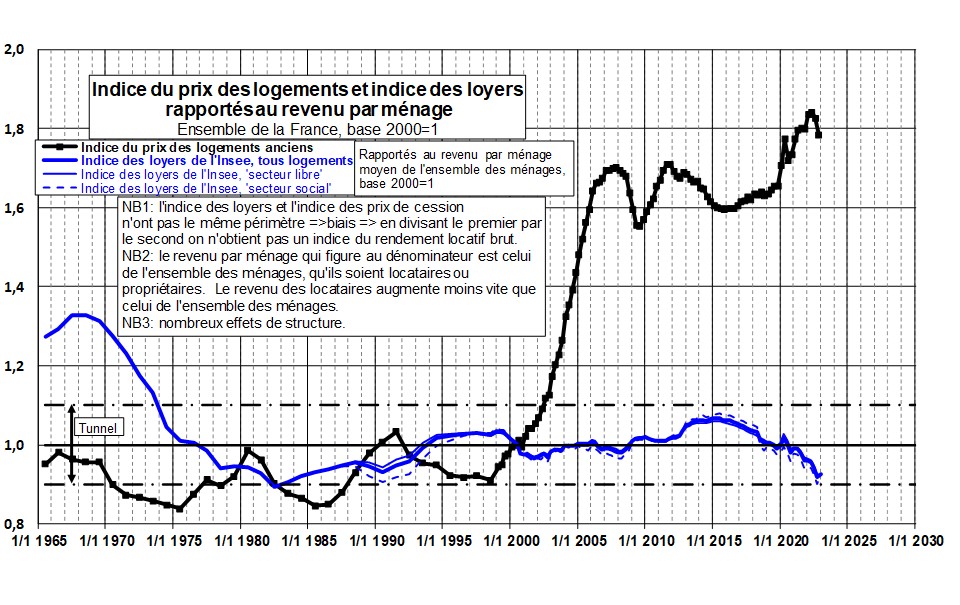
Housing, again is easy to disprove for the relevant timeframe - price to income ratios were not much higher than in the past before covid (after trump 1 and way after Reagan or Clinton). The size of the houses was steadily increasing too, indicating increased demand for bigger houses due to increased incomes and living standards. But the vibes among recent college grads wanting a house in SF specifically is certainly pretty gloomy.
The US are kind of an outlier because price recessed between the financial crisis and Covid, but it has then caught up with the broader western trend. And keep in mind that the “price to average income” ratio doesn't tell you anything about the situation of the lowest incomes, which have declined relatively to the mean.
> The size of the houses was steadily increasing too
Like with mobile phones or cars, a house twice as good and twice as expensive is still twice as expensive.
> indicating increased demand for bigger houses due to increased incomes and living standards
Unsubstantiated claim, and also wrongly assuming homogeneous growth of the house size (if 10% of your housing supply double in size, while the other stay still, the average size increase by more than 10% but this tells you nothing about the housing stock as a whole).
> But the vibes among recent college grads wanting a house in SF specifically is certainly pretty gloomy.
Not just SF, and not just recent college grads, that's the thing. Even social classes that used to be preserved from the housing cost increase are now affected as well.
Ratio was very similar in 1965 and 1995, for example and not much higher than previously after the housing bubble. So, not much to do with deregulation and welfare state in the 80ies or whatever.
Median house is not affected by average issues you indicate, and it increases steadily over time including when price to income is falling or staying low.
Also, since housing costs for most people are substantially affected by interest rates, the pre covid period would look even better.
Where is the data for the poorest, and what does the poorest mean, 1%, 10%, 0.1%?
Of course, housing prices, especially local, are mostly due to underbuilding, and underbuilding is to a large extent caused by zoning, and environmental/etc review. Nothing to do with "current system", unless by current system you mean too much government and too much democratic input over other people's property :)
It's funny how you always escape data by cherry picking other data instead of addressing the data you loudly reclaimed.
> and not much higher than previously after the housing bubble
Except that you cannot discount the “bubbles” when they represent a significant fraction of the recent period. And as mentioned before, the relative housing cost decline during the 2010s is a US peculiarity that didn't happen elsewhere in the West.
> Median house is not affected by average issues you indicate, and it increases steadily over time including when price to income is falling or staying low.
That's a nice counterpoint to your original argument, thank you.
> Of course, housing prices, especially local, are mostly due to underbuilding, and underbuilding is to a large extent caused by zoning, and environmental/etc review
That's a comfortable myth. I wonder why housing cost hasn't fallen to zero in Detroit as the “law of supply and demand” say it should have.
> and too much democratic input
“Market gud, democracy bad and I am very smart”, I see …
(Also, if you scroll up a little, you'll see that my argument wasn't just about housing but more globally about basic necessities like housing and healthcare becoming less accessible, negating the apparent “standard of living” improvement. And while the US has been an exception in the 2010 with respect to housing costs, it unfortunately also has been an exception in terms of healthcare cost).
"in reality welfare state with its massive redistribution and limits on concentration of power that won"
The welfare state increased 3x since post war time so that one is plain wrong. It was not clear if the 2nd part was "its" or separate . What is the metric for concentration of /power/? Rather than wealth. If anything the recent developments are the result of more direct democracy. Candidates like trump would have never been allowed by concentrated media and party machines mid century


There ought to be a better balance, and the US found it in the period between the end of WWII and the 1970s. High marginal taxes on extreme wealth, high inheritance taxes and zealous antitrust and anti-monopoly enforcement all kept people's wealth and power disparity somewhat in check.