The past two administrations, arguably the past three if you think the pandemic was overblown (I don’t), have been totally reckless with spending and their ostrich-like refusal to reform entitlements. Maybe the suspension of SNAP will “break the seal” on further entitlement cuts?
Genuine question - why is taking benefits away from the poorest among us the only answer? Corporations and the wealthy upper crust have made record profits YoY for like a decade now. But we can only find the money by taking it away from people who are just trying to eat?
Entitlements and interest on the debt itself make up the majority of spending.
Most corporations don't make extraordinary profits. They make enough to stay in business, and if you tax them too heavily they will either raise prices or just close. So higher corporate taxes will ultimately depress business and be paid for by the consumer.
A few corporations certainly do make a lot of profit, and various "windfall profit" or "excess profit" taxes have been tried, but that's more about politicians trying to earn favor than anything that makes a practical difference.
Spending is the thing that's out of control, so that's where the problem must be attacked.
> Most corporations don't make extraordinary profits. They make enough to stay in business, and if you tax them too heavily they will either raise prices or just close.
Corporate taxes are levied on profit, not revenue. Raising corporate taxes would not cause any businesses to fail. And businesses can only raise prices if the market will bear those higher prices. Prices are set based on what customers will pay, not on what profit margin the company wants.
> Raising corporate taxes would not cause any businesses to fail.
It is a little more nuanced than that. Raising corporate taxes can make it harder for businesses to succeed if it sharply reduces after-tax profits or discourages investment. OTOH, if done well, the incremental tax revenue can create a healthier business environment overall.
because the poorest don't have the power to stop anyone taking their benefits whereas being rich by definition is having access to levers of power like the courts and political contributions and have also been running what is essentially a multigenerational PR campaign that says that the poorest among us are the source of all of our problems and that eliminating any help for them will simultaneously make things better for us by cutting spending and make things better for them through vague notions of encouraging responsibility or whatever.
tldr - the reason that going after the poor is always the answer is that it's the rich who are both asking and answering the question.
SNAP should be the last thing that gets reformed, aside from its tendency to fund less than ethical corporations (coca-cola, big agribusiness, Taco Bell). On that I totally agree.
The wealthy boomers who own multi-million dollar California track homes and don’t pay taxes because of prop 13, who are consuming millions on quasi-necessary medical procedures because they partied too hard in the 70s, gorged on trans fats in the 80s, smoked drank and didn’t go for walks, that’s where entitlement reform should start. But those are the base of one, maybe both parties and will vote out anyone that refuses to subsidize their ozempic and knee surgeries. They will even vote to reduce democracy by gerrymandering the state to block third party candidates and ensure nobody can come for their unnecessary health care costs and other ballooning entitlements.
It’s not the only answer. There are no good answers, that’s the unfortunate truth. An empathic government would avoid getting us to this point, but alas here we are.
Where I live, private sector food programs are very healthy, and so it seems unlikely this will be much of any local impact beyond retailers’ bottom lines. For example, the Taco Bell drive thru down the street from me has a huge sign “WE TAKE EBT!!!” which I assume corresponds to the local consumers being largely subsidized chalupa eaters. I wonder if chalupas will decline in value from $7 dollars or whatever artificially inflated price they’ve reached, back down to their old timey price of $3? (I’m not sure I have those prices exactly right as I’ve only purchased Taco Bell once or twice since in the past few decades. I confess I don’t get EBT yet, so my perspective is a naive one. It may be the case that chalupas are a better value proposition than Safeway prices in the suburban food desert where I live. There’s certainly a dearth of drive thrus.)
I looked this up and it seems like restaurant meals are only available to SNAP users that cannot use a kitchen because they are homeless or too disabled. Programs like meals on wheels have waiting lists now so that might not be an option.
Taco bell seems ridiculous but the alternative is that they eat cat food.
That makes no sense. Who do you think pays the bill for EBT? If entitlement programs are done away with, no one will accept EBT, because it won't exist.
SNAP would be a start. Medicaid, Medicare, Social Security would be the place to end. Those are all politically tricky to take a bite out of, of course.
I don’t approve of a policy that entails the premature death or destitution of millions of Americans while also ensuring that a couple thousand obscenely wealthy families remain obscenely wealthy.
Or we could just raise taxes on high income earners (which will barely make a dent in their quality of life). If the alternative is cutting programs that keep people from starving, from losing their homes, and obtaining basic health care... no thanks, I'll pass on that.
Letting 70M+ Americans, many of which are children, go hungry is good for the country because it saves money. And if they don't die from malnutrition, don't worry, we're going to save even more by cutting their health coverage, and eventually social security, a program that people paid into their entire lives.
Take a step back...do you believe these 70M+ people are just lazy, inept, ...? Do they deserve to suffer, especially the children? What are we buying with their suffering? A reduction in spending? A tax break for the wealthy? Is this the only solution?
What if we were to create a real national healthcare system which cared for everyone at a vastly lower cost? That would also save money AND reduce suffering. Seems like a net win.
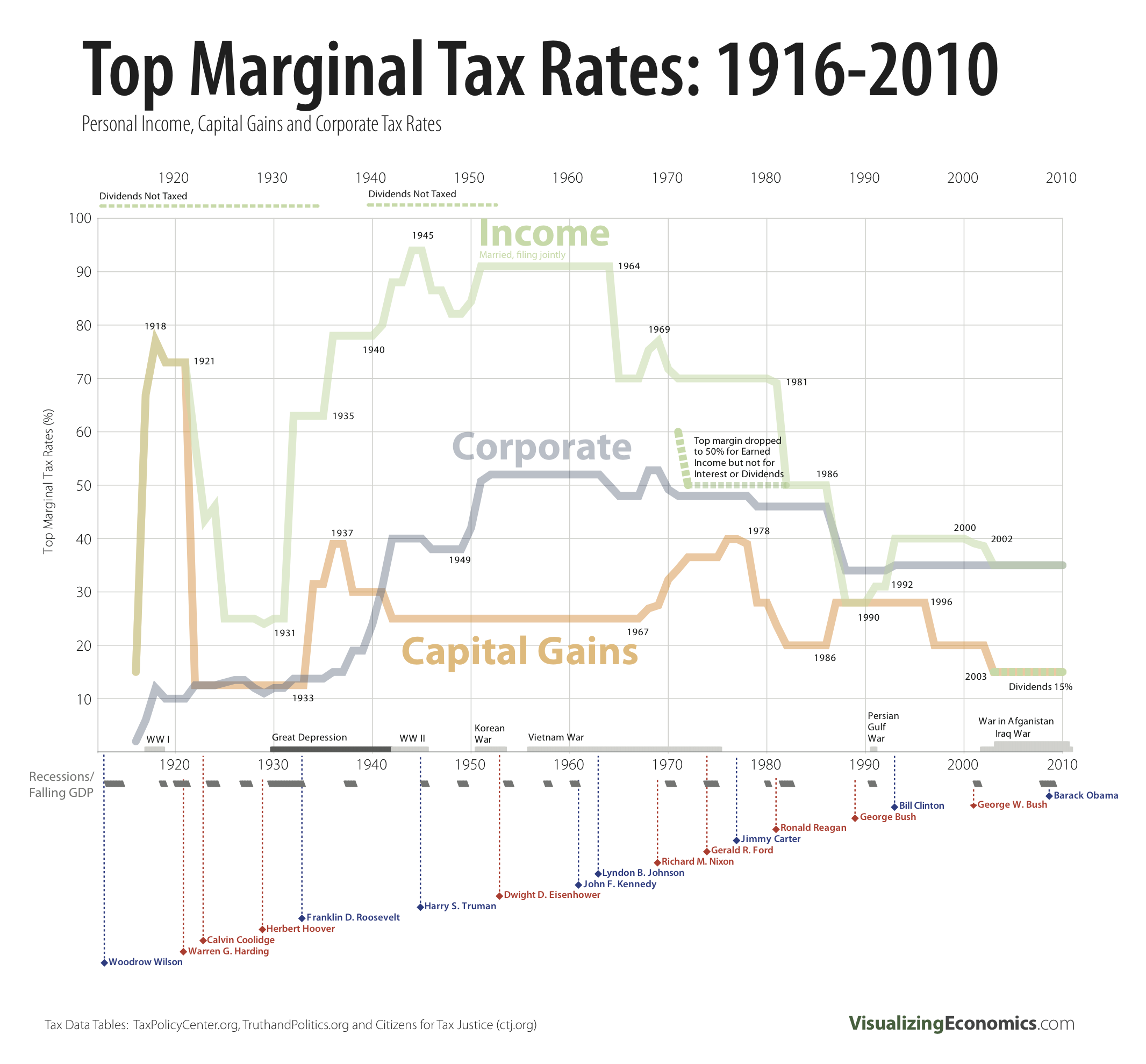
But that won't get us all the way there, so what else can we do? Everyone knows the answer, increase taxes on the wealthy. Top marginal tax rate used to be 90% (1950-1964), so perhaps there's some wiggle room between that and today's 37%.
I said this up thread. Trying to get 20% of GDP (or probably even a bit less then that) out of the economy and into the Federal government hasn't worked historically. I would encourage you to look at what people really paid when rates were 90%. They didn't pay 90% of the money that was coming through their door.
I'll agree that eliminating SNAP is an extreme measure that in the overall picture saves little (unlike modest cuts to SS and Medicare) but consider that 20% of Americans are to some measure dependent on SNAP. There's something wrong with that in my view.
> consider that 20% of Americans are to some measure dependent on SNAP. There's something wrong with that in my view.
but what interpretation leads to "therefore SNAP is the problem" ? compared to land management or anti-trust, etc
as a policy alternative, we could say, ban the exports of alfalfa until the SNAP usage is 5%, and split up cisco into 2000 different food distribution companies.
funding for social spending i think is a very strong chesterton's fence, in that the program was introduced to mitigate a problem. getting rid of the mitigation isnt going to get rid of the underlying problem
Not sure why you're being down voted. SNAP was bleeding us on the front end by subsidizing sugar water mega corps and on the backend by subsidizing the collosal medical bills that come from the overweight, diabetic millions.
One day we'll look back and wish we had the self-control to both impose austerity measures to get the spending under control and the foresight to spend wisely on long term functions like infrastructure.
Until then it's business as usual from both political parties.
> Not sure why you're being down voted. SNAP was bleeding us on the front end by subsidizing sugar water mega corps and on the backend by subsidizing the collosal medical bills that come from the overweight, diabetic millions.
Letting people starve is a better solution than letting them drink soda and potentially develop diabetes over the long term? Preposterous. I don't understand why the common sentiment is that everyone who uses SNAP must enter into a contract with the state to lose weight and only eat heads of iceberg lettuce, lest they be labeled leeches.
It's not one extreme or the other. There's a reasonable middle where SNAP can't be used for soda or candy, etc.
But such regulations are easily subverted and ultimately may not make a lot of difference. If people want to live on Dr. Pepper and cigarettes they will find a way to do that.
I personally agree it shouldn't be one extreme or the other, but the person I was replying to was defending a comment about the suspension of SNAP. My wife and I used SNAP when we first moved in together and she couldn't find a job, so it annoys me when I see people imply that SNAP users just need to make better choices, be less lazy or eat healthier.
people shouldnt be prevented from ever drinking doctor pepper because they are poor.
snap should reclaim their money from dr pepper if peopleare spending too much on it, or they should be pushed on making doctor pepper healthier if thats what people are spending snap money on.
Sorry, the entire political establishment learned that debt didn't really matter back during Bush and then Obama.
How different would the world have been if either of the two "grand bargins" that Boehner started, and then Obama torpedo'd last minute (in the first example) or the second one (which biden as VP torpedo'd) happened? No rise of the tea party, working bipartisan arrangement on spending?
The tea party was a front by the Koch brothers to pay less taxes. It was and always will be a thing by the rich, for the rich. It was also just wrapped up in the entire republican agenda of trying to sabotage the first Black president, because too many white folk couldn’t accept that the president was Black. There was never any possibility of a bipartisan agreement.
Well, I think just very rough numbers Biden added about 7 trillion, which was about the same as Trump 1, driven of course by the pandemic. I think we’re headed for another 6 or 7 trillion under Trump 2, give or take tariffs and whether we can Art of The Deal our way with Xi’s communist empire and enter some new era of AI driven prosperity. So if the total debt is, rough numbers, about 40 trillion, then the past 3 admins account for a substantial fraction 15-20 trillion, tough numbers, given that the economy has been objectively strong since Obama’s second term. We should have decreased to debt in those years of strength, aside from the short few months of the pandemic when vaccines were needed and temporary lockdowns had to be subsidized.