This is not really true of most SSDs. When Linux is really thrashing the swap it’ll be essentially unusable unless the disk is _really_ fast. Fast enough SSDs are available though. Note that when it’s really thrashing the swap the workload is 100% random 4KB reads and writes in equal quantities. Many SSDs have high read speeds and high write speeds but have much worse performance under mixed workloads.
I once used an Intel Optane drive as swap for a job that needed hundreds of gigabytes of ram (in a computer that maxed out at 64 gigs). The latency was so low that even while the task was running the machine was almost perfectly usable; in fact I could almost watch videos without dropping frames at the same time.
Do you know how the le9 patch compares to mg_lru? The latter applies to all memory, not just files as far as I can tell. The former might still be useful in preventing eager OOM while still keeping executable file-backed pages in memory?
le9 is a 'simple' method to keep the fixed amount of the page cache. It works exceptionally well for what it is, but it requires manual tuning of the amount of cache in MB.
MGLRU is basically a smarter version of already existing eviction algorithm, with evicts (or keeps) both page cache and anon pages, and combined with min_ttl_ms it tries to keep current active page cache for a specified amount of time. It still takes into account swappiness and does not operate on a fixed amount of page cache, unlike le9.
Both are effective in trashing prevention, both are different. MGLRU, especially with higher min_ttl_ms, could cause OOM killer more frequently than you'd like it to be called. I find le9 more effective for desktop use on old low-end machines, but that's only because it just keeps the (large/er amounts of) page cache. It's not very preferable for embedded systems for example.
That may be the intention, but you shouldn’t rely on it. In practice the average IO size is, or at least was, almost always 4KB.
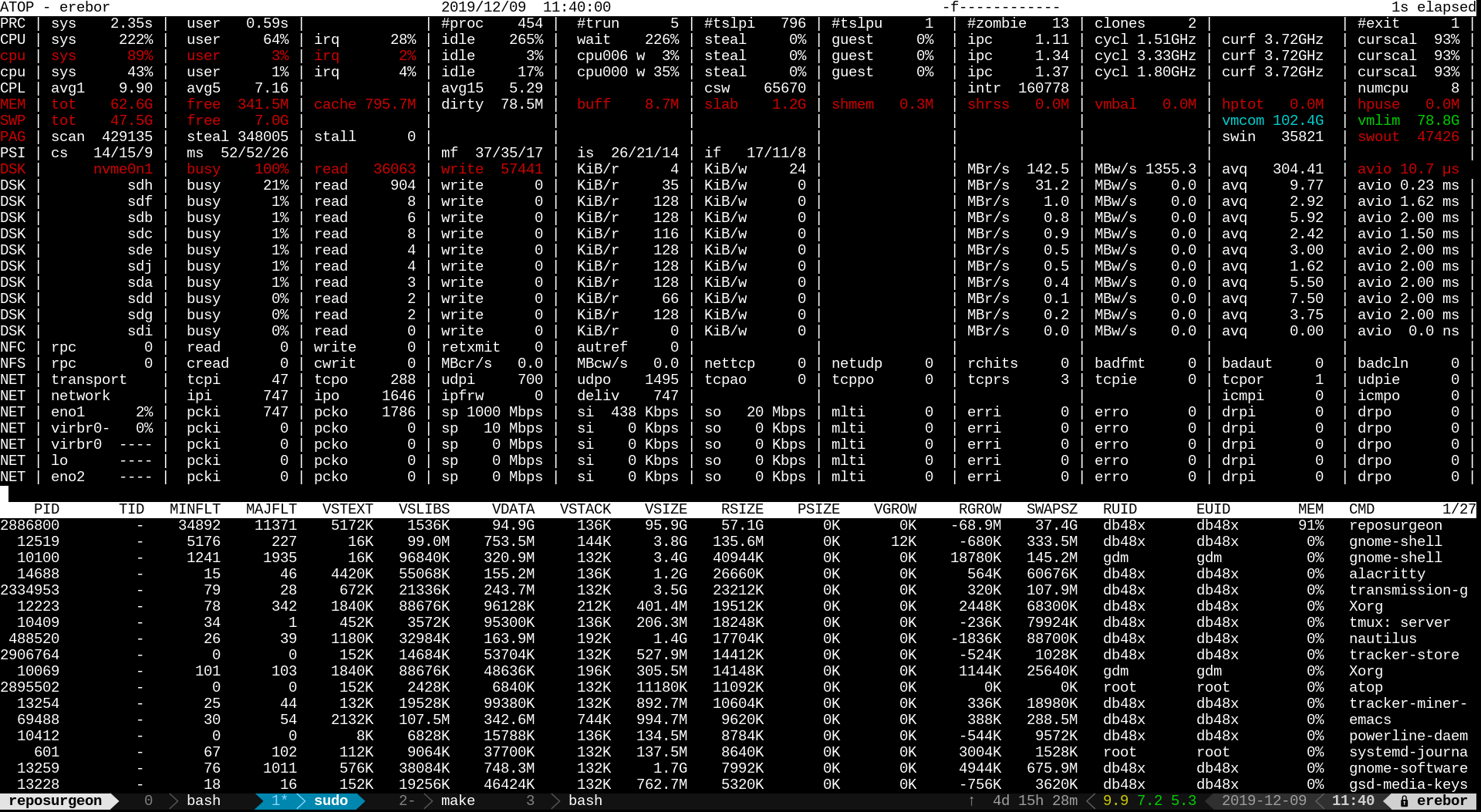
Here’s a screenshot from atop while the task was running: <https://db48x.net/temp/Screenshot%20from%202019-11-19%2023-4...>. Note the number of page faults, the swin and swout (swap in and swap out) numbers, and the disk activity on nvme0n1. Swap in is 150k, and the number of disk reads was 116k with an average size of 6KB. Swap out was 150k with 150k disk writes of 4KB. It’s also reading from sdh at a fair clip (though not as fast as I wanted!)
<https://db48x.net/temp/Screenshot%20from%202019-12-09%2011-4...> is interesting because it actually shows 24KB average write size. But notice that swout is 47k but there were actually 57k writes. That’s because the program I was testing had to write data out to disk to be useful, and I had it going to a different partition on the same nvme disk. Notice the high queue depth; this was a very large serial write. The swap activity was still all 4KB random IO.
That's surprising. Do you know what your application memory access pattern is like, is it really this random and the single page io is working along its grain, or is the page clustering, io readahead etc just MIA?
I didn’t delve very deep into it, but the program was written in Go. At this point in the lifecycle of the program we had optimized it quite a bit, removing all the inefficiencies that we could. It was now spending around two thirds of its cpu cycles on garbage collection. It had this ridiculously large heap that was still growing, but hardly any of it was actually garbage.
I rewrote a slice of the program in Rust with quite promising results, but by that time there wasn’t really any demand left. You see, one of the many uses of Reposurgeon <http://www.catb.org/esr/reposurgeon/> is to convert SVN repositories into Git repositories. These performance results were taken while reposurgeon was running on a dump of the GCC source code repository. At the time this was the single largest open source SVN repository left in the world with 287k commits. Now that it’s been converted to a Git repository it’s unlikely that future Reposurgeon users will have the same problem.
Also, someone pointed out that MG-LRU <https://docs.kernel.org/admin-guide/mm/multigen_lru.html> might help by increasing the block size of the reads and writes. It was introduced a year or more after I took these screenshots, so I can’t easily verify that.


I once used an Intel Optane drive as swap for a job that needed hundreds of gigabytes of ram (in a computer that maxed out at 64 gigs). The latency was so low that even while the task was running the machine was almost perfectly usable; in fact I could almost watch videos without dropping frames at the same time.