"There have been 263 power outages across Texas since 2019, more than any other state,
each lasting an average of 160 minutes and impacting an estimated average of 172,000
Texans, according to an analysis by electricity retailer Payless Power
(https://paylesspower.com/blog/blackout-tracker/)"
Also in 2021 210 people died. This is a huge deal. This wasn't just a little outage.
That website shows California as currently worse. It looks like Larger states just have more power outages, which is to be expected. Texas also is a weird state that is very large it gets Tornadoes, extreme heat, and hurricanes, while also having several very large metro areas in it. There also isn't anything indicated differences in grid monitoring, are all grids (like large rural grids) monitored to the same levels?
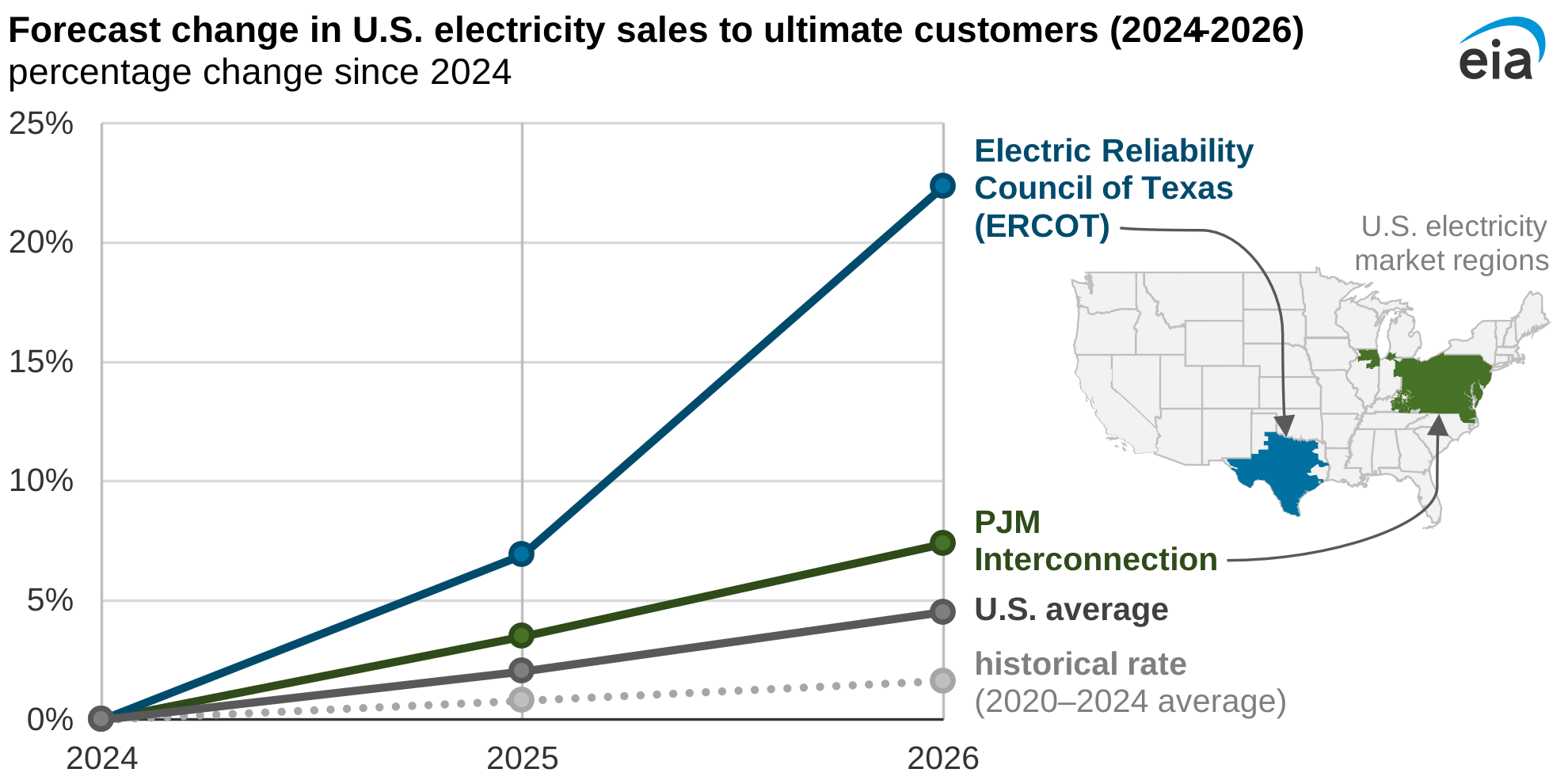
We also have a lot more growth in the past few years than most other places, both in relative terms, and in absolute (big state + high growth introduces more absolute friction than small state). Demand is forecast to rise over 20% from 2024 levels vs. an American average under 5%: https://www.eia.gov/todayinenergy/images/2025.07.31/main.svg
We have high power demand in both winter and summer: in the latter, air conditioners use a lot; in the former, about half of Texans heat with electricity because we have less cold and so less usage of cost-effective, grid-preserving furnaces.
Texas has been building a ton of wind and solar to supplement generation capacity and is taking some leadership in the next-gen nuclear stuff for a reliable base load, but in the mean time the shortage of CCGTs is going to bite in a state where demand goes up this much, this fast. SB6 passed this summer also should help with reasonable control and oversight.
California has power outages as a matter of routine in some places. When I went there the rural areas were constantly experiencing load-shedding power outages and some of the rural lodging advertised that they had backup generators because this is so routine there.
Yeah, but that isn't really an apples to apples comparison. Texas for example had ~400 heat deaths in 2024 depending on where you look but in 2023 it was 334 or 563 depending on your criteria [1].
>But I want to put it into perspective. In 2024, ~62,800 people in Europe died to heat-related events.
Most of these deaths are not because of electrification but the fact that homes are built out of bricks and mortar and become ovens with heat waves that get hotter each year and ~10% to ~20% [2] of homes in Europe have air conditioning meanwhile ~95% [3] of homes have air conditioning. Your apples to oranges comparison mostly shows how Europe is generically unprepared for climate adaption (specifically heat resilience) and has nothing to do with electrification stability.
The vast majority of these 400 heat deaths have nothing to do with the power grid. They are people living outdoors, roofers, elderly, etc. When the temps hit 105+ for long periods there are bound to be people who don't have access to AC or overexert themselves outdoors.
It's a perfect apples-to-apples comparison if you level accusations of grid incompetence at Texas. Should all those EU homes suddenly go out and buy AC, EU power grids would have to enact massive load shedding during heat waves. Such waves already push demand up, causing local blackouts and price spikes: https://www.ft.com/content/23b3dc59-b40f-48e2-ad93-e301de7ac...
Texas has installed a vast number of solar and battery backup systems since 2019. And it will be a few years, but is going HEAVILY into nuclear (and for the next 3.5, is going to get auto-approval to actually build them. ERCOT is changing fast, don't rehash stale narratives.
Only as long as the Texas politicians don't sabotage wind. Texas businesses make lots of money on wind, but the legislature and governor absolutely hate it.
Having experienced the Snowpocalypse and mini Snowpocalypse, weeks of 2019 PG&E PSPSes, and the 2000–2001 CALISO-Enron rolling blackouts, it's ridiculous for those in glass houses to throw stones.
So about one every 9 days that affects 0.55% of the population. So in a 3 year window a Texan has about a 50% chance of losing power for 2.5 hours. Seems pretty good to me.
> Texas loses power one time for a week and the redditors will never let it go. Wild how this is still a cringe joke so many years later.
Texas had the most number of power outages between 2019 and 2023 [1].
It wasn't one time. And it's not a joke. Infrastructure weatherization is a very real overlooked (and expensive) investment that still has not taken place.
Those power outages are local, not the Texas grid.
It was one time. I have been in Texas for over 30 years. Besides a local transformer exploding or something and giving me a temporary outage, I've only had the ONE extended outage in that time.
You guys just really don't know what you're talking about.
> In 2011, Texas was hit by the Groundhog Day blizzard between February 1 and 5, resulting in rolling blackouts across more than 75% of the state… Following this disaster, the North American Electric Reliability Corporation made several recommendations for upgrading Texas's electrical infrastructure to prevent a similar event occurring in the future, but these recommendations were ignored due to the cost of winterizing the systems.
> Unlike other power interconnections, Texas does not require a reserve margin of power capacity beyond what is expected. A 2019 North American Electric Reliability Corporation report found that ERCOT had a low anticipated reserve margin of generation capacity and was the only part of the country without sufficient resources available to meet projected peak summer electricity demand.
If I hadn't been reading headlines I wouldn't have even known about the 2011 blackout, and I was definitely here for that. Things were pretty much normal for everyone around me and friends around the state (Houston, Austin, DFW, Lubbock, San Antonio, etc). The Superbowl even went ahead in AT&T stadium. It really wasn't as big of a deal as a lot of internet commenters seem to act like.
I lived in Texas and we never got rolling blackouts for this. We didn't hear about it from family and friends in every major Texas city. Maybe this means 75% of the state by area rather than population? We just didn't drive because much of Texas isn't set up to clear roads and, more importantly, few of our drivers know how to deal with snow and so most get very unsafe to drive around.
The report your wikipedia article cites for 75% says this: "In the case of ERCOT, where rolling blackouts affected the largest number
of customers (3.2 million), there were 3100 MW of responsive reserves available
on the first day of the event, compared to a minimum requirement of 2300 MW." So an eighth or so of Texas' ~25 million population in 2011.
You originally called someone a redditor making a cringe joke for highlighting a serious historical problem. It wasn't clear to me that it was a joke at all, but my impression is that it seemed clear to you that it was a joke.
What if that person has also lived in Texas for 30 years? And what if they had a family member that died during that power grid failure in 2021? I personally would find it quite difficult to communicate to them the nuance of a local problem and a state-wide problem when the end result is the same: no power.
In the future, you might consider approaching an interaction online with more balanced judgement.
Edit: Actually, looking back at the original comment, it's not even clear they're talking about the Texas power outage in 2021. All they said was "Hope they have ample backup power." Seems like a reasonable thing to hope for what might be critical infrastructure.
I'm not sure what is meant by Redditors... I haven't used Reddit in many years.
Admittedly anectodal, but I don't remember any power outage here in Chicago over the last 11 years I lived here, but I was in Texas for work for a few weeks this summer at the NASA balloon base and there were multiple power outages.
Anecdotal, but I've lived in DFW for over a decade. The only time I lost power for more than a minute was due to a drunk driver hitting a utility pole just outside my house. They had the pole fixed and everything working again within an hour.
The Houston metro area is particularly bad. When I lived in Austin, the outages were very rare. In Houston, I would guess there is at least 1 outage every month that lasts for an hour on average.
Texas' grid was very reliable when I was growing up there. Since deregulation however, it's no longer reliable. It used to be mandated that grid facilities were overbuilt to have some headroom for emergencies. That's no longer true. Now, Texas utilities only maintain the minimum infrastructure needed for normal operations and they have no cushion if something goes wrong. Any CEO of a Texas utility that spends money building overcapacity gets fired by Wall Street.
This was supposed to change after the 2021 crisis, but I haven't seen much evidence that it has.
The US did do this for most of the 20th century. Or at least something close to this: Many utilities were private companies but they were regulated monopolies. The state allowed them to be monopolies in exchange for tight state control.
In the 1990s this started to change. The idea was that the different utilities could compete for customers, and thus they wouldn't be monopolies any more and thus market forces would take the place of government regulation.
Of course this has failed spectacularly. Deregulation brought us the Enron disaster and the 2021 Texas grid crisis, among others. But since corporations control the US government now, there's no chance regulation will be brought back.
I'm surprised that you put the blame squarely on the the (bought) government.
Deregulation and "free" markets are something that many americans actively want. You can argue that they're misinformed and they're advocating against their own self-interest. But it's still something they actively want, this isn't just the evil corporations taking control of the corrupt government.
In fact on this very site I'd wager that more than half of Americans users are against regulation in general, state ownership of any utility, or any additional control on financial markets.
It's not just the "snowpocalypse". In Houston, for example, there have been multi-day power outages since then, often during hot weather where lack of adequate cooling can become a life-threatening concern. Personally I don't find it any more "cringe" than the weird boasting people like to do about our state.