By the way, apart from the fact that dark matter predictions have been contradicted by increasingly sensitive experiments over and over and over, there is another inconvenient piece of observational evidence: An analysis of stellar velocities at the edge of the Milky Way, published last year [1] shows that they are "Keplerian", i.e. following classical behavior without the influence of any purported dark matter. So either the Milky Way is anomalously dark matter deficient (how very convenient :), or maybe the discrepancy that dark matter was invented to explain will simply disappear when more accurate astronomical data including the fainter stars becomes available.
That link also claims that the results you're listing are not likely to hold up, including comments from an author of the paper used for the article. So if one of the paper;s own authors expects these claims to disappear once more data is gathered, then maybe it's too early to claim the end of dark matter.
After all, DM has been measured in many different ways. One surprising finding doesn't negate hundreds of surprising findings without significantly more evidence.
> shows that they are "Keplerian", i.e. following classical behavior without the influence of any purported dark matter.
That is NOT at all what the paper says [1]. if you actually read the paper, and don't interject your beliefs and reword it, in every instance they use the phrase "Keplerian decline," which does not AT ALL mean classical, which would break relativity and be a massive surprise. The phrase "Keplerian decline" means the measured items are less than expected for the previous model. The movement, even with this decline, are far beyond what Kepler's laws would imply (and even Kepler's laws are demonstrably wrong in our solar system - see the precession of Mercury for example).
That is begging the question. Claiming that DM has been measured many ways presupposes that the different ways that "it has been measured" are have the same cause, which itself is the dark matter hypothesis.
Until we get a multimodal observation of DM itself we can't claim that DM has been measured many ways. We are very much still in the "guessing that these things are DM" phase.
> we can't claim that DM has been measured many ways
Yes we can.
It's shown up in 1) precise measurements of galaxy rotation curves (relevant to this paper, which only addresses this method), 2) velocity spread of bound stars, 3) x-ray emission from hot gas, 4) gravitational lensing, 5) cosmic background radiation measurements in CMBFAST and others, 6) provides solutions to issues in stellar strucutre formation, 7) supernovae behavior, 8) baryon oscillations support DM via empirical evolution compared computed with and without, 9) redshift observations support DM also. There are more.
So yes, we could claim there are 39 different causes, but that the effects of DM would give all these results, historical (and Occam's Razor, a still useful part of physics) means the most likely explanation is the simplest - 1 cause until proven otherwise.
If you dig, you can find papers covering all this with the math and experimental and computational error bounds to see how well all of these (and more) line up.
Next you'll tell me there are 5 types of electrons, despite all experimental evidence being consistent with one type of electron.
The 1st is good, but also not predicted a priori by dark matter. In it's defense, it doesn't need fine tuning to work (it works out with ~the estimated amount of DM)
For all the minor ones there's a lot of fine tuning necessary to obtain the results. So it's not surprising that an LCDM model (which can select an arbitrary distribution of DM) can fit some sundry minor observations. Again, you're cherry picking the minor ones.
LCDM has a hard time with: external field effect, renzo's rule, Tully fisher relation (requires tons of fine tuning), early galaxies, why dense elliptical and lenticular galaxies as a rule have no DM, etc. those are all phenomena explained and predicted (except for Tully fisher) by e.g. MOND.
LCDM doesn't explain how the mitochondria function, or why my dog prefers to shit in the yard instead of in the house, so it is clearly a failed model for not having explanatory power on those observations
We've also seen instances where visible "clumping" in a galactic disc correspond to differences in the rotation curves, which dark matter can't really explain. But this is still a topic of much debate.
However, there's lots of good evidence for dark matter besides rotation curves of galaxies. For instance, models of galactic formation work a lot better with it than without it (without dark matter, as galaxies coalesce, they get hot and the pressure keeps the gas apart and makes star formation really hard).
We also see the Bullet Cluster, where two galaxies collided/passed through each other. The gas and dust has been slowed down from collisions, but the dark matter has passed right through. We know this from the gravitational lensing. The lensing happens around the mass of the galaxy, but with the bullet cluster, the lens is off to the side where there is no normal matter, because the dark matter kept going when the regular matter slowed down.
In other words, we have some really good evidence for dark matter, but there's a few things going on here and there we can't explain.
I remember reading/hearing somewhere that the bullet cluster actually fits MOND better than dark matter. I think it was a video by Sabine Hossenfelder but I can't find it right now and I'm not qualified to say whether it made sense or not.
Bullet cluster is inconsistent with LCDM on the grounds that given the apparent dark matter:matter ratio a collision between clusters of that size is something like unlikely to the tune of one in a trillion? IIRC universes. (Aka the collision should not have happened in the first place).
The thing about lensing is that we don't have a solution in (GR would need to be tweaked if MOND is true -- the math is much harder!!) so we can't really say what the lensing would look like in any given MOND-like theory yet. Seems weird to declare that MOND can't explain lensing. It's should be more qualified: "we don't think MOND can explain the lensing"
It's not clear that GR would need to be tweaked to match MOND. The GR solutions we currently use in LCDM are based on the FLRW metric, but that metric could just be the wrong fit for our universe.
I wasn't familiar with the Bullet Cluster[0], but as you described it made it very interesting. I'm no astronomer, but from all of the examples of gravitational lensing[1] I'm familiar with have a very distinct look that I'm just not seeing with the Bullet Cluster. Where is the lensing effect occurring that is leading to this theory?
Gravitational lensing doesn't have to be apparent to the eye as those extreme examples on the wiki page are. The second image on the bullet page shows matter in pink and measured lensing in blue.
I thought gravitomagnetism was extremely weak? Wouldn't normal magnetism and its interaction with environmental plasma (which IIRC is also neglected on the grounds of being a rounding error) be more significant?
> apart from the fact that dark matter predictions have been contradicted by increasingly sensitive experiments over and over and over
My impression is that many physicists would disagree with this characterization entirely, and that they're eagerly working to constrain what it is or isn't. Ruling out big classes of phenomena that could be responsible for the things we observe isn't "contradicting" the predictions in the sense implied.
Particle physicist here. I've worked on direct detection DM experiments in the past, and personally know some folks who work on the LZ experiment. That direct detection experiments, such as LZ, have not detected a signal does not contradict any predictions.
Indeed, relevant to what an experiment like LZ might see, there really isn't much in the way of "predictions" which can be "contradicted." What we have at this point are mechanisms to calculate the interaction rate _given at least one free parameter_. If we were to detect a non-zero rate, then we would "know" the free parameter of a single-parameter theory underlying that calculation. If we were to continue to detect a non-zero rate, then we would try to do so using different materials, and look at the time dependence of the rate (or, really, the dependence of the rate on the Earth's direction of travel in our local galaxy). That would help us choose between different theories, pin down the free parameters, and confirm that what we're seeing is consistent with "heavy stuff just sitting out in the universe."
But, from a particle physics perspective, right now there are no predictions to contradict - just an opportunity to detect something.
I'd normally agree with you, but in the particular case of dark matter particles something still smells fishy. The theories that the predicted cross-sections are based on are just too flexible and numerous. I'm not sure how much we gain from ruling out yet more. What if there are in fact no weakly interacting particles? At what point do we decide that enough has been ruled out to start looking elsewhere? Like plasma dynamics or something (please don't shoot me if this is too silly to even contemplate).
Reprioritization of direct experimental searches for dark matter is already happening. WIMPs are by no means being abandoned, but because we are closing in on the neutrino fog background (which is mentioned in another comment), it's been recognized that to myopically cling to the same kind of experiment which dominated the 2000s and 2010s is not a strategic move (both from the "we expect to see something" and the "responsible use of tax dollars" perspectives).
For example: axions, an alternative DM candidate mentioned in another comment, have seen a significant growth in attention in recent years, and the usual detector technology for axion searches is currently being refined and scaled up, from benchtop-scale, dedicated experiments to lab-scale, wide searches.
At the same time, different groups which have developed past WIMP detectors are merging to collaborate on the larger, next-generation detectors. And there is R&D and prototyping happening to create detectors which, although looking for WIMPs, are sensitive in entirely different mass ranges than those of yesteryear.
That's just how particle physics research works. You build a detector that is designed to detect things with specific properties. You run the detector. Did you find the thing? If so, great, if not, well, that's the way the cookie crumbles. Either way you write a paper and you build the next detector.
The Higgs boson has numerous experiments exclude numerous mass ranges excluded before it was finally found.
> At what point do we decide that enough has been ruled out to start looking elsewhere?
"We" don't make that decision. The various institutions who pay for these things decide, one by one, that they're going to fund some thing that sounds more promising instead.
It does kinda suck that there's something there in the universe that is perniciously difficult to see--in fact, that's how it's defined--but that is so important in the way the universe works that we can't simply ignore it. But this is the universe we're given, so this is the universe we'll run experiments on.
> maybe the discrepancy that dark matter was invented to explain will simply disappear when more accurate astronomical data including the fainter stars becomes available
FWIW, that would be a much more surprising result than anything to do with dark matter. We can see "faint stars" just fine in the near field. What you're positing here is that somehow "faint" stars in the farther universe behave in notably different ways than they do in the Milky Way, which is exactly the kind of theory you're arguing against.
No, a few confusing results isn't going to throw dark matter out. It's too strong a signal, and too hard to explain via classical means (I mean, it's not like astronomers haven't tried!).
> maybe the discrepancy that dark matter was invented to explain will simply disappear when more accurate astronomical data including the fainter stars becomes available.
That's unlikely. Measuring the milky way galaxy's rotation curve is bitchingly hard because we're inside it. Curves of other galaxies are much, much easier to measure and for example Andromeda is likely to be correct.
Moreover galaxies with exceptionally large satellite galaxies are known to have keplerian decline, so this could have been predicted.
The more interesting recent results is that for some galaxies the rotation curve is flat very very far out (those measurements might not be as accurate ofc) which would imply much larger dark matter halos which are inconsistent with e.g. cmb ringing
Even better recent evidence shows that rotation curves are flat up to a million light years, which no feasible particle dark matter halo could reproduce:
This is an old article (2023 yea I know that's recent but it's still out of date) and the crisis in cosmology (AKA dark matter) came back harder than ever with subsequent studies: https://www.youtube.com/watch?v=T1JuCPhONlg
As written in that article, there are questions to be answered before this observation can be considered a serious challenge to dark matter. Such as: why don't we observe the same phenomenon in other galaxies? Why are things orbiting the Milky Way farther out (such as the Magellanic clouds) not affected either?
> maybe the discrepancy that dark matter was invented to explain will simply disappear when more accurate astronomical data including the fainter stars becomes available.
Clearly you mean galactic rotation curves. However, your statement seems to ignore the numerous, independent probes of dark matter which we have seen since then, most of which are much stronger evidence, most notably the shape of the CMB angular powerspectrum.
I’m betting on primordial black holes for at least some of it. If you consider early universe densities their formation seems almost certain.
Most models predict that they exist but the unknowns are around how common they are and their mass ranges and therefore whether they could account for most or all dark matter.
There’s a little bit of speculation that “planet nine” is a PBH. I really hope for that one. It would give us actual access to a black hole within probe range, which could allow us to “complete physics.” Could also be a gateway to the universe through gravity assist, letting us yeet interstellar probes out at incredible velocities.
Assuming P9 is further out from the sun than the other planets... It would be orbiting slower than the rest, and will probably give you a smaller gravity assist than the rest. Gravity assist can only change your velocity by up to your relative velocity (because it's just a flyby orbit as far as the assister is concerned - speed in equals speed out).
This is different from a normal gravity assist. Close to a black hole the gravitational field would be quite strong, making this potentially very powerful.
You wouldn't get close enough to be torn apart. You'd fly by and thrust into the gravity well for an Oberth effect boost. I'm thinking of unmanned probes of course. We could send them on flyby missions to other star systems to do things like take pictures of possibly habitable exoplanets. It's unlikely that humans could survive the acceleration of such a maneuver without ending up like this guy:
There wouldn't be much radiation unless the black hole were actively "eating" something, which a PBH in far solar orbit would not. That's part of what makes it hard to find and what makes PBHs candidates for dark matter: they're dark and don't do much unless something encounters them. There would be no net emission of Hawking radiation since the BH's Hawking temperature would be colder than the cosmic microwave background.
The hypothetical PBH that could be planet 9 would be about 2-3 Earth masses and about the size of a golf ball in terms of event horizon radius. You couldn't get that close to it without being "spaghettified" and added to its mass.
Probably the most valuable thing we could do with it is study it and use it as a lab to learn about quantum gravity. We could chuck small things into it with probes nearby to precisely measure the result, etc. All black holes we know about are far too distant to reach. Having one we could study would be huge.
I think primordial black holes are the Occam's Razor solution too. No exotic new particles required, no modifications to gravity required, no new physics period. Observational results have ruled out certain masses of black holes but far from all.
Primordial black holes do not require new fundamental physics, but for them to constitute the primary component of dark matter would require a revision, at some level, of our narrative of the history of the universe. This gets a bit outside of my core knowledge, but as it stands there aren't any super solid mechanisms for generating black holes of a plausible mass distribution, early in the universe, such that we would see what we see today.
But, IMO, this is worthy of more study both theoretically and experimentally. An update to the evolution of the universe would be awesome!
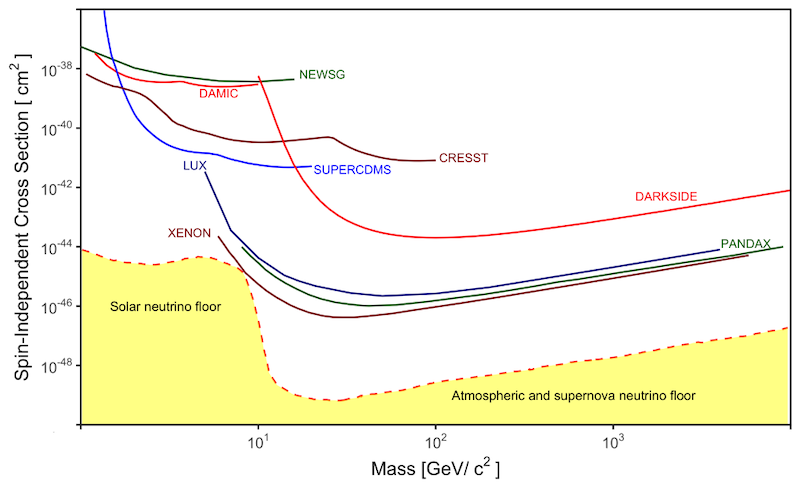
Summary: An experiment that looked for WIMPs (weakly interacting massive particles) found none with masses above 9 GeV.
So either they exist but are too rare for the experiment to see, or they are massive but not that massive*, or dark matter isn't WIMPs (or dark matter doesn't actually exist at all).
Seemingly, the most mundane possibility here is they exist, they're not rare at all, but "not rare" on the global scale of all galactic and larger superstructures in the observable universe doesn't mean you're necessarily going to find them in South Dakota in some specific 280 day window.
Notably, the possibilities are quasi-finite because of the solar neutrino noise floor. When we reach that, we stop needing to scale to 10x larger detectors for a 90% reduction in reaction cross section, and they start to need to be 100x larger, in my understanding.
Even in a world with WIMPs, we aren't necessarily privileged to have them show up above the solar neutrino noise floor.
It's going to be funny if the reason we get a mission to Neptune's moon Triton a century from now is to house a dark matter search experiment, once the cost for continuing to scale Earth's search becomes dramatically worse.
Is it the solar neutrino noise floor, or distant supernova neutrino noise floor?
Maybe the justification for interstellar colonization will be so we can run a DM experiment on the near-relativistic ship during the trip. Boost those dark matter particles to some good fraction of c for easier detection.
Considering time dilation, a detector inside a relativistic spacecraft will be hit by a lot of neutrinos in the apparent short duration of the mission.
I wonder what is the speed at which interstellar neutrino bombardment becomes lethal to a crew considering it’s essentially impossible to shield against them. You can put a mountain in front of the ship, but neutrinos will just pass through it like is a cloud.
OTOH if the ship is so fast neutrinos are a problem to the crew, that mountain will be suffering some intense ablation from everything including neutrinos that’ll hit it.
Neutrinos already move at relativistic speeds, so they aren't much of a problem.
The real possible problem would be massive dark matter particles. These would be traveling now at around 300 km/s, so a relativistic spacecraft would boost their speeds by three orders of magnitude and their energies by six orders of magnitude or higher. And, of course, the number passing through a given area in the vehicle per unit of time would also be orders of magnitude higher. If the interaction cross section is high enough (and not so high they could be shielded) then travel at that speed becomes impossible.
I wasn’t thinking of the speed of the neutrinos, but the increase in encounter frequency. From a passenger’s perspective, the number of interactions per second will be much higher, not just because the ship is covering large distances and hitting more particles (although I’m not sure about that - it might cancel out) but hitting them more frequently from the crew’s perspective because of time dilation.
No large amount of time dilation is likely to be practical, even with laser propelled light sails or antimatter. And the heat load on the vehicle from running into interstellar matter would be very high.
The more massive DM particle issue I discussed might be problematic even with very little time dilation.
Whatever tech is used, it'll need to be something really fancy (as in new, fancy laws of physics being bent in fancy ways) to make near light-speed travel feasible.
Even Alcubierre-White warp drives would create interesting problems because compressing spacetime in front of the ship would heat up whatever matter is there.
Unless something miraculous happens, I don't think we'll live to see these problems in real life, but, if we do, it'll be fun to work in solving them.
The "floor" is due to solar neutrinos - the sun is a continuous source of neutrinos and is located much closer to us than virtually every past supernova was. It is also a soft floor, as there are analysis tricks that can be played to distinguish between interactions from neutrinos and WIMPs at the statistical level. For this reason, the current fashion is to refer to a "neutrino fog," which can be entered into to some depth, as opposed to a "neutrino floor."
This is absolutely correct, as there are no solar neutrinos with energy above ~20 MeV (but below that, the solars dominate). Thanks for the clarification.
The interesting thing is the physical process creating the floor is a fairly novel one, coherent scattering of neutrinos off nuclei. This is where the neutrino scatters off all the nucleons together, with the contributions adding coherently, rather than incoherent scattering off individual nucleons.
This process was first observed only fairly recently, at the Spallation Neutron Source using neutrinos from stopped pions. IIRC, they realized a service corridor under the target room would be unintentionally suitable for the experiment.
Sure, although I do think scientists are asking better questions than that. In the public perception, it seems like we're trying to find information about something that's basically matter, but we can't detect or measure it. In reality, 'dark matter' is just a placeholder for "Well, it looks like there should be a lot of matter here, but we measure a lot less than expected. There must be some kind of phenomenon we don't understand, one of the effects of which is that it makes galaxies that seem not to have enough matter to sustain their structure"
It's worth repeating for the Nth time that dark matter may be a previously unknown form of hydrogen that doesn't interact with light because the electron is bound in a lower energy state than the traditional ground state. This is based on a novel classical atomic model where electrons are bound in "orbitspheres" see
I assume you are related to, an investor in or some kind of shill for this organization, because many of your submissions are related to the organization you are speaking about. This could be untrue, but I would not trust any "theory" that you posit at ground value without peer review and all of this is never going to make it into the scientific mainstream.
If your theory depends upon denial of quantum physics and things which have experimental proof, it has no rigor. Especially if the organization in question feels the need to take wikipedia editors to court in order to silence them. Shame on this organization.
I have no interest in or relation to Brilliant Light Power other than as a long time follower. Mills went to court to defend himself against an accusation of fraud I believe. Wikipedia is about 10 years out of date. As for 'crackpot /con-man "free energy" scam' the theory is fully available for review. The energy is not free since it involves binding the electron in hydrogen more tightly to the nucleus thus releasing energy. Normal hydrogen is converted into its dark matter form.
the tl;dr is that "dark matter" is a bit of a misnomer. (But also a fun name so it's probably here to stay through sheer memetic momentum.) Dark matter is not actually a hypothesized kind of matter. Dark matter is just an unresolved discrepancy between theory and observation. I'll say that again: "dark matter" is not an attempt at explaining the discrepancy; dark matter is the discrepancy.
There are some hypotheses that postulate some kind of as-yet-unobserved matter
that could resolve the discrepancy, but these hypotheses are not the actual problem that we call "dark matter". And not all hypotheses postulate unobserved or exotic matter. Some of them suggest alternative physics, others suggest measurement error.
So this rules out many kinds of WIMPs, but not axions, or the more exotic white holes of loop quantum gravity. There's also the JWST observations which oddly seem to fit certain MOND scenarios better. Or Claudia DeRahm's massive gravity.
I think white holes actually pop up from calculations outside of LQG as well.
Specifically I seem to recall there's something using Einstein-Cartan as a basis, written by someone of note which predicts white holes as a permanent endpoint of evaporation. Then again, maybe it was rovelli?
Alas, I can't seem to find the paper now. Google sucks and keeps dumbing down my query.
Axions can seem a bit goofy. One thing to know is that when talking about particle physics, we like to talk about particles, but "particles" are really a concept from classical physics. When doing quantum physics, one is fundamentally concerned with waves. If you've read any about quantum mechanics, you've heard of "wave/particle duality," which is something of a connection between the two pictures. Another thing to know is that axions should interact electromagnetically.
The bottom line is that because axions would necessarily be very "light" (that is, very much not-massive), it is misleading to picture them as "particles" and better to picture them as "waves." So while it's true that axions would feel the electromagnetic field of an atom's nucleus, that's really just because it's an electromagnetic field. So to make an experiment which is sensitive by modern standards, you say "forget individual atoms, I'm just going to make a cavity and crank it up to large electromagnetic field." And that's exactly what is done in practice.
To a certain floor. Of course a particle which only interacts gravitationally is still possible but that's the cosmologist's nightmare. It'd be basically impossible to prove it's existence and anything could happen (like a small but fast fairly massive ~asteroid mass clump of dark matter explaining poltergeists)
> like a small but fast fairly massive ~asteroid mass clump of dark matter explaining poltergeists
This is clever, but I have to believe the back of an envelope would show that a dark-matter scale distribution of "dark blobs" big enough to throw things around the room and frequent enough to be given names in human experience would be many, many orders of magnitude higher than the observed gravitational effects.
A lot of weird shit gets floated around, like planet X is dark matter, or at one point someone suggested sag x-1 was a dark matter blob. At that point Why not poltergeists?
There is no dark matter in theories of superfluid quantum gravity.
Dirac later went to Dirac sea. Gödel had already proposed dust solutions, which are fluidic.
PBS Spacetime has a video out now on whether gravity is actually random. I don't know whether it addresses theories of superfluid quantum gravity.
>>> "Gravity as a fluid dynamic phenomenon in a superfluid quantum space. Fluid quantum gravity and relativity." (2015) https://hal.science/hal-01248015/
>>> PBS Spacetime has a video out now on whether gravity is actually random. I don't know whether it addresses theories of superfluid quantum gravity.
It doesn't, it talks about the possibility of randomness allowing gravity to be classical and not quantum. If my understanding is correct, the gist of it is that certain random fluctuations in gravity would prevent it from contradicting Heisenberg's uncertainty principle when interacting with quantum entities.


Way better press release with lots of cool pictures: https://newscenter.lbl.gov/2024/08/26/lz-experiment-sets-new...