This is very interesting. I just have one minor nitpick. Broadcom did not buy Avago, Avago bought Broadcom. They then changed their name to broadcom as it was more recognizable in the industry (while keeping their old stock ticker AVGO as that was more recognizable in the financial industry).
This is entirely a tangent but the rise of Avago from a minor second rate spin off from a spinoff from HP to one of the biggest and most profitable companies of the world (and one that is many times the size of current HP), is one of the most unusual mostly untold stories of the modern business world. It is a story of success (by Avago and Broadcom engineers and management) and incredible incompetence (by hp management that let them go for a pittance).
Oh wow, I was just transplanting some TC702 amplifiers to save the doubler in an old 50GHz HP signal generator... would that have been designed by these guys back when they were part of HP?
EDIT: that's registration-walled, but this HP Journal article isn't. https://archive.org/details/Hewlett-Packard_Journal_Vol._42_... The amplifiers in question are blue-colored in the background, and the doubler that uses them is the spiritual successor to the rear-most golden module.
EDIT2: yep, the timeline lines up. The HP journals with these amplifiers were early 90s, and "This division became part of Agilent Technologies when HP spun off its test and measurement business in 1999. Later, in 2005, Agilent spun off its semiconductor products group, which became Avago Technologies. "
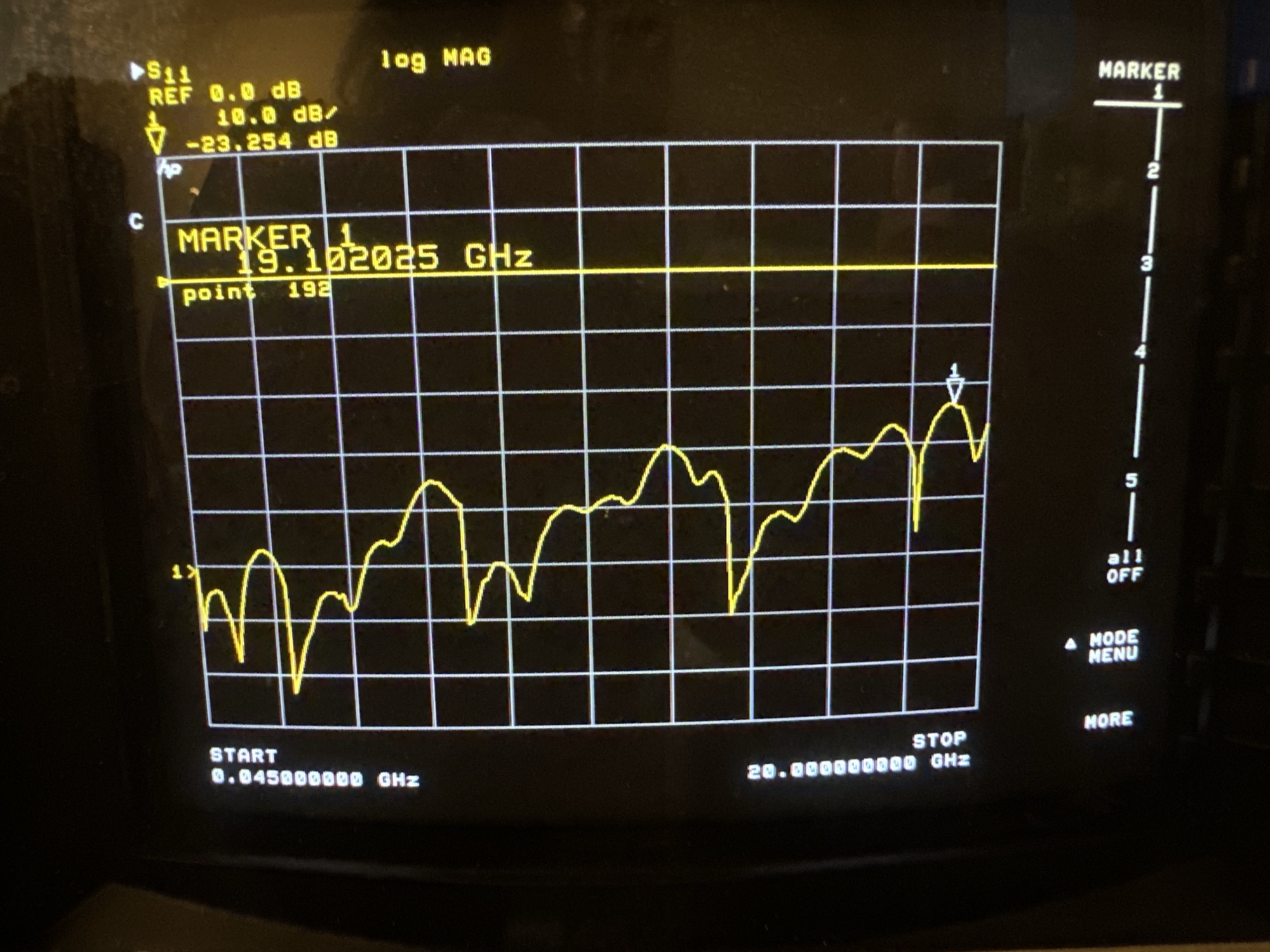
One of the few places you run into fellow 8510C users. How stable do you find your calibration on the 50GHz 83650 setup? My 20GHz one with the 8341B is very, very, very drifty for the first couple of hours after powerup (i.e. a good load goes from -60dB to about -15dB half an hour after calibration), but I'm not sure whether it's normal or something up.
That doesn't sound right at all. I mostly use mine as a TDR (50 GHz with 83651B) but I can generally reload saved calibrations from months ago, less than 5 minutes after a cold start, and still see < 50 dB return loss through 20 GHz if I look at the same load.
I'd go through the receiver channel tests in the manual and try to isolate the problem to the test set or IF box. Does S21 drift as well?
Yes, I'd expect better (though maybe not necessarily 50dB+). Troubleshooting:
1. First suspect is always a bad calibration -- they tend to be unstable in addition to incorrect, but if you have anything with known(-ish) S parameters you can check for correctness too.
2. Second step is to put it in TDR mode and watch to see where the TDR changes. That's where your problem is.
3. A trip through the test set with a torque wrench is a good way to not just check the connections but also calibrate your intuition about the couplers/mixers, which should help interpret #2. You can loosen connectors in sequence and watch them spike on TDR to zero in on the actual problem.
As it happens, I was comparing my 8510C + 8517B to a FieldFox recently and I took some drift measurements, although those were on a short rather than a load. The 8510C blew the FieldFox out of the water, lol. Given the TDR, this might be because the standard itself was temperature sensitive and the FieldFox ports are piping hot, but still.
Thanks, it's really useful to have a reference point. Having played about a bit with which device is left to warm up, I'm fairly sure it's the 85102 (IF box) that's drifting. I've also tried my old 8350B sweeper instead of the 8341B and although the pattern's very different (different band-switch points) it drifts about equally badly. The odd bit is that it looks like it's related to the sweep position - I get a sawtooth effect as it drifts, like so: https://www.jamiecraig.com/wp-content/uploads/2024/06/image....
Oh, you're in RAMP mode! Yeah, that drifts too much to hold a load calibration. This is expected behavior, it's designed to trade away precision to get speed. This will be worst on the 8350, which is completely unsynthesized, and on the upper end of each band on the 8340, which is also unsynthesized. You should see much better stability at the low end of each ramp band on the 8340 (which is synthesized) and you should be able to get that good stability everywhere if you use the 8340 source and put it in STEP mode to synthesize every point.
If you can get your hands on an 8360 source, it will synthesize both the start and end of RAMP sweeps (starting on the second sweep -- it looks to see how far off it was and corrects it), and you will also have significantly faster STEP sweeps.
If you like this kind of content, I highly recommend checking out the Youtube channel 'The Signal Path' [1]. It has some fantastic technical teardowns and repairs of instruments, including really high frequency equipment.
Woah, thanks for the comparison. I'm a huge fan of the signal path and marco reps, but I don't think I've gone that far down the volt nut path yet. Maybe I need to fix up a broken 3458a for my next writeup :D
Curious Marc[1] works on a lot of old HP test equipment, and he’s also a Silicon Valley native, frequent contributor to the Computer History Museum, and his channel features an HN regular, Ken Shirriff, who can reverse engineer everything from vintage Russian Soyuz components to uncapped IC packages.
> the MSO adapter can accept low power signals up to 40v, but it offers no input protection when the host oscilloscope is off. Thus, if the DUT (Device Under Test) has a short of some kind near the area of probing, and the host oscilloscope is not powered, there's a good chance you've just damaged the Maxim MAX9201 comparators in the logic analyzer section of your scope! It's worth checking all 10 pins for voltages outside the MSO operational range.
Whoa, it's been a long time since I haven't used these tools but I learned now I was very lucky when using because I didn't knew this and didn't check the voltages when using the logic analyzer in the scope I had at the time from Tektronix - which I guess had the same type of limitations.
Yeah! I was surprised myself when I sifted through the 800+ page manual and found that tidbit. Certainly good to know. Boy is manual a true coffee table book!
That NAND flash is a 128MB SLC part rated for 10 years of retention after 100K cycles. It's interesting that the datasheet says ECC is only "strongly recommended" and not "mandatory", but I guess SLC of the time, unlike MLC and later generations of flash where correctable errors are part of normal operation, was reliable enough that some applications didn't bother using ECC at all. It also recommends the 22-bit/256-byte SECDED ECC algorithm which originated in the earliest NAND flash with 256-byte pages and later became popularised by SmartMedia.
Flash memory bits wear out after 100,000 to 1,000,000 writes. Thus, file systems must keep track of the number of writes and have a strategy to avoid wearing out storage, such as by moving popular data. —Patterson & Hennessy, P.23 Computer Organization and Design 5E
That quote would've been true in the 90s or early 2000s at the latest. These days it's more like 100 to 10K cycles for most mass storage flash, with the majority trending towards the former.
Thanks for the input! That is a pretty reasonable conclusion. I was surprised there was no mention of wear leveling or garbage collection in any of the spear documentation when that's essentially assumed today. Wild.
I assume that's because wear leveling is something that would be implemented purely in software, so there's no much point having such info in a hardware manual.
I love seeing ridiculously technical investigations like this. It has zero relevance to me but it’s just sooo satisfying to see someone solve a tough problem.
It's so good and satisfying to see a person ply a trade to success. When I find myself stressed out for some reason, I like to do something I'm well trained at to help my brain kind of reset, which often gives me a different way of looking at what stressed me in the first place.
Absolutely! I find repair to be therapeutic at times, like repairing a stuck or dirty 1970s film camera lens. It's usually a straight forward repair, it just takes a bunch of patience and attention to detail. This repair was far more complicated than that, but it was worthwhile to get another instrument working around the lab.
I have one of these scopes, with exactly this issue after a long period in storage. When I was looking into it a few years ago the failure mode was known but I couldn't find a recovery procedure. I'll need to give this a try when I get a few hours. I have been putting off getting a new scope in hopes that I could repair this issue.


This is entirely a tangent but the rise of Avago from a minor second rate spin off from a spinoff from HP to one of the biggest and most profitable companies of the world (and one that is many times the size of current HP), is one of the most unusual mostly untold stories of the modern business world. It is a story of success (by Avago and Broadcom engineers and management) and incredible incompetence (by hp management that let them go for a pittance).