it sounds like a reasonable enough measure, but even in its devil-may-care heyday, nuclear energy never undercut coal's pricing by much. now that solar energy is far cheaper than coal ever was, this seems like they're trying to fight last century's war: a bayonet charge into a machine gun nest
basically a nuclear power plant is a coal power plant which replaces a coal fire with the nuclear island. you can describe it most charitably as a coal power plant where the fuel is free and doesn't make carbon dioxide or pollute the air. the problem is that coal power plants would already be too expensive to compete with solar on a pure capex basis, even if the coal and other operational expenses were free
maybe if someone finds a way to make commercial nuclear power that doesn't involve driving an electromechanical generator with a steam turbine, nuclear could win. and obviously undersea and in parts of alaska nuclear is a better option
If we're aspiring to 1970s standards then sure. Nuclear power isn't about achieving the lofty heights of the 1970s. I'm just going to wave the famous article by Crawford on the economics of nuclear around: https://rootsofprogress.org/devanney-on-the-nuclear-flop [0]
What you can see there is a very impressive learning curve that was well on the way to very cheap electricity. Then it suddenly and sharply inverts in a shape that defies common sense. Then no-one else really builds any.
"Supporting nuclear" isn't supposed to mean splitting the atom at any cost. The point is if we would just stop regulating the industry into oblivion and let costs drop then it'd be a perfectly competitive form of power. We have this lobby that goes in, wrecks the economics of nuclear then uses the wreck they created as justification for why we can't build any more. And in some senses that is fair because if they had the power to destroy past nuclear projects they can do it again. But lets not pretend that these costs are fundamental to nuclear.
Keeping a weather eye on China, if they do their usual trick and start learning how to build nuclear cheaply they could leapfrog everyone else on energy tech in another industry. On the one hand that'd be fantastic to the point where I'd love it. On the other it is so frustrating to be relying on nominal communists to push the state of the art forward on energy technology after listening to my western compatriots whinge about exactly that topic for decades while blocking the obvious solutions. We could have built the future in the west, we never had to have a do-it-in-China policy.
[0] If you read the article, he's paraphrasing some book by someone called Devanney. I'm going to gamble on nobody reading the article so I can get that wrong without being corrected.
Just a FYI that article you linked is written by someone that doesn’t actually understand what’s going on they even say: “I‘m a little fuzzy on the economic model, but” And then say things that aren’t true.
The baseline cost of fuel rods alone ends up being ~0.9c/kWh. That already significantly eats into the margins before you consider the ~500 person workforce required to maintain such a complex system 24/7 365. The physical degradation of equipment like pumps, turbines, and lightbulbs costs yet more money. Decommissioning again yet more costs.
People focus on the upfront construction costs because they are extreme, but even if construction costs were the same as a coal power plant nuclear electricity would still be quite expensive. Further, many things like the initial fuel supply get lumped under ‘construction costs’ but are better thought of as something else like operating expenses.
It is an argument based mainly on learning rates. He doesn't need to know any details about the economic model of nuclear; the observations are based on the economic model changing over time.
> The baseline cost of fuel rods alone ends up being ~0.9c/kWh.
I saw a quote from the 4th generation reactor wiki page (it came up while people were talking about China getting started on the build out of next gen of nuclear tech) that mentioned "100–300x energy yield from the same amount of nuclear fuel" as a potential advantage. People will figure out how to make fuel rods cheaper. We haven't really pushed the limits of this stuff.
Besides, even in the current climate 1c/kWh is still a great lower bound to aspire for. Possibly even that would be worth pushing through the political blowback for.
Gen IV doesn’t mean anything specifically. No individual gen IV designs has every single advantage you see in any of those designs. You need to look at a specific designs in isolation as well as what trade offs are involved in that design.
“100-300x energy yield from the same amount of nuclear fuel”
That’s one of those things that sounds good in isolation, but ends up being more expensive. It’s just like CANDU reactors don’t need enrichment and can operate on natural uranium, but it turns out fuel costs drop by 20% when they started enriching the fuel.
Similarly LWR/HWR could make better use of their fuel if they could operate at higher temperatures, but that causes a world of other problems.
Unfortunately nuclear engineers aren’t dumb, they’re doing things for surprisingly solid reasons even if counter intuitive reasons.
i'm not convinced that the fuel is inherently that expensive; plausibly a lot of that cost is unnecessary bureaucracy and antiproliferation costs. i think the killer is your point, 'even if construction costs were the same as a coal power plant'
Again when you dig into things some things are inherently extremely expensive like operating a lot of gas diffusion centrifuges.
You could cut fuel use in half if the thermal efficiency of nuclear increased to that of a combined cycle coal power plant. But having two water loops (or a liquid salt then water etc) inherently reduces the temperatures the second loop reaches compared to the primary loop. On top of this you want to stay well away from material limits for safety concerns. Net result the maximum Carnot efficiency is only like 45% and achieved efficiency is significantly lower than that.
gas diffusion centrifuges are an excellent example; possibly, for example, silex will turn out to be orders of magnitude cheaper. the absolute thermodynamic limit for isotope separation is many orders of magnitude away from what is currently practiced. and of course if you run your reactors on thorium or plutonium you don't need isotope separation
interesting, i hadn't heard of igcc before. thanks!
Yea, I don’t think things are hopeless here. What you mention might drop fuel costs by as much as 0.3c/kWh which would be a major step forward, but nuclear needs several such wins and it needs them quickly.
People aren’t going to ramp up construction until the economics change significantly and then you’re looking 6+ years out before anything comes online. Meanwhile investors are thinking what will renewables look like in 6-60 years from now? which makes such projects hard to justify without massive subsidies or at minimum locked in pricing for decades.
60 years is way beyond the prediction threshold. in https://dernocua.github.io/notes/backward-exponential.html i calculated that we can produce 16 earth-surfaces of human living space in less than 30 years, using 0.3% of the mass of the moon
60 years ago was 01962, when moore's law hadn't yet been noted, most people were farmers, there was no energy crisis, global warming was a forgotten 19th-century speculation, nuclear energy was hoped to make electricity too cheap to meter, communism was widely believed to be more efficient than capitalism (and produce higher living standards, if you discounted the gulag), mass imprisonment was a defining characteristic of russia rather than the usa, global thermonuclear war was widely considered survivable, overpopulation was driving inevitably toward widespread famine because the green revolution hadn't happened yet, and electric generation capacity in the usa was starting its last pre-energy-crisis doubling
The world doesn’t actually change that quickly. A great deal of energy infrastructure designed or even built well before 1962 is still in use. The hover dam for example was constructed between 1931 and 1936 for ~800 million in today’s money. It’s paid that off over time, but time horizons get really long. People had been evaluating that site for ~30 years before construction began and the project was authorized all the way back in 1928.
With nuclear you’re essentially betting that the plant will have an operating surplus long enough to both pay down the initial construction costs plus interest and be able to set money aside for decommissioning. If you predict the nuclear plant will be shut down 30 years after construction finishes that’s a deal killer. Further while people talk about construction timelines but projects start well before construction begins because you need to convince someone to pay for it. So you’re essentially looking out 40 years before the possibility of profit exists.
the vast majority of energy infrastructure in china was built in the last 20 years. actually that was true in the usa in 01962 and 01972 as well. the world is changing much faster now than it was in 01936, when all we had to deal with was the rise of fascism, the end of the millennia-long gold standard, history's deepest recession, communist revolutions around the world, radical overhaul of the economic system in the united states, and the rapid adoption of automobiles and electricity. you probably think i'm being sarcastic but i'm not
consider that 20 years ago photovoltaic was too expensive to be a viable alternative to nuclear and fossil fuels, youtube didn't exist (and your isp would often shut down your account if you posted a video on your web page), russia and china were friendly to the usa, friendster and orkut were the hot social networks (because you had to be at harvard to get a facebook account), javascript was too slow for most apps so demanding web apps used flash, gmail was only available inside google (so email was still really distributed), most people in the usa didn't have cellphones, cameraphones were new, the iphone hadn't come out, consequently most people who owned computers had root, orrin hatch was trying to ban the ipod, fast company demanded that you fax them a permission form before linking to their website, most people thought the nsa's worldwide dragnet surveillance was a myth, bitcoin didn't exist and was considered probably impossible, ycombinator didn't exist, neural networks were an interesting failed approach in ai history books, it was the year of desktop linux for the seventh year in a row (but there was no android), the only global pandemic in living memory was aids, the leading semiconductor fabs were in the usa and israel rather than taiwan, one laptop per child hadn't yet made it credible that internet-access computers would be cheap enough even for children in poor countries (who now mostly have one in their pockets), nasa still monopolized crewed spaceflight in the usa (if we don't count spaceshipone; carmack's x-prize competitor went 131 feet high), microphones and cameras in most people's homes reporting to secretive overseas data centers were dystopian fiction, the geforce 6800 yielded 15.6 gigaflops, and led illumination was new.
> the world is changing much faster now than it was in 01936
Hardly.
In most ways things were advancing much more quickly in 1936. Look at say medicine, cars, aircraft, physics, nuclear power, even computers and communication systems, and if anything things are currently slower right now than back then. In 1905 the fastest aircraft did 30 MPH and had troubles traveling 30 miles in bad weather, by 1965 we could fly ~1,000x as fast and that’s ignoring interplanetary probes etc. 1935 sat in the middle of that transition but fly somewhere today and there’s good odds you’ll be in a 30+ year old airplane with some new paint an arguably upgraded interior.
Walk into a Walmart today and ~99% of the stuff sold had direct equivalents 10 years ago. Most of it is minor improvements on stuff available 50 years ago. That really wasn’t the case in 1935.
it is true that if transportation speed is your metric, things are advancing much more slowly; even considering 01876 to 01936 physical movement sped up enormously, and it was widely felt that speed was the defining feature of the age. and progress in aviation, as in many other fields, basically stopped 50 years ago
but i'd say that the differences in computers and nuclear power up to 01936 were all zero since neither of them existed. and i'm not sure you're right about physics and medicine either
unfortunately i can't walk into a walmart (they pulled out of my country, which is in an economic crisis worse than any it's seen since, coincidentally for this discussion, the great depression) but i have two rebuttals here:
1. walmart sells starlink, alexa (echo), airpods, impossible burgers, apple carplay, cheap solar panels, and ring cameras, none of which existed ten years ago, and i think doesn't sell divx anymore. they sold cassette tapes in 02014 and don't anymore. they decided the live lobster tanks were inhumane and took those out too. a lot of locations also stopped selling cigarettes. and they no longer sell fish. or ar-15 and similar rifles. also 02014 was the last year you could buy polaroid film anywhere (though maybe not in walmart)
also, there are lots of products which were hobbyist or luxury niches 10 years ago and are now on sale at walmart. 3-d printers and google chromecast come to mind. oled tvs might be another example. you could argue that ring cameras are really just a webcam, but webcams you bought ten years ago weren't remotely controlled by a surveillance company
2. if you walked into a woolworths in 01936, 99% of the stuff sold there had direct equivalents in 01926. i don't have a woolworths catalog from 01936; the closest thing to hand is https://archive.org/details/1937-sears-christmas-wishbook-ca.... selecting 5 random pages (12, 44, 52, 83, 101, all counted from the beginning of the pdf) and 3 random items from each page we get:
- a 13½-inch doll with jointed arms
- the 17-inch version of the doll
- a 13-inch doll with closing eyes and rayon socks that says 'momma'
- a 10¾-inch-wide chalkboard with interchangeable educational chart cards with a whiteboard side for erasable crayons
- 10 coloring-book-like picture cards that come with a glue stick and colored sand to color them with
- 12 picture cards that come with six colors of sand instead of three
- a radio-controlled model train controlled by voice recognition (though i suspect the radio part may have been just as fake as the voice recognition part, because it says 'transformer included' but doesn't say it requires batteries, and also because it would have required several vacuum tubes to actually use radio control, and it cost less than the vacuum tubes)
- another 'remote-controlled' model train which is fairly clear that there's no radio
- a wind-up train
- a wooden men's suitcase covered in top-grain cowhide leather with a tray inside for toiletries such as a toothbrush and a mirror
- a similar suitcase for women
- another men's suitcase with split cowhide leather on a metal frame
- a 1-pound bag of extra fancy fresh mixed nuts (walnuts, pecans, brazil nuts, almonds, and filberts)
- a 1-pound bag of filberts
- a 5-pound bag of brazil nuts
this obviously isn't enough to conclude that 99% of the stuff in the catalog had direct equivalents in 01927, but i think literally every item in this list (generated by python's systemrandom object) did, which i think justifies the claim that probably at least 94% of it did. even electric model trains date from 1897, and hornby was selling toy versions from 01925
> differences in computers and nuclear power up to 01936 were all zero since neither of them existed.
Computers existed in 1936, they were mostly analog but still surprisingly capable. Unlike today where we’ve basically standardized on only using transistors things where rapidly evolving in serval directions at the same time including the use of vacuum tubes and electromechanical relays etc. Look at the evolution of say 3D graphics card pipelines and sure things are getting faster but we’re well past the peak period of innovation when dramatically different architectures where showing up regularly rather than just more processing power.
Nuclear power isn’t limited to electricity, we used to do things like paint watch dials with phosphors that lit up at night. Radioactive quackery had largely died down by 1936, but that in itself was a significant change as was the understanding of worker safety issues.
> starlink, alexa (echo), airpods, impossible burgers, apple carplay, cheap solar panels, and ring cameras, none of which existed ten years ago
Alexa was released in 2014, and it’s arguable how distinct it is from Siri (2011) etc. You’re basically defining new in terms of brands on that list.
Satellite internet, bluetooth earpiece, vegan burgers, cheap solar panels, internet security cameras were all available 10 years ago. Solar panels have gotten cheaper per watt, but in 2014 you could get a 10kW system for ~30k vs 26k today. Adjusting for inflation it’s a bigger price drop but breakeven times aren’t that different.
this is a great find, thank you, but keep in mind that 81% of the prc's new electrical generation capacity last year was wind and solar; 16% was fossil fuels, 2% was hydroelectric, and ½% nuclear. so while they're certainly going to do their best with nuclear, for the foreseeable future they're moving rapidly to solar
How about we keep in mind that they're doing both, in parallel:
China intends to build 150 new nuclear reactors between 2020 and 2035, with 27 currently under construction and the average construction timeline for each reactor about seven years, far faster than for most other nations.
with a clear stated long term planned intent for a target mix of solar+nuclear.
yes, but the nuclear ingredient continues to be insignificantly tiny. 10 new nuclear reactors per year is maybe 20 gigawatts per year. they installed 216 gigawatts of solar capacity last year, and that's a number that's rapidly increasing. i think the reason they're building nuclear plants is the same reason so many nuclear plants were built during the cold war: to build nuclear weapons
Currently coal still accounts for nearly 60% of China's electricity. The vast bulk of global solar production comes from China and the bulk of that production of solar panels is being carried by coal power underpinning the required energy demands.
Go on, say solar again.
Act like I have no idea and that saying solar again will change something about the current state of China's energy supply and demand, their plans for the future and my current understanding of those plans.
> i think the reason they're building nuclear plants is the same reason so many nuclear plants were built during the cold war: to build nuclear weapons
There's also having consistent reliable baseload power for 24|7|365 day industry and personal use which they intend to achieve with a lot of solar and somewhat less nuclear.
This is kind of scary considering Chinas huge variability in quality assurance. I’m sure they can build with great quality most of the time. But it only takes one bad project to set the whole world back another decade or two when it comes to nuclear energy.
Yeah, I know it’s not rational. Doesn’t matter. Humans just are not all that rational. People will shun nuclear no matter how safe you assure them that your reactor is if there’s one big catastrophe somewhere.
Who cares? If solar is cheap people can build solar. That isn't a particularly controversial idea. When coal was cheaper coal plants got built, when gas was cheaper people built gas plants. When solar is cheap we can build solar farms.
The issue is that nuclear has the potential to to shift society's energy costs 2+ orders of magnitude cheaper and we're explicitly retarding its progress by policy. Apparently only because of irrational beliefs.
hmm, so, if i get a 360-watt solar module for 30 dollars and set it up someplace with a 30% capacity factor (like in the north of argentina where it's sunny) it will produce an average of 110 watts, which is 950 kilowatt hours per year. if i demand a 10% return on my investment, i'm getting 950 kilowatt hours for 3 dollars, which is 0.3¢ per kilowatt hour
this is already better than wholesale electrical prices, which average about 4¢ per kilowatt hour, but of course that involves all kinds of auxiliary equipment and batteries and whatnot. so let's assume generously that you're saying that nuclear energy has the potential to produce electricity for a wholesale price of 0.004¢ per kilowatt hour, which would be 2 orders of magnitude cheaper
why would you think that it has that potential? you cited crawford and devanney, but they don't say anything that even suggests that they think that. at the extreme they think that you can get those same 360 watts from nuclear power for 360 dollars. what are you basing your estimate on?
https://en.wikipedia.org/wiki/Energy_density#In_nuclear_reac... - the difference in energy density from coal to uranium alone is absurd, let alone if we have some breakthrough that taps in to a more exotic substance. It isn't that much harder to mine these fuels, the only problem is that we haven't really squeezed down the cost of building those honking great plants and focused on making the whole supply chain cheap. We're talking potentials like 6 orders of magnitude improvement over coal (which is currently competitive enough to run an industrial society).
We should be giving the nuclear industry as many opportunities as possible to achieve breakthroughs, not limiting it.
yes, clearly that is correct when it comes to spacecraft, where what matters is energy density; voyager 1 would not be transmitting to us today if it were powered by kerosene or solar panels.
but, here on earth, operating power plants is generally not an expense in proportion to how much their fuel weighs. only about half of the cost of a coal power plant is the coal; the other half is the plant, with its spinning electromagnets, parsons turbines, deionized supercritical steam circuit, cooling towers, and so on. as long as you're using nuclear power as an alternative way to drive steam through the coal-plant machinery, the best you can do is knock the cost down by a factor of about 2, which is 0.3 orders of magnitude rather than 2+
also, by the way, if you can come up with a heat engine that's cheaper by one or more orders of magnitude, you can compete with photovoltaic power plants using not just nuclear energy but also concentrating solar and geothermal. that would be a huge boon
Well, yeah. If you assume we keep doing everything the same as we do right now, we'll get similar results to what we are getting right now. You've put your finger on the core issue with that paragraph, but I suspect not in the way you intended.
What you're not dealing with is that the likelihood we figure out alternative ways of doing things is extremely high. Or it would be if we didn't have a brain-dead regulatory state in the West that blocks us from doing things differently. We're talking a fuel source where we can fit the energy equivalent of 10 trains of coal into an 2L ice cream container - assuming no improvements from using Uranium. There aren't any laws of physics saying it has to be expensive to turn that into useful energy. We haven't really tested any part of the industrial supply chain to see how low costs can go. And any ideas the academics are having aren't being put in to the practice - or at least they weren't until the best and brightest over in China started getting involved. Hopefully it works out.
Not to mention that, as you point out, nuclear is also a technically superior form of energy in a bunch of specific applications where weight and volume are factors.
There's a big handwave at "an average of 110 watts." There will be periods where it generates 0. Does that line up with demand? How will you satisfy demand at night? Solving that is the majority of the costs of solar/wind. The cost of the panels is almost insignificant.
currently the cost of the panels and balance of plant, not batteries, is the majority of the costs of solar power. the panels have historically been about ⅓ and are edging up past ½ of the total. batteries are not insignificant but also not overwhelming. obviously the amount of battery needed is dependent on demand patterns
> Supporting nuclear" isn't supposed to mean splitting the atom at any cost. The point is if we would just stop regulating the industry into oblivion
Sounds to me like just that.
If deregulation is the only way you could make nuclear work in the 21st century, then it rightfully is on the way out.
> Keeping a weather eye on China, if they do their usual trick and start learning how to build nuclear cheaply they could leapfrog everyone else on energy tech in another industry.
Oh, China learned to do all kinds of things cheaply. They are famous for their tofu dreg and the catastrophes connected with this meme, which is a result of regulative negligence and corruption. I would question the theory that this model should become an example for the rest of the world and especially in technologies which are as dangerous as nuclear power generation.
But there are actually fantastic news coming from there with much lower risks where we could learn from:
it would be a perfectly competitive form of power by 01970s standards, but naval nuclear reactors, chinese nuclear reactors, and russian nuclear reactors are not regulated into oblivion and have not had their economics wrecked by lobbying. nevertheless, they remain more expensive and less economical than even fossil-fuel plants in both warships and china. conceivably capitalism could solve that problem (us defense contractors and chinese power plant builders are pretty tightly state-linked rather than free-market actors) but we don't have strong reasons for believing so
crawford here talks optimistically about building nuclear plants for 250¢ per (nameplate) watt. europe and india are already building solar farms for 60¢ per (peak, nameplate) watt, a cost that is dropping dramatically year by year. he does plot some plants being built that cheaply in the 01960s in the us, in inflation-adjusted 02010 dollars, but for some reason he doesn't comment on that, and he doesn't find anyone able to do anything like that in recent years; the 'building cheaply' he cites in south korea and india is 190¢–250¢ per watt. this suggests that perhaps either the inflation adjustment or the original cost figures are incorrect
solar does of course have a lower capacity factor than nuclear, but there are numerous countries where it's 30% or better, so 60¢ per peak watt is still less than 200¢ per long-term average watt. also 60¢ today is 41¢ in the 02010 dollars crawford is using: https://data.bls.gov/cgi-bin/cpicalc.pl?cost1=60&year1=20240...
i sympathize with crawford's leanings but even the most generous reading of his claims doesn't support the contention that nuclear can be built cheaply enough to compete with solar
None of those watts are dispatchable though. A solar plant can't look ahead a month and bid a block of kWh on any given day with any confidence.
Solar and Wind in "price per watt" are meaningless when storage is not accounted for. In fact a huge chunk of their actual cost of power has to be buying contracts for the backup plants to provide the kWh they want to promise but may not be able to deliver (hence the true cost of a kWh from a solar plant is basically whatever it would cost a gas plant to produce it).
The quality isn't the same, but price is its own reward. We'll learn how to shift a lot of industrial production around if the price goes low enough.
Watt-for-watt dispatchable is superior, but for half price there are probably a lot of uses that will turn out to be quite flexible. The energy markets don't appear to have quite gotten to the point where they handle that flexibility (prices keep dipping negative, which is unfortunate if you understand what that implies), but it is reasonable to expect that it is coming.
>We'll learn how to shift a lot of industrial production around if the price goes low enough.
Are you going to send everyone home on overcast days? What if production needs to run 24/7? Solar is a whole solution if and only if storage is solved on a massive scale. Even with adequate storage, it still isn't going to work in some parts of the world or during certain seasons.
In the end, I think we need a mix of energy sources and working to make nuclear cost effective is part of a practical low carbon energy future. I just don't understand the confrontational nature of the solar vs. nuclear argument. Solar is absolutely going to be a huge part of our energy future. Supplementation by cost-effective nuclear would be a great complement to solar. Nuclear costs might not ever get low enough, but we'll never know if we don't put serious effort behind the goal.
yeah, negative lmps with solar is 100% perverse bureaucratic incentives. solar panels aren't like coal plants (or conventional nuclear) where they overheat if you stop drawing power from them, and take hours to heat back up if you ramp down their burn rate; they're perfectly happy to be left in the sun either open-circuited or (more safely) short-circuited, and can return to supplying grid power in literally nanoseconds
you'd think it would turn out to be a huge chunk, but it turns out to be relatively marginal. also power producers bid on day-ahead markets generally, not month-ahead markets
The issue with solar (and wind) is unstable generation profile, and need to overprivision a lot to compensate for worst-case scenario, e.g. cloudy windless December (you can't have batteries this big). Usually the way to do it is solar/wind + natural gas plants, which usually shut off
in theory, flow batteries and fuel cells could allow you to afford days or weeks of batteries, but the incentive to invest in those isn't there until the renewable transition is a lot further along. aluminum-air batteries are sort of like fuel cells that burn aluminum, which you could stockpile a lot of, and i think they could potentially be cheaper per watt than gas turbines. and iron-air batteries are another similar variant which can in fact be recharged
my intuition is that gas turbines have a much higher power density than steam turbines because the temperature difference is greater and you don't need an external boiler. but i don't know if that works out to a lower cost per peak watt. do you have any idea?
Many industrial countries already have lots of gas power plants. If they don’t actually need to run that often and don’t need that much fuel, just run them on hydrogen or biogas instead.
Near zero investments to be made. Just somewhat larger operational costs per MWh delivered.
If you collocate some industry that needs hydrogen (necessary for green steel and fertilisers for instance) then making and storing the hydrogen on-site should be fairly cost efficient.
Running hydrogen in gas turbines has been demonstrated already btw.
right now only about a third of the 18 terawatts or so of world marketed energy consumption is electrical. to electrify the rest of the existing economy, we need to triple electrical generation capacity. since some of that new capacity will be intermittent sources like solar and wind (probably almost all of it) we also need to expand peaker plant or battery capacity, probably a lot, in order to supply essential uses that aren't amenable to demand response; the alternative is blackouts and deindustrialization
if your peaker plants are gas turbines, running them less drives up their capex per megawatt hour delivered, so i'm interested in how much that capex is
i agree that hydrogen is a plausible form of storage and can certainly be used for gas turbines
>now that solar energy is far cheaper than coal ever was
I'm sorry, this is simply not true. Usually such claims are the result of ignoring two basic facts:
First, solar is only online 50% of the time, at most (in most regions, considerably less than 50%). That means that you need at a minimum twice the nameplate capacity for a solar plant than for a coal one.
Second, being offline half the time means that you also need sufficient (very expensive!) storage capacity to cover the half the time that the solar plant is not working at all.
In other words, to replace a 2GW conventional plant you're going to need at least 4GW worth of solar cells, plus 24 megawatt-hours of storage.
If you have a source for reliable figures that take these factors into account, and still show solar being "far cheaper", please provide it.
Edit: oh, and no woo-woo battery or solar cell technology that's not currently in mass production. Your statement was that it's "far cheaper" right now, not using future fantasy batteries or solar cells that may (or may not) be on the market in the future.
You nailed it. What do you do when you have cloud cover for two weeks in a row? It’s not unheard of when some areas have 200+ days of at least some cloud coverage.
Nuclear is essential to avoid using coal and not having regional rolling blackouts due to weather. Solar alone is not realistic anytime soon in all regions of the US.
Nuclear is a horrible complement to cheap intermittent renewables. Running it as a peaker multiples your costs and running it as base loads means selling power for negative prices when the sun is shining.
Solar/wind plus batteries for short term storage and pumped hydro for long term storage is the cheapest way to get zero carbon energy. Pumped hydro is more expensive than fossil peakera so build out of that hasn't happened yet.
How do you scale up to producing far more energy in that approach? What about the efficiency to produce large amounts of energy on large spacecraft and other planets and in the ocean?
are you asking how you scale up to producing far more energy with solar panels? world marketed energy consumption is about 18 terawatts, total terrestrial insolation is about 128000 terawatts, and current mainstream panels are about 23% efficient, so if you put solar panels on 50% of the earth's surface, you get 15000 terawatts, which is almost 1000 times more than the humans are using now. on the bottom of the ocean you probably need a different approach, maybe nuclear, or egs geothermal, or maybe running a cable up to the surface, or periodically receiving shipments of thermite in a submarine. some other planets will have no trouble with solar panels; others will need nuclear reactors
Getting only 1,000 times more than humans are using now but requiring 50% of the earth's surface seems like an awful deal. Not only do you need much more of the earth's surface, taking away from trees and habitats and other uses, but you need to significantly increase mining activities to produce the panels and their associated infrastructure. Whereas to get 15,000 additional terawawtts from more nuclear reactors, you could do that with 1,200 - 1,900 additional nuclear reactors occupying just the size of Rhode Island.
mostly you'd be floating them on the oceans (ideally the currently-nutrient-depleted parts of the oceans that aren't teeming with algae), but yeah, that's roughly the limit for solar, and as you're approaching that limit, you need to be thinking about space-based solar power, nuclear power, geothermal power, etc. maybe when you're at 64× of current energy consumption, say
probably we should think of this as a lower bound, though; adoption is likely to slow down as solar moves into application areas that are not already electrified or indeed yet done at all by humans, and the last 24 years have been, historically speaking, unusually peaceful
That depends on how much more efficient solar panels get and what future energy requirements are, but in any case it'll be worse to scale energy creation with solar than with nuclear.
i would instead say that as long as nuclear energy is horrendously expensive, it won't scale. but nuclear energy is not inherently horrendously expensive; it's just that human technology is very primitive still
Costs are high because gas peakers exist and pumped storage generally doesn't. For rarely used long term storage, capital costs dominate, and already built sites don't incur additional capital costs.
All you need is a hill and some water for pumped storage. Those sites are very plentiful.
no place has as high a capacity factor for solar pv as 50%; the world average is 14% (i.e., 14 watts average output per 100 watts nameplate output) and the country with the highest is egypt at 35%
(this doesn't mean that you get zero power for 65% or 86% of the day. it means that you get lower than max power at all times except noon. to a great extent you can compensate by that by just installing more panels, but at night you need a better strategy)
but the capacity factor is irrelevant to the fact that solar energy on the power grid generally sells for about half the price that coal-generated electricity sells for, on the same grid, when storage capacity is insufficient. in fact, prices used to go negative at night (to avoid shutting down slow-ramping baseload plants) and now they go negative in the day
https://pv-magazine-usa.com/2020/05/28/record-low-solar-ppas... is an article from four years ago giving some specific prices: a solar ppa had just been signed for 15 dollars per megawatt hour, while the cost of production with coal at the san juan generating station was 44.90 dollars per megawatt hour, even though it was built right on top of a coal mine to save on shipping costs. that's why the san juan generating station has been decommissioned. if you look, you'll find stories like this all over the place, and solar panels now cost half of what they did when that story was written
now, it's true that a ppa that includes battery storage will be more expensive than the 1.5¢ per kilowatt-hour ppa in that article. (https://emp.lbl.gov/pv-ppa-prices has a queryable database of all the ppas signed in the usa, although the usa is less reliable as an indicator of true costs because of how its prices are artificially inflated by protectionist tariffs.) how much more expensive depends on how much utility-scale storage is needed; you suggest 12 hours, but a much more typical number in practice is 3–4 hours, partly because there are still coal plants and partly because electrical demand drops a lot at night
also, you are incorrectly assuming that 'conventional' plants have a capacity factor of 100%, when a more typical capacity factor for a coal plant is 60%
so let's consider a kind of worst case: replacing your suggested 2 gigawatts (nameplate) of coal plants in the usa, where construction costs are ridiculously inflated. before we swung the wrecking ball, those coal plants were generating 1.2 gigawatts (real) of power (10.5 billion kilowatt hours per year), so we need 1.2 gigawatts (real) of solar panels. in the usa the average capacity factor is 21% (the article i linked above is from an area with more sun than average) so that's 5.7 gigawatts peak. typical costs for utility-scale fixed-tilt solar plants in q1 02024 were 98¢ per peak watt https://www.seia.org/research-resources/solar-market-insight... including costs like permitting, design and engineering, etc. so that's 5.6 billion dollars. utility bond yields in the usa are currently at 4.35%, and often these things are amortized over 25 years. i think the amortization calculation is that you have to pay 372 million dollars a year, which works out to 3.5¢ per kilowatt hour or 35 dollars per megawatt hour. definitely too cheap for coal to compete with, but still a lot more expensive than the price that ppa came in at
so, suppose we need 4 hours of storage for our 1.2 gigawatts. that's 4800 megawatt hours. six months ago lithium-ion batteries have fallen precipitously to 139 dollars per kilowatt hour https://about.bnef.com/blog/lithium-ion-battery-pack-prices-... so we need to spend another 670 million dollars on the batteries, which adds about 12% to the cost of the project. except that in real life you need more than just a pile of batteries, you need to pour concrete and run wires and connect inverters and so on. and the batteries won't last 25 years, maybe 8, so you have to amortize this capex over a much shorter period. but it should be clear that this is not a crushing cost that dwarfs the cost of the solar farm
(theoretically lead-acid might be cheaper by a factor of 1.5 or 2 or so, but lithium-ion's advantages seem to have driven it out of the utility-scale market)
aha, here we go.
https://atb.nrel.gov/electricity/2023/utility-scale_battery_... says that a 4-hour 60-megawatt lithium-ion battery system costs 446 dollars per kilowatt hour and has 240 megawatt hours of storage. so our required 4800 megawatt hours cost 2 billion dollars. that's about three times the cost estimate above for just the batteries, but that's an estimate from before the batteries dropped in cost by half, so 1.3 billion dollars is a better estimate. this plus the 5.6 billion dollars for the solar plant gives us a total up-front cost of 6.9 billion dollars
the main reason for the difference seems to be how sunny the location is; the technical brief explains:
> Aided by the ITC, most recent PPAs in our sample are priced around $20/MWh
(on a levelized basis, expressed in real 2021 dollars, and including bundled energy, capacity, and RECs) for
plants located in the West, and $30-$40/MWh for plants elsewhere in the continental United States.
the itc is a subsidy, so the real cost is a bit higher (due to the tariffs)
> when a more typical capacity factor for a coal plant is 60%
This is, of course, patent nonsense. "Not producing maximum power because it isn't needed at the moment" is an entirely different thing from "not producing maximum power because you can't".
A coal or nuclear plant that's producing less than its maximum output because the power isn't needed at the moment can be ramped up if needed (not super quickly, hence the need for peaker plants, but it can be done).
A solar plant that's producing less than its maximum output because it's night, or because it's cloudy, cannot.
> https://pv-magazine-usa.com/2020/05/28/record-low-solar-ppas... is an article from four years ago giving some specific prices: a solar ppa had just been signed for 15 dollars per megawatt hour, while the cost of production with coal at the san juan generating station
1) No storage costs are mentioned.
2) Most places are not New Mexico.
3) I'd bet money that there's some heavy government subsidization involved here. Ah, yes: "EPE will also receive the associated renewable energy credits (“RECs”) bundled with the purchased energy."
> you suggest 12 hours, but a much more typical number in practice is 3–4 hours, partly because there are still coal plants and partly because electrical demand drops a lot at night
Wait: you're claiming that the nighttime zero production from solar plants doesn't matter because there are still coal plants?
I'm sorry, that is a benefit of the coal plants, not the solar plants.
What happens in your scenario when there aren't any more coal or nuclear plants? Again, that might work in New Mexico, but in most regions people would prefer not to freeze in the dark.
for someone who started out demanding that people 'please provide' a 'source for reliable figures', your comment is astoundingly devoid of any sources or indeed factual information. you are very much not living up to the standards of debate i was hoping for; please try to do better
> "Not producing maximum power because it isn't needed at the moment" is an entirely different thing from "not producing maximum power because you can't".
your replacement solar plant also doesn't have to produce the un-needed power, so you have to take the capacity factor into account when you're calculating the replacement size
> No storage costs are mentioned [in the article about the palo verde trading hub prices]
yes, that's why other parts of my comment explore storage costs in great detail
> Most places are not New Mexico
most places that people live are sunnier than new mexico or close enough to someplace that is
> there's some heavy government subsidization involved here
yes, you may note that the comment that you're replying to discusses those subsidies and actually names another one and computes what the unsubsidized cost would be for your suggested 2/4/1.2 gigawatts. as i mentioned, there's also some heavy government taxation involved here; solar panels in the usa cost twice what they cost in the rest of the world. also, as i mentioned, the price of solar panels has dropped by half since the article was written
> you're claiming ... because there are still coal plants
technically what i claimed was that the typical number in practice was 3–4 hours not 'because there are still coal plants' but 'partly because there are still coal plants and partly because electrical demand drops a lot at night'. probably i should also mention wind power, nuclear plants, hydroelectric power, gas peakers, and distributed storage such as car batteries, all of which currently play a role in compensating for the intermittency of solar
the current average is about 3 hours; that will presumably increase as solar becomes a larger fraction of the grid. to estimate how much it increases, we need to start by understanding the current situation, but we also need to predict how extensive demand response will be. you posit that the storage requirement will increase to 12 hours, but that seems unlikely to me. if it did increase to 12 hours, that would make the battery system cost as much as the solar farm. unless batteries somehow got cheaper
what's at issue is not 'freezing in the dark'. people generally do want it to be dark most of the night, because they're asleep, so not being in the dark only requires storing about 40 watt-hours per person, which is a single usb power bank. and you can reliably avoid freezing with a so-called 'sand battery'; 12 hours of 6000 watt heating can be provided by a tonne of sand heated up to 250° when the sun is shining. that's about fifty bucks of sand and a few meters of nichrome wire. if you live in a normal sized house with maybe some insulation you need a lot less than that
so relax, you're not going to freeze in the dark
a mean man scared you with a scary story, but it's not real
rather, what's at issue is industrial process plants like blast furnaces and haber–bosch nitrogen fixation, which are traditionally pretty intolerant of being shut down; it takes a long time to bring them back to steady state after a perturbation. in some cases there are alternative batch processes that compete with continuous-flow processes, which have conventionally been economically uncompetitive, though there are exceptions such as electric arc furnaces. in other cases, it may be possible to design continuous-flow process plants in such a way that they can ramp up and down efficiently, so that they can take advantage of the unprecedented abundance of free energy during the daytime
I’ll never get behind solar as anything but supplemental or “roof top solar” until we have grid scale batteries that can power more than a few hours. I’m talking about days, because weather events happen. which is what we need to call it “a replacement” unless you live in an area like Hawaii or San Diego that has nice weather year round.
> untik we have grid scale batteries that can power more than a few hours
In the West we are doing this with gas. We are deploying trillions of dollars into new gas infrastructure with 15+ year payback periods and 40+ year lifetimes.
We don’t need to wait for batteries. The peaker power and minor storage is already here.
Yes, a lot of people who install residential solar have a battery, and "common wisdom" tends to size the battery up if the solar install is larger.
But nothing stops the battery being really small, or indeed (like commercial solar generation) there being no battery at all.
Yes, of course, solar is not 24 hours. But having cheap energy "only" half the day (1) is a major plus. And as energy cost fluctuates, so do habits. For example since we got solar we tend to use the dishwasher in the mid morning instead of at night.
(1) actual solar availability depends on the width of your country. For example solar plants in say Arizona happily generate good power while the East coast is dark, and panels in say Florida would cater for mornings in California.
And that's before we factor in wind, which is commonly stronger in the late afternoon into the evening.
>Very few people have batteries with their solar in my neighborhood.
This is common. It is of course due to the cost of battery systems, particularly if the solar system was installed several years ago. I just bought a house that has solar and not only does it not have battery storage, but the solar cannot power the house when grid power is down. Seems insane to me to build a system that can't bootstrap from the solar and run things on an as available basis during outages but apparently this is typical.
I'm still learning, but I also think that I am not getting great value for the power I am supplying to the grid during the day. Add to that the extra cost of power during peak evening hours when I don't have solar and a battery to time shift my solar for my own use during the evening seems like a win. It still helps the grid since I am pulling less during peak evening hours.
I'm saying that people adapt very quickly when costs are involved.
I'm not saying we sit in the dark at night. I'm saying that we time-shift some energy consumption because some of the day energy is free, and some of the day we pay for it.
The pool pump runs during the day. As does the hot water cylinder. The electrical cost for these us now zero (on most days.) Our night-time electricity usage has gone down because it's more expensive.
When energy costs the same all 24 hours then it's not something I take into consideration. When it's different habits change. I don't use less energy, if anything I use more. But I factor time-of-day into -when- I use it.
Not everything can be shifted. Our peak usage is still in the morning and evening. But scheduled things have moved from night to day.
I can run 10 old 100 watt light bulbs for an hour for 14 cents. Or 100 led light bulbs. I can run my hot tub full blast for an hour for $1.40. A head of lettuce is $4. A bag of coffee is $18. Five chicken breast is $20. A tank of gas for my wife’s car is $80, and for mine is over $200.
The cost of electricity for the loads I can control, such as those other heating or cooling living space, would have to 10x for it to be worth worrying about the cost, which would mean a $1400/MWH. The ceiling on the wholesale market price in ontario, last time I checked, was $2000/MWH.
I can see the price of electricity rising quite a bit across the board, but I don’t think people are going to inconvenience themselves at all to respond to it.
> I can see the price of electricity rising quite a bit across the board, but I don’t think people are going to inconvenience themselves at all to respond to it.
People already do that, and have done so for decades. Many places have different electricity costs for defined peak and off-peak times, and many people absolutely do move their heavy electricity uses outside the peak times when they can.
Naturally ymmv depending on your energy costs. And indeed other costs. ($4 for a lettuce sounds high, we pay pennies for that here.) It'll also vary depending on your overall income.
I would gracefully suggest that your life-style might not necessarily reflect the life style of the general public?
it sounds like british columbia grocery prices are insane. are those us dollars? five chicken breasts here is about $3000, which is about 2½ us dollars
aha, thanks. xe tells me those are 27% smaller than us dollars, so those prices are respectively 1 dollar, 3 dollars, 13 dollars, 15 dollars, 58 dollars, and 150 dollars, speaking in us dollars
or, using today's mid-market rates from https://preciodolarblue.com.ar/, $1300, $3800, $17000, $19000, $75000, and $190000. $19000 is sure a lot more than i'd pay for five chicken breasts
as a clarification from further down the thread, since you said those are canadian dollars, those prices are respectively 1 dollar, 3 dollars, 13 dollars, 15 dollars, 58 dollars, and 150 dollars, speaking in us dollars
me, i pay $3000 for five chicken breasts, which is about 2.3 us dollars
I think that's an incredibly uncharitable interpretation of what GP said.
We already change our behavior around electricity costs and demand: for example, a couple years ago PG&E (California) forced everyone to switch to a time-of-use rate plan where electricity costs go up quite a bit between 4pm and 9pm. You better believe I avoid doing things like laundry or running the dishwasher then, and opt to run them earlier in the day or later at night.
If I had solar (without battery storage), I'd absolutely be running my heavier electric load when the sun's out instead of at night when I have to pay for power. Sure, the ideal would be everything is similarly cheap no matter what time of day, and maybe we'll get there in 75 years or so, but until then, I'm fine continuing to do some time-of-use optimization here and there.
i agree that using less energy would be bad; we sure as hell aren't going to achieve atmospheric carbon capture that way, much less terraforming mars. but i think using less energy is not what's being advocated; rather, presuming that consumption patterns will remain unchanged in the face of a new incentive structure will result in an unrealistically pessimistic assessment of the required battery storage. having energy that's literally free during the day is likely to result in using more energy, not less
commercial building hvac systems have been responding to these incentives for decades: freeze water with chillers at night when electricity was cheap (or free, or actually negative cost), then circulate coolant through the ice during the day to get cold coolant to cool air through heat exchangers and thus air-condition your office. you could imagine freezers and refrigerators that worked the same way, storing energy when the sun is up to keep your food cold when the sun goes down
the popular evacuated-tube solar hot-water heater of course only heats the water during the day, storing the hot water for nighttime in an insulated tank, usually supplemented with an electric heating element for the rare occasion that the stored heat is insufficient. and there are already places where electric hot-water heaters respond to commands to preheat water at off-peak hours. these so-called 'sensible heat storage' devices are much bulkier and leakier than the phase-change type from the previous paragraph, but they can be very simple indeed
going beyond phase-change energy storage, tces energy storage uses phenomena like the enthalpy of hydration of the muriate of lime. this provides thermal energy storage that's another order of magnitude more compact; it can be used for heat and dehumidification as well as cooling, and some storage media such as lye can even get hot enough to be used for cooking
The biggest challenge I see in similar discussions is that we don't have a shared understanding of what progress because we don't define the goals we're moving towards.
To some people, progress is not being made unless useless middlemen are raking in the bucks and getting more out of the energy you are using than you are.
What's so hard to understand? Children can't do schoolwork after dusk without electricity. Society doesn't function after dusk without massive electricity. Let's do our work while the sun shines brightly is 19th century level behavior.
You're making assumptions here though that children having to do schoolwork after dark is a fundamentally good thing. The same goes for the assumption that society can't function after dusk - what did society do before the lightbulb was invented?
Taking modern norms as a basis for why we need the tech that allows the modern norms is a logical loop. People did learn things before electricity, and electricity didn't predate society.
if you read william kamkwamba's autobiography, you will gain a major appreciation for what a huge improvement functioning after dusk can be. his 12-watt windmill revolutionized his family's life, for the better, even before it made him world-famous
I have little doubt that going from no electricity to 12 watts can be a huge leap, but I'm not familiar with William Kamkwamba. Help me out here, what goals or metrics did he point to when showing that his family's life was better?
I may. In the meantime is it really so hard to give highlights or an example that at least better explains the point you were raising? Just saying one person felt their life drastixally improved with one change they made isn't really helpful at all, you can find countless anecdotes to make whatever argument you want.
you can do your schoolwork with a 1-watt led, a 10-watt smartphone, or a 30-watt big-screen backlit laptop. if your nighttime electricity costs are a ridiculous 40¢ per kilowatt hour, abstaining from 30 watts 4 hours a night will save you 43 kilowatt hours per year, almost 18 dollars. even in like lesotho those aren't the kinds of loads you'd have a strong economic incentive to shift to the daytime
it's more things like baking dinner in an electric oven, demolishing concrete with an electric hammer, welding with an arc welder, heating the water in your hot-water heater
Yeah, most of the load I cannot move so cost has no effect on my usage it just means I have less disposable income. 75% percent of my bill is network cost so power source cost make little difference to me.
Dude all he suggested is running your dishwasher while at work instead of at night, and you're acting like he wants to end modern life as we know it. Chill.
Grid-scale battery storage is still a terrible idea when you can simply build a nuke station that does the same job with 0.01% of the waste material and space used.
Nuclear has the opposite but related problem of solar; whereas you often generate excess solar and need to store it somewhere during the day, nuclear energy often generates too much during low demand times and has excess energy to store as well. And you can’t easily scale down nuclear during lower demand hours.
Similar time frame. Slightly smaller capacity, Northfield Mountain was brought online to store power from the Vermont Yankee nuclear power plant. Interestingly the pumped hydro facility is still functioning as a grid battery, even after the nuclear plant was decommissioned for no longer being cost effective.
I think "simply" is doing a lot of work there. Work that completely overwhelms it.
Building a new nuclear plant is a hugely capital intensive project, not to mention the massive amount of time it takes to complete it and get it fully online.
Places like France (that feed a huge percentage of their demand with nuclear) don't somehow magically have super cheap energy. Nuclear plans cost a lot to build, and a lot to operate.
Either global warming is a serious catastrophe or it isn't.
If it isn't, this is all moot and we should burn cheap, clean, abundant natural gas.
If it is, surely it isn't a problem to shell out more money to get green baseload generations from nuclear? We need to meet base demand around the clock, and nuclear is the least harmful way to do it.
Those huge capital costs are certainly limiting China's expansion into nuclear:
China intends to build 150 new nuclear reactors between 2020 and 2035, with 27 currently under construction and the average construction timeline for each reactor about seven years
right, you could imagine a much higher level of investment. that waste isolation pilot plant is 400 million dollars over 7 years, 50 million dollars a year. the 217 gigawatts of solar power the prc installed last year represent an investment of probably 88 billion dollars last year, assuming 40¢ per peak watt. so the prc spent more money building solar plants in the last five hours than they will spend on that nuclear waste facility in this entire year
"Simply" building a nuke station sounds like an oxymoron.
Plus 0.01% is quite small but if it's got U235 it will still be more deadly millions of years later than thousands of percent of other deadly toxic highly energetic materials such as pure TNT, in the time the uranium half-life has barely elapsed. And due to the nature of radioactive half-life, the second half of the uranium will not lose its radiation until many millions of years more than the first half required.
it seems implausible that a nuclear power plant occupies 0.01% of the space of a battery bank of the same peak power capacity; if anything, i'd suspect the discrepancy is closer to the other way around (edit: it is, see the comment below where i do the math, and please stop posting thoughtless bullshit)
if you were talking about the solar farm, then yeah, i'd agree
well, nuclear fuel rods certainly have much higher energy density than any battery. but they're only a small piece of the power plant, and i wasn't talking about the energy density (joules per liter) but the power density (watts per liter or, since we're talking about land use, watts per square meter)
a 10c 2000 milliamp hour 18650 cell produces 20 amps at nominally 3.7 volts, which is 74 watts. if it occupies 18 mm × 18 mm × 65 mm that's 3500 watts per liter. tepco's kashiwazaki-kariwa nuclear power plant is 8 gigawatts, which is 2300 cubic meters of 18650s. if you stack them two meters high, that's 1100 square meters, an area 34 meters square. maybe you have to double that so you can drive a forklift in between the racks of batteries, plus you need some space for things like fireproof bulkheads, wiring, and inverters, but we're talking about maybe 50 meters by 50 meters, 0.0025km². kashiwazaki-kariwa is 4.2km², 1600 times bigger. (also, it's more than two meters tall.) the hypothetical 8-gigawatt battery bank uses 0.06% of the land area. even if you scale up the discharge time from 6 minutes to the usual 4 hours, it's still only 2.4% of the area of the nuclear plant
you can get better batteries than that, too. and if you're worried about land consumption, as you have to be in japan, you can put your batteries in a building with multiple floors
I think the assumption they would get cheaper given a massive change in their adoption patterns is unfounded. We know that lithium prices have gone up from the rise in EVs, and this has in part driven Tesla to switch to LiFePO4's rather then Li-Ion packs in some of their cars. Same effect with coltan. (although lithium is declining currently because EV sales in China have slowed).
What would be the effect of the demand for terawatt-hour levels of batteries? Even if lithium is replaced with sodium in the application, the manufacturing capacity isn't there and won't be for quite some time - and the higher-value applications will get first take (i.e. EVs).
Even if the lithium demand was saturated battery wise, at the steady state point the cost can then simply stabilize around the refurbisment/recycling cost of lithium/sodium/whatever from batteries.
Sigmoidal adoption curves look exponential at the start, linear in the middle,and then become asymptotically flat.
What do we get if we look at say, FLOPS per US $ over time? This[2]. There is no reason to think batteries are any different, the only margin you have is to argue over which part of the curve you think we're in.
That FLOPS graph is an exponential scale... so that straight line "after the sigmoid" is an exponential growth curve. I'm not sure it makes the point you're trying to make.
> Energy consultancy LevelTen says that solar power purchase agreement (PPA) prices fell 5.9% in the first quarter of 2024, with decreases recorded in all analyzed countries except for Romania. It attributes the decline to lower wholesale electricity prices and a fall in solar module prices
however, they haven't yet recovered to the 02020 levels, presumably because the astounding precipitous fall in module prices over the last year hasn't been priced in yet
Often there is no battery, but regardless when solar cost goes up it could be due to expensive contractors in-between the panels and the installation & maintenance, before the lightbulb even gets a chance to see a single watt.
a major reason in the usa is the tariff regime that has basically completely shut out chinese solar panels from the market; this makes solar panels in the us cost about twice as much as in the rest of the world
Even if you discount by capacity factor it's the #1 new energy source being installed in the US, and similar or better anywhere with enough sun.
I've done some armchair analysis that says that solar plus battery is cheaper than basically any other kind of new plant, obviously the biggest gains come first in peaking and adaptive load, but once you factor in fuel costs it even beats out natural gas now I think.
You do realize solar isn't viable in norther parts, due to peak demand being during cold winters and just less sun in general? Solar is great in the south where peak demand is during the warm sunny summers.
Even in the southwest this is a problem - peak output from residential rooftop solar is mid-day but peak demand is early evening when people are getting home, cooking dinner, charging their EVs, etc. Without some major changes to residential storage or large grid-attached storage systems, solar alone isn't going to cut it.
Don't get confused by peak net-demand i.e. demand that is left after you subtract solar.
The newly cheap midday power should be driving demand towards that time period but it won't show up on net demand charts, which will show the famous duck curve belly at that time. That doesn't mean people aren't using energy at that time.
In fact the main way to detect this demand shift in a net demand graph is to see that the evening peaks are dropping year over year, even as they seem relatively larger compared with net demand when solar is working.
But anyway, in California the massive deployment of batteries in the last few years has already solved this problem. Compared with peaking gas plants that only run once a day for a few hours batteries are both cheap and clean.
I'd agree. Clearly solar is sun-dependent, and other options may be more suited to other locations.
That said, electricity is one form of energy that is really cheap to distribute (once you are close to "the grid".) Which means that moving electricity from sunny places to darker corners is very practical.
There are some economics in play. Remote populations (like on islands, or in Alaska) are unlikely to be connected anytime soon. These populations are generally dependent on coal.
Nuclear might be appealing, but refueling nuclear takes time. So if it's your only electrical source, you need two reactors, each capable of supplying enough power. And of course the expertise to run it (expertise possibly harder to find in far-north Alaska.)
Ultimately diesel is likely to remain the fuel of choice for small communities because engines are cheap, fuel is easily transported, and expertise is local.
incidentally i don't think it's true that engines are cheap; diesel-engine generators seem to be on the order of 100¢ per watt, while pv modules are 8¢ per watt and falling. at least, at the few-kilowatts level where i've been able to find prices. maybe wärtsilä's multi-megawatt diesel power plants are cheaper per watt but they don't seem to publish a price list
maybe you just mean that diesels and especially otto engines scale down to smaller scales than nuclear or coal power plants?
It kinda is though because refueling is a long job. Typically in the order of weeks. I'm not sure most communities would enjoy running on no power, or limited power for some number of weeks every couple years.
And sure, maybe "fast refueling " gets built into new designs. A day or two is likely the longest you can tolerate though.
Obviously that's before we consider other concerns of being dependent on a single source. I'm not sure living in remote Alaska, being dependent on a single complex machine for power is an ideal situation.
i edited that into my comment while you were writing yours, yeah. norway and finland have capacity factors of 6% for solar (compared to 30% here and 21% in the usa) and north of the arctic circle you'd need enough batteries to power you all winter long (though if i did my calculations correctly, it turns out that total yearly insolation rises after you cross the arctic circle)
this is why scandinavian countries are using a lot more hydro and wind than solar. wind and especially hydro are cheaper even than solar, but wind and especially hydro are much more limited resources
still, consider a counterfactual where somehow norway had to satisfy all its energy demand from solar. they burn 78.8 million barrels of oil per year, which is 15.3 gigawatts. they consume 124.29 billion kilowatt hours of electricity per year, which is 14.18 gigawatts (already over 95% hydro and wind, with no significant nuclear or solar component). they burn 3.98 billion cubic meters of natural gas per year, which at .0364 megajoules per liter is 4.59 gigawatts. all of these together (assuming no overlap) are 34.1 gigawatts, and over 5.55 million norwegians, that's 6.1 kilowatts per norwegian. (if that sounds like a lot more than your house uses, that's probably more because most of it is used by transport and heavy industry than because norwegians have to heat their houses more.)
34 gigawatts divided by a 6% capacity factor is 570 gigawatts of solar cell nameplate capacity you'd need. at 02021 german costs of €0.60 per (nameplate, peak) watt of utility-scale solar, (including modules, inverters, permitting, inspection, customer acquisition, etc.; see slide 48 of the fraunhofer deck linked above) this would cost €340 billion, about 8 months of norway's gdp. if you could only spend 5% of their gdp on the transition, you could get it done in about 15 years, maybe 25 if you need batteries
of course it's unnecessary because norway is already renewables-powered! but my point is that solar cells are now so cheap that they're a viable power source even in ridiculously polar countries. incidentally, they now cost half what they did in 02021, so the price would be a lot less now
antarctica is much more interesting than the arctic, though, since there's land there
> You do realize solar isn't viable in norther parts
I lived in the Yukon for 4 years, would drive many hours due south to get to the capital of Alaska.
I met dozens of people that had off-grid houses powered entirely by solar. Remember the sun is up for 20+ hours a day in summer. In winter they had to be careful, but the had full houses with washing machines, fridges, etc. etc.
This was in 2015 when people had lead acid batteries and only a few kW of panels. I bet it's much more common now.
How would transmission solve the massive electricity demand during cold winter nights? Even in more southern areas generation during winter is lower, then pay the massive loss of transmitting that so far north and it is no longer viable.
hvdc transmission doesn't have massive losses from transmitting long distances, so you could literally transmit power from the tropics or even the other hemisphere. but overprovisioning solar locally is probably cheaper
Are there hvdc transmission lines already spanning those kinds of distances? How much raw material and upkeep does that require? If over-provisioning solar, how much more surface area would be needed to have the solar? Seems like the additional costs would pile up to get to current energy needs being met by just solar.
you'll probably be interested in reading https://en.wikipedia.org/wiki/High-voltage_direct_current. it says typical losses are 3.5% per 1000km, and typical voltages are 100–800 kilovolts, but china built a 12-gigawatt 1100-kilovolt link over 3300km in 02019
unfortunately i don't have a good handle on how efficient that link is. the numbers above suggest it would be about 89% efficient, but those are for lower-voltage systems
in general you expect the resistive losses in the cables, at a given diameter and power, to scale with the inverse square of the voltage, so an 1100-kilovolt link should have 47% less resistive losses than an 800-kilovolt link at the same power level running over the same cables. however, corona-discharge losses increase at higher voltages rather than decreasing, and i don't know which one is dominant. so i don't know if that link is closer to 89% efficient or closer to 95% efficient
the distance from the north or south pole to the equator is of course 10000 km, but people don't build very near the poles. for example, from svalbard to algiers is 4700 km. so, yeah, there are hvdc transmission lines already spanning those kinds of distances, but not quite that far yet
transmission lines require utterly insignificant quantities of raw material, but where they cut through forested terrain, they do require upkeep. in the meeting of a tree and a megavolt, neither one comes out unscathed
for some calculations on how much you need to over-provision solar, see my earlier comment at https://news.ycombinator.com/item?id=40724349 considering a counterfactual where somehow norway had to use solar. 6.1 average kilowatts per norwegian at a capacity factor of 6% works out to 102 kilowatts peak per norwegian. if you're using low-cost 16%-efficient solar panels (as i assumed you would in my cost estimate, even though mostly people spring for the more efficient 'mainstream' ones) that would require 635 kilowatts of sunlight per norwegian, which is 635 square meters per norwegian (we rate solar panels on the assumption that sunlight is 1000 watts per square meter). 635 square meters is 25 meters square, .000635 square kilometers per norwegian. multiplying that by 5.5 million norwegians gives you the truly immense area of 3500 square kilometers of solar panels
but wait! that's not all! you can't just lay the panels out flat on the ground and expect them to get a 6% capacity factor. you have to angle them toward the equator and spread them out so they don't shade each other. oslo is at 60° north, so your panels need to be angled at 60° from the horizontal, toward the south. maybe a bit more if you want to increase power production in winter, say 69°. so you have to space them out by 1/cos 69° ≈ 2.8. so actually you need 9800 square kilometers for your €340 billion of solar panels. how much space will you have left?
a lot, it turns out. norway is 385000 square kilometers, so this is still just 2.5% of the country
so norway, despite being the #2 highest user of energy per capita in the world after canada, and having cities that are literally inside the arctic circle, could switch to all solar. it's totally feasible. fortunately they have plenty of hydropower and wind so they don't need to
In that transmission is very expensive and inefficient in ways that are challenging to improve because of physics? Transmission isn't getting a lot better very quickly, and certainly not by waving a magic wand.
transmission is in fact getting a lot better very quickly, becoming much less inefficient, because people rose to the challenge; i took some notes about recent hvdc systems in https://news.ycombinator.com/item?id=40725189
It's definitely a generation issue. When there's no sun(overcast, nighttime) there's no energy. This doesn't even factor in solars quick deterioration from peak performance and the cost of the panels and environment damage from producing them.
Yeah, I think people looking at just the upfront cost are not really acknowledging or addressing that solar panel installations degrade faster than a nuclear reactor. They also take up more space and as you mentioned will likely end up causing more damage to produce at planetary scale. They are definitely great when coupled with batteries for many use cases including decentralizing aspects of the grid for residential and smaller scale usages, but the raw performance of nuclear is impressive and exciting. So little inputs needed for how much you get, and for how long too. There are old reactors still producing after over 50 years…that is mind-boggling.
Who knows how far the tech can be pushed with modern advancements and less blockers on developing the technology further. It should be in the toolbox as part of a strategy for renewable energy needs on Earth and beyond.
nuclear energy is very exciting and absolutely crucial for space exploration, but not economically competitive with solar in the foreseeable future on earth's surface
there are also solar panels still producing power after 50 years; they do degrade a little, especially in the first ten years, but the 20–30 year panel lifetimes you see published are more of a warranty and accounting issue than anything else. (of course some panels crack or yellow within a year or two)
it's true that solar farms take up a lot of space, but even in high-density countries like japan there is room for them. singapore might have a problem tho
What would surface area needs be like for over-provisioning needs in the US? What if we want to scale energy production by 2x or 10x or 100x for advanced industrial and commercial usage needs in the future? I think then the solar panel approach becomes limited on earth.
You’re right that the panels don’t degrade a ton. I read online that after 20-30 years they might drop 15% efficiency. For residential usage that might be okay, but it does mean needing upkeep and worrying about baseline potential dropping, which in some climates could be bad.
I do think a combination of the technologies is best, since scaling up energy production will be simpler and easier and more resource-friendly with nuclear than with more solar. Moving up the Kardashev scale will require capturing all the energy that can be captured from all sources so why let any go to waste. :)
If you want to scale to 100x power you're going to have to rely on solar power even more than we already do. You seem to be awfully attached to the idea that the reactor must be located on earth. Solar power is fusion power with the reactor being located in space. It is very unlikely that humanity can build a bigger reactor.
humanity, defined loosely, can definitely build a bigger reactor than the sun. the milky way is a trillion times bigger than the sun, and mostly made up of stars (as opposed to large black holes, which are probably effectively inaccessible), so there's plenty of material available
already-existing natural blue hypergiants can reach energy outputs several million times that of the sun, in large part because they're on the order of 100 times bigger, usually limited only by the eddington mass limit. bat99-98 is estimated at 226 solar masses. so designed artificial stars can clearly reach that size, and conceivably, with a better understanding of plasma dynamics, they could be stabilized. in fact, we already know† how to build an even larger star: if you build a star of very low metallicity (similar to natural population-iii stars, of which possibly none survive today), its eddington mass limit is much higher, around 1000 solar masses
more likely, though, the humans will instead build a larger number of smaller, safer reactors. microscopic black holes can convert mass into hawking radiation at manageable photon energies and useful power levels. the necessary experimentation poses no risk of creating a large black hole (the density of matter necessary to grow small black holes to macroscopic proportion doesn't exist outside of the cores of stars, and the necessary quantity of matter at those densities is also literally astronomical) but will surely involve many explosions as starving black holes explode in a final tantrum of high-energy gamma rays, and of course must be carried out in free fall to prevent your nascent black hole from simply falling between the atoms of your laboratory floor before exploding deep inside your chosen planet
constructing larger reactors, by contrast, does pose a risk of producing phenomena such as disappointing white dwarfs, neutron stars, and black holes, or worse, supernovae, rather than a useful power source
if we believe dyson's calculations, though, a much more worthwhile thing to do is to figure out how to slow down our entropy production enough to preserve life into the cold, dark post-stellar era
______
† i mean we know in scientific terms what the structure of such an artificial star would be, where to find the materials, and what would be required to bring them together in the right way. it's fairly simple, actually. the only difficult part is getting a large enough budget to build the necessary fleet of spacecraft to harvest 10³³ kg of hydrogen and helium, about a billionth of the milky way, and bring it together over a distance of several light years; plausibly you need on the order of 10³⁵ spacecraft, about 120 doublings of a von neumann probe
yes, as you approach kardashev type 1 you will definitely want to start harvesting sunlight from von neumann probes on solar orbit
including transportation, natural gas, etc., but not including foods like corn and canola, the usa uses 100 quads per year, or 3.3 terawatts in si units. its average utility-scale solar power capacity factor is 21%, so you'd need 15.7 terawatts peak of solar farms to supply that, before scaling up by 2× or 10× or 100×. 15.7 terawatts of 24% efficient solar panels would require 65 terawatts of sunlight, which is to say, 65 billion square meters or 65536 square kilometers (to pick a round number). this is of course 256², so, like the entire spectrum of mainstream political opinion in the usa, it would all fit between houston and austin. you could drive around it in a day
well, not quite; that's 29° latitude, so you need to space your panels apart by a factor of 1/cos 29°, about 14%, so they don't shade each other. also in texas, unlike any other phenomenon known to humanity, it would be a bit smaller, because texas has a 25% capacity factor; the reason the usa has an overall lower solar capacity factor of 21% is that some solar farms are in suboptimal places like maine (10%) so the power doesn't require long-distance transmission
so right now it's really tough for nuclear to compete with solar on earth
I always wondered how do we get to 'free' energy with our current status quo. As soon as energy prices drop, investment dries off and suddenly future supply disappears (see oil and how many new oil rigs are coming online in the US, see uranium and the current yellow cake shortages)
She and the movement she was a face for set back Nuke power 40 years. Forty Years!
We can only imagine where the world would be today in terms of energy independence and state of Carbon exhaust of we had progressed the tech for the past 40 years.
"On May 7, a few weeks after the accident at Three-Mile Island, I was in Washington. I was there to refute some of that propaganda that Ralph Nader, Jane Fonda and their kind are spewing to the news media in their attempt to frighten people away from nuclear power. I am 71 years old, and I was working 20 hours a day. The strain was too much. The next day, I suffered a heart attack. You might say that I was the only one whose health was affected by that reactor near Harrisburg. No, that would be wrong. It was not the reactor. It was Jane Fonda. Reactors are not dangerous."
Yes. And the fact we don’t build nuclear at scale. All projects have been essentially one-offs, built and managed by inexperienced teams working on custom designs. If we build the same type of plant hundreds of times by experienced teams, the cost per unit will plummet.
Exactly, I think we should promote both solar and nuclear, and when energy is so cheap, everyone will naturally switch to using electricity for everything from heating to driving.
Should still maintain infrastructure for gas for the foreseeable future just in case of EMP. Coal too. That valuable knowledge should not be lost in case we ever need to go back to simpler ways as well.
With way more money. ITER's budget is so far 22 billion. I would think development could be accelerated if they put more money into it. And I would argue that 22 billion for fusion research has the potential of doing way more for world peace than spending the same amount on defense.
Sooooo the natural next step is to take essential services and infrastructure out of the hands of private companies that have a desire to extract profits by screwing with quality of service.
I agree, but it doesn't seem any more obvious than the same being true for transport, healthcare, decent education etc and government funding for those is immensely unpopular with a large portion of the population.
Edit: sure, I'll narrow this to just housing and transport.
It's much more obvious than education. For education, what they are educated in matters.
For healthcare, it's much harder to fundamentally lower the cost. Ie for energy, we know if we build a ton of nuclear reactors, wind turbines, and solar we could have practically free energy. It's just about increasing supply. Health care does not have that easy lever.
For transport and housing, I agree it's analogous. If we lower the cost of housing and transportation dramatically then everything will also get cheaper.
> For healthcare, it's much harder to fundamentally lower the cost.
I strongly disagree. Compared to the rest of the OECD we have much higher costs (3x OECD average!) and worse health outcomes (life expectancy 4 yrs < OECD average).
If they can do it, obviously we could do. There's just no political or social will. Everyone complains but no one is willing to make the radical changes (i.e., Medicare for all), or lifestyle and environmental* changes (i.e., to combat obesity, which costs us $150-200 billion/year in health care costs).
Education also has the problem that, to all evidence, we don't know what to use more money for. There does not seem to be any correlation across US school districts with dollars per student and educational outcomes. No one disagrees that "better" education would be great. We, as a society, just don't seem to know how to get better education, but just throwing more money at the problem doesn't appear to be working.
You can argue about how "cost effective" nuclear is, but at the end of the day, if you spend money, you know, for a fact, that you will have more energy than you did before. Maybe you could have gotten more MW/$ with a different technology, but you will still be ahead of where you were before you spent the money.
I worked for a consultancy of ex-GE NE folks in the 90's. This is too little, too late. Renewables are so much cheaper and profitable to deploy, and PES and battery including v2g are ripe to backfill transient slack. Getting insurance and NRC licensing are blockers for any new nuclear project making it virtually impossible to build any new plant and this doesn't even consider local NIMBY or permanent waste storage concerns. Duke Energy can barely get 1 project off the ground. Consequently, the idea of new nuclear plants is a pipe dream that is only getting more distant. The economics aren't there, and there's no rational reason to religiously fetishize one type of power generation technology when others are cheaper, safer, and faster to deploy.
These claims get thrown around all the time yet I’ve seen more studies that point toward balancing renewable being possible than not, and all-in-all cheaper than our existing energy infrastructure even with today’s technology. Once the transition is complete that is. Any transition we do whether it’s nuclear or not will be quite expensive to start with.
Hell, most of the world already have what we need for those super rare long dunkelflaute: gas power plants. They’re already there, no investments needed. They can spin up fast, they’re great for load balancing. If they only run a couple of times a year then the fuel costs become negligible. Just co-locate it with all the new hydrogen-hungry green industry we need to make steel and fertilisers carbon neutral. Set aside some of the hydrogen produced for those dunkelflaute. It’s probably a good idea to have a decent amount of buffer anyway.
Nucleus is absolutely not carbon free. It’s
low carbon for sure. But at the very least it needs a huge amount of concrete which is far from zero carbon. Concrete is also problematic these days for other reasons.
Nuclear is not good or economic for load balancing. They’re thermal power plants. They’re not naturally suited for ramping up and down quickly. And they need to run at near 24/7 to be economical. One of the first pumped hydro plants was actually built to help balance nuclear.
The world will run on mostly renewables. It’s incredibly naive to think anything else is remotely realistic at this point. Nuclear is a bad pairing for renewables, and there are actually plenty of good alternatives for load balancing if you care to look. So nuclear will most likely get squeezed out.
Not to mention that the transition always from fossil fuels will come with a lot of load balancing capabilities. Hydrogen, as mentioned, and huge fleets of BEVs as well.
Then there’s the looming threat of advanced geothermal. I honestly think that field will go ballistic at some point in the near future: when the oil/gas sectors sees the writing on the wall a significant portion of the talent in that field will take a hard look at geothermal. If Quaise works out it’s truly game over (well, technically it’s still nuclear: supposedly a big portion of the cores heat is from nuclear reactions.. so it’s a reactor we don’t have to fuel, maintain or decommission)
I like nuclear fission actually. It’s a super cool technology. I don’t fear it, or its waste. But I just can’t see how it makes sense in the coming decades.
This is probably the primary project related to this at present in the US, a liquid-metal cooled design coupled to a molten salt storage system (also used in solar thermal systems, mirror-field collectors):
The bill itself requires some reports from the DOE to Congress. Any guesses on how big this number will be?
> "Not later than January 1, 2026, and biennially thereafter, the Secretary of Energy shall submit to Congress a report that describes... the projected lifecycle costs to store, manage, transport, and dispose of the projected inventory of spent nuclear fuel and high-level radioactive waste in the United States, including spent nuclear fuel and high-level radioactive waste expected to be generated from existing reactors through 2050."
The Chinese have introduced pebble-bed reactors with helium and graphite, and they're apparently capable of going into cool shutdown under a complete loss-of-power incident without melting down, and can produce high-temperature steam for industrial processes as well as electricity.
>Non-proliferation groups including the Union of Concerned Scientists have warned against measures that ease licensing for high-tech nuclear reactors, including those using highly enriched uranium, arguing that safety should remain the priority.
And the next generation reactors are 'passively' safe, in that a lack of coolant flow leads to shutdown of reaction unlike current reactors.
I'm very happy with the safety of nuclear reactors.
I'm somewhat more sceptical of human nature, and the greed factor, when it comes to the proper disposal of nuclear waste.
I get there are regs for that too - but our track-record for following regulations when it comes to waste disposal generally has not filled me with confidence.
Costs incurred after the profit has been earned, (aka "cleaning up") are too easily avoided with a simple bankruptcy- and too easily corners are cut to just "make it go away".
IMO cleaning-up costs should be paid for first, not last. Ie the govt should assume they'll be stuck with the cleaning bill, and should extract that during production.
Do you have any sources on SMRs that are passively safe? I haven’t seen one be declared as successful and viable yet and ready to start being produced in “numbers”.
The new Natrium reactor - mentioned in the article as being held up for lack of permit - uses HALEU which is a compromise fuel. But that's not good enough for even a single reactor?
> And the next generation reactors are 'passively' safe, in that a lack of coolant flow leads to shutdown of reaction unlike current reactors.
That's already true of current Gen III+ reactors (dating to the 90s), e.g., AP1000 (the recent reactors at Vogtle). But it's true that many of our existing reactors are older than that.
There is a good Decouple Podcast for background on how the US got to the point where it had outsourced its enrichment and had insufficient centrifuge capacity of its own.
The whole saga is politics (the US can build bigger/better; the US can help secure the world by soaking up Russian supply; the US can do it without relying on Uernco). I think the concept of a "minimum SWU/enriched uranium price" is appealing ... at least for Urenco.
I had not been following this story. Unexpected but very welcome news. The combination of climate change and accelerating energy demands makes this very timely.
In the 1940's Fermi already saw it as the future. Then many projects, in numerous nations, progressed towards the most promising path (a sodium-cooled 'fast' breeder) architecture and sailed OK... in the lab.
Then, since the 1960's, many (some huge) projects aimed at obtaining an industrial ready-to-decline reactor. In vain, and most projects are now abandoned.
It doesn't matter. Nuclear power generation is going nowhere because it's not economical and likely never will be.
Modular reactors make no sense because larger reactors are more efficient. Nuclera plants ultimately just boil water and turn a turbine to generate power, just like any coal palnt. Coal plants burn coal to generate heat. A nuclear plant simply has a nuclear pile that generates heat.
The failure modes are prohibitive. Just one incident (Fukushima) has a likely clean up cost of roughly $1 trillion [1] and will take decades, if not more than a century. Nearly 40 years later the absolutely exclusion zone for Chernobyl is still 1000 square miles.
Chernobyl is hand waved away as "poor Soviet construction and management". Fukushima is hand waved away too. Massive failures are hand waved away by talking in terms of deaths.
The real cost (including public money) of it is mind-boggling, and a serious accident cannot be ruled out. If uranium becomes difficult to import France will badly suffer. Then problems induced by real decommission costs and waste long-term management will hit.
It has 58 nuclear power plants without any serious accidents in the past 50+ years. That's a pretty good record.
People always bring up Fukushima, but what killed ~20,000 people was the tsunami, not the reactor meltdown. The 2004 tsunami killed > 200,000 people. It hasn't stopped people worldwide from living near the coast.
> electricity prices in France are lower than other large European countries
Allow me to repeat: the taxpayer (France is the worldwide champ when it comes to taxes) pays a hefty part of it. See the Cour des comptes report published in 2012
> the taxpayer (France is the worldwide champ when it comes to taxes) pays a hefty part of it.
I agree French taxes are high, but Americans pay an estimated $20 billion a year in subsidies to the oil and gas industry, and that's just on the supply side. There are subsidies on the demand side as well for power and heating bills.
Also, if there weren't nuclear power energy subsidies, would French prices be higher than their neighbors? That's the question. Domestic energy prices in France are 1/3 lower than the EU average, which is significant[0]
Frances energy costs are about as ideal as they could possibly get right now.
They have significant maintenance and decommissioning costs ahead of them. Right now it feels like they’re basically building up a form of debt, where they’re just hoping the nuclear power plants won’t experience unforeseen issues due to their age.
This has become problematic. They recently had to import energy from Germany for an extended period due to nuclear power plants being shut down. They’ve also had to temporarily shut some down due to heat.
Thermal power plants, especially old ones, are increasingly disadvantaged in a warming climate.
They also contribute directly to global warming (thermal forcing). Not a huge amount, but surprisingly significant. Shouldn’t shut them down as long as we’re using fossil fuels. But once those are cut the planet may be too warm for us to afford having thermal power plants. Every little bit counts when the climate is on the edge of total disaster
> Americans pay an estimated $20 billion a year in subsidies to the oil and gas industry
We agree: this is inept. However we probably also agree on the goal (get rid of fossil fuels), therefore the question is about the approach: which proportion of nuclear and of renewable energy?
100% nuclear is impossible: not enough uranium, too expensive as it implies over-provisioning reactors which are financially potentially realistic only with a high load factor.
100% renewable is in balance: some think it can be done, other disagree.
Nearly all experts (see IEA, IPCC, McKinsey, Bloomberg...) predict that renewable will, once fossil fuels will be nearly dealt with, produce approximately 70% of our electricity (gridpower). This has a heavy implication for nuclear as it will reduce its load factor => its TCO will skyrocket.
> if there weren't nuclear power energy subsidies, would French prices be higher than their neighbors? That's the question.
This is IMHO certain, see the Cour des comptes' report. EDF history ( https://en.wikipedia.org/wiki/%C3%89lectricit%C3%A9_de_Franc... ) provides many hints: jumpstarted by nationalisations (gifts!), immediately obtaining a monopoly (gift!), benefiting from military and fundamental research budgets (gifts!), very favorable loans from the gov, gov acting as a guarantor for market-provided loans, gov periodically injecting money and often not even obtaining its dividends (or obtaining as stock, that is to say at null value as most of the assets are nuclear plants which cannot be sold, along with huge debts...), speaking of debts: abyssal debts (approx 55 billions €, mid-2024)... not really a resounding success.
Moreover recent nuclear-reactor building projects are expensive failure (Finland, France, China, U.K.). In France the reactor was scheduled to be delivered in 2012 for approx 3,3 billions € and we are waiting for it in 2024 after dissipating around 20 billions €.
> Domestic energy prices in France are 1/3 lower than the EU average, which is significant
This is only about electricity (not "energy": in France fossil fuel are very expensive) and its end-user price is only 22% less than the UE average («prix de l'électricité en moyenne inférieurs de 22 % à ceux pratiqués dans l'UE»).
All good points, and I'm not arguing that we should go full nuclear. But I'm still of the opinion that 100% renewable is an almost impossible target to meet (at least with current technologies) and that if we want to meet climate change targets, nuclear needs to be part of the mix. Not saying it'll be cheap, but the consequences of continuing to burn fossil fuels will be much more expensive.
Attributing deaths to nuclear power due to political choices makes no sense. These fatalities were completely unjustified and driven by baseless fears.
Besides, what is the point of counting deaths? In Germany, an estimated 1,100 deaths per year result from the use of fossil fuels to replace the shutdown of nuclear power plants.
Fatalities are strongly correlated with pollution, and deaths caused by hydroelectric power are significantly higher. Unfortunately, decarbonization is crucial. Otherwise, in the coming decades, we won't be discussing a few thousand deaths but several million.
Nuclear power often faces harsh criticism, being labeled the worst of all energy sources. However, this perception changes when it's compared in context with other sources. We are in a critical period and cannot afford to exclude any energy sources simply because we like them less than others.
> Attributing deaths to nuclear power due to political choices makes no sense.
> These fatalities were completely unjustified
At Fukushima part of the nuclear was judged necessary due to the nuclear accident.plant There is nothing 'political' here (appart for the mere decision of building such a plant). Prime Minister Naoto Kan testified that, during the nuclear accident, experts calculated that the worst case would imply to evacuate up to Tokyo. You probably aren't an expert and weren't there at the time. They were.
If, instead of this plant, the field was occupied by wind-turbine or photovoltaic panels this part of the evacuation wouldn't be triggered. And this part of the evacuation officially caused 2200+ deaths.
Please note that N. Kan was advocating nuclear energy. On March 10, 2011, he felt assured that "nuclear power was safe and vital for Japan." After Fukushima he became hostile to nuclear power.
Like it or not, those a solid facts.
> Besides, what is the point of counting deaths?
It is one way to assess real risk, which in turn is one parameter when it comes to decide which set of types of energy source is the more adequate.
> In Germany, an estimated 1,100 deaths per year result from the use of fossil fuels to replace the shutdown of nuclear power plants.
Germany's quick nuclear phaseout is indeed debatable upon this perspective. The best way is IMHO to avoid fossil fuels and nuclear altogether.
> Fatalities are strongly correlated with pollution
The challenge (climate...) is huge and our time and resources are scarce, therefore we have to prefer to most efficient ways.
Nuclear isn't arbitrarily excluded, there are arguments against it (risk tied to accidents/waste/proliferation, dependency towards uranium, total cost...), alleviated by renewable sources.
> "In contrast to this, the subsequent decisions on 10km and 20km radii evacuation zones were not made on the basis of such knowledge. The 10km radius evacuation zone was decided solely for the reason that if venting was not implemented, and the pressure continued to build unchecked in the containment vessel, then it was not clear whether an evacuation zone with a radius of 3km would be adequate. A 10km radius zone was chosen simply because it was the maximum area for an Emergency Planning Zone (EPZ) as set out in the Disaster Prevention Plan; it was not decided on the basis of any kind of concrete calculations or rational grounds. As for the 20km-radius evacuation zone, due to the progression of the situation, including the hydrogen explosion in Unit 1, a radius of 20km was decided upon simply because of some people’s subjective opinions. This can hardly be called a rational decision."
As you can see, the evacuation was entirely based on subjective opinions and lacked scientific basis. Refer to Page 63, Point 3 ("Baseless decisions on evacuation zones") of this report:
I suggest you read the full report as it details not only these decisions but also issues with communication, hierarchy, and more. The report highlights human fallibility and the impact of illogical fear, while saying very little about nuclear power itself.
> Please note that N. Kan was advocating nuclear energy. On March 10, 2011, he felt assured that "nuclear power was safe and vital for Japan." After Fukushima he became hostile to nuclear power.
In what way personal opinions should be relevant, besides we are talking about the same person who made the disaster, it seems human to me to point the finger at nuclear power and not himself. He is trying to defend himself.
Your arguments are self-contradictory. You explain how the Fukushima problem is due to nuclear power, yet argue that dam-related fatalities are not the fault of dams. Either I misunderstand your argument, or you are confused. The dam directly caused those fatalities, whereas at Fukushima, the poor decisions of individuals led to unnecessary deaths. Even without an evacuation plan, the fatalities would have been fewer.
Regardless, even when adding Fukushima’s evacuation deaths to the count, nuclear remains safer than dams. So, why should dams be acceptable and nuclear not? The numbers show that nuclear is inherently safe, making the "safety of nuclear" discussion irrelevant.
> most efficient ways
Diversification has always been the most efficient way to lower costs and improve competitiveness. Nuclear industries exist and will continue to exist. Not investing in them because of ideological reasons is shortsighted; you could make the same argument about any technology, including solar and storage.
I understand that nuclear power is expensive and long to build, but most of the costs come from overregulation and low investment. Nuclear is expensive for these reasons, not because it is intrensically costly.
Nuclear power is expensive and takes a long time to build, but much of the cost comes from overregulation and underinvestment. It's not intrinsically costly. Pretending to not invest in nuclear, doing nothing about it, and complaining on forums adds nothing to progress. The same could be said about storage, which is currently expensive and requires further investment to become affordable.
Moreover, 90% of the solar and battery supply chain is in China. Any conflict could disrupt the renewable transition plans for 2050. Given the current geopolitical climate, this is not an unrealistic concern.
Finally, I fully understand your ideology against nuclear power. No matter the arguments and data presented, your stance will likely remain unchanged. My response is for the benefit of other readers who might be more open to different perspectives.
> the evacuation was entirely based on subjective opinions and lacked scientific basis.
This is not what experts say: at the time of the nuclear accident information was scarce and volatile, and they estimated that the worst potential accident would have major effects up to Tokyo and require evacuation in a huge zone. "In 2012, ex-prime minister Naoto Kan was interviewed about the Fukushima nuclear disaster, and has said that at one point Japan faced a situation where there was a chance that people might not be able to live in the capital zone including Tokyo and would have to evacuate" (source: https://en.wikipedia.org/wiki/Japanese_reaction_to_Fukushima... ). Also: "Kan commissioned a report for the worst-case scenario from the Japan Atomic Energy Commission, which confirmed his worst fears: a potential evacuation area reaching as far as 250 kilometers from the stricken power plant—a zone of exclusion that would have reached all the way to Tokyo and affected roughly 50 million people" (source: https://www.scientificamerican.com/article/nuclear-power-ody... )
This major disaster did not happen thanks to sheer luck (one of the parameters was wind, which blew most radionuclides towards the ocean).
> issues with communication, hierarchy, and more
The classic "Chernobyl was only possible in vodka-drinking derelict USSR" 'explanation' is obsolete: most nations aren't as organized as Japan, and Fukushima exposed that even in such an adequate context a nuclear accident canot be avoided and, even in a low-impact form, may causes huge damage.
> The report highlights human fallibility
This is the cause of each and every industrial accident.
> and the impact of illogical fear
It seems "illogical" after the fact.
Armchair-experts always "win" every war.. but are nowhere to find when things go awry.
>> N. Kan was advocating nuclear energy
> In what way personal opinions should be relevant
This is pertinent because it shows that the Japanese Prime Minister did not use the Fukushima nuclear accident as a mean to fight against nuclear power.
> we are talking about the same person who made the disaster
According to you the Prime Minister was the culprit. Source?
> Your arguments are self-contradictory. You explain how the Fukushima problem is due to nuclear power, yet argue that dam-related fatalities are not the fault of dams.
Nope. I argue that a dam is way more robust and also that it gives numerous early signs announcing a failure while a nuclear reactor can quickly transition from 'all systems OK' to 'major accident'. Read the Banqiao dam history (from its building to its demise), and imagine a nuclear reactor in such a context.
> The numbers show that nuclear is inherently safe, making the "safety of nuclear" discussion irrelevant.
Past nuclear accidents (their effects are disputed) don't reveal the max potential damage caused by a nuclear major accident.
>> most efficient ways
> Diversification has always been the most efficient way to lower costs and improve competitiveness.
True, however renewable sources may be sufficiently diverse.
> because of ideological reasons
No. Risk (accident, proliferation, waste...), dependancy towards uranium, cost... are not 'ideological' biases but facts. The 'ideology' hinting at neglecting them suffers from an event such as Fukushima's accident.
> costs come from overregulation
Which comes from past accidents. Is, in your opinion, enhancing safety thanks to knowledge obtained thanks to accidents useless?
> low investment
Many nuclear projects (R&D, new reactors, refurbishing...) are running.
> Moreover, 90% of the solar and battery supply chain is in China
This is not intrinsic, many nations (even in Western Europe) did built such equipment and are willing and ready to resume doing so.
In most nuclearized Western nations there is no uranium to mine, and no existing industrial way to tackle this challenge. Any conflict could disrupt the uranium market.
> I fully understand your ideology
When there is no more argument you may indeed rant.
> In 2012, ex-prime minister Naoto Kan was interviewed about the Fukushima nuclear disaster and mentioned that Japan faced a situation where there was a chance that people might not be able to live in the capital zone, including Tokyo, and would have to evacuate.
Still, how should a person's opinions have scientific value?
The scientific report I linked to comes from the independent committee in charge of the investigation. If you want to assert something, you should start there.
I understand you may not have a completely scientific background, but what people say does not necessarily represent reality or have intrinsic worth. Talking about science is not the same as conducting science.
Regarding your comment, the article you mentioned seems inaccurate.
There is no mention of the Japan Atomic Energy Commission. Rather, it seems that idea came from Yukio Edano:
"The report quotes the chief cabinet secretary at the time, Yukio Edano, as having warned that such a 'demonic chain reaction' of plant meltdowns could result in the evacuation of Tokyo, 150 miles to the south."
In contrast, the report I shared (page 58) discusses the worst-case scenario commissioned by Kan from the Japan Atomic Energy Commission:
"The conclusion was that there was time to spare before a worst-case scenario would be reached, and that for the time being there was no need to reevaluate the current evacuation zones."
This completely contradicts what you stated, proving that interviews or people's words should not be taken as truth without evidence.
Apart from this way of clinging to quotes based on nothing. Evacuation remains a political issue, and not a nuclear one.
> The classic "Chernobyl was only possible in the vodka-drinking derelict USSR" 'explanation' is obsolete: most nations aren't as organized as Japan, and Fukushima exposed that even in such an adequate context a nuclear accident cannot be avoided and, even in a low-impact form, may cause huge damage.
A 60-year-old power plant withstood the most powerful earthquake in Japan and failed only due to a tsunami, causing one death.
If that's not a demonstration of nuclear power safety, what is?
> Nope. I argue that a dam is more robust and gives numerous early signs of failure, whereas a nuclear reactor can quickly transition from 'all systems OK' to 'major accident'. Read the Banqiao dam history (from its building to its demise), and imagine a nuclear reactor in such a context.
Below I have posted a risk analysis below that highlights how dams are statistically not as safe compared to other structures.
> Which comes from past accidents. Is, in your opinion, enhancing safety thanks to knowledge obtained from accidents useless?
It's not useless, but often exaggerated and unscientific. The public and politicians fail to rationally assess radiological risks and do not understand risk aversion.
The fear-to-real-danger ratio is much more exaggerated for nuclear technology than for any other modern technology. This inability to relate to other technologies has led to this misunderstanding.
As the figure shows, fatalities per GWh are extremely low for current generation reactors compared to other energy sources. This is simply statistics and the reality of the facts.
"An accident at a Generation III nuclear power plant with the consequences shown in Figure 3.5-1 is a highly improbable event. The calculated frequency of such consequences corresponds to about 10^(-10) per reactor year, or once in ten billion years of operation per reactor. However, such a number of fatalities, even if based on very pessimistic assumptions, impacts public perception due to disaster (or risk) aversion."
> This is not intrinsic; many nations (even in Western Europe) have built such equipment and are willing and ready to resume doing so.
Having the equipment means nothing without the entire production chain, investments, know-how, and affordable labor.
In fact, in the Chip industry, where this problem is much more real, and where Europeans build the equipment, however, in the event of a TMSC shutdown due to an invasion, it would be a disaster either way, with repercussions for decades.
If China raises prices, imposes tariffs, or halts exports, decarbonizing by 2050 would be impossible. How does this show diversification?
China controls the rare earths, cheap labor, and production chain. Changing these factors would exponentially increase costs, making solar panels safe but uneconomic. Not to mention the time it takes to make the transition.
I support adoption, research, and development, but producing panels economically to decarbonize by 2050 is impossible in that scenario.
> In most nuclearized Western nations, there is no uranium to mine and no existing industrial way to tackle this challenge. Any conflict could disrupt the uranium market.
False.
"Australia is estimated to have the largest reserves, followed by Kazakhstan, Canada, and Russia."
>> In 2012, ex-prime minister Naoto Kan was
>> there was a chance that people might not be able to live in the capital zone
> Still, how should a person's opinions have scientific value?
It is not about his opinions but about the maximal potential effect of the nuclear accident, as described to him by TEPCO (Japan's nuclear operator) staff.
> The scientific report
Was established AFTER the accident, using complete and stable data. The Prime Minister had to decide DURING the accident, with partial and sometimes obsolete/volatile available data. Given the extent of the potential max evacuation (reaching up to Tokyo) the (way smaller) evacuation zone defined seem pretty conservative to me.
> you may not have a completely scientific background
Here you are again. Who will, in your opinion, be convinced by this sort of 'argument'?
> the report I shared (page 58) discusses the worst-case scenario commissioned by Kan from the Japan Atomic Energy Commission: "The conclusion was that there was time to spare before a worst-case scenario would be reached, and that for the time being there was no need to reevaluate the current evacuation zones."
This is utterly absurd. This conclusion was reached way too late, the report states (same page) that in order to produce this conclusion the experts "finished their work in three days". In your opinion during a major nuclear accident everyone around the plant will quietly sit and wait 3 days? Is it a joke?
I already answered: the worst was avoided thanks to sheer luck (some reactors were shut down, some emergency cooling was against all odds possible, winds favorably blew a fair part of the dangerous stuff away...).
> A 60-year-old power plant withstood the most powerful earthquake in Japan and failed only due to a tsunami, causing one death.
Officially much more deaths (2200+), as already proved, and long-term effects are disputed. Plus huge damage.
> If that's not a demonstration of nuclear power safety, what is?
This is relative. How many victims would some renewable equipment (a field of wind turbines or solar panels) destroyed by a natural disaster cause?
> I have posted a risk analysis below that highlights how dams are statistically not as safe compared to other structures.
I answered: this is only valid if retaining the Banqiao dam case while considering that a nuclear reactor exposed to the same challenges wouldn't have caused more damage.
> fail to rationally assess radiological risks and do not understand risk aversion.
The scientific debate about all this (linear no-threshold, hormesis, bioaccumulation...) rages.
> fatalities per GWh are extremely low for current generation reactors compared to other energy sources
The real amount of damage on health and biotopes is disputed, moreover a single major accident may bump the figures up (Russian-roulette style).
> hype and investment cause prices to collapse, ignoring incentives (100+ billion per year for renewables).
> 2. LCOE completely ignores the capacity factor and reliability of various technologies
This is less and less a challenge, the way lower LCOE of renewables manages budget to compensate it, and many ways to do so (mainly V2G) use equipment (batteries) which is required whatever the type of energy source (even with an impossible "100% nuclear gridpower" scenario: we need batteries for transportation).
> overproduction costs
One of the trick is to use the continental grid which is needed even with the "100% nuclear" scenario in order to optimize, reduce the probability of failure, quickly restart after a local failure... Another is to produce green hydrogen for the backup. Result: less and less overproduction.
> backup costs
Nuclear also needs backup, this is about the amount and nature of it. Amount: storage (batteries) and continental-scale interconnections will reduce it. Nature: it emit less and less unwanted stuff, mainly thanks to green hydrogen.
> Lazard's LCOE calculations take the cost of nuclear power from the most expensive U.S. reactor, which is intellectually dishonest.
It would be dishonest if other recent or ongoing project in the US was more successful. Which one is?
> If China raises prices, imposes tariffs, or halts exports, decarbonizing by 2050 would be impossible. How does this show diversification?
This is not intrinsic to renewables, we can decide to enhance our autonomy, then do so.
Uranium dependancy is totally different as no one can 'decide' to create local uranium reserves.
>> In most nuclearized Western nations, there is no uranium to mine and no existing industrial way to tackle this challenge. Any conflict could disrupt the uranium market.
> False.
> "Australia is estimated to have the largest reserves, followed by Kazakhstan, Canada, and Russia."
This reinsures the US (anglosphere) and Russia, but doesn't do anything for "most nuclearized Western nations". If uranium becomes scarce most nuclearized Western nations (France, Hungary, Netherlands, Switzerland, UK, Finland, Romania, Czech Rep., Sweden, Belgium, Spain...) will have to pray and obey to superpowers.
On the other hand even superpowers cannot bar a nation from obtaining energy from the wind or the sun.
> nuclear fuel is not limited to uranium:
Please name a satisfying ready-to-deploy industrial nuclear reactor not needing uranium. There is none.
> Please name a satisfying ready-to-deploy industrial nuclear reactor not needing uranium. There is none.
There are certainly options in the wind, as you likely know given the overly precise wording used.
The Chinese TMSR-LF1 ( 2MW ) uses uranium fluoride but doesn't require it, thorium suffices to heat the salts.
That's now out of pilot testing and is running (since July 2023) with a ten year licence while a second much larger version ( 10 MW ) is currently being built.
It has been stated that should the 10 MW 2026 early trials go as planned that a full industrial GW scale version will break ground ~ 2028 ( but that's admittedly intended policy speak and not concrete in ground yet ).
>> Please name a satisfying ready-to-deploy industrial nuclear reactor not needing uranium. There is none.
> There are certainly options in the wind
Those are mere hopes, not ready-to-deploy adequate reactors.
> The Chinese TMSR-LF1
Its complete name is "liquid fuel thorium-based molten salt *EXPERIMENTAL* reactor" (emphasis is mine).
> ( 2MW )
2MW thermal, that is to say a lab toy. Even if it works adequately and for a reasonable total cost to obtain the aggregated thermal power of existing civilian US nuclear reactors producing electricity we will need approximately 47000 of them.
As the existing fleet accounts for 20% of the nation's total electric energy generation in order to 'clean' the gridpower approx 235000 of them are needed. Then we have to convert to electricity many thingies now burning fossil fuel, therefore we probable need at best approx 2x times more electricity...
> uses uranium fluoride but doesn't require it
... and yes, it now uses uranium. Maybe one day...
Let's be realistic. This is a mere hope, nothing more (yet). Remember that in the 1970's many planned to be able to deploy sodium-cooled fast breeders industrial reactors, which were then WAY more advanced than other Gen4 (thorium...) because lab reactors already worked quite well. Yet this industrial fleet didn't appear anymwhere, as albeit huge volume of resources poured at the challenge no nation was able to design a satisfying industrial reactor.
> a ten year licence while a second much larger version ( 10 MW ) is currently being built.
Its output, if it is successful: 10MW, therefore to replace the existing US fleet we will only need about 9400 of them.
> a full industrial GW scale version will break ground ~ 2028 ( but that's admittedly intended policy speak
OK, let's wait while deploying what works right now: renewables.
> This is utterly absurd. This conclusion was reached way too late, the report states (same page) that in order to produce this conclusion the experts "finished their work in three days". In your opinion during a major nuclear accident everyone around the plant will quietly sit and wait 3 days? Is it a joke?
Well, you were talking about the scientific report, this is the conclusion of the scientific report. Beside that, there is only politics and baseless decisions.
You were arguing about the fact that the evacuation is not opinion-based, and also that evacuate Tokyo was "reasonable".
I do not doubt that someone also theorized the explosion of the solar system at that time. But I don't see why that would be relevant to prove anything.
> I already answered: the worst was avoided thanks to sheer luck (some reactors were shut down, some emergency cooling was against all odds possible, winds favorably blew a fair part of the dangerous stuff away...).
Nuclear power plants are built to be intrensically safe, it's not luck.
> Officially much more deaths (2200+), as already proved, and long-term effects are disputed. Plus huge damage.
No you didn't prove anything lol, actually we are proving that you are saying things that are not true.
I pointed out how the evacuation was avoidable, and that it was based on people's fear, ideology, and inefficiency. You tried to disprove this, but with false claims.
> This is relative.
No its not relative, I linked beautiful charts before:
> I answered: this is only valid if retaining the Banqiao dam case while considering that a nuclear reactor exposed to the same challenges wouldn't have caused more damage.
> How many victims would some renewable equipment (a field of wind turbines or solar panels) destroyed by a natural disaster cause?
By ChatGPT:
Risk aversion in the context of nuclear and renewable energy refers to the tendency of individuals and societies to prefer options that minimize potential risks, even if those risks are statistically low but have high potential consequences.
For nuclear energy, rare failures such as reactor meltdowns can result in high fatalities and severe environmental damage, which fosters public fear and resistance despite the low probability of such events. Conversely, renewable energy sources like wind and solar experience common but low-fatality failures, leading to greater public acceptance.
This discrepancy highlights a psychological phenomenon where people perceive nuclear energy as more dangerous than renewables, despite statistics showing nuclear energy has lower overall mortality rates compared to fossil fuels. Public perception often emphasizes catastrophic potential over statistical reality, leading to disproportionate fear and risk aversion.
> The real amount of damage on health and biotopes is disputed, moreover a single major accident may bump the figures up (Russian-roulette style).
The EU report also take in consideration everything and uses the upper bound, still is safer.
> One of the trick is to use the continental grid which is needed even with the "100% nuclear" scenario in order to optimize, reduce the probability of failure, quickly restart after a local failure... Another is to produce green hydrogen for the backup. Result: less and less overproduction.
Right here you show that you do not understand what "overproduction costs" mean and their impact. More specifically, when you state:
" Another is to produce green hydrogen for the backup. Result: less and less overproduction."
That's exactly where you're wrong, because a hydrogen plant of a few billion that you use only in peaks raises costs even further. A hydrogen power plant is designed and built to produce h24, not a few hours a day.
> It would be dishonest if other recent or ongoing project in the US was more successful. Which one is?
I linked in the previous comment to an article that explains everything. And I repeat:
If you want a comparison between the two techs, you should take into account in number of investments, subsidies, general hype, ongoing projects. Nuclear power's inefficiency is tied hand-in-hand with low investments. Building more reactors in parallel can only make production more efficient. In china they are doing excellently.
Rather than taking the data as tautologies true only to themselves, it's more honest to understand the causes.
> This is not intrinsic to renewables, we can decide to enhance our autonomy, then do so.
"Then do so" its not something that we can do in some decades.
If you really care about decarbonizing, accept the risk of that option, and the devastating consequences.
Honestly, I have no intention of taking that risk without diversifying.
> Please name a satisfying ready-to-deploy industrial nuclear reactor not needing uranium. There is none.
> You were arguing about the fact that the evacuation is not opinion-based, and also that evacuate Tokyo was "reasonable".
No. I was arguing about it being adequate. A decision is always opinion-based. Science explains how the universe works, it explains but does not deliver decisions. During the accident experts described its worst potentiel effects and therefore the potential largest zone to evacuate and the evacuated zone was far (FAR!) smaller.
> I do not doubt that someone also theorized the explosion of the solar system at that time. But I don't see why that would be relevant to prove anything.
You invoke 'science' and only use rhetorical 'hyperbole'. Your point could be strong if you could exhibit (source!) that the worse potential effects of the accident described by the experts while it was unfolding were strictly impossible. Good luck!
> Nuclear power plants are built to be intrensically safe, it's not luck.
Yes, they are, however nothing is perfect (they also are built to not trigger any major accident...).
> > Officially much more deaths (2200+), as already proved, and long-term effects are disputed. Plus huge damage.
> No you didn't prove anything lol, actually we are proving that you are saying things that are not true.
Only hydro-electric dams (better design and supervision) are pertinent. Considering all dams types is equivalent to pretending that victims of the bombs at Hiroshima and Nagasaki are 'victims of nuclear'.
> For nuclear energy, rare failures such as reactor meltdowns can result in high fatalities and severe environmental damage, which fosters public fear and resistance despite the low probability of such events.
Indeed, most of 'risk aversion' here lies in the 'low probability'. Nuclear reactors provide only about 2.2% of final energy, many think that their past mishaps don't really entice us into building many more reactors.
> The EU report also take in consideration everything
All hypothesis are highly debatable.
Another point is ethical: to which extent do those who prefer nuclear can coerce those who refuse the associated risk to accept it? Play with your stuff at will, but it should never be a threat for me.
> a hydrogen plant of a few billion that you use only in peaks raises costs even further.
The solution is know: use adequate membranes (PEM) tolerating intermittency, have only a few centralized plants and let the grid convey to them overproduction from the whole continent (reducing intermittency), have a battery buffer...
> Nuclear power's inefficiency is tied hand-in-hand with low investments.
This is only part of the problem. Interest rate sure bump the total cost up because nuclear project are nearly always (way) late, but the root cause are the reasons for them to lag on.
> Building more reactors in parallel can only make production more efficient.
No. During the past 10 years they deployed on average 3.3 reactors/years, and nuclear now produces about 5% of their gridpower (renewables: 31%). Those are meek results. The best ones compared to the nuclear quagmire everywhere else, granted, nothing else.
https://ourworldindata.org/grapher/elec-mix-bar?country=~CHN
>> This is not intrinsic to renewables, we can decide to enhance our autonomy, then do so.
> "Then do so" its not something that we can do in some decades.
One may prefer an impossible task: creating uranium reserves.
> If you really care about decarbonizing
... I do, and have to prefer the best tools available: renewables.
> All CANDU reactor (~31) can use Thorium as fuel.
> No. I was arguing about it being adequate. A decision is always opinion-based. Science explains how the universe works, it explains but does not deliver decisions. During the accident experts described its worst potentiel effects and therefore the potential largest zone to evacuate and the evacuated zone was far (FAR!) smaller.
Just to recap:
2) I quoted the report (took three days) from the most important institutes in Japan, which stated that no further evacuations were necessary.
3) Even the opinions of scientists or experts are not science. These are more informed opinions, yet they are still subject to bias, context, and emotions, especially considering such situation.
4) Can you at least provide evidence for the "experts' description" you mentioned? After several comments, you're still claiming there was a panel of experts who recommended evacuating Tokyo, but so far, you've only linked a fake article with no sources.
5) Since opinions are opinions, and as you say, opinions are human choices, not science, they are largely dependent on the person or group of people making the decision. This demonstrates that it's not the fault of technology but rather human fallibility.
I agree with your point that opinions are not science. However, we are still waiting for you to substantiate your claims.
> You invoke 'science' and only use rhetorical 'hyperbole'. Your point could be strong if you could exhibit (source!) that the worse potential effects of the accident described by the experts while it was unfolding were strictly impossible. Good luck!
> Yes, they are, however nothing is perfect (they also are built to not trigger any major accident...).
Nothing is perfect, but we have statistics, risk analysis, and other tools. These are sufficient to understand that nuclear is safe, based on science, not opinions.
> Indeed, most of 'risk aversion' here lies in the 'low probability'. Nuclear reactors provide only about 2.2% of final energy, many think that their past mishaps don't really entice us into building many more reactors.
Are you serious? Do you know that risk is calculated per GWh or years of operation? I'm sorry, but basic statistics and probability seem to be missing here.
> All hypothesis are highly debatable.
How? Prove it.
Before making a claim, you should provide evidence. Otherwise, it's a completely empty statement.
> The solution is know: use adequate membranes (PEM) tolerating intermittency, have only a few centralized plants and let the grid convey to them overproduction from the whole continent (reducing intermittency), have a battery buffer...
That's a good point. So the problem of overproduction costs doesn't exist because you can just install batteries, thereby raising the costs. Nice "solution".
Funny one.
> This is only part of the problem. Interest rate sure bump the total cost up because nuclear project are nearly always (way) late, but the root cause are the reasons for them to lag on.
But do you consider it before writing such comments?
I linked the article about it before.
The inefficiencies start from the lack of economy of scale, little investment, and excessive bureaucracy. A delay in a single piece (made uniquely, since open construction sites in the Western world are few) can halt the entire project. Besides, changing regulations can lead to redesigning certain parts, causing further delays. And delays increase costs because you have to pay salaries even if the work is stopped.
It's very simple, but you make it sound like arcane, obscure, unsolvable stuff. Please don't comment on things you don't understand. I linked the article in a past comment, so have the decency to read what I linked before lecturing me on things I've already covered.
> No. During the past 10 years they deployed on average 3.3 reactors/years, and nuclear now produces about 5% of their gridpower (renewables: 31%). Those are meek results. The best ones compared to the nuclear quagmire everywhere else, granted, nothing else. https://ourworldindata.org/grapher/elec-mix-bar?country=~CHN
The fact that nuclear produces 5% and renewables 30% shows that they invested more money in renewables. What exactly are you trying to prove? It's their political choice.
> But a single one does so. Please name one.
You stated: "Please name a satisfying ready-to-deploy industrial nuclear reactor not needing uranium. There is none."
I replied: "CANDU by design can run on thorium."
I don't understand. You first state false things and then change the question afterward?
This is key. During a nuclear accident autorities cannot wait 3 days, then start to evacuate.
> 4) Can you at least provide evidence for the "experts' description" you mentioned? After several comments, you're still claiming there was a panel of experts who
recommended evacuating Tokyo, but so far, you've only linked a fake article with no sources.
This isn't a "fake article with no source".
Link: https://www.scientificamerican.com/article/nuclear-power-ody...
Pertinent section: "Kan commissioned a report for the worst-case scenario from the Japan Atomic Energy Commission, which confirmed his worst fears: a potential evacuation area reaching as far as 250 kilometers from the stricken power plant—a zone of exclusion that would have reached all the way to Tokyo and affected roughly 50 million people."
Numerous other sources exist. PBS, in direct style: https://www.pbs.org/wgbh/frontline/article/naoto-kan-japan-w...
"I asked people to do a simulation of what could happen. The worst-case scenario was an evacuation of 120 to 190 miles around the plant. If that happened, Tokyo would grind to a halt. Japan would grind to a halt."
Will you dare to write that, in your opinion, the Prime Minister lied? Or that the Japan Atomic Energy Commission erred while elaborating the worst case scenario, or lied to him about it?
> 5) Since opinions are opinions, and as you say, opinions are human choices, not science, they are largely dependent on the person or group of people making the decision. This demonstrates that it's not the fault of technology but rather human fallibility.
This is just another reason to prefer renewables: no mistake can lead them to trigger a major accident durably endangering remote areas.
>> Your point could be strong if you could exhibit (source!) that the worse potential effects of the accident described by the experts while it was unfolding were strictly impossible. Good luck!
Where (page number, sentence) does this document state that the Japan Atomic Energy Commission assesment of the worst case scenario effects were strictly impossible?
>> Yes, they are, however nothing is perfect (they also are built to not trigger any major accident...).
> Nothing is perfect, but we have statistics, risk analysis, and other tools. These are sufficient to understand that nuclear is safe,
> based on science, not opinions.
This is an opinion, and it doesn't counterbalance the fact that renewables free us from such considerations.
> Indeed, most of 'risk aversion' here lies in the 'low probability'. Nuclear reactors provide only about 2.2% of final energy, many think that their past mishaps don't really entice us into building many more reactors.
> Are you serious? Do you know that risk is calculated per GWh or years of operation? I'm sorry, but basic statistics and probability seem to be missing here.
The risk is evaluated by 'reactor.year of operation'.
In your opinion the risk tied to a worldwide fleet made of N reactors is equivalent to the risk induced by a fleet made of 2N reactors?
>> All hypothesis are highly debatable.
> How? Prove it.
Please state a pertinent hypothesis which is in your opinion non debatable.
((green hydrogen production, thanks to intermittent renewables))
>> The solution is know: use adequate membranes (PEM) tolerating intermittency, have only a few centralized plants and let the grid convey to them overproduction from the whole continent (reducing intermittency), have a battery buffer...
> So the problem of overproduction costs doesn't exist because you can just install batteries, thereby raising the costs. Nice "solution".
It is called 'engineering': add things which optimize the whole process.
> The inefficiencies start from the lack of economy of scale, little investment, and excessive bureaucracy.
Where did nuclear suffer from this (please source)?. Surely not in the US nor in France or Russia.
> and excessive bureaucracy
'Excessive' here means that, in your opinion, experts of the field failed at recognizing the real value of experience gained from past nuclear incidents. This is laughable. Should they simply ignore them?
> A delay in a single piece (made uniquely, since open construction sites in the Western world are few) can halt the entire project.
The root cause ("open construction sites in the Western world are few") is the effect of many causes: too much failed (overbudget, over-delay) construction projects, competition from renewables, major blunder at Fukushima showing the "everything is under control" propaganda for what it is, growing concerns about nuclear waste (as industrial breeders failed)...
> changing regulations
Safety-related requirement changes after recognizing (sometimes after an incident, or worse) that existing ones are insufficient. Do you petition that this is inadequate, that they should be intangible?
> It's very simple
> but you make it sound like arcane, obscure, unsolvable stuff
In your opinion. The whole nuclear industry, worldwide, is federated by a dedicated UN agency (IAEA) and tries hard to overcome those difficulties since the 1980's. You should help them.
((China))
> The fact that nuclear produces 5% and renewables 30% shows that they invested more money in renewables. What exactly are you trying to prove? It's their political choice.
You are the one who wrote in this thread: "Building more reactors in parallel can only make production more efficient. In china they are doing excellently.", and I was answering to this.
> You stated: "Please name a satisfying ready-to-deploy industrial nuclear reactor not needing uranium. There is none."
> I replied: "CANDU by design can run on thorium."
I replied: WHERE does an industrial CANDU run without uranium? This is not abut theory, about what may be possible, but about industrial gridpower generation; about what is possible, not about dreams/hopes. Where? There is none. This is not industrial and therefore not a solution.
Uranium exists almost in every country and is like 1% of the cost of nuclear power. It's availability is not a risk. There is enough of it to power Earth for millions of years.
Nope. "As of 2017, identified uranium reserves recoverable at US$130/kg were 6.14 million tons (compared to 5.72 million tons in 2015). At the rate of consumption in 2017, these reserves are sufficient for slightly over 130 years of supply."
Source: https://en.wikipedia.org/wiki/Uranium_mining#Peak_uranium
Nuclear produces about 9% of electricity worldwide ( https://en.wikipedia.org/wiki/Energy_mix#World ), which in turn is about 22% of the consumed (final)) energy. Nuclear produces less than 2% of our energy.
This is roughly linear: 130 years at 2%, therefore 65 years at 4% (and no one will nowadays invest in a reactor with no hope to exploit it for at the very least 60 years)
Exploiting uranium ore of a lesser grade is possible but quickly gets more expensive and adds to nuclear greenhouse-gas emissions ( see the study "Life Cycle Greenhouse Gas Emissions of Nuclear Electricity Generation" in "Journal of Industrial Ecology" (2012, Warner, Heath)): up to 110g eqCO2/KWh .
Those are _identified_ reserves. The same was said about peak oil until much larger deposits were found and/or new extraction methods discovered.
Not saying it's unlimited, but at current consumption rates we're much more likely to run out of petroleum than uranium[0]. But of course we've been saying we have "50 years left" of petroleum for decades, so who knows.
And that doesn't account for alternative fuel sources such as thorium[1]
When it comes to uranium this is a mere wish (low and decaying probability), as exploration is very efficient because major investments were made during the 1950's, in order to obtain stuff needed for atomic weapons: we are pretty good at finding uranium (much more than for petroleum), and forecasting proved efficient at predicting such events.
The uranium bubble (around 2007), for example, triggered a massive investments raise, but subsequent campaigns had very insufficient results (identified reserves grow by ~15%) and campaigns winded down.
The most promising game-changing new uranium extraction method (from seawater) lags since the 1980's. Nothing industrial here.
Same for thorium (and all Gen4 reactors): there is not a single ready-to-deploy industrial reactor. It is about a "Long-Term Potential in Nuclear Energy" (title of the document you refer to), nobody takes it as a significant part of our incoming electrical system.
Yet nuclear still seems to be a front-runner candidate for net-zero-carbon solutions in the arena of "almost always online" base-load. AKA - what solutions are best at carrying the base-load in low-daylight or low-wind scenarios...?
And datacenters for LLM applications...? How much land will be required to build a power plant facility to power each new LLM datacenter...? What solution carries that base-load during the low-light or low-wind time-periods...?
If this is the status-quo in the US now regarding nuclear fission tech then don't look now but NASA and other nations R&D sectors are already making significant progress towards anti-matter solutions. Luddites beware - the risks with new high-energy tech doesn't get any less scary moving forward but they DO score better on net-zero-carbon metrics.
No, you can't. Particle accelerators make anti-matter. And they do so extremely inefficiently. This is not an energy source: it's at best, a conversion or storage system. Making anti-matter is an inefficient, energy losing process, it is not a fuel source.
And the storage sucks: the longest anti-matter confinement time is 405 days in a Penning trap and we've only done so for amounts measured in total count of atoms, in the thousands. Not even micrograms.[1]
if your power demand is for neural networks in data centers, you can just turn the data center off when the sun goes down and reroute users' queries to a data center on the other side of the planet. as i understand it, though, things like aluminum smelters, cement kilns, and haber-bosch ammonia plants are not quite so forgiving of power intermittency
your comments about antimatter make it clear that you have no idea what you're talking about
as for baseload, the current frontrunner for dark nights with no wind seems to be batteries
Feel free to attempt to educate me on antimatter then ofc. Otherwise, I'll continue to consume the NASA public R&D slides while laughing off silly comments.
"A version of the bill had already passed in the House of Representatives and it will now go to President Joe Biden for a signature to become law. It passed the Senate 88-2 votes."


)
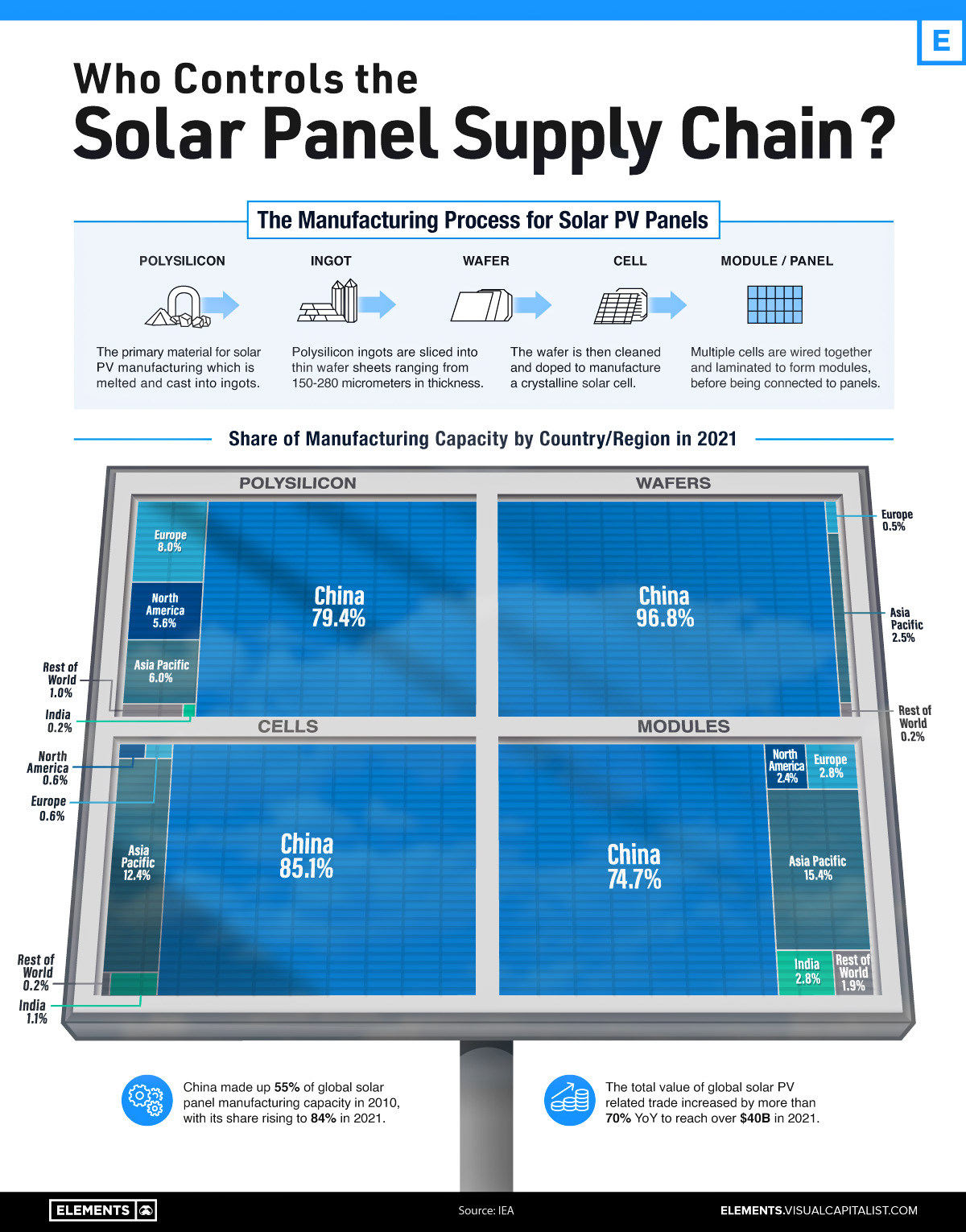

basically a nuclear power plant is a coal power plant which replaces a coal fire with the nuclear island. you can describe it most charitably as a coal power plant where the fuel is free and doesn't make carbon dioxide or pollute the air. the problem is that coal power plants would already be too expensive to compete with solar on a pure capex basis, even if the coal and other operational expenses were free
maybe if someone finds a way to make commercial nuclear power that doesn't involve driving an electromechanical generator with a steam turbine, nuclear could win. and obviously undersea and in parts of alaska nuclear is a better option
(i wrote a comment earlier tonight on the recent history of solar energy costs https://news.ycombinator.com/item?id=40723188 and its parent has a link to an excellent slide deck by fraunhofer ise https://www.ise.fraunhofer.de/content/dam/ise/de/documents/p... providing a lot more detail)