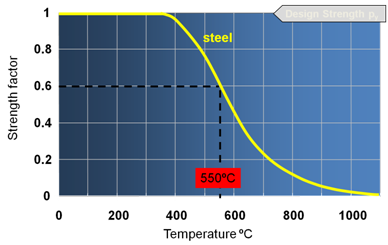
The outcome of this project is an illustration of a rule of thumb from materials science: many solid materials begin to lose their mechanical properties at about half their absolute melting point. This is why (for example) ordinary steel should not be used above about 550 C; there's too much creep.
I thought the "failed" result of the project was more due to economic factors, and the reduced need due to other actions in the war meaning a waterborne carrier was less useful. Not some issue with the mechanical properties of pykrete. If the tested properties were already past that 1/2 absolute temperature point and considered acceptable, it doesn't really matter what the behavior would have been at less than that.
"The full-sized ship would also need to have a range of 7,000 miles, support heavy bombers and be torpedo-proof. It was to be over a mile in length, weigh as much as 2.2 million tons and require as many as 26 electric motors to move and steer across the ocean."
That's a crazy target growing out of "cheap to produce aircraft carrier"
I'd add in that ot would have been difficult to operate as well.
For starters aircraft carriers face into the wind for takeoff and landing. So that means either engines for maneuvering (noted in the article) or support vessels. Presumably support vessels are vulnerable so not in the picture.
It would sail like a pig ‐ with 90% underwater it'll pretty much go where the current goes. And very slowly.
I imagine the engines would either be small (slow maneuvering) or large (need fuel etc).
Once you need significant fuel you need to store it. Plus of course all the men, and their stores. And a lot of this doesn't like freezing temperatures.
To be useful the thing presumably has to be far from land, presumably closer to the enemy. So the enemy deploys a bunch of anti-aircraft ships to basically follow the thing. Returning aircraft are sitting ducks.
I'm no mechanical engineer, but none of this makes any sense to me at all.
I'm even less an admiral or air marshall but I dont see any tactical or strategic advantage here either.
> I'm even less an admiral or air marshall but I dont see any tactical or strategic advantage here either.
Not disagreeing with your main points at all, but from a strat/tac point of view, up until later in the war, there was an air gap in the Atlantic where German U-Boats didn't have to worry about a significant air threat from the Allies. A large airfield parked mid-Atlantic might have significantly improved Allied air coverage, and helped reduce the stunningly bad shipping losses they were experiencing.
Exactly, and we also developed longer range aircraft and better anti-U-Boat weaponry. Hence my observation regarding the air gap that existed earlier in the war (not that the bergship would have been ready then)
If your runway is a mile long you can tolerate a lot more crosswind component (or, more precisely, aren't so desperate for every know of apparent headwind).
As I understand it, they found out they needed to refrigerate the ice to keep it from creeping too much, and this increased the cost too much for the idea to work.
The US did make some vessels out of concrete because of constraints on steel production. A famous example was a barge in the Pacific (I think at Ulithi?) that was devoted to making ice cream.
The article seems to make it clear that the refrigeration requirement was known from the start (how could it not be?) but that the amount of steel required had to be increased substantially to avoid creep in the ice.
Can you expand on this comment in the context of ice/water? It implies ice changes behavior at about 140K, but that isnt close to a phase change boundary, so what would you expect to be seeing here?
Also same with cold . Up north it’s a fools errand to run heavy machinery past about -55c. The steel develops tiny fractures, and six months later the ten ton loader will just break in half.
"Strength loss for steel is generally accepted to begin at about 300°C and increases rapidly after 400°C. By 550°C steel retains approximately 60% of its room temperature yield strength, and 45% of its stiffness. At high temperatures, steel is also subjected to significant thermal elongation, which may lead to adverse impacts, especially if it is restrained."