The world's climate has been consistent for most of the history of modern humanity - certainly since the advent of farming - until the 20th century.
Where humans grow their food is where they've been growing the same food for THOUSANDS of years.
Industrialization has certainly improved yields and the scale but by and large the spaces we allocate for farming have been chosen because they are optimal for the specific plants we grow there.
Rapidly changing climate means many of these locations will no longer be efficient or effective.
The regions of the world that are becoming more comparably temperate and perhaps theoretically would be the new ideal do not have the nutrients in the soil to be effective.
And anyways as long as the climate continues to evolve rapidly, they will not stay stable for long.
This isn't as simple as "We'll just start growing our food 100 kilometers to the north" and nothing else changes.
> The world's climate has been consistent for most of the history of modern humanity
That really was not the case.
Most major civilizational collapses (Bronze age, Rome) can be linked to climate change (of course premodern societies were generally much more sensitive to even relatively slight changes).
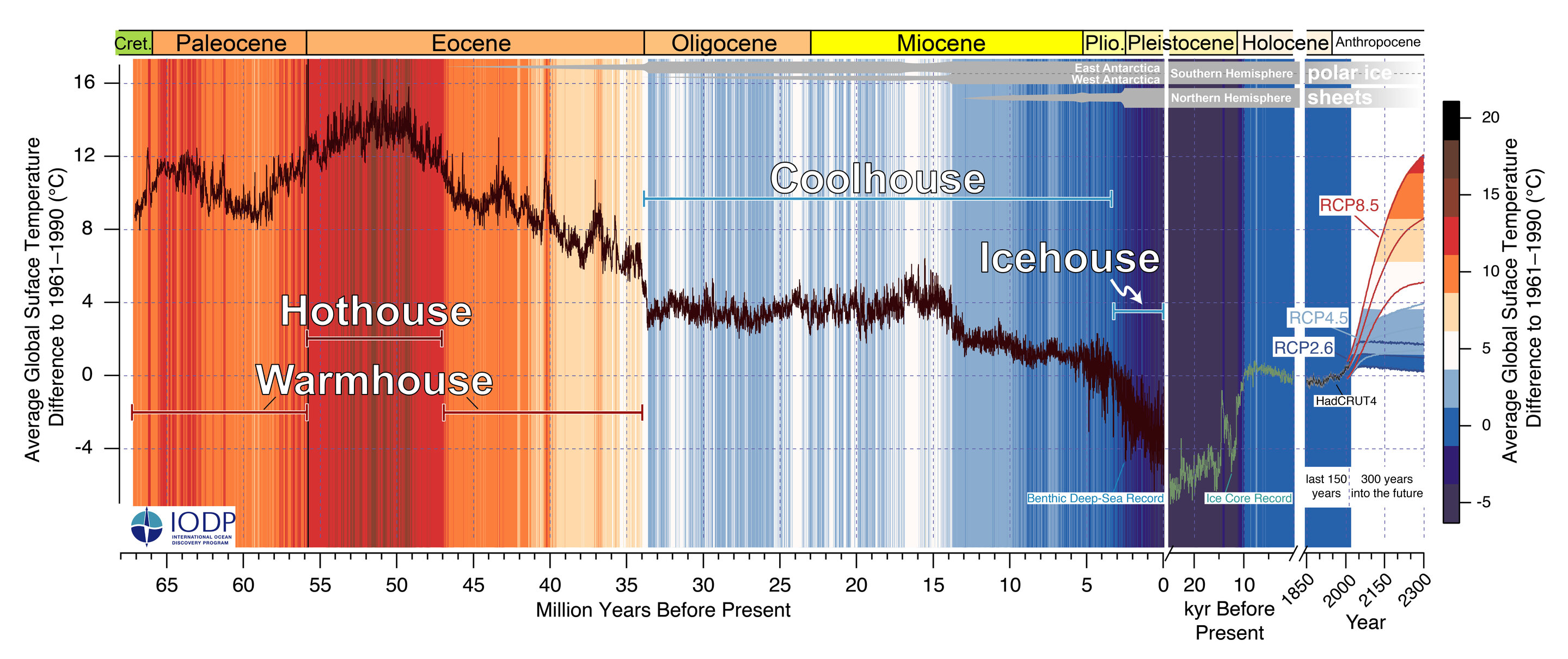
Note too that the timescale is discontinous, with the scale expanding at 30,000 years ago and in 1850 (173 years ago). The span to the right of 1850 shows 350 years, the span to the left of 1850 shows ~30,000 years, before expanding again to show 65 million years of climate history, back to the extinction of the (non-avian) dinosaurs.
Chart is "Average Global Surface Temperature: Difference to 1961--1990 (°C)". Citation is IODP: International Ocean Discovery Program.
Appearing in context here:
"High-fidelity record of Earth's climate history puts current changes in context" by University of California - Santa Cruz. September 10, 2020.
Except that all agricultural lands have increased production with increased CO2. There hasn't been any degrading of agriculture to date with the warming we've seen. And at 400ppm to 800ppm for CO2 you barely get any more greenhouse effect from this doubling, it's already nearly saturated. At most only .7C more increase which is easily manageable.
Plug in 400 and 800 here, it barely changes the effect:
https://climatemodels.uchicago.edu/modtran/
Yeah, but it's not just the CO2/temperatures alone.
Heatwaves, heavy rainfalls, droughts, hailstorms and other extreme weather events can devastate crops and disrupt agricultural systems.
Don't forget that overshoot is our problem, and climate change is just one of its symptoms. The loss of biodiversity, particularly pollinators like bees, can threaten crop yields. Increased pests and diseases. Soil erosion. Fires. Etc. etc.
A specific plant’s response to excess CO2 is sensitive to a variety of factors, including but not limited to: age, genetic variations, functional types, time of year, atmospheric composition, competing plants, disease and pest opportunities, moisture content, nutrient availability, temperature, and sunlight availability. The continued increase of CO2 will represent a powerful forcing agent for a wide variety of changes critical to the success of many plants, affecting natural ecosystems and with large implications for global food production. The global increase of CO2 is thus a grand biological experiment, with countless complications that make the net effect of this increase very difficult to predict with any appreciable level of detail.
Cyclonic energy may show a specific trend, but it's just one aspect of the broader climate system. While cyclones might not have intensified, the multifaceted impacts on agriculture, ecosystems, and weather patterns due to increasing CO2 are undeniable. The entire picture should be considered, not just isolated metrics.
Increased CO2 impacts agriculture through changes in precipitation patterns, heat stress, reduced soil moisture, soil salinity, accelerated weed growth, pest and disease proliferation, pollinator disruption, shifts in crop phenology, nutrient imbalances in crops, decreased water availability, altered growing seasons, and the possibility of novel crop diseases, to name just a few.
The full range of potential impacts is vast, complex, and is a subject of ongoing research.
> This isn't as simple as "We'll just start growing our food 100 kilometers to the north"
why not? doing that would ironically counter all your prior arguments. besides displacing the incumbents and needing adaptation, I do not see a reason why the poor need to be taxed 30% in energy costs in Seattle
Do you understand that last ~2C the permafrost melting accelerates climate change out of our control, and that the end result in a post-5C world is that the ozone layer goes to shit because of all that methane?
Do you understand food production shutdowns once we get beyond a certain carbon threshold?
It’s warmer now, but it won’t be very nice when you have to live in a cave because skin cancer will develop so quickly.
If you want a short answer 'Because even minor temperature variations play havoc with agricultural output. And 1.5 C isn't minor. Nor is it the limit for climate change - it's just the starting point.'
This is not a satisfying answer. Sure, temp variations affect current farms and what they currently grow, but if you assume adaptation, it’s not so straightforward.
"Adaptation" means: people moving from places that become uninhabitable (middle east, Africa, India, Latin America) to places that are inhabitable (Europe, USA, Russia, South America), while those people flee to places that become inhabitable (Alaska, Siberia). That's billions of people, trying to cross borders.
In the mean time there will be failed harvests and conflicts around the globe. Yes, we'll adapt, human kind in some form will survive, but it's pretty gloomy.
What if prevention is futile (human caused or not)? Wouldn't we be better off preparing (which seems practically possible) for the inevitable, rather than the futile exercise of burdening society with ESG, energy costs, etc
It's quite straightforward: The cost of 'adaptation' - moving global food production and populations - is astronomical; it's absurd. Just look at the impact of food logistics disruption in Ukraine.
Adaptation will require moving tens and hundreds of millions of people, and we live in a world where people were screaming bloody murder over accepting 20,000 refugees that were fleeing a civil war that we have been pouring weapons and missiles into for the past 12 years.


Put it this way, where is humanity suffering from the current hot temperature? Deaths are still far higher due to cold.
We are better off now at these CO2 levels than we were in the past century.
https://ourworldindata.org/crop-yields