If modellers were caught by surprise by this then they are clueless. But they weren't because population doesn't factor into models. They go straight from projections of CO2 levels, which have also grown at a constant rate:
> World population has grown at exactly the same rate for the last 70 years
Did you actually look at what you linked?
The main graph is only China and India and already shows a net inflection for China in the past few years. It will keep slowing. Read about population-lag effect.
The second graph nicely confirms that contrary to what you pretend population growth has started slowing globally.
There is no consensus about how much it will slow and when the peak will be reached. IPCCC had to adjust their hypotheses in the past because the lowest credible estimation where falling outside the lowest considered by the first climate model and some specialist argue we should look at even lower prediction. People in developing nations have stopped having large families faster than we thought.
> So it's not clear why you bring up population growth. It's not relevant.
If you don’t see how population size affects consumption, production and in fine pollution, I can’t do much for you.
> What is it and how is this impact measured in an undeniable way. It can't be temperatures because they don't track CO2 levels.
You are clearly arguing in bad faith or are clueless about the research surrounding climate change. In both case, I think it would be a waste of my time arguing further.
But as I said, they don't care about population, only CO2 levels, which also go up in a straight line.
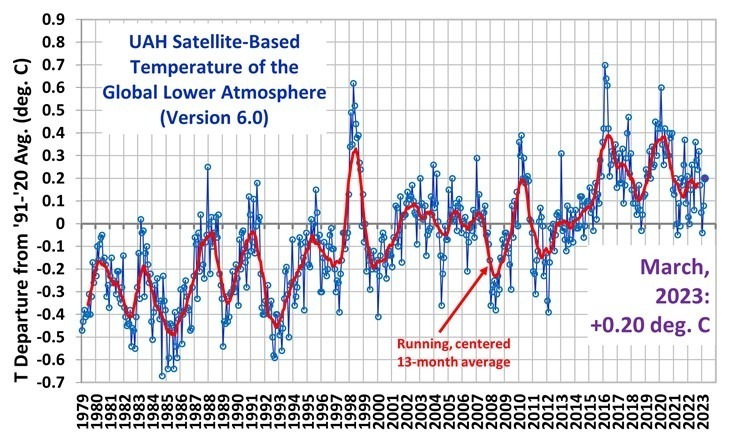
It would indeed be a waste of time for you to argue further, because you don't seem able to respond to the points being made. Here is a graph of temperature as measured by satellites. It consists of long flat periods, punctuated by sudden rises. This is not correlated with CO2, which grows smoothly.
I was serious when I said you should learn about the population-lag effect. The global population has been steadily declining since 1990 as even a cursory search would have shown you. So that eventual other readers haven’t entirely wasted their time, here is a link to the relevant UN source: https://population.un.org/wpp/Download/Standard/MostUsed/
I’m not going to bother answering the rest of your comment.
There is disagreement about when the peak will be reached. As your link shows, the UN puts it in 2086. The Global Burden of Disease Study published an article in the Lancet putting in 2064. The UN projection is solely based on current demographic trends and assumptions regarding life expectancy are quite optimistic. I have seen at least one study put the peak in the 40s while arguing that the rate of decrease in the total fertility rate is underestimated which while not likely is not impossible - historically predictions of variation in the TFR have not been very accurate.
Generally, the impact of potential feed back loops including climate change are understudied. There is a convincing argument to be made than worsening conditions could lead to the peak happening sooner.
At the end of the day, models remain models. They are not exact forecast. It's important to keep in mind when people argue we are doomed based on them.
(not a climate scientist)
Also, for the graph showing "peaks" - it seems to me that the "pattern of peaks" is constant through your graph, but the average temperature rises continually through the peaks.
If I were to guess, the peaks are things like volcanoes, currents and such, which are "constant" through time. The rise in CO2 is shown in the graph by the median not being a flat line.
If you have a step function and draw a trend line through it, the trend line will go up, but that doesn't imply a continuous process. CO2 forcing is (asserted to be) a continuous process. More co2 = higher temperature. The attempts to explain why that's observably not the case have become particularly wild in recent years, yet we are constantly told the science is settled and other untrue things.
Co2 is far from the only thing affecting temperature. The graph you're posting is clearly not a step function either. More like some kind of oscillation with an additional linear trend. Maybe the oscillation is el nino, it seems to be roughly periodic to 7 years or so, I don't know.
Edit: the bigger peaks are bang on el nino years, especially the '98 peak
Yep the step function is El Nino. There is also La Nina which can cool things, the AMO and other natural inputs that affect temperature. So it turns into a debate about how much each factors matters, which is the big set of unknowns that have no clear answer. Hence why the science isn't settled.
Modelling assumes it's carbon, that's taken as a premise. The models are built to calculate that the climate is stable if not for industrial activity. If the climate is simulated as non-stable even in pre-industrial times, that's assumed to represent a bug in the model.
Technically speaking, gradual increases and decreases over time don't have to be explained for CO2-doom to be wrong. Invalidating a theory doesn't require replacing it with a different one. But it could be AMO or sunspot activity or many other things that were once considered uncontroversially to have a big impact on the climate.
National Geographic, 1967:
Dr. Hurd C. Willett, Professor of Meteorology at Massachusetts Institute of Technology, suggests the answer. Dr. Willett, one of our staff affiliates this year, has shown us how cyclic changes in the climate closely parallel the cyclic changes in sunspot activity—the manifestations of powerful electrical energy discharges from the sun. We now feel confident that our investigations here back up the solar-climate theory of weather cycles.


https://ourworldindata.org/world-population-growth
If modellers were caught by surprise by this then they are clueless. But they weren't because population doesn't factor into models. They go straight from projections of CO2 levels, which have also grown at a constant rate:
https://gml.noaa.gov/ccgg/trends/
So it's not clear why you bring up population growth. It's not relevant.
>> there is undeniable evidence for human emitted CO2 having an impact
What is it and how is this impact measured in an undeniable way. It can't be temperatures because they don't track CO2 levels.