> likely have some non-compliance with the current electrical code.
It frustrates me that every year quite a lot of people are killed due to old houses not having whole-building GFCI's.
A GFCI costs only $20 and can be installed inside 10 minutes. So it seems crazy to be letting people die...
Yet typically electrical regs require that if an electrician installs a GFCI, they bring the whole house up to modern standards. Suddenly the $20+10 minute job has turned into a $15k and 3 weeks complete rewire. So most people don't have a key safety device added. And still every year people die from not having one.
Good luck finding an easy-to-install whole house GFCI in the US market.
IMO there should be standardized trip curves so that outlet GFCIs can coordinate with branch breaker GFCIs, which can coordinate with whole-house or other larger GFCIs, etc.
You really don’t want a 5mA GFCI on your house. You do want a 5mA GFCI somewhere involved for a regular outlet, though, especially if it’s anywhere damp or wet.
(And you probably do want a GFCI tripping at a larger leakage current on any outdoor circuit. Leakage on crappy outdoor wiring is very very common and can go undetected for years. And for some reason code allows new outdoor circuits to be run in galvanized steel conduit, and there seems to be little enforcement of the use of appropriate wire nuts and such outdoors. You can buy actual high quality submersible wire nuts, and stainless steel outdoor electrical boxes exist (at absolutely obscene prices), but they’re rare. So even nominally very fancy newish buildings do things like using regular galvanized steel outlet boxes outdoors by the ocean with predictable results.)
(A GFCI outlet does not help at all of your whole outlet box floors. A 100mA GFCI upstream would presumably trip very quickly.)
> Good luck finding an easy-to-install whole house GFCI in the US market.
Not sure I'd want one, to be honest. There are some devices that trip GFCIs and I don't think I'd like my mains to trip that easily. I just use GFCI breakers as necessary. And certain circuits I go with AFCI instead.
IIRC, in the US, code now requires AFCI pretty much everywhere except when GFCI is required.
And AFCI is a bit of a PITA, to the point where electricians advise me against adding anything new to existing circuits in my house (because then the local inspector would require a new AFCI breaker, apparently in other areas the inspectors are less picky and would be satisfied with an AFCI outlet).
Last time I had work done, which was about six months ago, we didn't have to use AFCI for anything other than bedrooms (and maybe others, nothing that applied to the four circuits I was having installed though). Maybe a very recent change?
I agree on them being a PITA sometimes. They're somewhat prone to thinking that electric motors (e.g. fans) are trying to start a fire.
In Germany where I lived for the past decade I have never seen a non-faulty device trip a RCB. The ones that tripped it hat the full 230V on their metal case.
1. Deep freezers are prone (for reasons unclear to me at my level of knowledge) to tripping GFCIs. For this reason they're allowed to be on a non-GFCI outlet in the garage (must be a single outlet receptacle by itself on the circuit).
2. Downstream GFCIs are prone to messing with upstream GFCIs, so you should not put them in series. My RV has it's own power distribution panel with GFCI, so it gets plugged into a dedicated TT-30 RV outlet without GFCI protection.
3. My Tesla doesn't like GFCIs at all. It does a brief ground check before charging and trips the outlet. Known issue, solution is to find an outlet that isn't protected by a GFCI. In a pinch, when I was renting my first Tesla from Turo I stole the freezer outlet in the garage for a few hours at a time to charge the car. When I bought my own Tesla, I put in level 2 of course, problem solved.
I'm all for GFCIs on individual circuits, that makes total sense. Just not on the mains.
1. Deep freezers are prone (for reasons unclear to me at my level of knowledge) to tripping GFCIs. For this reason they're allowed to be on a non-GFCI outlet in the garage (must be a single outlet receptacle by itself on the circuit)
Guess when the compressor kicks on you get sharp current spikes in units that do nothing to prevent that from hitting the grid.
> 2. Downstream GFCIs are prone to messing with upstream GFCIs, so you should not put them in series. My RV has it's own power distribution panel with GFCI, so it gets plugged into a dedicated TT-30 RV outlet without GFCI protection.
I don't know if this is an english word, but in German this known under the term selectivity. You cannot just put any RCD behind any RCD, you must select them specifically to have the downstream one trip first (otherwise, what is the use of having two in a row)?
3. My Tesla doesn't like GFCIs at all. It does a brief ground check before charging and trips the outlet. Known issue, solution is to find an outlet that isn't protected by a GFCI. In a pinch, when I was renting my first Tesla from Turo I stole the freezer outlet in the garage for a few hours at a time to charge the car. When I bought my own Tesla, I put in level 2 of course, problem solved.
Might be an issue with the wiring or the connector (some current is flowing where it should not flow), but it could also just be a broken GFCI.
selectivity is an English word. I usually hear it in the context of describing the bandwidth of a radio receiver system (how well the receiver can select signals of interest and reject others)
Now i'm a little confused, I think i have a global one of these in my house. I don't think there is a power point that isn't protected by one of these earth leakage type devices (I think they are called different things in Australia). They have been standard for a long, long time.
My Vitamix blender keeps tripping the GFCI breaker. (My panel was upgraded a few years back.)
My kitchen's circuits are to code (as far as I know). I've asked Vitamix themselves and on various forums (eg r/homeimprovement) about how to fix this. No joy so far.
There are device testers where you can check if the PE resistance and isolation resistance of your mixer are within spec. If not, it is a broken device.
The grid, wiring, connectors etc can also be tested.
In Germany any company is required to have external contracters carry out these tests every 24 months due to work safety laws, this test is called DGUV and I think there is an ISO equivalent. If you ever have an electrician over that is worth their money they should be able to carry out those tests.
My brand new Samsung fridge has tripped the upstream GFCI since day 1. Called an electrician, and he just moved it off the upstream circuit and called it a day
Filter caps in SMPSs can cause enough fault current to flow to trip your RCD if you have enough of them. The same with MOVs for surge protection that comes standard in many devices now (they are also capacitors when below the threshold voltage). With so many devices using SMPSs and having built in surge protection, the only sensible way forward is having RCBOs instead of MCBs on individual circuits. AFAIK, this is already becoming standard in some countries.
Ive never even heard of a 5mA GFCI. In Sweden afaik 30mA is the standard, and I assume much less likely to be tripped up by tiny faults.
Also, a GFCI install here is a simple and cheap affair. Does not require checking everything else or inspection or upgrading of fuse boxes or consumer unit.
There is a good chance that smoke detectors peep if random small fires break out in your house regularily.
There is also a good reason why you would like to know.
A tripping RCD is annoying, but not as annoying as dying from electrical shock and hurt all the way till you are dead because, guess what, you don't have a device that switches off the circuit if current flows where it should not.
Ah, and it could also kill your friend and make you liable for life. It could start a fire and ruin your whole existance. But yeah duh, so annoying.
Seriously, get an RCD. If it trips find out which part of your house sinks current into the environment in potential "he was killed in his sleep"-fashion.
Where I live RCDs are mandatory in every electrical installation.
Some old houses have exposed wiring in damp places, so there really is electricity leaking all the time. Theres probably some wire with paper insulation touching a plant root under the house, slowly steaming away.
OP is correct that in this case a GFCI would trip all the time.
But on the other hand, GFCI leaks are fairly easy to track down and fix, especially with the right equipment.
Old wiring with exposed conductors (!?!?!?) is a five-alarm fire situation (maybe even literally) and needs to be fixed, it's not a casual 'lol silly house' situation.
I had a GFCI installed in my 1930s built house the other week
The circuit repeatedly tripped, so the electrician uninstalled it. To install the GFCI he would need to spend 1-2 days splitting circuits to find the leak(s) so instead of ~$40 + 1 hours labour it's potentially thousands of dollars
Instead of spending thousands of dollars to fix the wiring, another option would be to spend hundreds of dollars installing GFCI outlets at every outlet instead of protecting the whole circuit with a GFCI breaker (or upstream GFCI outlet)
But if I had wiring that was leaking enough current to trip a GFCI, I'd rather find the fault in the wiring.
When I rewired an old house, the livingroom circuit kept tripping the GFCI breaker. It took a while to find, but apparently at a junction box, the bedroom circuit was connected to the livingroom neutral, so that neutral was connected to 2 circuits and was potentially overloaded.
Yep, that means somewhere there is current flowing through some pipe, some wall, something. And that is bad. 30mA is not much of a threshold, but it has been chosen because currents above that (or currents that flow longer than the 0,03s it should take maximum to trip an RCD will kill people. Not to speak of fire hazards.
So, somewhere you have a thing, that could kill you, a firend, a loved one or whomever. And you decide to ignore it because money. Where I live, if something would happen this could land you in prison.
I mean...this doesn't seem to apply to the GP, but you do understand that there are many, many people in the US for whom the amount of money needed to install that whole-house GFCI would be fine...but the amount needed to track down the faulty wire and fix it to make the house genuinely safe would bankrupt them?
Just FYI I am a certified electrical engineer and I do risk assessment as well, all the time. Certain things are "taking a risk" as in "there is sharp knife in the kitchen", others are just plain stupid like "one of the door knobs in this house is a knife".
So the results of my risk assessment might just look a little different, because I am more familiar with the matter and the potential consequences than you might be.
That might still be worth tracing, you may have a fire risk or a risk of electrocution on your hand there. It really shouldn't happen. Those things are typically 30 or 50 mA and that's a lot of heat (12W worth) at 240V.
so....you just left a significant phase to ground fault in your house wiring? That you live in? That seems like monumentally bad decision making if so.
Standard breakers only interrupt the hot side. Old wiring is full of shared neutral ghosts. It's not great but it isn't as dangerous as randomly dissipating the current throughout the house.
You need a AFCI in most places now. In the 2020 edition of the NEC®, Section 210.12 requires that for dwelling units, all 120-volt, single-phase, 15- and 20-ampere branch circuits supplying outlets or devices installed in dwelling unit kitchens, family rooms, dining rooms, living rooms, parlors, libraries, dens, bedrooms, sunrooms, recreation rooms, closets, hallways, laundry areas, or similar rooms or areas shall be protected by AFCIs.
The latest National Electrical Code requires both AFCI and GFCI protection only in kitchens and laundry rooms, but if you're already doing AFCI, why not do it all everywhere as it is clearly to be required at some point
Main downside is they are expensive. I've recently installed a new 24-slot subpanel and I'm using them everywhere required. At $50 a pop, that's a quick $1200.
See, this is the part I hate. I bet someone patented the design, then the NEC made it mandatory, and now they just rake in the money on something that likely costs <$10 to make. If something is legally mandatory, it should not be patented.
Some countries you have a single one for the whole building, rather than one per circuit.
That dramatically lowers the cost.
The only real downside is that if you accidentally put your finger in the toaster, rather than just the power to your kitchen cutting off, the power to the whole house cuts off. I think thats a fine tradeoff to save $1200.
The bigger downside is nuisance tripping because the breaker doesn't like electrical noise emitted by some device or another in your house. I don't have any AFCIs but I've heard it's pretty common.
You'd rather have one circuit go out instead of the whole house, and if all you have is the one AFCI breaker you're going to have a much harder time identifying what device(s) is the culprit.
I've mostly used them on new circuits, but have put them on a few of my older circuits too. For my small sample size, I've yet to have one nuisance trip.
Yeah I've replaced all of the breakers (to living areas) in my 90s home with AFCI ones. Haven't had any nuisance trips. If I had "nuisance trips" I'd be more worried about my wiring than about my breakers...
I guess you don't know if it's faulty until you try to use it. Manufacturing defects are a thing, but kind of a once every 30 years type thing, so maybe not a big deal to worry about. The reason you install circuit breakers and AFCIs is to avoid a fire in these cases; rare, but worthwhile to avoid.
Of course I should not be plugging in faulty devices. But sometimes appliances that were fine before break down, perhaps some insulation broke down or just the ravages of time.
I would absolutely like that to be safe. And like I said, if it's immediately life-saving, then I don't mind the power to the whole house being cut. But if it's "just" a bad appliance, then, well, I do find it a bit annoying that it reset all my electronics, and I would have preferred it if only that specific outlet was effected.
Also because plugging in faulty devices into outlets is something that ought to be safe. Because with probability 1 it will happen in every house. If the way the house is wired makes the only safe action to shut everything off that's the problem and shitty wiring.
Exactly: it's just like computer OSes. You should be able to run a faulty program that divides by zero or dereferences a null pointer without the whole computer crashing. The computer should flag the error, tell you what went wrong and why, and let you continue with your work and the other stuff going on in other windows.
real downside: many things work poorly on gfci stuff. E.g. A miter saw or welder. I had AFCI/GFCI breakers in my garage per code, but essentially no power tools work with those kinds of circuits.
GFCIs have a simple and well defined function. What is the current through one lead? What is the current through the other lead? Do they differ by more than x amount? If so, trip.
AFCIs are a whole different thing - the plug is trying to predict when arcing is happening somewhere downstream of it and it has very little in the way of 'processing' power to do it, so generally there is a classical filter that is designed to detect the characteristic harmonics of the current waveform that are inherent to an arcing condition. When you experience a sharp upward or downward step in power draw you introduce harmonics, when you have capacitive coupling between SMPS you introduce harmonics, motors often introduce harmonics, etc.
There's like a zillion things that can create AFCI trip conditions and cause spurious trips and frustration for users, and there's very few documented cases of them doing the thing they're supposed to do. I think it's a case of someone being well intentioned but releasing regulatory guidance to use a product that isn't quite there in terms of technology maturity.
Agreed on AFCI circuit breakers! They are now mandatory for all 15-20 amp light and plug circuits on new construction where I live - although breakers for large appliances do not require them. But I have several portable tools (eg a carpet cleaner) which will make an AFCI breaker trip every time. AFCI circuit breakers seem to be more fragile (read the box: much smaller range of acceptable heat and limited number of duty cycles) - I apparently killed one just by tripping it repeatedly. And while a regular 15 amp breaker is a few bucks, the CAFCI breaker I'm supposed to use is $45...
They highlight bad appliance design especially hard, while also being somewhat difficult to pinpoint due to the design of many electrical systems.
Arc detection is also basically somewhat complex RF processing, so there are multiple approaches to it and implementations vary.
Plus (detected) arcs are common with for example brushed motors.
Maybe there's something else the person you replied to would like to highlight, but I wouldn't call them a money grab, just made difficult due to some past choices.
AFCI's are of dubious effectiveness at their purpose (preventing fires). They're kinda snake oil because each manufacturer won't tell you under what exact conditions they'll trip. Somehow the law in the USA now requires them on every circuit, although they aren't used at all in Europe (which has a higher voltage yet far fewer electrical deaths).
FWIW, Google says 540 electrical deaths per year in Europe vs. 200 per year in the USA. Whether that's from lower voltage or more GFCI is anyone's guess.
According to the CPSC, who analyzed some 10s of thousands of fires, something like 50% of them were caused by wire arcing that could be prevented with AFCI breakers. This is the exact reason why the NFPA is moving the NEC towards eventually requiring AFCI on every circuit in the house.
Not an electrician, but an observer of tradespeople at r/electricians.
There are definitely bad feelings about these AFCI breakers. The feeling is that the code mandate for AFCI got out front of the reliability of actually-produced AFCI's, and actually-in-use products like blenders that may have small "arcing". This results in expensive call-backs from unhappy customers who are getting nuisance trips.
I recently installed some new circuits and was able to find them, but strangely it was $20 or more per circuit cheaper to get an AFCI/GFCI outlet and a regular breaker instead of combo breakers.
Is there a site that show what states have adopted what version? looking at my states webpage the official adopted code for my state is NFPA 70 - National Electrical Code, 2008 Edition.
Brushed motors in particular are largely indistinguishable from an arc fault. Lots of home motors (in vacuum cleaners, fans, blenders, food processors, garbage disposals, blah blah blah) use them.
They only need to be installed in specific places... But they ought to be installed for the whole house.
You do want your refrigerator on one. What when your mom is putting a metal saucepan into the fridge of leftovers, knocks and smashes the lamp inside, and the AC lamp power supply kills her though the metal saucepan?
What when a baby puts a fork into an electrical outlet in the living room?
What when floodwater comes in and kills everyone on the ground floor of your house while you are frantically wading in the water trying to move furniture upstairs?
There are plenty of times you want a whole house GFCI.
> You do want your refrigerator on one. What when your mom is putting a metal saucepan into the fridge of leftovers, knocks and smashes the lamp inside, and the AC lamp power supply kills her though the metal saucepan?
Your fridge scenario is.. fantasy. What is the path to ground? There isn’t one.. you can hold onto a live phase conductor all day and not get shocked if the circuit isn’t completed.
Refrigerator only needs a GFI if it is within a certain distance of a sink.
> What when a baby puts a fork into an electrical outlet in the living room?
The NEC requires tamper-resistant receptacles in all dwelling units.
Also re: flooding and GFIs, all basement receptacles need GFI protection due to flood risk.
> Refrigerator only needs a GFI if it is within a certain distance of a sink.
Not anymore. NEC 2023 requires GFCI for every 120 or 240V outlets in the kitchen, regardless of their location or proximity to the sink. This was a big change.
European GFCI's are 30mA, and don't false trip. US GFCI's are 5mA, and frequenty false trip.
lots of info here[1]
TL;DR: The US regulations prevent small electrical faults into things like swimming pools from causing people to drown. The european regulations will stop you getting killed by electricity directly, but won't stop you drowning if you happen to be in a pool while touching some wiring.
This thread is really baffling to this Dutchman. All houses have a house-wide residual-current device here; it is not a topic for debate at all. And indeed, these don't false trip.
US electrical wiring always weirds me out. Cables run through walls without pulling them through hard plastic conduits and sockets that look like something designed seventy years ago. It's probably a matter of perspective, but it seems like such a completely different approach.
Those hard plastic conduit are not providing much in the way of mechanical protection. wires in studs works pretty well, really.
Whole-house GFCI is a good thing, but we should be careful to consider what you get for that. In order for GFCIs to coordinate the whole-house device is going to trip at a relatively high current. This is definitely on the edge of what will disrupt the heart of a person. American GFCIs are often at the device level on the outlet, so they are more error prone in terms of spurious trips but they are also much, much safer because they are substantially more sensitive.
If the system voltage is between 150 V and 300 V, then either double insulation or a separate safety ground with the same gauge wire as the hot conductor is required; the purpose of the safety ground is to keep the equipment case or cabinet from reaching 150 V in case of a fault.
In this case a Class C GFCI may be used to provide fibrillation protection, let-go-protection is optional.
A Class C GFCI is 20mA trip current.
This will not spuriously trip your freezer. If you're having issues with this it's because you're designing your power distribution system incorrectly.
GFCIs also have a lifespan. Ideally they’ll be easily replaced at the breaker panel, but most of the time they are put on outlets. Those outlets could be in a difficult to reach location. They are about twice the cost of a regular outlet/breaker. AFCIs seem to be about three to four times.
My mom doesn’t live with me (the bulb inside the fridge is LED anyway), I don’t have a baby (babies don’t carry metal forks), and I live on the second floor (but the power would be out long before the first floor floods).
I agree that over-zealous GFCI is annoying. BUT, as a new parent, I can assure you that babies will manifest dangerous objects and do dangerous things.
I have twice lost a fridge full of food due to spurious GFCI trips, once when I was a recent graduate and it was a painful experience financially.
I now make sure my fridge/freezer is NOT on a GFCI. I'll take my chances of getting a 120VAC shock from my fridge [which is attention-getting, but very unlikely to be injurious].
Check out the YoLink temperature sensors on Amazon. They are amazing for monitoring our secondary freezer. All their sensors have been great. Temp for fridge/freezers, leak detectors, temp+humidity for basement, they have a motion sensor that is a magnet you can place in the back of your mailbox if you want to know when mail is delivered. Their door sensor can be installed on overhead garage doors by a magnet and a velcro strip for the part that goes on the wall. They also have a 1/4 mile range and the sensor can be inside your fridge/freezer and still connect. App is great, no monthly fee, you get notifications on your phone you can also get a small number of SMS messages for free. All notifications/limits are configurable.
Also funny how fridges are required to have their own circuit, but newer fridges are increasingly vfd/inverter drive, and don’t have surge power draws anymore. They use a few hundred watts continuously and that’s it.
I’d be more quickly to find out my fridge died if the lights in the kitchen stopped working.
Not sure why fridges don’t just have a battery-powered alarm that goes off when the temperature gets too high for too long.
I have a lot of power surges in my area. Recently, the old power shut off, then power back on in 3 seconds thing happened - and the surge was enough to pop my fridge motors and cause a $900 repair.
I upgraded them to not only a surge protector, but this little neat shut off device. It's a device that goes between the fridge and the wall outlet, and basically if for any reason this device loses power - it shuts off the power to the powered device for a minimum of 3 minutes. This way the power can blink 100 times in 3 minutes, and my fridge won't have to eat 100 surges. It will just happily sit off for 3 minutes, and then come back on.
What kind of fridge do you have that draws several hundred watts continuously? I haven’t tested my fridge, but I have a very large chest freezer that never draws more than ~35W. Surely a fridge can’t be 10x worse than that.
I seriously doubt that your freezer max draw is 35W. An Energy Star freezer can only average ~25W across the entire year. I doubt that the peak is less than 1.4x the average draw.
A fridge max power draw is usually during the defrost cycle. My defrost heater measures a bit over 500W.
You’re probably right, but I did watch my freezer plugged into a kill-a-watt for a while, and even when the compressor first kicked on, I never saw anything higher than 35W. Maybe the kill-a-watt is inaccurate, or maybe it doesn’t update fast enough, I’m not sure. Another factor, too: it doesn’t have any sort of auto defrost.
Different models and different designs and everything, but just as another data point, I recall my chest freezer pulling 300W+ when the compressor kicks on, and likely higher transient spikes, as it kept burning out the fuse on my 500W transformer, and I had to switch to a 1kW one.
A shock on 120VAC can absolutely kill. It’s not the volts which kill you, it’s the amps, and it’s specifically why GFCI trip at somewhere between 5mA and 30mA (depending) — it’s because those are not levels as likely to cause fibrillation.
> In the U.K., you just can’t have plugs in bathrooms (aside from the shaver plug),
Disclaimer: I'm not an electrician
My understanding is that is not entirely technically correct.
You can have standard sockets in bathrooms in the UK.
But, and it's a big BUT, 99.999% of bathrooms in the UK are not big enough to be able to place the socket 3m away from the relevant wet "zone" (shower and/or bath and/or sink, IIRC).
However, IIRC, shaver sockets are OK, as are spurs. Irrespective of bathroom size.
You’re correct, bathrooms in UK are zoned and most houses aren’t big enough to meet the distance requirements from the “wet zones” to accommodate a regular socket/outlet.
Shaver sockets are typically going to have ingress protection.
My understanding is a GFCI is an American term for an RCD or an RCBO?
My (UK) fridge is on a standard 30A breaker which itself comes off a single 80A/30mA RCD which was presumably part of the regs at one point. It's never tripped. All the RCBOs I've seen are 30mA too.
(I have some sockets on a 10A breaker downstream of this which have tripped - the house needs a total rewire, total bunch of bodge jobs from the previous owner, including a 13A socket in the bathroom)
Does a GFCI typically have a lower trip that 30mA?
It's funny, In was doing a huge renovation once and during the work my refrigerator had to be plugged into another outlet that happened to be GFCI. We had to be very mindful about making sure power was flowing. Sometimes, certain combinations of things being on at the same time would trip it. It was an old house with only 100A service and who knows what with the wiring.
America has 110 V which is more of a nuisance than a threat when it’s dry. Our GFCIs are specifically for wet applications (like bathrooms) and so are much more sensitive than European GFCIs.
Because they trip much more easily, and they are sinply not needed all the time. Plugging a motorized refrigerator full of perishable food to a GFCI receptacle is a bad idea.
I used to work on residential construction jobsites and the only power on-site would be a pair of GFCI duplex receptacles in the basement beside the panel. Tripping the actual overload breaker was rare (and usually only happened when multiple people were running off a single extension cord), but the damn GFCI breakers on the receptacles themselves tripped all the time, particularly when the table saw was running at full tilt for 20 minutes straight. They're just too sensitive for certain applications. Now, you can buy combined overload/GFCI circuit breakers for in the panel, but they're ridiculously overpriced so no one uses them, and they're probably just as sensitive.
There is no way a pro can install a GFCI for less than $150 in the ideal case where everything else is up to code. Anything non ideal adds cost. While there isn't much labor, you also have to count the time to get from the last job to yours, and other overhead.
While potentially true, this does not speak to the biggest part of their statement, which was that a predicted small cost project becomes an enormous cost project so regularly to the point that the smaller cost projects are altogether ignored, to the detriment of all.
$150, $1000, all of these are smaller than $15,000. One is a surprise laptop breaking and needing replace. The other is a surprise car purchase and cash purchase.
I'm guessing he was talking about DIY. It's not really that hard, I did it in the 3 circuits in my garage. I'm no pro, although I'm fairly knowledgeable in electronics and electricity.
If you have one guy spending 10 mins in every house on a street, he can probably fit GFCI's to 40 houses in a day. But that's only possible if it's a government/power company scheme. Installation could be even quicker and cheaper if it's installed internal to the electricity meter by the power company, and then you don't even need the homeowner home to do it.
Power companies have an incentive to add GFCI's, because ground leakage costs them real money, and those power flows are only 50% measured by the power meter (depending on the meter design). A 100 milliamp leak at 230 volts costs ~$30/yr or so.
I hate the damn things. If a breaker pops, it's easy. You have a box, maybe two if you live in a really huge house. Go there, look for the switch that's not quite lined up, toggle switch, done.
GFCI, you gotta figure out which one popped. If the wiring's not great, it may well be in a totally different room from the outlet that stopped working. On top of it, they seem to outright fail (get stuck in a broken state, start tripping under even very light load, simply stop working at all) much faster than breaker-box switches (I'm... actually not sure I've ever seen one of those fail? I've had several GFCI outlets fail, across multiple houses).
I get why they're good to have, but they're really annoying. And expensive.
> If a breaker pops, it's easy. You have a box, maybe two if you live in a really huge house. Go there, look for the switch that's not quite lined up, toggle switch, done.
FWIW, you can have the same thing with GFCIs. I recently wired my garage for woodworking and installed all GFCI breakers in the breaker box, so a GFCI trip is just like a regular breaker trip (not that either of those has happened with the new circuits). The GFCI breakers cost about $50/ea [1] and protect the whole circuit.
> GFCI, you gotta figure out which one popped. If the wiring's not great, it may well be in a totally different room from the outlet that stopped working.
I once couldn't operate my garage door for a few days. There were no tripped breakers in the box. Eventually, it dawned on me that the circuit was labeled "GFCI" so maybe I should go check the GFCIs in the house, and I found that the GFCI in the upstairs bathroom had tripped. The upstairs GFCI is nowhere near the garage (and in the opposite direction from the breaker box). Since then, I've talked to several people in the area whose houses are wired the same way. I guess GFCIs must have been really expensive in the 80s, when these houses were built.
The moral of this story is that GFCI breakers can save a lot of headache. (Plus, those GFCI outlets are kinda ugly IMO).
Ground fault interrupters are life savers. The minor overhead of figuring out the cause is well worth the price of admission: without them you might not be around to figure anything out.
In the UK, where ground fault interrupters can be part of the sockets it can be hassle, but then again that is strictly optional: in most other countries the ground fault interrupters are always integrated into the circuit breaker at the distribution panel. The upside of that it is that it also protects the wiring.
Wow ok, I've never seen that in the wild. RCDs are required on all circuits including lighting in the current regs (i.e. old installations can not have them and be compliant, but they have been required and socket circuits for a long time; bathroom & outdoor lighting for less; all lighting more recently). Maybe these sockets are for when you have no more room in the panel and don't want to replace it, but need it upgraded due to other work or to pass an EICR to let the property? Not sure.
The university halls that I lived in had those RCD sockets installed. The halls dated back to the early 60s - the sockets + Ethernet were installed in perimeter trunking. I suspect it was the cheapest option available to the university to modernise the electrical infrastructure inside the halls.
It's weird on imported goods here in the UK too. Macs are infamous for the fuzzy feeling of the double not-quite-insulated chassis. My Marantz amplifier (not US made but also sold there) that arrived today is the same. Weird looking plug too, like they had to go out of their way to source a dummy Earth to Earthless kettle lead and the result is bizarre and cheap looking but it's all they could get, because it's a weird requirement.
Grounded outlets became code for kitchens and baths in 1961, although it wasn't that uncommon to see in '50s new construction. 1971 code started requiring them throughout the house.
What are you talking about? GFCIs are integrated into the outlet. Did you mean something about chaining GFCI plug wiring? If it's even possible, such a wiring configuration seems like an obvious building code safety violation.
Edit 1: If you're in Europe, my apologies - I have no experience with the wiring outside of the US. It sounds genuinely annoying and a bad user experience indeed.
Circuit breaker versus GFCI outlets (which also have breakers). I find the former far more convenient—I know they don't serve the same purpose, but the way one interacts with them is similar, except that the GFCIs are scattered all over the place and may require moving things to find.
> If it's even possible, such a wiring configuration seems like an obvious building code safety violation.
Norm in every house I've lived in in the US (except one so old it had knob-and-tube wiring... hahaha) is one GFCI for a set of outlets. Like, if you have a long vanity in a largish bathroom, you might end up with two or three outlets, one GFCI, the others following after it so they trip it, too. The only times I've seen a single one used with nothing hanging off it is when it's the only outlet in the room, or for under-sink outlets for dishwashers and disposals to plug into. This can turn into a real mess if anyone got "creative" with wiring at any point. We've had a garage GFCI kill a couple outlets in the house proper (in a nearby laundry room, not super distant), plus an outdoor outlet probably 30 feet away, all of which were evidently attached to it.
Every GFCI outlet has a line side and a load side designed specifically for protecting additional downstream outlets. it's perfectly safe and legal (and a great way to protect multiple outlets, especially in older houses with ungrounded outlets).
What OP is saying is that one of those downstream outlets can trip the GFCI and if you don't know which GFCI it tripped, then you have to go looking.
Right, that. And it's not like they're intolerable or anything, but they do represent a pretty high percentage of the time I spend messing with my house's electrical system. It's probably light bulbs (I swear, all but the crazy-expensive LED bulbs are blatantly lying about their lifespan, like by a literal order of magnitude) then GFCI stuff after that.
If single phase you'll notice sometimes it has a little extra ground wire connected (now mostly obsolete), for 3 phase it doesn't, in both cases it will say so on the outside (typically: the test current, and usually there is a test button which makes them easy to identify, this test button forces a small leak causing the circuit to become unbalanced resulting in a trip (if it doesn't trip when the test button is pressed the breaker is considered faulty and should be replaced).
For instance, here is an 'Eaton' 3 phase breaker with integrated ground fault protection circuitry:
Note the little yellow 'test' button. That's a 30 mA fault current device, you can have higher permissible fault currents for certain gear that tends to be a bit more leaky which would otherwise cause nuisance trips. These little things are quite the work of art inside, if you ever have a faulty one I would encourage you to pick it apart to see what makes it tick.
Circuit breakers trip when there's too much current going through the circuit (enough to melt the wiring for example), and so protect from short-circuits: hot and neutral touching each other, or a short in equipment.
GFCIs protect against current leaking to ground, by detecting if the current flowing on a hot and neutral leg are different. If they're different, the current must be going somewhere else: to ground, through you, etc. The GFCI breakers do this in the breaker, the outlets do it at the outlet. As someone else mentioned, you can also have other non-GFCI outlets chained to a GFCI outlet, so that upstream outlet is the one that pops if there's a fault.
TL;DR they detect and protect against different fault conditions.
4 people per week in the USA [1]. GFCI devices would prevent almost all of those. There are a very small number of ways to electrocute yourself even with a GFCI installed, but you are unlikely to find one of those unless you have electrical expertise and are suicidal.
There are a few things that aren't practical to protect with a GFCI, such as high voltage grid power transmission cables. But people killed by those I wouldn't think are included in deaths 'at home'.
It frustrates me that every year quite a lot of people are killed due to old houses not having whole-building GFCI's
A whole building GFCI sounds like a bad idea, throwing the entire house into darkness as well as cutting off the refrigerator and HVAC because a contractor plugged in a damp power tool in an outside outlet sounds like a bad idea. Worse if you were out of town when it happened.
There are many ordinary motors that will leak just a bit to ground, enough to trip the GFCI, but no hazard exists — this would mean disabling the whole building, computers, refrigeration, water pumping, etc. just turning on that device. I've actually got one in a treadmill, and also a wood router tool - they trip the garage GFCI every time. At first I was concerned and "what's wrong with these things?". but as far as I could read, there is no issue, just an issue with certain types of motors that is no hazard, but a basic incompatibility.
And yes, being able to kill the entire power to the house merely by plugging a device into one of the outside outlets would be an insane vulnerability, not just by the contractor's accident you mentioned, but also by deliberate action - great way to start a burglary or home invasion, don't even need to find a wire to cut.


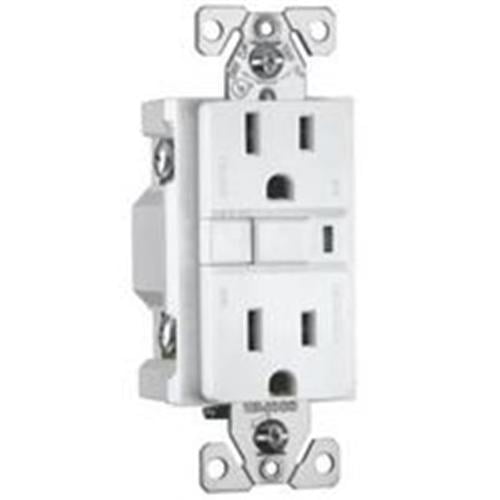
/cdn.vox-cdn.com/uploads/chorus_asset/file/21847995/iStock_1169476062.jpg)
It frustrates me that every year quite a lot of people are killed due to old houses not having whole-building GFCI's.
A GFCI costs only $20 and can be installed inside 10 minutes. So it seems crazy to be letting people die...
Yet typically electrical regs require that if an electrician installs a GFCI, they bring the whole house up to modern standards. Suddenly the $20+10 minute job has turned into a $15k and 3 weeks complete rewire. So most people don't have a key safety device added. And still every year people die from not having one.