Nice savings! Tho no ingenuity is needed to calculate them as there is actually an established process used in the energy saving business. It uses "degree days" that are derived from temperature measurements, rather than using temperature measurements directly.
Degree days work better in regression as, assuming the correct base temperature is chosen/calculated, heating degree days are directly proportional to heating energy consumption (including being zero when it is warm enough that no heating is needed) and cooling degree days are directly proportional to cooling energy consumption.
I'll just add a little more explanation here since our site goes pretty in depth and I imagine most here would only be interested in a brief overview:
So buildings have what is known as a heating base temperature, which is the outside temperature above which heating is not needed inside the building. This is not the thermostat temperature inside the building (say 20 C), it is actually lower because of various factors like people and electrical equipment generating "free heat" inside the building, and how well the building is insulated to retain that free heat.
The base temperature varies from building to building, but let's say, for example, a fairly-well-insulated home might have a heating base temperature of 14 C. If the temperature outside is 14 C or above, that building will stay perfectly warm inside on its own, without the heating system needing to come on.
But, if the outside temperature drops below 14 C the building will need some heating to keep it comfortable inside. How much heating it needs will depend on how much the temperature drops below 14 C, and for how long.
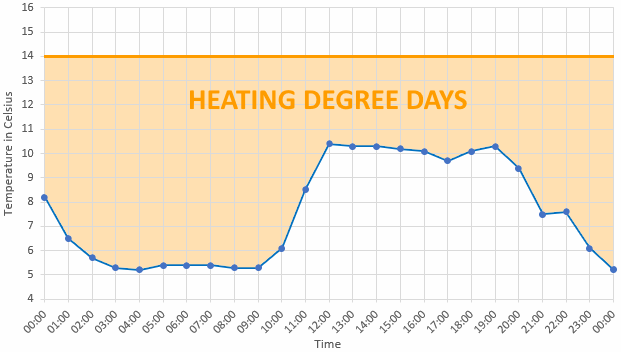
And this is what heating degree days quantify. Here is an example diagram that demonstrates quite nicely how they are calculated (using a base temperature of 14 C):
The neat thing is that the heating degree days for any period of time represent all the relevant temperature variations across that period of time, and assuming you used an appropriate base temperature, are proportional to the heating energy consumption over that period of time. So for example you can have just one figure that represents the heating degree days across an entire week/month/year, and that will encapsulate all the relevant temperature variations across that week/month/year.
If January had 200 heating degree days, and February had 300, you can expect the heating energy consumption of the building to be 50% greater in February than in January. (Assuming you have chosen the right base temperature for your building that is!)
Compare this with knowing that the average temperature across a week/month/year was 12 C. What does that tell you about how much heating was needed in that week/month/year? Not a lot, cos you have no idea how much it varied within that time. This is the case even within a single day, since the temperature can vary a lot within a day.
Hence why people in the energy-saving business would typically use degree days rather than temperature data :)
(That said, hourly temperature data or similar is good for more sophisticated building simulations. But those are a lot more involved. On the simpler end of the spectrum degree days are a much better choice.)
One thing people are not so much aware about other than insulation is air sealing. A tiny gap that may seem like nothing is in fact very bad. Take windows notoriously bad for heat and air leaks. A small seam along a window that isn't locked (it should be) could be the equivalent of having a 1cm hole in the wall.
If insulated well and air sealed a home would lose very little energy. But also you'd need a good air handling system to move and refresh the air.
> But also you'd need a good air handling system to move and refresh the air.
And therein is the rub! Ventilation is critical in building design and many older houses cannot easily be retrofitted with a mechanical ventilation system, not to mention the costs.
Also, sealing air gaps is pretty much impossible in a house that wasn't built this way. I have been trying all kinds of things in my (30 year old) house to seal up gaps but there are spaces inside the floors to the outside through small mortar gaps, spaces behind electrical sockets, gaps in various parts of the floor and even around windows between the finishing.
I would personally like to see a more top-level view from governments. In the UK, for instance, they should be targetting the oldest housing stock and simply replacing it. I know this is hard because people own their freeholds but if we are serious and if someone would get a nice warm house in return for their old house then I think most people would be up for it.
Have you heard of AeroBarrier[0]? It's an aerosolized silicon sealant that is sprayed throughout a home while a pressure door system is used to negatively pressurize a house. The silicon is sucked through all the tiny gaps and fills them. It's pretty crazy.
That's right. The other day I drove by a house that's currently undergoing renovation, but the guy who owns the house does everything himself in a jack-of-all-trades kind of manner. He had put on a nice thick layer of insulation on the outside, but the sheets/blocks were apparently too short in some parts or simply fitted poorly, and in other areas I saw that he had just used some left-over cut-offs of various shapes and sizes in what looked almost like a mosaic. To make everything stick and fit, tons of sprayfoam has been used in an attempt to fill the inevitable large gaps (1 inch) between the blocks.
I kinda feel sorry for the guy, investing all the hard work and having good intentions, but due to poor workman ship he cannot expect to get the insulating effects he's surely hoping for.
In terms of CO2 specifically we can think of it as the 'embodied carbon' which the CO2 created during manufacturing of the parts, transportation, and assembly. Then we have the 'operational carbon' which is the day to day impact.
So to amortise the carbon cost we take the embodied carbon, plus the operation carbon over a time frame. If the operational carbon is negative we would expect that at some point it would break even.
So to help with the English, I don't think it makes sense to talk about the amortisation during the change over since that is just the embodied carbon. But I think it definitely makes sense to talk about the amortised cost over some other time period after the change over.
One thing to point out is that yes, saving CO2 is grand, but this doesn't sell just how much more _comfortable_ decent insulation makes things.
I live in a '30s UK semi detached. It had an air brick , a blocked up fire place and blown double glazing in each room. (barring two that were replaced)
We had to re-render the place, as it was starting to fall off at the front, and the back was scarred from unfinished renovations.
We replaced the double glazing with triple (it was cheaper than double glazing at the time, so a no brainer. has a u-value of about 1.0)
We also put 90mm of external wall insulation round the outside as part of the re-render. This cost an extra £4k compared to just a normal re-render.
before the insulation, in summer the front room would reach 37 degrees C with the blinds down, and in winter with a 5kw wood burner and central heating on full we'd reach about 18 degrees c when outside was either windy or -3c
Now in summer the hottest we've had it is about 29, with the blinds open. In winter we reach 20 within 30 minutes of the heating coming on. ( no need for the wood burner)
I wish I had done that to my father's home last year when he was alive. I didn't realize how much heat can come into a home from the attic. The joists act as a heat bridge radiating heat down from the ceiling. I plan on installing fibre wool in two layers one in joist cavities and one perpendicular over the exposed wood frame.
My parents also have a door to the attic for storage and heat leaks up through the un-insulated edge of the pull-down stairs door.
On YouTube Matt Risinger is a great resource for home repair and information. He tends to like expensive products but overall he explains main concepts well.
Early on, Risinger did a bunch "building science" explainer videos. Challenging then conventional building practices. Like advanced framing (using 2x6 studs at 24" spacing). Like properly insulate attics to prevent condensation and heat loss (keep HVAC vents within the thermal envelope).
Those early explainers are the foundation (harhar) of subsequent product and project highlights. Alas, now they're hard to find (via YouTube's lame UX). Risinger should probably pin primers to the top of his playlist, linking into his archive.
> We also put 90mm of external wall insulation round the outside as part of the re-render. This cost an extra £4k compared to just a normal re-render.
Having insulation on the outside of your structure, and especially outside of your air/vapour barrier, is ideally where you want it (behind whatever cladding you're using):
For us it stopped our moisture problem. We had mold growing on the walls, because all the moist air would hit the wall and dump out water (proper drops).
Now the walls are 10 degrees warmer, none of that condensation is built up.
there is also thermal mass and junk, but not having to wipe down the walls every night is a big big win
This is going off-topic somewhat, but I am thoroughly confused by the article you link to. The author insists we should put the rain control layer inside of the insulation, even on roofs.
He does not go into much detail on roofs, but in his wall examples, the outer cladding and the drained cavity behind it appear to be a de-facto rain control barrier outside of the insulation layer (which could be, he says, rock wool or glass fiber, which are surely a big problem if they get wet, right?) If this is so, then what does it mean to say the insulation is outside of the rain control barrier? Furthermore, if we combine these diagrams with the one showing a roof-wall junction, there does not seem to be any barrier against rainwater reaching the wall insulation that way, and I cannot see how this is not a problem.
> If this is so, then what does it mean to say the insulation is outside of the rain control barrier?
Yes, the cladding is acting as a bulk water control layer, but there is still moisture in the air from humidity.
* In a cold climate the warmer/moister inside air will at some point reach the edge of the building: by having the insulation on the outside of the control layer(s), the air will be kept warm, and so there won't be a cold surface for it condense on. If the insulation was on the inside then the control layer would be cold, where the air would condense, possibly causing mold growth.
* In a hot/humid climate the humid outside may get by the insulation and hit the cooler control layer and condense, but will just roll off the control layer outside of the building (and not cause mold inside).
> Furthermore, if we combine these diagrams with the one showing a roof-wall junction, there does not seem to be any barrier against rainwater reaching the wall insulation that way.
This is probably regarding Figure 5. All the various layers are connected to each other, so what's on the inside cannot get out, and what's on the outside cannot get in.
The black line (air/vapour layers) is continuous up the wall, around the corner, and onto the roof. The light blue (insulation) goes continuous up the wall, around the corner, and onto the roof. And the cladding is also continuous so that bulk water and UV rays are also blocked continuously.
That is what I originally thought it might mean, but the article uses the term "rain control barrier", and has a separate item for vapor control.
With regard to their relative placement, see, for example, the caption to figure 2:
"Figure 2: "The Perfect Roof"—The perfect roof is sometime referred to as an “inverted roof” since the rainwater control layer is under the insulation and ballast." [my emphasis.]
The author also writes, in the caption to fig. 1: "The claddings function is principally to act as an ultra-violet screen", thus seeming to differentiate it from any of the control layers he listed at the start of the article.
In addition, the author also lists a separate item for air control, but later writes "What about this air control thing? Well air can carry a lot of water and water is bad for the structure" - further muddying the issue, as now he seems to be discussing water vapor.
I guess this could all be attributed to being sloppy about definitions, to the point of being unambiguously wrong when it comes to roofs.
> The author also writes, in the caption to fig. 1: "The claddings function is principally to act as an ultra-violet screen", thus seeming to differentiate it from any of the control layers he listed at the start of the article.
The cladding can not stop any water and, if the control layers beneath the insulation are properly installed, it won't make any difference. The fact that the cladding does help in blocking rain is just a nice bonus to its primary function.
In some locations it may be difficult for the cladding to do this: think of any place very foggy. There's no way to make the cladding air tight, so high humidity (100%) air will get behind it (stopped by the c. layers). Or if you have shingles on your roof that leak (or get blown off in a storm), they can still block UV, but there will be dripping. And that's why you want the control layer(s) further in.
Water can destroy a structure very quickly if you don't allow for easy/quick drying. Defense in depth.
> In addition, the author also lists a separate item for air control, but later writes "What about this air control thing? Well air can carry a lot of water and water is bad for the structure" - further muddying the issue, as now he seems to be discussing water vapor.
At the top of the article he lists the control layers in order of importance. Controlling for air is more important than control for vapour, as this video explains:
It's just if you control for air you also just happen to do a lot of controlling for vapour. There's can be a lot of moisture in air, i.e., humidity.
Further there can be some subtleties with moisture/vapour: in many case you want to stop any flow either in or out of the building; in other cases you want to control air but let moisture out:
> The cladding can not stop any water... The fact that the cladding does help in blocking rain...
Clearly you are using some words differently than I do, but it is not clear to me which ones.
>...blocking rain is just a nice bonus to its primary function.
In our house and our neighbor's houses, blocking rainwater is its primary function - we do not live in a desert.
> Or if you have shingles on your roof that leak (or get blown off in a storm), they can still block UV, but there will be dripping. And that's why you want the control layer(s) further in.
And that is when you need to fix your roof, regardless of what is underneath.
In your replies here, you seem to be trying to turn this into a discussion about water vapor, but I have made it very clear that a) my questions are about what the author has to say about rain and water, and b) the author himself makes a distinction between water and vapor control.
Tellingly, you have nothing to say about this quote from the article:
"Figure 2: "The Perfect Roof"—The perfect roof is sometime referred to as an “inverted roof” since the rainwater control layer is under the insulation and ballast." [my emphasis.]
> In our house and our neighbor's houses, blocking rainwater is its primary function - we do not live in a desert.
Wherever you live the sun shines, and UV damage can be extensive against materials that are not designed against it. Cladding is about physical protection to the layers underneath.
> And that is when you need to fix your roof, regardless of what is underneath.
Yes, when you notice it. The shingles may be leaking into the roof structure without you seeing it for a while. Then once the roof has disintegrated, the leakage may go into the attic, which most people don't visit/inspect very often.
So by the time it gets to the ceiling in the livable space, where it is actually noticeable, there could be a lot of damage done.
> "Figure 2: "The Perfect Roof"—The perfect roof is sometime referred to as an “inverted roof” since the rainwater control layer is under the insulation and ballast." [my emphasis.]
You can call the things Foo, Bar, Baz, or whatever you want. The important points are the principals in the design and the order in which the different layers are (ideally) put together.
>>>...blocking rain is just a nice bonus to its primary function.
>> In our house and our neighbor's houses, blocking rainwater is its primary function - we do not live in a desert.
> Wherever you live the sun shines, and UV damage can be extensive against materials that are not designed against it. Cladding is about physical protection to the layers underneath.
This is a non-sequitur on at least two levels. Firstly, regardless of the truth of your statement about UV, it does nothing to address the point I was making here. If our houses were stripped of their cladding, they would soon fail - from rainwater damage, long before UV took its toll. Secondly, it is yet another attempt to avoid the overall issue, which is the author's position on the placement of the rain (not vapor or UV) barrier.
You seem to think that you can make an argument by quoting out of context and then stating some vaguely related fact, but, unless that fact has relevance, it does not work. Your comment about roof repair is of the same type.
> You can call the things Foo, Bar, Baz, or whatever you want.
This is just ridiculous. You are not even trying to address the question.
> If you want to argue Joe Lstiburek, be my guest:
I am not arguing with Joe Lstiburek, I asked a question about something he wrote, and have ended up arguing with you about what you mistakenly think would work as answers to that question. Your replies make it clear that you are no Joe Lstiburek.
it seems these 'perfect' walls are really double walls, with an exterior wall and interior wall separated by a "control layer" that blocks air and moisture/vapor penetration, and reduces heat transfer.
the exterior wall features brick/stone cladding as a primary rain/UV barrier and thermal buffer, and a channel to wick away air, heat, and moisture on its interior, before hitting the "control layer".
the interior wall can be concrete block, steel frame, or wood frame, with only the latter insulated, and with a semi-permeable interior skin (gypsum board + latex paint).
both walls are designed to wick moisture away from the control layer to reduce mold and other problems.
the big downside to these perfect walls are that they're actually two walls, and as such, (roughly) twice the cost of regular stick-built walls, and they're twice as thick, which, given a fixed lot size, reduces interior square footage.
Specifically with insulation, have you had trouble with air exchange?
I keep hearing (to my naive/inexperienced/non-builder mind) contradictory advice about how insulated houses should be, and I've been trying to figure out how to square decreasing heating/cooling costs with keeping a house from feeling stuffy.
I guess for stuff like the triple glazing that's not really affecting air exchange in the first place, it's just preventing energy loss, since you're already not doing air exchange through your wall. And maybe getting better insulation in walls means you can crack open a window without it being as much of a problem?
Modern construction standards like Passive House call for an extremely well insulated and air tight building envelope. Because you're no longer losing conditioned air to drafts, they then use a system that constantly brings fresh air from outside, runs it through a heat exchanger to extract most of the heat (or cool, and in some cases moisture) from the conditioned air before it's exhausted. Generally you constantly pump fresh air into the living areas and bedrooms and exhaust air from the bathrooms and kitchen (places with lots of moisture and smells).
This is very important. But there’s a good solution (last paragraph).
Our old house, built in the 1920s had been basically sealed. Since it was only 1600 sqft and had no air ducts, the rooms were small and got terribly icky. Id crack the window open in the winter to get rid of the humidity (in PA, so hardly mild winter).
You have to realize that a lot of moisture from those those 8 tall glasses of water you’re supposed to drink leave your body as vapor. I think I’ve read half the water you expel is through your lungs [citation needed]?
If your house is sealed this water has no where to go. If there’s four of you it gets bad very quickly. This moisture eventually will escape through your drywall, into your insulation and finally through the cracks of tour siding; but that means materials that should be kept dry aren’t
Our new house is very drafty and I dont plan to fix that until I instal a heat exchanger. The air in the new house is much better, and despite being at least double in size our bills have only doubled (ie the added draftiness doesn’t seem to have had that big an effect)
The solution is a heat exchanger. This is a device that exhaust stale air and replacing it with fresh air while passing through a heat exchanger. You can have very large air flows with the outside almost free energetically.
As I understand it -- In a passive house you exchange air with an always-on air exchanger (HRV or ERV depending on your climate) which also has filters.
> Specifically with insulation, have you had trouble with air exchange?
I don't have empirical evidence, however I am pretty sure that we have reasonable air exchange. My evidence for this is threefold:
1) when we have used the log fire, it didn't kill us, or pull the door open.
2) there is still a slight draft,
3) we have a missing floorboard in the understairs cupboard
Whilst all of the air bricks in the rooms were covered, the suspended floor still has four bricks exposed. The triple glazing is sealed UPVC, however in the loft conversion we were forced to have trickle vents (I think thats overkill)
It doesn't ever feel stuffy, which is good. I do need to get a real CO2 monitor though.
One last bit of evidence is how quickly particulates from cooking disappear
I think houses often have air to air heat exchangers. They suck in air from the outside, and through the power of physics somehow warm it up or cool it down to match the room temperature.
> annual carbon budget of each person is about 3 tons per person
To put that stat in perspective, the average carbon emmisions per person [0]:
Qatar is almost 40 tonnes pp
United States, Canada, Australia is about 15 tonnes pp
Switzerland, France, Italy, under 5 tonnes pp
South Sudan is about 0.13 tonnes.
It really puts in perspective how much wasteful carbon reduction and lifestyle changes are needed for us to have any reasonable expectation at curbing this.
Remember that these figures include indirect emissions such as the ones made by the government on your behalf to maintain, for example, carbon expensive infrastructure.
The roads are a big part of that in the US. American suburban car dependency needs to die.
This may sound intuitive but is actually wrong. [0]
All construction activities including roads, account for about 10.6% of emissions.
For comparison energy use inside buildings accounts for 17.5% of emissions. Transport emissions (Land, Air, water) account for 16.2%.
There are absolutely lifestyle choices at play here: Size of houses, size of car engines, car tonnage, commute distances, Travelling/Shopping habits.
We cannot change minds and infrastructure overnight, the second best thing we can do at a policy level is to (magically) find ways for our energy production to not depend on coal/natural gas.
Spread out living (which is equivalent to car dependent living) has a knock on effect on consumption of everything, and it is more than a linear relationship.
The more spread out people are, the further water, electricity, gas, sewage, trash, food, human bodies, and everything else has to travel. Energy is mass times acceleration times distance.
In other words, detached single family homes with garages and 2 cars driveways on a quarter acre lot preclude any environmentally conscious changes one could make, barring the miraculous discovery of some new technology that supplants fossil fuels. Or drastic reductions in population.
The simple, but not politically viable, solution is to increase fossil fuel taxes so much that it forces people to give up detached single family homes and individual cars and move into apartment or rowhouses so that public transit can be implemented.
The biggest energy expenditure and as a result CO2 emission source per person is food. You like having peaches in February in Michigan? You like having meat 7 days a week? Guess what: all the industrial agriculture and transportation of that meat from a thousand miles away nets you an energy expenditure of about 10kW 24/7. In theory the biggest lifestyle change you can make to save CO2 is to go vegan and buy local food at 2-5x the prices from local farmers or grow it yourself (which is a full time job).
> The biggest energy expenditure and as a result CO2 emission source per person is food?
Do you have a source for this claim?
All I have read until now points to a majority of individual emissions associated with vehicle emissions and Energy usage for Heating/Cooling houses/offices. I am all for a vegetarian lifestyle for animal welfare sake but I feel this focus on Agricultural emissions is misleading or at least misreported.
I think people get confused because of double-counting.
If you move a load of produce in a truck, do the truck emmissions get counted as "transport" or "agriculture"? I guess depending on your angle, you could say either.
The paper you link includes CO2 'equivalent' emissions, i.e. they are including NOx from diesel engines and Methane from oil/gas extraction and calculating some CO2 equivalent volume. Whereas the source I referenced is only including CO2 emissions.
Just to state the obvious: this is a country's Gton CO2 / pop.
i.e it's not that common French is more carbon economical than a Canadian - she just happen to have been born in a place with established nuclear power generation.
Interesting, so Mars' surface level insolation is similar to Earth's surface-level insolation, due to having less atmosphere? That makes solar power - and the Sabatier process - seem more feasible that I initially thought. I understand that Martian orbiters do require much larger solar panels than terrestrial scientific satellites with similar sensor packages.
I was researching before posting and I think I saw something like 40% in a paper, which is much more than the naive 25% you’d get at 2au.
But for things like heating, latitude makes a big difference. I did some calculations for a fanfic I wrote, and at a moderate 30°N or so, you basically get the same insolation as Rovaniemi in Finland assuming similar atmospheres. No wonder those characters never got sunburns.
I wish! In Asia, single-pane/single-glazed is pretty much the standard. Even in 3600 usd/month apartments in Hong Kong, it's very unlikely you'll see double glazing.
It drives me up the wall, winters are not long and it doesn't get that cold but there's a few days a year when the weather drops to around 12 degrees celcius within my apartment (so 54 degrees Fahrenheit) and as someone from colder climes that's used to central heating, I'll say that I much prefer a cold winter with a warm home than a mild winter with a super cold home. I've seen the same when I lived in Japan...
Additionally due to the poor insulation, you get to hear the noise outside quite a bit which I personally hate.
In New Zealand it is available but I have never seen a house with it. Double glazing is the required minimum for new houses and has been for 20 years, but I would say at least half the country is single glazed.
Yeah, Councils can be really bad at requiring people to either replace their old single-glazing with some exactly the same in double-glazed or keep the old inefficient windows. This is understandable for historical buildings but we experienced it with a box office building built in the 1970s, cost us another £11K to get cream coloured uPVC windows instead of white ones.
I think that might change as we go towards energy efficiency, we need to swing the needle back towards more efficiency = good.
It would have been nice to add a calculation of the energy required and CO2 produced to manufacture, transport and install that roof.
I feel this is an important metric that is generally ignored in these conversations. And yet, it is crucially important in order to determine the true outcome.
That said, I understand just how complex this input can be to obtain. You can’t reduce it to a number per window. That’s not how it works.
In order for someone to produce those ten (or whatever) windows somewhere in the order of twenty companies must exist and operate constantly. Aluminum mining and processing, steel production, extruders, paint/coatings, chemicals, oil/petroleum, fasteners, cardboard and foam packaging, forklifts, trucks, CNC machines, computers, etc.
The point is: These companies don’t exist just for the 42.5 minutes it took to assemble and pack the windows. In order to be able to buy ten windows, they have to exist whether or not someone is buying that model window or not. The energy required and CO2 produced comes from the combination of all of these factors. And, yes, this is hard to estimate. Yet the numbers are very far from zero.
It’s like saying you are going to go live in a tent on a small island to reduce CO2 emissions while ignoring the car ride, flight and ferry that get you there and the freighter that delivered your possessions.
I'd also like to point out that with switching from gas to heat pump heating/cooling you'd probably save even more on your bills and have 0 on-site carbon emissions and likely 0 off-site emissions as your electricity starts coming from non-carbon sources. Heat pumps are around 3x more efficient than the most efficient gas heating because they're just moving heat around, not creating heat.
As Saul Griffith says[0], "You can't 'efficiency' your way to 0" (meaning 0 emissions, which is what we need).
Efficiency is a great win for our bills and cutting some emissions but even if every building made their current systems more efficient, we'd still be on track for over 1.5C of warming. What we need is transformation, and most of that to electric heating/cooling/transport/cooking. And we need it fast, all across the residential and commercial economies in the next 2 decades with more in the next decade. It's going to be a war-time-like effort. Thanks for getting it started!
Average UK indoor temperature is about 17.5c-18c apparently so hardly freezing. A bit chillier than I like in my office.
Personally in winter I heat my house to 14c as a minimum, 20c in the living room and office. Reason being I only need warmth if I'm sat down and not moving, so any higher and I start to get too hot.
No it’s not. That’s a very normal temperature for our bedroom in the winter time. It probably depends where you’re from, in colder climates people are used to it.
Actually my experience is the opposite.
In colder climates such as Russia, Finland I have seen room temperatures to be quite mild, above 20C for sure.
However, in Italy in winter it is quite cold inside.
Needless to say that thermal insulation is awful in IT.
Agreed, not sure what jb1991 refers to as colder climates. Countries with colder climates normally have decent indoor temperatures during winter. In Norway for example, you would be considered crazy to have anything less than 21-22C indoors.
Mine too. I'm from Michigan and my wife is from Hong Kong. In HK they don't have heating at all, and they generally keep the windows open all the time because it's so humid. It's usually pretty mild in the winter, but they have "cold snaps" where it might only be 12C; and if it's 12C outside, it's 12C inside. They just put on more clothes. So in a reversal of the stereotypes, she's usually the one wanting to turn the thermostat down, and I'm the one wanting to turn the thermostat up.
My old Cantonese teacher from HK told me he used to play Theme Hospital growing up, but he didn't understand why or how to stop the patients complaining about/dying from the cold. He didn't realise you need to build radiators!
I’ve experienced more chilling temperatures in a southern brasilian house during winter than my current apartment in poland. I didn’t even had to turn on heating this winter while in São Paulo I often had to use multiple blankets to sleep.
I think that its all about the windows. In warm climate regions they are made to allow air circulation.
> I think that its all about the windows. In warm climate regions they are made to allow air circulation.
Windows, walls, roofs, ceiling heights, …
In warm climates until you have AC you want shade and air circulation / drafts.
Having no roof insulation is not much of an issue (might even be advantageous to trigger forced airflow) as long as you’re far from the roof. Likewise high ceilings keep the heat climbing above head level.
And imperfectly adjusted doors and windows with dodgy (or missing) seals isn’t a bother when it’s not an advantage.
In cold climes none of those is really acceptable unless you want to absolutely nuke your bank account on heating, at least if the house is anything more than a place to sleep in.
It’s because mild climates have bad insulation and when it’s 5C out moving the thermostat from 17 to 21 is a big change.
When it’s -25C out, not so much.
Japan can actually be a case study of that: detached homes on Honshu (the main island) generally have poor insulation, in winter they tend to be quite cold and spot-heated (using kotatsu and kerosene space heaters, with heavy clothing).
On Hokkaido meanwhile, good insulation (including double or triple pane windows) and central heating are common (the island has insulation regs and there are loans dedicated to properly protecting against the cold), and inside temperatures tend to be cosy. It’s a regular occurrence that Hokkaido residents catch colds when visiting tokyo in winter, because they don’t have the habit of bundling up inside.
Though when it comes to Honshu, one of the justifications for the lack of insulation is the difficulty of keeping indoors drafty and dry during the extremely wet summer, to avoid the walls outright rotting on you.
Ofcourse, it chills faster if you don't apply heating when its cold outside.
However that doesn't dictate inside temperature. Well, maybe if you heat with firewood - you will get high/low temperature rises/drops. But people just like 20+ inside. 22-23C for me is comfort. Currently 24C at office - higher is out of comfort, but happens.
Someone like lower temperatures. Someone wants to save some money and keeps temperature lower than comfort.
And yeah, warmer climate results in colder inside temperature, because houses are not very well insulated and may not have advanced heating systems. But that's just experience from few data points I know of (and some HN comments confirms that).
Some people seem to like cold bedrooms, but it's far from universal. I try to keep mine around 27C in the winter (at the bed level, as measured by a small digital thermometer), and I still have to cover myself with a blanket (although a relatively thin one).
Now I'm wondering how the comfort varies with the temperature of the walls (due to infrared radiation), which are obviously much colder in the winter than in the summer.
It's the other way around. Indoor temperature varying with the outdoor temperature is one of those weird things you experience when going abroad from your colder climate, at least in Europe.
I only found out that you don't have to be freezing your ass of for the entire winter (and a big part of fall and spring) when I went to a university and moved from my coastal home town to the colder continental city. It's cold enough there that they can't pretend that "it's not cold" with a straight face.
I work in temps as low as 5 C and as high as 34 C in this old Dutch house attic. It's not at all pleasant, but there's no upgrading this rented place. It's not worth it for the owner as they will never recover their costs by increased rent.
So I wear 3-4 layers, including fingerless gloves and a hat. It looks ridiculous, but nobody sees me. And in summer, well... I don't wear much or anything. I at least put on a shirt for video calls :P.
Frankly, it sucks; and this is my last year here before I go nomad full-time.
Back in 2012 to 2015 I worked most of the time I think in the radio lab at the company I worked for at the time. Temperature was often above 30 degrees in the summer. I didn't think much of it back then, went into office, started working and forgot everything but after a while I realized I was drinking 1.5l water during the work day without needing to visit the restroom and I would be exhausted when I came home.
It was noisy and warm but almost no interruptions and still very nice compared to insulating an attic in in the summer (I've done that too so I know.)
(This winter I tried working from the garage in December but at below 0C it gets impractical even with really warm clothing.)
> Temperature was often above 30 degrees in the summer. I didn't think much of it back then, went into office, started working and forgot everything but after a while I realized I was drinking 1.5l water during the work day without needing to visit the restroom and I would be exhausted when I came home.
These conditions are improper for extended work hours and intellectual work. I don't know how it is on your country but generally there are regulations regarding that. For offices the ideal climate is ~25 degree C, 40-60% humidity and <1m/s wind.
> These conditions are improper for extended work hours and intellectual work.
Have my upvote, I agree. But let me share why I sat there if you want (warning, somewhat violent towards the end):
I wasn't supposed to be there but the alternative was working in an open floor plan office where everyone from project engineers to service managers had access, and that was purpose-built to be cool so that it could be shown to customers.
> I don't know how it is on your country but generally there are regulations regarding that.
Norway is good at this but sadly we don't have effective regulations against managers who come into the room "joking" about impaling some people from another culture on our coat rack :-/
In my case I found it better to stay in the radio lab instead of risking that conversation or another one like that going in the background while I was one the phone with an important customers.
I sit all day in front of the computer in something like that. Just use 60 s to put on two sweaters and woolen underwear and you will save money/the world. It's really weird to heat the whole house just to heat yourself.
While I agree in the theoretical principle, I don't feel warm when everything I touch is cold... Floor, kitchen counters, desk, toilet, bed, it just never truly feels warm
It would have been interesting to also estimate how much CO2 would be reduced if instead of a glass roof they used a normal properly insulated roof. So we can see what is the CO2 cost of a stylish glass roof.
Note: I suggest using underfloor heating, it should be more efficient with a glass roof, because there is less hot air to raise to the top of the house.
It would have been interesting to also estimate how much CO2 would be reduced if instead of a glass roof they used a normal properly insulated roof.
Buildings like this in Paris are often so tightly packed together that windows in walls barely provide any light. Replacing the roof with a more standard one would necessitate giving up any daylight and having lights on all the time.
The interesting part of underfloor heating is that it is not the hot air that warms the room. It is the radiation from the floor. Smth like 10w/C/m2.
And the heat profile in the room looks much better.
For example https://www.researchgate.net/figure/An-example-of-vertical-t...
Well, the infrared heating warms the air which warms the room if you want to be pedantic.
Unless you're losing heat through the floor I doubt that temperature difference between the floor and ceiling is accurate with a radiator system, perhaps if you measure it 30 minutes after you turn on the heat, but throughout the day the temperature should be mostly consistent throughout the room unless you're losing heat through the floor.
I think the air is almost transparent to infrared.
The underfloor heating uses a low temperature; the floor is ~24 C. There is little air movement because there is a very small temp gradient. With a radiator or a stove, its temperature is much higher, prob > 60 C. So you will have a column of hot air that rises to the top of the room and stays there. And at the floor level it is much colder.


Degree days work better in regression as, assuming the correct base temperature is chosen/calculated, heating degree days are directly proportional to heating energy consumption (including being zero when it is warm enough that no heating is needed) and cooling degree days are directly proportional to cooling energy consumption.
More info and data here: https://www.degreedays.net
including an article explaining the process typically used for before/after calculations:
https://www.degreedays.net/calculate-energy-savings
Disclaimer: I work for the company behind that site, and yeah I know it looks a bit dated :D