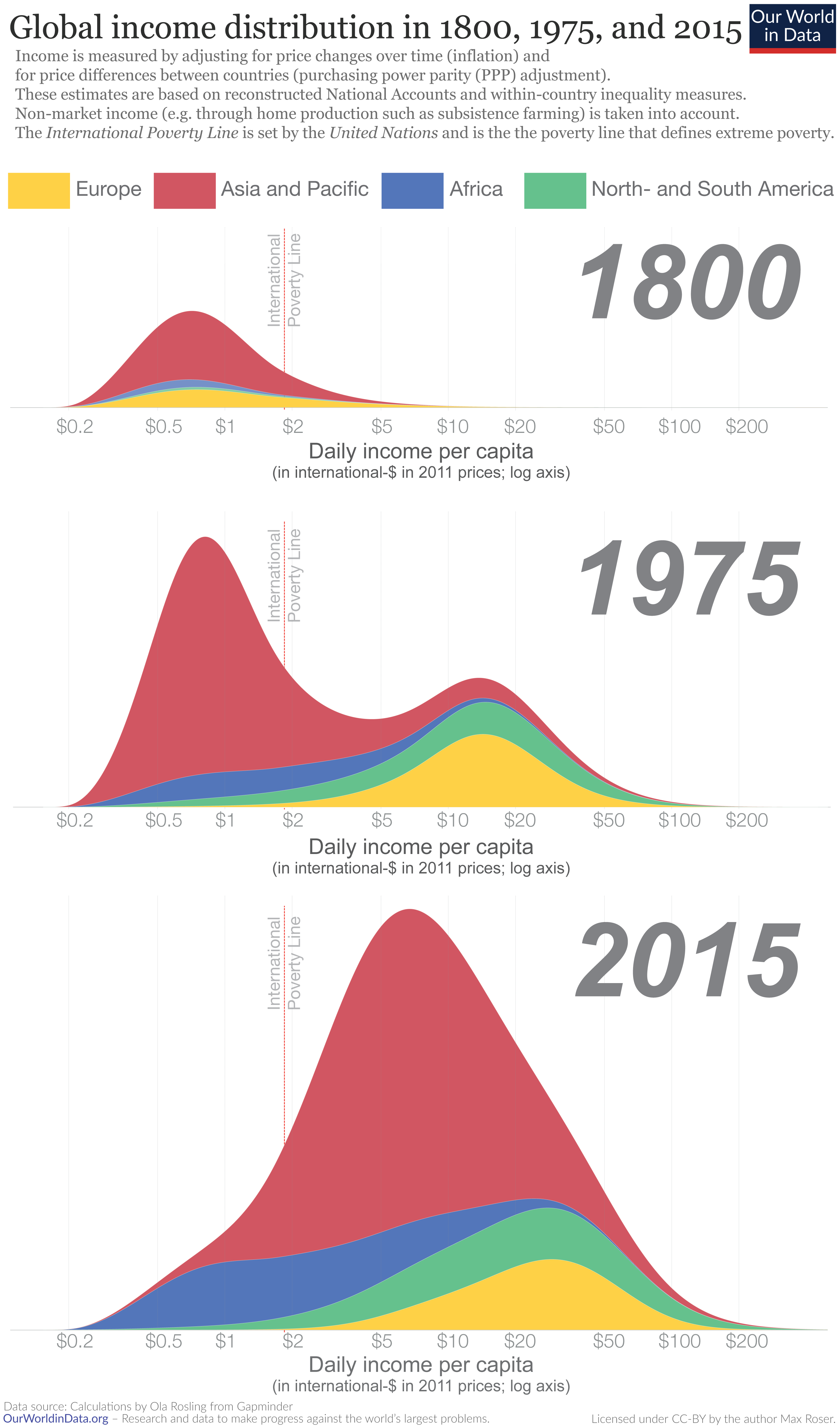
The US is just one country and we're talking about the future of humanity as a whole. Here in the UK we've eliminated more than half our carbon emissions from energy generation, and generally the US is lagging far behind a lot of other countries. Covid aside, economic and health improvement trends globally have been incredibly positive. Since 1995 about a billion people have been lifted out of extreme poverty. That doesn't look much like a collapse to me.
>Since 1995 about a billion people have been lifted out of extreme poverty
That is a great soundbite for the news but is it actually as great as it sounds? If we take it as fact that "one billion humans have been lifted out of extreme poverty" what about how many are in extreme poverty? Note that how many is outside extreme poverty doesn't say anything about the amount in extreme poverty, just that more are now above it. The world population grew by 1.6 billion between 1990 and 2010 according to the UN. So on one side we have the "one billion have been lifted out of extreme poverty" but on the other we have "1.6 billion more humans" with the greatest growth in poverty stricken countries like Nigeria. I don't know the numbers but I don't believe that the "about a billion people have been lifted out of extreme poverty" is the whole truth since AFAIK the amount in extreme poverty have grown.
EDIT:
Looking up the numbers it hasn't "grown" but "extreme poverty" is seen as "statically less than 1.9 international dollars per day". Is it a lift to $3 or $30? $3 is still living in squalor and destitution if you ask most people in the West I'm sure. IMO extreme poverty haven't declined outside statistics.
This is a simple and knowable answer. And it doesn’t change the facts the sound bite is based on. Extreme poverty is lower now as a percentage. There are fewer born into extreme poverty now, etc.
You can also pick other cutoffs and they are improving as well. Obviously the goal is to raise people higher than $3/day, but this is just an existing measure that’s getting better.
It’s frustrating to me when people nitpick unimportant details as if they were significant.
I don’t think anyone who established the extreme poverty cutoff thinks that it is the end goal, or that $3/day is as good as $30/day. So everyone agrees that 10x is better. But there are measures for extreme poverty because it’s a problem and needs to be addressed differently to get people from $.01/day to $3/day differently than interventions for $3 to $30 (and $30 to $100).
Pinker’s book, Angels of our Better Nature, goes into this quite a bit. And there’s a lot of global health primary sources to also help answer your questions.
And I think you’re underestimating the marginal utility of going from $1.90 to $3 — both would suck for someone with a baseline of Western expenses, but it is the difference between a literal hand-to-mouth life of subsistence farming in a shack, versus a family that all works being able to collectively afford to rent a basic concrete flat with terrible plumbing on an unpaved street (citation: my ex took me to Nairobi a few years ago, we met one of her local friends, the friend’s flat was about $800/year to rent, $800/year is the increased income from two people going from $1.9 to $3 per day).
You're right to call that out. There are one billion fewer people in extreme poverty now than there were then. A bit over 500 million compared to over 1.5 billion, even taking into account the increase in the worlds population. Most of this increase has been in Asia where hundreds of millions of people have risen into the urban middle class. Industrial wages in China have increased almost 10x in the last 2 decades, and industrial employment has ballooned.
The situation in Africa isn't so good, but has substantially improved. Of course the cost of this has been stagnant wage growth and anaemic employment in the developed world, as hundreds of thousands of people in China and South East Asia joined the global labour pool.