Outside of the more technically inclined; Does anyone who is a long-form (novel) writer actually use markdown? Outside of blogging, which it was invented for and makes total sense for syntax conversion of free formed text to html is there any real use for it?
Obviously you don't have to use it if you don't want to, but it sort of feels odd to me that all these developers making writing/notes apps that neglect rich text editing entirely in favor of markdown simply because it's easy to implement. I am definitely tired of seeing my writing littered with a detritus of special characters when it's never going to get exported to anything other than text.
I'm using Papyrus Autor because I write in German [1,2]. It's expensive but superior to everything else for the German language. They're expanding to English users, but only offer a super-expensive subscription model for them [3]. If I wrote novels in English, I'd probably use Scrivener [4].
I'm very familiar with markdown, pandoc, and LaTeX, but none of these are relevant or important for writing novels. As a novelist, you need grammar and style correction features, pinboards for ideas, databases for characters and sources form the Net, easy snip management, advanced typography (especially quote correction and automatic quote conversion), name generators, non-continuous selections, selection by font, search & replace of formatting, automatic backups over network and advanced data integrity features, excellent ebook and PDF export, different views for writing/editing/correcting, etc.
It's interesting to see differences in desired features here, because I'm currently writing my third novel, and ditched my previous editors because I realised I needed basically no features - I need a clean canvas without distractions, and ability to do some basic tagging for cross-references. That's it. So now I'm writing in my own editor, in windows with nothing but the text - not even a menu or title bar - and literally not a single one of the features you list.
Some of it because I don't want to focus on it while writing and/or because it's something my editor or proofreader handles (grammar and style correction, typography, selection by font, search & replace of formatting, ebook export). Some of it because I'd rather pick and choose separate tools (name generators, backups, data integrity). Some because I've never had a use for it (pinboards, character databases beyond a folder of plain text files by name, snip management).
To be clear, I'm not at all disputing that these features can be useful or essential for you. I just find it fascinating how different our expectations are.
There's room for a lot of very different editors for the writers market, as people have very strong and contradictory ideas about what you need... The UI for Papyrus Autor looks like something I might have nightmares about, for example...
You can define arbitrary work views in Papyrus Autor, including distraction-free fullscreen mode, and there are plenty of reasonable "view" templates to chose from, too. It even has a special "typewriter mode" scrolling. I don't want to advertise the expensive subscription (don't think it's really worth it), but this program has been sold commercially since the 80s for a reason.
It does seem like a fantastic tool for those who want more functionality. I'm absolutely not surprised there's a market for it - as I said, there's clearly a huge span in terms of what writers want.
Funnily enough, a lot of the work I've interacted with has been in the Lit RPG genre - which needs a lot more, since they're often including tables of "character data", not to mention "system" fonts. It's surprisingly challenging to typeset and make it broadly readable across devices.
I’m just getting into making RPGs and I was using Joplin. Switched to Zettlr for the linking and file folder == a project paradigm. What are you using? I was hoping to use the PHP based command line tool Ibis to convert to PDF but in order to auto-generate a table of contents I’d need to have way too much white space after each section. Ideally I could change the output formatting with a CSS file.
As an avid LitRPG reader, i can tell you most authors need to scale their system WAY back. I like the crunchy parts, but at the end of the day story should take the focus, not 10 page long stat tables. Either that, or there's just enough crunch to slap a litrpg label on a bucket of cliche fantasy tropes.
> most authors need to scale their system WAY back
Oh, no doubt. I've seen entire chapters devoted to "character evolutions" and the associated spew of repetitive skills/character sheets.
What I personally like is when there's a secondary resource (aka a wiki) which tracks changes to the various character sheets and skills over time. Perhaps this could be done within the novel by using appendices? Wouldn't help extensively with Patreon-based web novels, sadly.
All that said, litrpg - not to mention software development books, cookbooks, etc - do still need these kinds of extended typesetting resources.
how do you convert from markdown to standard manuscript format?
starting to write in markdown or even plain text is fine, but once the first draft is submitted to the editor or sent to a publisher for consideration it usually needs to be a word or rtf document in standard manuscript format.
once converted i am stuck using libreoffice to revise and edit the story.
i found tools that convert from markdown to ODF (which i can then load and export as word) but i have not found any way to apply a standard manuscript style in the conversion process.
without that i'd have to manually reformat the document each time i want to submit a new revision.
I tried out and one issue I had was with indented paragraphs. I ended up using LibreWriter's regex search replace to remove all the extraneous newlines.
I only gave it a try for a chapter or two just to get a feel for what might be involved. I first tried pandoc. This mostly worked, except for the indentation of paragraphs. I took care of that by setting up LibreOffice's paragraph indentation, and used LibreOffice's search replace to remove the (now) extraneous new lines.
My recommendation is to grab a decently long markdown document and give it a try.
hmmm - if it is an editor that handles text files, then myself, I would rely on one of the myriad of sync tools/platforms available, rather than have someone else's implementation
True and it's actually possible to use any tools you want as it supports local directories of markdown files (I use git to version my writing) but the product does not target at a technical audience but writers in general and their cloud sync is pretty well implemented. I like their cloud sync for the ability to sync with ios devices without doing anything in particular.
I use Ghostwriter, it's free. I write in a directory that is continuously synced to Dropbox. And I write in pandoc flavored markdown, so a single script can spit out compiled PDF or epub.
I've wanted to try it as it looks pretty slick but it's apparently "a [...] Markdown editor for Windows and Linux". Not much of an help if you are using macOS.
I would be interested to know why you choose "Ulysses" and not "Odysseus"?
ps. I followed a conversation about James Joyce novel which was hinted that there is a difference between the two names and Joyce didn't pick "Ulysses" randomly. I'd like to know if you went through the same process.
UPDATE: Ok, I mis-read the comment, I though the name of the Novel was Ulysses, apparently it is an app.
Which moved to subscription model and lost me completely.
After trying Scrivener, I realised that for my needs is overkill, moved to something that I know will not bite me in the future: Folder organisation plus Vim - Org mode.
Adobe in their infinite greed ruined propriety software model for all. SaaS is pure hell.
That's the kind of need for text manipulation I would expect of a typical writer. Hence why bother with markdown at all (unless it's the only thing available). Rich text is a much cleaner solution for that. Markdown really shines when it comes to text that has to be formatted just so for web layout. e.g. tables, bullets, multi-headings and linking.
Because it's not a bother. It's pretty much just plain text.
And having it as plain text means adding your own special annotations is easy. E.g. I'm writing my third novel in my own editor using Markdown, and key for me was that it was easy to write small little scripts to e.g. process front-matter with similar "@pov" tags etc. to let me trivially cross-reference
things.
The point I am getting at is that if an editor wants to use markdown in place of rtf, fine. But it should hide the syntax just like rtf editors do (unless you want to see it). No editor that supports markdown to date has been able to achieve the quality of editing that rtf editors already have. So in essence outside of markdowns original use case of web publishing, why bother using it?
Here is the grand total of formatting supported by RTF in use in my novels:
* headers
* italics
* maybe 2-3 instances of *bold* through the entire text.
I don't need any additional "quality of editing". Hiding the syntax is irrelevant because the needs are so limited. Hiding the user interface on the other hand, matters to me, because it's a distraction (to others it isn't). My editor color-codes the headers and the italics, and having it stand out matters far more to me than that it looks the way it will in the formatted book, because my draft looks nothing like the finished book will anyway.
If you look at interviews with writers, you'll find a whole lot of obsession over the process, and things like how it feels to write with a pen vs. a typewriter vs. a word processor, and very, very little about what their drafts look like. It's far down the list of considerations you'll find novelists care about.
Nobody cares what the drafts look like, because they are transient. In fact you'll find a whole lot of authors advocate avoiding going back and editing and arguing for things like dictaphones etc. to make going back harder or using tools that won't let scroll up in some cases to simulate the typewriter experience, and all kinds of similar obsessions with spending as little time as possible on formatting and what the manuscript looks like in preference of being able to just dump the first draft into text the fastest way possible (while other authors want writing the first draft to take longer on purpose - to some that is a reason for using pens or pencils).
You mentioned Gaiman in another reply - someone who has talked at length about how since he wrote Stardust in a fountain pen he has come to enjoy being forced to rewrite his second draft entirely instead of being able to go back and forth and editing it since he switched to writing with pen on paper.
I'm sure you can find novelists that want to see a beautifully formatted manuscript while writing it. They have tools they can use.
But to suggest Markdown is some sort of big hindrance compared to some of the barriers novelists create for themselves on purpose doesn't pass the smell test for me.
>If you look at interviews with writers, you'll find a whole lot of obsession over the process, and things like how it feels to write with a pen vs. a typewriter vs. a word processor, and very, very little about what their drafts look like. It's far down the list of considerations you'll find novelists care about.
This.
I chose emacs because I'm a programmer who uses emacs frequently. And its just damn text and I don't have to get all fiddly with everything. And like I don't want to have to fiddle around with Word, I don't want to fiddle around with some complicated markup langage like rst either. I just want to write.
I wrote my thesis is Word, I know what it can be like.
Writing a novel is definitely a 'to each, his own' practice.
I can format text all day. It's a huge distraction that allows me to also feel 'productive'; which gets in the way of actually writing. Using a markdown editor lets me do the formatting that is necessary for the work (e.g., italics) without being hugely distracted.
> But it should hide the syntax just like rtf editors do (unless you want to see it).
I'm using Obsidian and wouldn't mind seeing this feature. However, it currently offers the option of toggling quickly between edit and preview modes, or opening up a second view for preview, which can optionally be scroll-locked with the editing window. That works great for me.
I use copious amounts of notes in my fiction writing, that sometimes include mathematical/physical formulas, data, and code. Obsidian supports (various amounts of) inline LaTeX, syntax-highlighting, and mermaid. (I'm also not above abusing these things for my own purposes: I've used mermaid graph to create a quick-and-dirty character family tree for my own reference, for instance.) And, of course, I use markdown to tie all these notes together and to the novel.
This allows me to create a family tree and, when I change a character's name, the diagram---along with every other reference to their name---is updated automatically. Here's a video showing how it works:
When I write markdown, I don't even see the syntax. All I see is bold, heading, code block.
I don't need to see some on screen typeset version of the text because this all subject to change anyway when it comes to typesetting the document and that will change depending on the medium (ie. book, web, email etc.)
I use markdown for drafting via the delightfully minimalistic iA Writer. It is useful for first drafts and editing on a sentence by sentence level.
However, it is not really ideal for getting the text into ms format or for organizing and editing something as complex as a finished draft, so I use Scrivener at that end of the process.
I think there probably is no single tool that is ideal at all stages of writing a novel. In the beginning you want something that gets the hell out of your way and lets you write quickly. Once the first draft is done, you need structural editing tools. And during that process you will want to dip into tighter, sentence-by-sentence tooling for rewriting and revising.
I wrote the first draft of my first novel in Vim using Markdown. I've since switched to Scrivener, mostly for the general convenience it offers and especially the mobile apps and syncing, but there is a lot about that old workflow that I miss. It's really convenient to have everything in a single buffer optimized for keyboard-only navigation, and with Pandoc there aren't really any concerns around exporting to .docx.
I absolutely hate WYSIWYG editing when I'm writing fiction, because it's totally unnecessary and only serves to muddy the waters when it's time to export the text, e.g. if some of the devices I was editing on were set to use smart quotes and some weren't. The text of a typical novel doesn't have much going on besides chapters, sections, and paragraphs, so Markdown really has everything you need, and for fancier formatting (like the side-by-side verse paragraphs in Stand on Zanzibar, just to name one example off the top of my head) I get the feeling that Scrivener isn't really flexible enough. There are better tools, like Vellum, and I think traditional rich text editing exists in a sort of uncomfortable middle ground where it offers just enough functionality to get in the way.
But obviously installing and using a command-line utility like Pandoc is not something the typical author can really be expected to do, so they're stuck using the standard industry-favorite tools that do it all from a GUI.
It’s a problem I’ve grappled with for a while. I used to use Scrivener but eventually got tired of its syncing capabilities, as I took a lot of notes on my phone in markdown and wanted an easy way to integrate and transform these notes into longer form pieces. Scrivener does support this, but it’s definitely not the most polished feature of the tool and it kind of clunky and annoying to work with in my opinion.
Tried using vim+git for a while. This combo is great for portability, but my eyes get tired staring at a terminal all day, and while git feels nice, it doesn’t give you huge advantages and is just more work when many GUI tools like scrivener have good enough version control built in — some would probably find a complete git version history useful, and use branches for different drafts etc. but I personally have never needed this and find it’s just another distraction from actually doing the work of writing.
Now that I stare at a screen for several hours a day during my day job, I’ve settled on pen and paper for my own health. No idea yet whether or not I’ll be able to translate this into finished products or if typing out handwritten text will prove too tedious.
I keep seeing references to markdown editors on HN. As a non-tech person it would have never crossed my mind to use something like this to write a novel or even keep notes, but it seems to really strike a chord here. Perhaps it's simply the comfort associated with code over a long period of time?
Part of it might be preference for plain text files with no vendor lock-in.
Or it might be preference for explicitness, we've all fought with rich editors bleeding format from one word into another and struggling to un-format the text at the right location.
I’m halfway through my second novel. Both in very barebones markdown (using pretty much only headings). Plain text is a blessing. I can keep everything in git, searching in emacs with swiper is fantastic (and good search is a must as the material grows) and any tool I lack I can hack together.
publishers format for print, but the submission needs to be in a specific format too.
this stems from the days where manuscripts were submitted on paper, and not electronically. one could argue that with electronic submission such format requirements are no longer relevant, but we all know that people don't like change.
standard manuscript format looks roughly like this:
lines are double spaced
first line of each paragraph is indented, but there is no space between paragraphs
first page contains contact information and word count.
section headers are centered
each page (except the first) contains a header with: "authors lastname / story title / page #"
Makes it hard to definitively answer your question:
> Does anyone who is a long-form (novel) writer actually use Markdown?
I am aware of published authors who've used Ulysses, a Markdown-based multi-document editor for the Mac, for writing novels.[1] Semi-famously, mystery author David Hewson is a huge Ulysses fan, and wrote his own book about his process. I don't get the impression Hewson is super technically inclined the way, say, Matt Gemmell -- a software engineer turned novelist who's also a huge Ulysses fan -- clearly is. Some of the appeal for non-nerds is, I think, part of what grognards like George R.R. Martin and Robert Sawyer argue gives WordStar for DOS a big appeal: it's just you and your text with very little else to distract you. I've personally found that a bit overstated (most word processors have some kind of "draft mode" that, while perhaps not as minimal as just You And Your Plain Text, gets the job done), but it's clearly a thing, and I admit I enjoy writing in Ulysses more than I would expect.
Ulysses does, it's worth noting, have the capability to compile and export documents to Microsoft Word format. It's not as flexible (or overengineered) as Scrivener's compilation tools, but that's really something you should be saving until you have what you think is the final draft -- Ulysses and Scrivener, and for that matter NovelWriter, are ultimately composition tools, not editing tools. (Once you're in a "dialogue" with your editor sending Word documents with embedded revisions and comments, your manuscript is almost certainly going to stay in Word.)
I've written two novels with Scrivener, but I am slowly moving toward Ulysses for a variety of reasons -- but they are, indeed, technical reasons. I don't find the "detritus of special characters" to be particularly annoying with a well-chosen Ulysses theme; the underlines/asterisks are faded out and the italics and bold are, well, italics and bold, and for fiction that's virtually all I need.
One of my personal projects is https://betabooks.co, which is a markdown based feedback collection tool for pre-publication books. In other words, securely share a complete draft with beta readers and get their feedback nicely organized in an easy to use app.
The app works best with markdown, but very early on I had to add "paste from word" and rich text formatting because I discovered that, while _I_ write fiction in markdown, only ~5% of other authors do.
Too bad, because it fits really well for the task, and there are so many great long-form markdown writing tools. I personally prefer Ulysses for Mac.
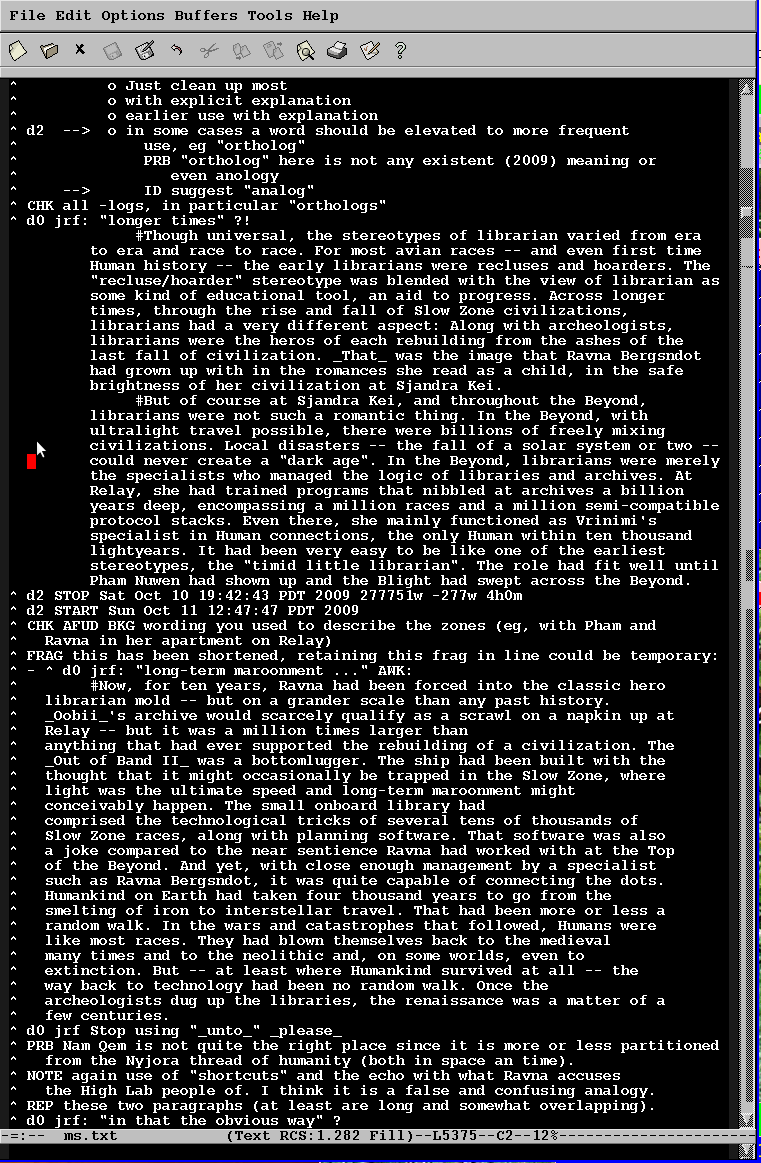
They don't produce richer text, they might write in a richer format, if you can all it that. Non-printing notes/comments were quite common in the DOS days, similar to the "front matter" in the screen shots, or what people would put in separate UI sections in tools like Scrivener or Ulysses (chapter notes, marginalia, cork boards etc.)
A more code-like (and probably extreme) perspective would be this screenshot from sci-fi author Vernor Vinge:
I think you are assuming. I also think there's a confusion here and that you're talking specifically about RTF while the people responding to you are talking about the capabilities provided when they use "rich". The point being that Markdown has far more formatting features than most people who write novels need, and so it is "rich enough" as a format.
I've written two novels and I'm writing my third, and as others have also pointed out, there's rarely a need for more than headlines, bold and italics, all of which are trivial in Markdown.
Whether or not the editors are capable enough depends on peoples preferences and tools. But there's nothing about writing a novel that requires a format more complex while writing (if you send it off to an editor, they'll almost certainly insist on something they can import easily into word, though some accept Google Docs or ODT these days)
But I am not assuming at all. In fact most professional writers still use Microsoft Word. It's sort of how people don't realize the world still runs on Microsoft Excel. Markdown is not "rich" in any way. It's syntactical representation for what you want the "exported" text to look like. It is not a drop in replacement for rich text editing.
Of course people who come here are going to be the outliers of this use case and say markdown is fine. Go ask Neil Gaiman or Stephen King if they know markdown and after explaining what it is ask if they need it? And I'd be willing to put money on them just stating "why not just make my italic text italic, why do I really need to put special characters around it?"
> Go ask Neil Gaiman or Stephen King if they know markdown and after explaining what it is ask if they need it? And I'd be willing to put money on them just stating "why not just make my italic text italic, why do I really need to put special characters around it?"
Gaiman has at least in the past stated he prefers to write his first drafts with a fountain pen in a physical notebook, to the point where there's various lists of the specific brands of pens he uses.
Stephen King prefers a Waterman fountain pen, though he's also been known to use typewriters, and may very well also use word processors. He's known to use Word for some work, certainly.
But because of the tools a lot of novelists use, a lot are used to using special marks to indicate the (very limited) formatting they do. Many people use multiple tools, including pens, text editors, smartphones, typewriters, or whatever is to hand. For some picking tools depending on what they work on is part of the process.
You may be right that most professional writers today use Word, but novelists makes up a very specific subset of professional writers and have very much idiosyncratic ideas about their preferred writing environment, ranging from the aforementioned fountain pens on anything from loose-leaf paper to very specific notebook choices, to old typewriters (some insisting on specific models of manual typewriters), via long outdated word processors, to modern word processors or editors written specifically for novelists (like Scrivener etc.). Or tools like the one linked here.
The point remains that in terms for formatting, Markdown is sufficient and simple. That does not mean it will be what everyone will prefer, like or even tolerate. But it has all the functionality needed to represent the formatting done in a typical novel, with minimal interference in the writing.


Obviously you don't have to use it if you don't want to, but it sort of feels odd to me that all these developers making writing/notes apps that neglect rich text editing entirely in favor of markdown simply because it's easy to implement. I am definitely tired of seeing my writing littered with a detritus of special characters when it's never going to get exported to anything other than text.