I thought the skeuomorphism in iOS was pretty bad, even at the time. Although, my problem wasn't skeuomorphism so much as the result of it just looking ugly.
I agree about the OS X screenshot but... i do not understand what is skeuomorphic about the iOS 6 one. It is just a grid of icons with mostly the same photorealistic style as the OS X icons (though with a greater tendency to be squareish, but i think that fits better with the always grid-y interface that iOS has). And FWIW personally i prefer it to any later iOS style.
Also i was really referring to desktop. I think a bit of skeuomorphism can be fine for a mobile device that you interact with via a touch screen. For the desktop though, i do not think it fits, but even then... it was rare, not something that was so rampant as to warrant an entire industry to change its style everywhere.
The applications i had in mind were something like these:
Skeuomorphism is more than just aesthetically resembling real world objects, it’s an imitation of the behavior of real world objects. Think a digital book that duplicates the way you interact with a book, not just using fancy page turning animations, but demanding that this be the way in which you go to the next page.
The advantage software has over real physical objects is that it need not duplicate the limitations of a real world object. A software book can jump to the next page instantaneously, and index your notations, and provide instant dictionary lookups. More importantly, it can’t duplicate precisely any of the real advantages of holding and interacting with a book because you’re not interacting with a book, you’re interacting with a program through a proxy device (a mouse, a trackpad, a keyboard, a screen, a d-pad, whatever).
The skeuomorphic aesthetic was ugly in the eyes of many including my own, but there was an argument to be made that instead of taking advantage of the fact that this is software, Apple was leaning too hard on the skeuomorphic design trend in terms of how their applications behaved. The two most egregious examples were Notes and Newsstand, the Notes app tried to duplicate a memo pad and the only typeface was Marker Felt in a single style (to imitate handwriting) and Newsstand behaved almost exactly like a Newsstand you might find in a bookstore, holding magazines and offering them for sale. The magazine apps usually tried to duplicate the look and feel of an actual magazine, but with the addition of audio and video.
Now the Newsstand is gone, you can still get magazines, but through News or the App Store a lot of publishers caught on that duplicating the look and feel of actual magazines probably doesn’t make their product more appealing. Notes is a much more powerful tool than it used to be and if it were your only Notes app, it isn’t a bad one to have and supports actual handwriting input if you so desire.
That said I will say throwing out skeuomorphism didn’t have to mean throwing out depth and detail, but when Ive’s team took over software design, they imposed their own vision and that vision went too far into minimalism, foregoing detail for slight and subtle contextual clues that could be missed, and then further refined from there into something a bit more usable. Thinking about it, I don’t really have a problem with how it stands in iOS 13, although iPad OS 13 needs to fix its interaction paradigm.
I do not disagree with what you are writing here, but i do not think this applies even to iOS 6 in general (as opposed to a few apps). Also from what i remember, Newsstand was just a grid of icons like the main screen launcher, except that it had a wooden background. The functionality was the same though, again at least from what i remember (i didn't use iOS 6 much).
Just noticed your reply, and while there's a decent chance you won't see mine this late, I still wanted to reply to you.
Newsstand was a folder with special powers that made it behave in some ways like an app but with some of the limitations of folders. You could download special apps to it that pretended to be paper magazines that mostly behaved like paper magazines, and Newsstand would faithfully try to recreate the effect of a magazine rack inside a bookstore. That said, it was another "app" which people wanted to hide, or uninstall, or just somehow get out of the way of what they actually used their phone for and because it was also a folder, you couldn't do what was the custom at the time and put it in a folder which would at least tuck it out of the way. True it's a minor annoyance, but it was a minor annoyance on an expensive phone that people paid a lot of money for through what was at the time, usually a contract and wanted to exercise some modicum of control over. iPhones have a lot of minor annoyances, but if you remember some of the other controversies at the time like the Twitter Dickbar, people get upset over the things they can see that they can't exercise control over. It's one of the reasons Newsstand is gone, and also one of the reasons why people can now uninstall most of the default apps on an iPhone, even if it breaks expected functionality.
It wasn't just that the Newsstand was skeuomorphic design, it's that it was skeuomorphic design that tried to be special and important in a way that users didn't want it to be special and important, but it was still skeuomorphic in the way it looked, behaved, and encouraged other apps ("magazines") to behave. Yes, it was just a grid of icons with a grid of icons, but it was a special grid of icons with a wooden background that placed Apple's and publishers' interests ahead of yours and mine. Apple still hasn't really figured this out either, they ditched the skeuomorphic design, but they replaced it with the News app which is still terrible but that's a whole other topic.
Now to be clear, I don't hate all skeuomorphic design, some of it can be quite good. I still use the Finder, or attempt to anyway with primarily icons and lists, with my Desktop as a Desktop, and I keep the Clock and Calendar icons on the first screen of my iPhone and iPad because I like how they update in real time and resemble a clock and tear off calendar as far as the icons go.
I use bookmarks in my browser, and my ereader software, and my PDF reader and I still use a terminal emulator which emulates the look and feel of a terminal, although with fewer limitations as the physical ones. I even have some Stickies on my screen right now which I use as more or less digital sticky notes.
I also appreciate how the Trash can on Mac OS X looks and behaves like a literal wastebasket. It's just software, but if I dump something in there by mistake, which doesn't happen often but it's happened, I can just "reach" in there and put it back where it belongs.
I keep PCalc installed despite using Soulver for most calculations simply because for something that imitates a physical calculator, it is a very nice looking calculator. I keep the widgets accessible as both decoration and for quick one-off calculations.
I have GoodNotes 5 on my iPad, which has slowly replaced the stack of paper notebooks I used to keep with a stack of digital notebooks that I can create and sort on whim without taking up the shelf space my physical notebooks did. These do behave largely like notebooks.
iOS 6 was the terminal destination of a trend, that appeared to be more of a trend than it ended up being, possibly because of a political shakeup within Apple, possibly for other reasons, but it was the most recent culmination of a trend that Apple did reverse course on in which their software was resembling not just the look, but limiting itself to the behavior of physical objects. Some of that took root in Mac OS X 10.7 Lion and was gone by 10.9 Mavericks, so I can't say it was incredibly long lasting, but without the ability to see into the future and know that Apple was going to end its drunken skeuomorphic bender with iOS 7 (which went too far in the other direction but in later versions found its own mostly happy medium), it was still roundly criticized both to discourage Apple from continuing its drunken frenzy and extend it to even more apps on the operating system (a worse case scenario, maybe an unlikely one even then, moot now), and the 3rd party developers which were imitating it, less judiciously, and badly.
Lots of skeuomorphism in audio VST/RTAS/AAx effects plugin, but you can argue there that it at least makes sense since they're designed to appeal to guitar/synth and audio engineering enthusiasts who are very used to having knobs to mess with.


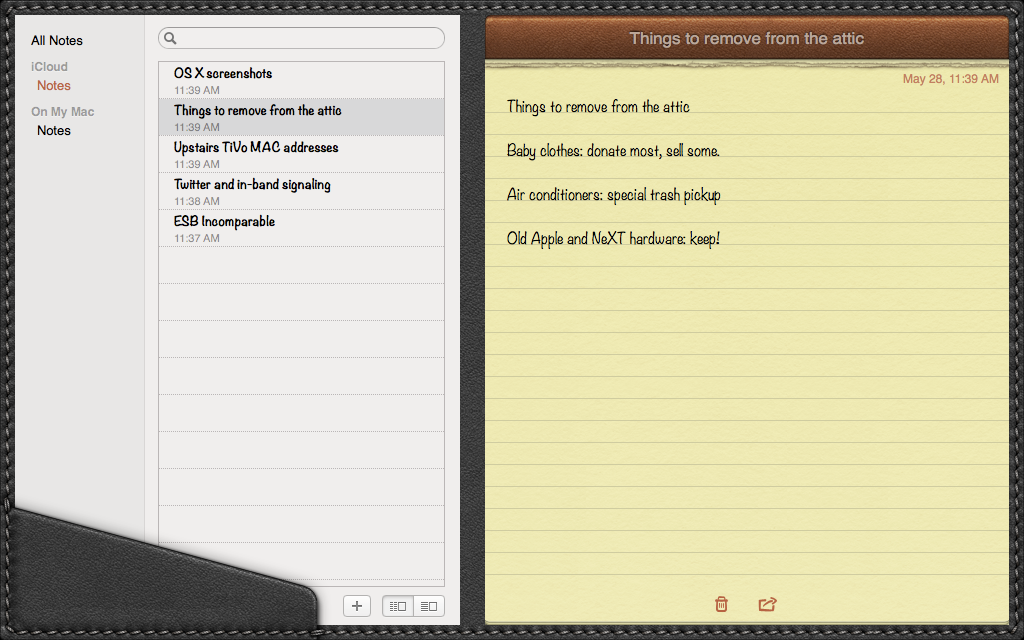
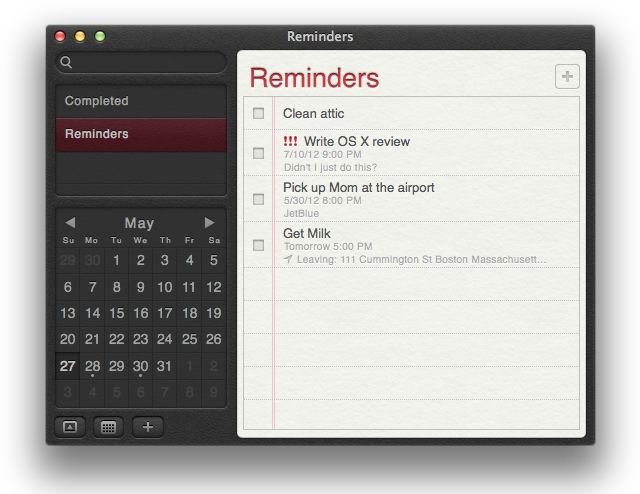
I mean: https://upload.wikimedia.org/wikipedia/en/7/7d/IOS_6_Home_Sc...
Everyone is going to have different tastes, but IMO there's just nothing attractive about that!
OS X, by contrast, looked consistently gorgeous before it went flat: https://i.ibb.co/qkC8kcw/Screen-Shot-2020-06-09-at-7-40-02-P... It's also really not particularly skeuomorphic, beyond vaguely suggesting a metal surface in some places.