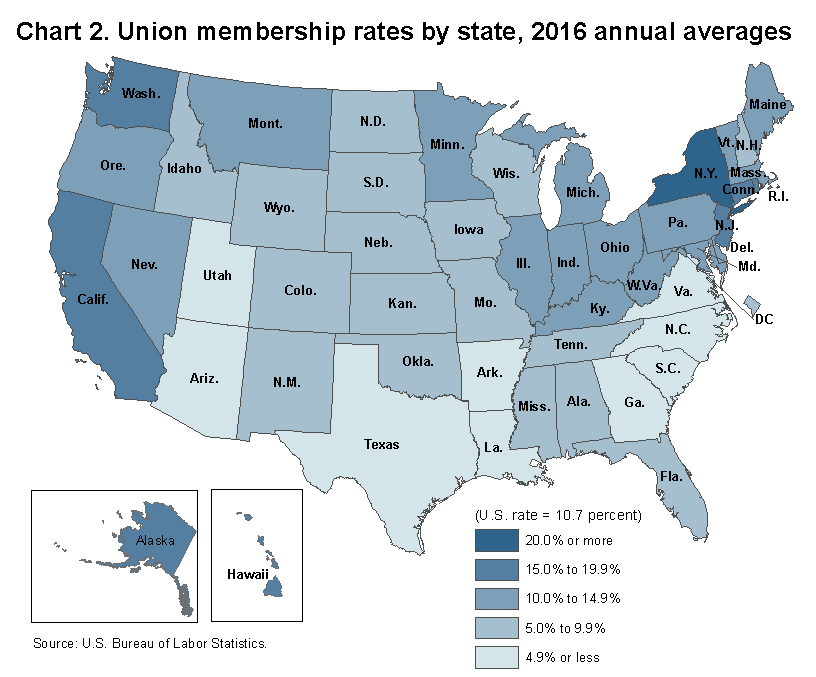
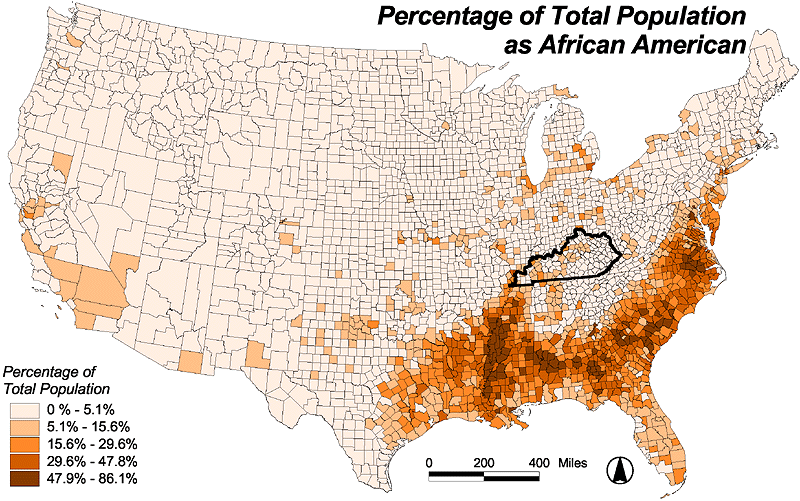
I wonder why they suggest that racial diversity has an inverse relationship with union formation. Is this because of a broader range of employee perspectives on work? Are employees in diverse environments less comfortable talking to one another? Both? Something else?
If I've learned anything from growing up in the South, it's that having both poor white people and poor black people makes it much easier for those in power to convince both groups that the other is the source of all of their problems instead of it being the rich and powerful.
“If you can convince the lowest white man he's better than the best colored man, he won't notice you're picking his pocket. Hell, give him somebody to look down on, and he'll empty his pockets for you.” — Lyndon B. Johnson
I would be curious to see the numbers and whether they truly mean "diversity" or if it is being used as code for non-white. For example, would an all Latinx workforce be more or less likely to unionize? If they are using the dictionary definition of "diversity", that indicates something interesting about people's ability to empathize and work together with people of other races. If "diversity" is just a code for non-white, it might simply be a substitute for a variety of other socioeconomic factors that we know correlate with race that might impact an employees' likelihood to unionize.
Carnegie definitely tried to keep a diverse workforce in his steel mills as part of his strategy for fighting unionization.
I'd expect the main driver would be different groups within the workforce feeling that they're different sorts of people hurting efforts to band together, for which it's mostly subjective diversity that would hurt. The sort of thing where a mix of old-stock Americans, Irish-Americans, and Italian Americans would have considered themselves racially diverse in 1920 but not in the modern day.
Other potential things would be different languages, different notions of fairness, attending different social organizations, etc.
All other things being equal (and of course they never are), it seems like organizing in a homogenous cultural environment would be much easier than otherwise.
You could also have some economic pressure (low wages from whole foods) causing fewer ethnicities to self select into the job because they have better options elsewhere [1]. Then the workers realize things aren't so great and try to improve their situation through unionizing.
Interestingly, various Greek tyrants were known for intentionally diversifying their cities in an attempt to break the solidarity of a population that might otherwise rise against them.
Thucydides noted: "A crowd like that are hardly likely to respond unanimously to any proposal or to organize themselves for joint action"
I've also read the "conspiracy theory" that racial division is pushed in an attempt to disrupt solidarity based on economic class.
I was more referring to the "conspiracy theory" that such a tactic is currently in use by the powers that be. Not a topic I am familiar with so I certainly won't dispute that it occurred historically.
There were several rocky points in the history of unions relating to the transition of some large, existing unions from "white only" to "all inclusive", likewise from "male only" to "all inclusive". The TLDR is, "There are a lot of bigots who would rather hurt themselves than help someone they don't like."