> We literally don't have matriarchies, there's no data about it. And I also don't know why you put that in quotes, it's an actual word.
We may or may not have matriarchies - a couple countries like Spain do have more women in parliament than men so maybe they fit your definition of a matriarchy. But we do have data on how the female representation in tech varies with respect to increases in women's rights and resources, and the data shows that the more rights and resources women have the less they go into technology. This would indicate that a matriarchy would have among the lowest rates of women in technology.
> Of really? Which ones? Because Hungary certainly isn't. You just proved yourself wrong and you're not addressing what the core of the argument of what I said.
I did indeed address this. In this comment [1] You had claimed that Eastern Europe has similar shares of women in STEM fields as India, and that this is due to cultural factors. I pointed out that Eastern Europe does not, in fact, have similar rates of women in tech as India - only Bulgaria, Romania and Georgia do. Eastern European countries with lower rates of women in tech as compared to India include: Latvia, Lithuania, Hungary, the Czech Republic, Moldova, Poland, Slovakia, and Croatia (if you consider it Eastern European).
Furthermore, your comment rested on the assumption that gender roles in Eastern European countries are monolithic. This is not the case. Hungary, as you pointed out has very low gender equality as does Slovakia and the Czech Republic. Slovenia, on the other hand, is the 5th highest on this list. Latvia, Estonia, Slovenia, Moldova, and Lithuania have the same or higher ratings for gender equality as the United States.
So to recap:
1. Eastern Europe does not similar rates of women in tech than India's 30%, most have lower rates of women in tech than the United States' 25%.
2. Eastern European countries are diverse and have varied degrees of gender equality, they are not a monolith so talking about gender roles in "eastern europe" rests on the false understanding that these countries have the same culture with respect to gender.
I pointed out that your argument with respect to Eastern Europe is contradicted by the data we have, and is based on the false notion that women in Eastern Europe have a similar experience with respect to gender equality. This seems like this thoroughly addresses your point, care to explain what you feel is missing?
> I'm ignoring the fact that you can't even keep your numbers straight within the same comment. It's not consistent at all, it's almost the entire range!
Can you please read the article before posting comments like this? Every country including outliers falls between 15% (Chile) and 41% (Algeria). That's 36%. That's barely over half of the range, let alone "almost the entire range".
> And given that close to 0% or 50% is unlikely to happen in any country, that's pretty much where you expect the probability distribution to land anyway. It says nothing.
Why? Why wouldn't we expect countries to be 60% women in tech, or 70%, or 80% women in technology? Why do you take it for granted that there won't be any countries with majority women in technology?
> Wait, what exactly is your allegation then, if not that?
You're the one that originally brought up Eastern Europe and India. You falsely claimed that Eastern Europe has similar rates of women in tech as India, and I pointed out that this is factually incorrect - most Eastern European countries have lower rates of women in technology than India.
> You're still not addressing the labour participation rates between women and men. You don't get it. You're suppressed to compare bergen women and men in the same country. Women's labour participation rate has less than nothing to do with Vietnam. You don't get it.
What do you mean by adjusting for women's labor participation rate. You say that I'm not doing this correctly, but you neglect to explain what you mean by this. If a country that has 100% female labor participation had 30% women in technology, and another country has 50% labor participation and 15% women in tech then the latter's rate of women in tech is actually the same if you account for labor participation rates.
If you insist that the better way is to compare the ratio of men to women in the labor force, here's that data [2]. It does not significantly alter the results. The United States has a ratio of 0.82 female to male. Norway has 0.885 - so its share of women in tech would actually go down even further if we adjust it to match the US. Viet Nam has 0.889.
There are some that do have significantly different participation rates. Chile has 0.657, so its share of women in tech would rise by ~20% from 15% to 18% if we made its labor participation ratio the same as the US. Qatar has 0.531 so its ~23% women in tech would rise to 35%. But notice that these adjustments move these countries closer towards the trend line. In other words, adjusting for the differences in labor participation rates makes the inverse relationship between gender equality and women's participation in STEM even stronger.
> Furthermore, your comment rested on the assumption that gender roles in Eastern European countries are monolithic.
Neither is India but I feel this is splitting hairs.
> I pointed out that your argument with respect to Eastern Europe is contradicted by the data we have, and is based on the false notion that women in Eastern Europe have a similar experience with respect to gender equality.
Ok... but that's true in India, the US... they are all varied cultures. You're just pointing holes in you argument really.
I always said women equality and women participation in STEM is pretty random.
Once again, you're really arguing against yourself. There is no correlation between women in STEM and women's rights.
> Why? Why wouldn't we expect countries to be 60% women in tech, or 70%, or 80% women in technology? Why do you take it for granted that there won't be any countries with majority women in technology?
Again. Because we don't have matriarchies. You really don't seem to grasp the concept. Please take a minute to think about it.
> You're the one that originally brought up Eastern Europe and India. You falsely claimed that Eastern Europe has similar rates of women in tech as India, and I pointed out that this is factually incorrect - most Eastern European countries have lower rates of women in technology than India.
Oh ok, I should clarify then. Some countries in Eastern Europe have similar rates as India. It does not change my argument one bit, except you win some semantic nonsense.
I can rephrase my argument from before with "some Eastern European countries" instead. Will that change your mind?
> What do you mean by adjusting for women's labor participation rate. You say that I'm not doing this correctly, but you neglect to explain what you mean by this. If a country that has 100% female labor participation had 30% women in technology, and another country has 50% labor participation and 15% women in tech then the latter's rate of women in tech is actually the same if you account for labor participation rates.
Than why are you comparing these countries with the US's women participation rate in the workforce?! What does the US have to do with this?
> The United States has a ratio of 0.82 female to male. Norway has 0.885 - so its share of women in tech would actually go down even further if we adjust it to match the US.
> Chile has 0.657, so its share of women in tech would rise by ~20% from 15% to 18% if we made its labor participation ratio the same as the US.
Can you stop comparing things to the US? What's wrong with you? You're supposed to compare with men's labour participation rates, in the same country.
I already told you this.
0.657 means only 65 of women work for every 100 men.
How are you not getting this?
Qatar has 0.531 so its ~23% women in tech would rise to 35%. But notice that these adjustments move these countries closer towards the trend line. In other words, adjusting for the differences in labor participation rates makes the inverse relationship between gender equality and women's participation in STEM even stronger.
This hinges on how you define a matriarchy. Spain, as I pointed out earlier, has a majority female national leadership. If it isn't a matriarchy, one could still argue that's closer to a matriarchy than a patriarchy.
You insist that we don't have any matriarchies, yet my request for you to explain how you're choosing to define matriarchy remains unfulfilled.
> Ok... but that's true in India, the US... they are all varied cultures. You're just pointing holes in you argument really. I always said women equality and women participation in STEM is pretty random. Once again, you're really arguing against yourself. There is no correlation between women in STEM and women's rights.
> Again. Because we don't have matriarchies. You really don't seem to grasp the concept. Please take a minute to think about it.
And why would we think that a matriarchy would have over 50% women in technology? As countries move away from patriarchy and towards gender equality the percentage of tech worker that are women go down. Why would one conclude from this that a matriarchy would see a majority of women in technology?
> Oh ok, I should clarify then. Some countries in Eastern Europe have similar rates as India. It does not change my argument one bit, except you win some semantic nonsense. I can rephrase my argument from before with "some Eastern European countries" instead. Will that change your mind?
Sure, some Eastern European countries have similar rates as India. And most do not.
> Than why are you comparing these countries with the US's women participation rate in the workforce?! What does the US have to do with this?
You adjust for labor participation by selecting a baseline, and adjusting the other countries to match this baseline. Sure, I could have used any country for the baseline.
> Can you stop comparing things to the US? What's wrong with you? You're supposed to compare with men's labour participation rates, in the same country. I already told you this.
I am very confused as to what you're saying here. I am comparing women's labor participation rates with men's labor participation rates, in the same country. When I say that Chile has a female/male labor participation ratio of 0.657 it means 66 women work for every 100 men. By comparison the US has 82 women in the workforce for every 100 men.
So if Chile has 15% women in tech, and we want to know what this percentage would be if its female/male labor participation ratio was the same as the US we adjust for that: 15% * (.82 / .657) = 18.2%.
Why do you think that I'm not comparing women's labor participation rates with men? You do realize that the ratio of female to male labor participation is, fundamentally, comparing women and men's labor participation rates?
> 0.657 means only 65 of women work for every 100 men. How are you not getting this?
Dictionary definition. There's no opinion about it.
> Spain, as I pointed out earlier, has a majority female national leadership.
Not what defined a matriarchy.
> If it isn't a matriarchy, one could still argue that's closer to a matriarchy than a patriarchy.
Not how it works. It's a gradient, yes. Spain being a matriarchy? No.
> You insist that we don't have any matriarchies, yet my request for you to explain how you're choosing to define matriarchy remains unfulfilled.
I gave several examples...
Like, have any modern countries denied men to vote before women? No.
> And why would we think that a matriarchy would have over 50% women in technology?
You. You f-ing asked that. You expected some countries to have over 50% representation, which is stupid since every country is patriarchal on some level.
We don't have matriarchies. I can't stress this enough.
You can't make claims on what we can't observe.
> As countries move away from patriarchy and towards gender equality the percentage of tech worker that are women go down.
You yourself told me of several countries where that's not true. How are you not getting this?!
> Why would one conclude from this that a matriarchy would see a majority of women in technology?
I don't, matriarchies don't exist.
> Sure, some Eastern European countries have similar rates as India. And most do not.
Population wise, they do.
>> Than why are you comparing these countries with the US's women participation rate in the workforce?! What does the US have to do with this?
> You adjust for labor participation by selecting a baseline, and adjusting the other countries to match this baseline. Sure, I could have used any country for the baseline.
No... My point was about how many women were in that country's workforce... Do you not get maths?
> I am very confused as to what you're saying here.
Yes, you clearly are.
> By comparison the US has 82 women in the workforce for every 100 men.
Nobody cares. It does not matter.
> Why do you think that I'm not comparing women's labor participation rates with men?
Because you're not? You keep bringing up the US for some reason.
> You do realize that the ratio of female to male labor participation is, fundamentally, comparing women and men's labor participation rates?
Yeah, I told you that. Yet, still, you bring up the US. Why, ffs, why?
> 0.657 means only 65 of women work for every 100 men. How are you not getting this?
> Dictionary definition. There's no opinion about it.
There are a variety of dictionaries with different definitions. Some of them define it as a country where the majority of political rulers are women. As explained above, some countries can fit that definition.
> You. You f-ing asked that. You expected some countries to have over 50% representation, which is stupid since every country is patriarchal on some level. We don't have matriarchies. I can't stress this enough. You can't make claims on what we can't observe.
In a previous comment I wrote, "Why wouldn't we expect countries to be 60% women in tech, or 70%, or 80% women in technology? Why do you take it for granted that there won't be any countries with majority women in technology?" To which you responded, "Again. Because we don't have matriarchies. You really don't seem to grasp the concept. Please take a minute to think about it."
I asked why we wouldn't expect some countries to have majority women in tech and your response was that this was because there are no matriarchies. This definitely seems to indicate that you believe matriarchies would have majority women in tech. If not, then this response doesn't make sense.
If one does not suspect that matriarchies would have majority women in tech, then what does the absence of matriarchies justify your claim that it's unreasonable to expect any country to have over 50% women in technology?
I agree that such an expectation is unreasonable - but not because of the absence of any matriarchies. Quite the opposite, when look at the women's representation in technology patriarchal societies that are repressive towards women have the highest representation of women in tech and egalitarian countries have the least. The world, overall, is trending towards gender equality (though some regions are progressing considerably slower than others).
> > As countries move away from patriarchy and towards gender equality the percentage of tech worker that are women go down.
> You yourself told me of several countries where that's not true. How are you not getting this?!
I have re-read my comments and have not found any instance where I wrote such a thing. I believe I have been consistent in my two core claims: 1) The overall distribution of women's representation in technology is fairly narrow, occupying a total range of 15-41% and with 20-30% accounting for the majority of countries. 20-35% accounts for effectively all save for some outliers on either end. 2) What variation does exist shows that women's representation in technology is inversely associated with gender equality. The more equal countries are, the lower the representation of women in technology on average.
Your rest of your comments about my failure to compare men's labor participation and women's labor participation seem to reveal fundamental misunderstandings of what a ratio is.
A female/male ratio of X means that for every man there are X women in the workforce. So when I say that the US has a female to male labor participation ratio of 0.82 it means that there are .82 women in the workforce for every man. Or 82 women for every 100 men. Comparing ratios is comparing the women's labor participation rates to men's labor participation rates. Let me use a an example to put this in practice:
If one country has a female/male labor participation ratio of 0.75 and has 30% tech workers that are women, and another country has a female/male labor participation ratio of 0.5 and 20% of its tech workers are women then one could argue that these countries actually have the same rate of women going into tech. Although women's share in the latter is smaller, the labor participation rate is lower. If we used the former as the baseline, and adjusted the latter's female/male labor participation ratio to match it then the latter country would see it's representation of women in tech go up by 50%, rising from 20% to 30%.
You seem to be fixated on the choice of the US as the baseline. But the choice of baseline does not matter. I could have gone about it in the opposite direction in the above example. I could have taken the first country with a female/male labor participation ratio of 0.75 and adjusted it down to have a female/male labor ratio of 0.5 and its female representation in tech would have dropped to 20%. The conclusion is the same: when adjusted for female/male labor participation the two countries have identical rates of women in tech. So the fact that you're pointing towards choice of the US as the baseline and erroneously saying that I'm not comparing men's and women's labor participation rates reveals a fundamental misunderstanding of how this normalization works.
I am indeed comparing the men and women's labor participation rates. To say otherwise is factually incorrect.


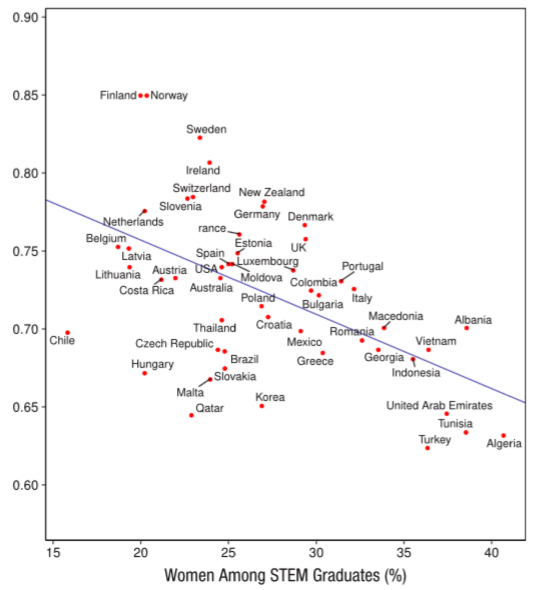
We may or may not have matriarchies - a couple countries like Spain do have more women in parliament than men so maybe they fit your definition of a matriarchy. But we do have data on how the female representation in tech varies with respect to increases in women's rights and resources, and the data shows that the more rights and resources women have the less they go into technology. This would indicate that a matriarchy would have among the lowest rates of women in technology.
> Of really? Which ones? Because Hungary certainly isn't. You just proved yourself wrong and you're not addressing what the core of the argument of what I said.
I did indeed address this. In this comment [1] You had claimed that Eastern Europe has similar shares of women in STEM fields as India, and that this is due to cultural factors. I pointed out that Eastern Europe does not, in fact, have similar rates of women in tech as India - only Bulgaria, Romania and Georgia do. Eastern European countries with lower rates of women in tech as compared to India include: Latvia, Lithuania, Hungary, the Czech Republic, Moldova, Poland, Slovakia, and Croatia (if you consider it Eastern European).
Furthermore, your comment rested on the assumption that gender roles in Eastern European countries are monolithic. This is not the case. Hungary, as you pointed out has very low gender equality as does Slovakia and the Czech Republic. Slovenia, on the other hand, is the 5th highest on this list. Latvia, Estonia, Slovenia, Moldova, and Lithuania have the same or higher ratings for gender equality as the United States.
So to recap:
1. Eastern Europe does not similar rates of women in tech than India's 30%, most have lower rates of women in tech than the United States' 25%.
2. Eastern European countries are diverse and have varied degrees of gender equality, they are not a monolith so talking about gender roles in "eastern europe" rests on the false understanding that these countries have the same culture with respect to gender.
I pointed out that your argument with respect to Eastern Europe is contradicted by the data we have, and is based on the false notion that women in Eastern Europe have a similar experience with respect to gender equality. This seems like this thoroughly addresses your point, care to explain what you feel is missing?
> I'm ignoring the fact that you can't even keep your numbers straight within the same comment. It's not consistent at all, it's almost the entire range!
Can you please read the article before posting comments like this? Every country including outliers falls between 15% (Chile) and 41% (Algeria). That's 36%. That's barely over half of the range, let alone "almost the entire range".
> And given that close to 0% or 50% is unlikely to happen in any country, that's pretty much where you expect the probability distribution to land anyway. It says nothing.
Why? Why wouldn't we expect countries to be 60% women in tech, or 70%, or 80% women in technology? Why do you take it for granted that there won't be any countries with majority women in technology?
> Wait, what exactly is your allegation then, if not that?
You're the one that originally brought up Eastern Europe and India. You falsely claimed that Eastern Europe has similar rates of women in tech as India, and I pointed out that this is factually incorrect - most Eastern European countries have lower rates of women in technology than India.
> You're still not addressing the labour participation rates between women and men. You don't get it. You're suppressed to compare bergen women and men in the same country. Women's labour participation rate has less than nothing to do with Vietnam. You don't get it.
What do you mean by adjusting for women's labor participation rate. You say that I'm not doing this correctly, but you neglect to explain what you mean by this. If a country that has 100% female labor participation had 30% women in technology, and another country has 50% labor participation and 15% women in tech then the latter's rate of women in tech is actually the same if you account for labor participation rates.
If you insist that the better way is to compare the ratio of men to women in the labor force, here's that data [2]. It does not significantly alter the results. The United States has a ratio of 0.82 female to male. Norway has 0.885 - so its share of women in tech would actually go down even further if we adjust it to match the US. Viet Nam has 0.889.
There are some that do have significantly different participation rates. Chile has 0.657, so its share of women in tech would rise by ~20% from 15% to 18% if we made its labor participation ratio the same as the US. Qatar has 0.531 so its ~23% women in tech would rise to 35%. But notice that these adjustments move these countries closer towards the trend line. In other words, adjusting for the differences in labor participation rates makes the inverse relationship between gender equality and women's participation in STEM even stronger.
1. https://news.ycombinator.com/item?id=21786037
2. http://hdr.undp.org/en/content/labour-force-participation-ra...