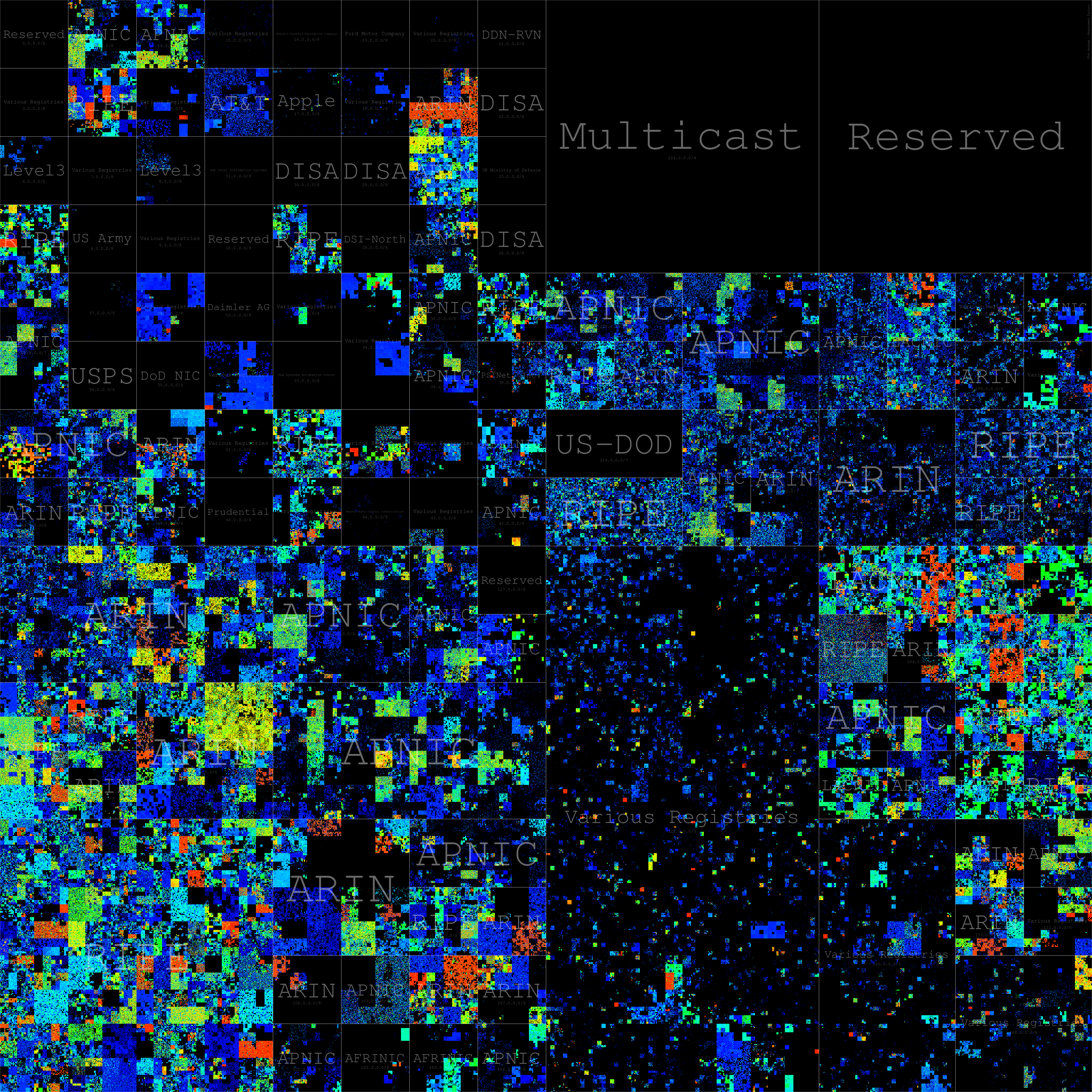
>These days, less than one third of the address space is assigned and in use. Large chunks of it have almost never been used
This part probably angers me the most as I (and I'm sure many others) have asked for an allocation in this address space and after waiting months without reply was eventually denied the request.
I’m not usually a “let the market decide” person, but ARIN has only made this problem worse with their idealism over reality policies. Their response has continued to be “time to switch to ipv6” which grossly oversimplifies the reality of the issue.
Oddly enough, the Europeans, through RIPE are doing it right by allowing a market system so that unused but assigned net blocks can be sold to people that actually have a need for them.
I’ve also faced denials from ARIN for tiny allocations, with a clearly justified use case. They are a miserable bureaucracy to deal with. But as others have indicated, there is still a lot of IPv4 that is allocated to organizations but completely unused.
I believe the op is not talking about a denial by ARIN. The 44 space is administered by a series of volunteers that I believe is distributed worldwide. Some people in the amateur radio community like to create little fiefdoms and the distribution of subnets in 44 is not immune to this type of gate keeping.
Correct. ARDC (managing entity of AMPRNet) then used the lack of use of the 44 address space as an excuse to sell it off to the highest bidder. Those addresses were indeed unused, but not for lack of want.
There are still blocks for sale in the US and probably always will be. Not saying your wrong just that the reality is more of a gray market vs the official ARIN party line. There are blocks that were assigned predating ARIN and if you never agreed then you can still sell these at a market rate.
Yep, I looked into that but you basically cede all control back to ARIN. ARIN does not let you consider them “assets” so they get involved in any company acquisition. IPv4 space from other regions is much more flexible.
Its a bit of a compromise from ARIN, because in order to sell it and be recognized by ARIN (able to update whois, get RKPI records, etc) the sellers must give ARIN authority over the sold netblock space.
I personally own a /24 block predating ARIN, registered back in 1993. I am not planning on selling it, and never signed their RSA agreements and probably never will as long as reverse DNS remains delegated.
It’s frustrating that they paint the unused space as evidence of of abandonment, but the reality is that it’s been impossible to use any of this address space!
I didn't even know about it until yesterday! It's kept quiet and secret I guess. As a ham for 10 years now, I totally would've used this for projects if I could've got allocated space. I believe http://hamwan.org/ is on 44.0.0.0.
Well, I've known of it for 30 years. Since starting with AX.25 to a TNC, then playing with KA9Q NOS.
So it isn't really a secret.
As I understand it, the range was supposed to only be used for Ham to Ham comms, so if routed (generally tunneled) over the Internet, was only supposed to be to other Hams.
Certainly there are people with ACLs expecting that 44.0.0.0/8 will never be sent to the Internet, nor received from the Internet. So it has in effect been a bit like a shared RFC1918 space, but for Hams alone.
Moreover those in the know probably have it in their Bogon filers, I certainly do. So it may not yet be as usable as Amazon hope.
People considering it a bogon are simply wrong. 44.0.0.0/8 has been routed on the internet for decades. If you register a subnet, you can even announce it with BGP just like any other. Also note that ampr.org (not www.ampr.org) resolves to a 44 IP.
I didn't ham radio (beyond building a regenerative receptor), but my father was very active on 80's. Him and a few others, build a computer network using ham transceptors and something called "digipiper". I remember saying that had a small BBS on it, running on a 286.
As someone who does not know any more about ham radio than can be inferred from "Contact" and "Stranger Things", I'm curious to know what kind of projects you would have used it for.
There are a lot of digital interconnect systems operating on HAM bands. Personally for me I've been part of the ARES (Amateur Radio Emergency Services) network for a while.
A lot of that volunteer work is getting communication up and running to people in places that have been hit by natural disasters. Normally this involves HAM with mobile rigs driving into the affected areas and acting as a hub to get messages out.
Currently this is a voice service "Hey WXXX, I've got a message for the Adam Smith at phone number 555-555-1234. Jane and her family made out of the flood and are unharmed. They're going to try and find a ride to your home in the next couple of days." This is very error prone and would likely benefit from having a reliable digital service available.
It would be valuable at least IMHO to have repeaters that operate as part of the ARES network be vetted and given a tunnel to a public address like this. It's not much but having a recognized digital presence that could be used as an identifier not only for contacting loved ones in distress but also by organizations such as FEMA to distinguish random emails from volunteers on the ground trying to get specific assistance might be useful.
This was kinda just my first wish list item when I thought of how I could use some public space so maybe there are better ideas out there.
The money involved in IPv4 allocations - and name allocations too - really sickens me. It's a blemish on humanity and a testament to the limitless nature of human greed. IANA (and ICANN as a whole) is a corrupt, captured organization that I think represents the worst of the internet when it should have been the best of it. Removing price caps on .org, gold rushing outrageously priced gTLDs to anyone with the money (private corps), and the ridiculous marketplace of IPv4 subnets - I'm ashamed to have anything to do with this community. I'm loathe to extend my contempt to capitalism as a whole but it's crap like this which makes me wonder if the humanity of future centuries will look back at our greed-powered society with disdain.
I'm confused. You're blaming humanity because a marketplace developed following the scarcity of a commodity? Why was any of this bad behavior? I'm genuinely confused.
Here's my take - creating a marketplace where a sole actor has control over a scarce resource (IP addresses) is exactly why anti-trust exists. A true marketplace assumes there is competition. How do you have competition when the underlying resource (1) has a clearly understood finite number (2) is controlled by one entity and (3) can't be differentiated in any way (e.g. 10.0.0.0/8 has no differentiated intrinsic or extrinsic value over 11.0.0.0/8).
If IANA were profit-seeking, they would rent rather than allocate addresses, and force people to pay $10 per IP per year, and roll in the billions of dollars they'd collect.
> gold rushing outrageously priced gTLDs to anyone with the money
I'm actually happy about that one. For realistic usage, it mostly went nowhere. People with money paid lots and got something they wanted. It's like a crazy rich person building a castle because they can. I'm happy they distributed the money.
> it's crap like this which makes me wonder if the humanity of future centuries will look back at our greed-powered society with disdain.
If there is any humanity left in the coming decades, they will for sure look down on us as monstrous greedy beasts killing each other for a little power. Because that's all that capitalism and private property brought humanity since their invention.
But it's far from sure there will still be anyone alive to resent us given the very likely collapse of capitalist civilization (and most of life on earth with it).
There's an excellent ecologist documentary specifically on this topic called End:Civ. You can find it in many good corners of the web/net for free :)
In the meantime, we'll keep working on decentralizing naming authorities of the Internet, such as with tor, cjdns, etc..
Wow, this sounds crazy to an outsider. I highly recommend reading deep into the mailing list conversation from the link. It really does sound like a private organization "squatted" on a public resource, went under the radar for a long time, and then cashed out on their adverse possession.
My outsider perspective on this is ARIN needs to provide a transparency report on the number of complaints it received from legitimate ham operators who attempted to register addresses in this block but were denied by ARDC, and a general oversight review of the characteristics of ARDC as a community steward of this space.
AMPR was one of the first organizations to register with the DNS in the early 80's. It was an original player on the ARPANET before it was "the Internet." In fact, they tried to register in 1987 using their own TLD (.AMPR) because, according to them, they were a "mobile" network (didn't fall under the ccTLDs) and did not fit into any of the existing gTLD categories. After some deliberation the NIC ultimately registered them under .ORG in 1988.
ARDC had administrative control of 44.0.0.0/8 for decades. It's not squatting... It's their space. There aren't enough active Hams in the world to use all of it, so nothing is lost. We'll all benefit more from Amazon and their customers making use of some of it.
ARDC is notorious for radio silence followed by soundly rejecting claims for address space. They're absolutely squatting on it and hoping it flies under the radar, as noted in other comments.
Even so, we're left with less space than we had before. To my knowledge the FCC is pretty liberal with dishing out public RF spectrum ranges to private entities, but they're much more conservative with turning over private RF ranges to the public.
Every part of the RF spectrum that the public loses is unlikely to be reclaimed. We have less airspace, permanently.
ARDC is supposed to be controlling it on behalf of amateur radio operators throughout the world, not selling it off to amazon.
A mission that they have completely ignored for years and years at a time mind you, it has been nearly impossible to get allocations out of them for extended stretches of time.
I don't really have a problem with selling off parts of 44/8 that are unlikely to ever be used.
I do have a big problem with the ARDC unilaterally doing this without any public discussion or real accountability.
They should have created a new foundation with board members from various amateur radio organizations (ARRL, AMSAT, IARU, TAPR, etc) in order to manage the (rumored $50 million) funds.
I hate to be a downer, but nobody even knew about this space until it was mentioned here. I've been a ham for almost 10 years and this is the first I've heard of it.
The Internet and ham radio don't mix. The rules of the modern Internet are "encrypt everything and trust nothing." The laws of ham radio are literally "you must not encrypt anything". It wasn't meant to be, unless you want to change the laws in every ITU member state. By the time that's done, we will all be accessing the Hypernet with IPv20 from our personal space stations.
Selling off this IP space to Amazon so that some people can get grants is going to make way better use of this resource than than the ham community ever did.
(I like all the people on the nanog list trying to derail it. "Some of the board members don't have ham licenses!" Not actually a requirement to manage a ham radio organization. Only a requirement to transmit a signal. "There is an antique router configuration out there that creates a peering arrangement between the University of California and Amazon that's not authorized!" Guess what guys, they'll probably shut down the arrangement. They're not going to say "welp, there is no way to fix this, here's your money back Amazon!" The thought that that's a possible outcome is making me laugh. I am sure Amazon can find a transit provider if they need one.)
>I hate to be a downer, but nobody even knew about this space until it was mentioned here.
Speak for yourself. :)
>The rules of the modern Internet are "encrypt everything and trust nothing." The laws of ham radio are literally "you must not encrypt anything". It wasn't meant to be, unless you want to change the laws in every ITU member state.
More to the point, the regulations around third-party communications [0] mean that this could never be routable from the public Internet.
And if 44/8 will never be routable, then what's the point of using public addresses? It could use private network addresses instead.
All the same, I find ARDC's response to be high-handed. They refuse to acknowledge that they are selling off what is essentially a public resource. They refuse to believe that others might not trust them to be a responsible steward of ~$50 million.
> They refuse to acknowledge that they are selling off what is essentially a public resource.
I think I'm OK with this. Someone decided to ask for a ton of free IP addresses when the Internet was a crazy thing nobody cared about. That person appointed a board of directors to manage the resource. The appointed board then decided "let's turn that valuable resource into money." That's just capitalism. Is it fair that someone buys stock that increases in value 100x? Is it fair that someone is born rich and you're born poor? Not really. But that's the way the world works.
If you want to post to a networking mailing list "I don't like the way the world works, it's unfair," I'm totally fine with that. But being mad about who owns what today because you weren't around to claim some land before the gold rush seems irrational to me. These folks got lucky. It appears that they are going to donate 100% of their luck to charity. It's all going to be okay, probably.
I agree. If the ham community has internal disagreements about the sale or the use of the money, they should talk to one another in a courthouse. Meanwhile, let the rest of the world make better use of those millions of IP addresses! It's not like Amazon is going to squat on their new /10. We all know they will soon be available for anyone to use on AWS.
You've never heard of it because the ARDC has been absolutely abysmal stewards of it, now they get a nice multi-megabuck payday for decades of negligence. Don't count on these "grants" ever actually materializing, count on huge paychecks for the board though.
This didn't come up in https://news.ycombinator.com/item?id=20363705
earlier this month. That "FreeBSD - A lesson in poor defaults" post
said FreeBSD's OpenSSH port has "The NONE cipher is somewhat of a
misfeature, removing the encryption bits and only keeping the data
integrity. It allows users to accidentally shoot themselves in the
foot pretty easily. The trade-off in performance isn't really worth it
either, as the bottlenecks one might experience have a lot more to do
with the MAC than the actual encryption."
So, when someone uses 44.0.0.0/9 where encryption isn't allowed, and
they don't want to create and maintain their own OpenSSH fork, this
FreeBSD code might be exactly what they want.
> "There is an antique router configuration out there that creates a peering arrangement between the University of California and Amazon that's not authorized!" Guess what guys, they'll probably shut down the arrangement.
The 44/8 route would never get used for Amazon traffic in any case given that Amazon's BGP advertisments for 44.192.0.0/10 would be more specific than 44.0.0.0/8. In the worst case, the University of California would get inadvertently DDoSed if Amazon suffer routing issues and then retract the /8 route in favour of advertising the remaining 3 /10s they care about.
The FCC, which has explicit purview over how radio frequencies are used, details the rules for amateur radio in part 97. In particular, "Amateur" is explicitly defined there to not allow commercial interests to use those radio waves. The US government allocated portions of the radio spectrum for use by (licensed) amateurs, kind of like the national parks. I'm not allowed to cut down trees in Yosemite and run my own private road so I can make a shortcut and drive right up to Half Dome. The prohibition against encryption comes from a similar place. If you're looking for privacy, ham radio is not the medium to use.
FCC part 97 covers amateur operation (in the US), and the relevant part is §97.309 (4)(b), which states "data emissions using unspecified digital codes must not be transmitted for the purpose of obscuring the meaning of any communication."
The intent of the "unspecified digital code" matters. My reading of this is that unspecified codes for authentication are allowed. I've always wanted to build telnet with authentication - if interested, others could to watch what I'm doing, but not be able to impersonate me.
Would be interesting to know the salary of the board will be in the future. It looks and smells like a cash grab to benefit those at the top with cushy jobs to be a pseudo VC under the guide of giving "grants".
If they were being honest with themselves, they would donate the entirety to the EFF instead of this bullshit maneuver.
Just to add, even if they dont get a salary at all (I would be shocked), the responsible thing for them to do would be to give the money away to the EFF or another org who knows how to best put the money to use.
The idea we are entrusting a group thats financial statement going back the past few years show just 5k-10k in assets with a 100 million dollar windfall is insane. If they dont fuck it all up within the first 6 months I will be shocked. More likely though will be some lawsuits which delays any use of the funds.
I would have more faith that the ARDC will use the proceeds from the sale for the benefit of the ham community at large if they engaged the community beforehand.
It seems to me that they saw the opportunity to make a lot of money, and figured having a lot of money is a good problem to have and they could figure out what to do with it later.
The fact that they have no specific public plans for the money is telling. They mention vague plans for grants, scholarships and a perpetual endowment, but how do we know they won't keep most of it in the endowment and use most of the interest to pay board member salaries? If the board decided to do that, who could stop them? Who elects the board?
I particularly don't like this response:
> This makes
me one of a VERY small group of people with any arguable personal
property interest in network 44. And yes, 25% of this space, which is
VERY unlikely to ever be used by hams, has been sold to Amazon.
> Rather than try to personally profit from this, we all readily agreed to
place the entire proceeds of this sale into a 501(c)(3) charity
chartered to support amateur digital radio and related developments. No
one is buying a yacht or a mansion.
I'm not saying I expect the board will use the money to buy a yacht or a mansion, but the whole tone of that email makes it sound like they feel entitled to do so, and it was only their own magnanimity that caused them to give the proceeds to a 501(c)(3).
I'd much rather the board of the organization see themselves as stewards who are not personally entitled to the money. Otherwise you end up with "charities" like the Trump Foundation.
I guess that at some point Ford though they could have an IP for each car? Out of curiosity I looked at the headers of an email I got from them and sure enough it came from an IP in their allocation! However, the same was not true for emails from Daimler...
We were supposed to run out of space in the 90s, but NAT was a temporary bandaid that turned into the status quo. Not the original intent, and it’s used as a de facto firewall with really mixed results.
I say, exhaust it and force people into IPv6 like we should all be on.
There's no incentive for migrating to ipv6 for corporations. I have said this previously NAT breaks the Internet [0]. Without setting an expiration date for ipv4 NAT is going to get dragged to 2050.
IPv6 significantly simplifies your internal numbering.
Inside a corporation you don't need to "dual stack" you can just go pure IPv6 wall-to-wall and now all your subnets are arbitrary size and have globally unique addresses. You use NAT64 at the edge to get to the parts of the world that are stuck on IPv4.
Several big organisations have done this, it's a big saving.
Ipv6 adoption is slowly creeping up, and if you were to put grandma's broadband on ipv6 only, she would still be able to use Facebook, Twitter, and all the other major big sites.
I'd say the day some ISP's stop provisioning ipv4 (especially for 'social networks only' plans) might be getting close.
Maybe NAT breaks the Internet of twenty years ago. But we've already worked around it. I'm using a computer which is behind a NAT which is behind a CG-NAT and everything works fine. Sure, people can't connect to me directly, but why would I want that to happen? If anything, that makes my computer more secure.
I know this sounds like trolling, but let's be pragmatic.
Some users do want people to be able to connect to them directly though, hence Universal Plug and Play (UPnP), which can open ports on your router. You may disagree with the wisdom of automating the port forwarding process for people who don't understand networking concepts but there are people that do want other people to be able to connect to them directly, even if you don't.
Generalizing that one use case will suits everybody, fits about as well as one-size-fits-all clothing. Which never fits right.
This is why we are stuck with huge corporations to provide services to connect to each other. We are sacrificing privacy because we don't want direct connections. We could have hosted an Instagram clone at home as well if NAT wasn't there.
Ability to connect directly does not necessarily mean that you are somehow more vulnerable to attack. There are measures that you can take to prevent attacks from happening. It's trivial to configure.
I am not familiar with this domain, anyone mind answering: What does this mean for amateur radio practitioners, and what does this mean for the greater internet/communications industry?
They had a /8, out of that they sold a /10 to probably one of the big 5.
They never got close to using the whole /8 and currently allocated about a third of it.
They are using the money for grants and scholarships and perhaps an endowment to fund them perpetually (and just being cynical, probably paying the board who made this decision some of that money as well)
IPs and blocks have been allocated for decades to people for amateur radio related things and will continue to do so without any changes.
It has been nearly impossible to get an allocation from them as a ham, if they even bother responding at all, so i don't buy this. This is an obvious money grab.
A volume discount isn't a backroom deal. Unless you think for some reason the group that controls 44.0.0.0/8 is beholden to Amazon or big tech for some reason.


This part probably angers me the most as I (and I'm sure many others) have asked for an allocation in this address space and after waiting months without reply was eventually denied the request.