If you've never lived in NYC, you have no idea... just say the words "summer garbage strike" to any NYer and they'll have stories of 10-high bags of garbage piling up on streets in 95 degree heat and 95% humidity, while the unions wait until city hall caves...
Honestly, can you blame them. It's toxic, backbreaking work. Easily dismissed and essential at the same time. Trash collection is the number 1 contributor to public health.
I guess it cant be done in dense cities but in our area, the garbage collectors drive trucks with robot arms. They can stay in the cab the whole time and the machine does the work in a fraction of the time and workers involved. The catch is that the homeowner needs to pull their cart to the street curb but personally that is not a big deal. One good point is because the machine lifts the cart, I can fill them up quite heavy and they not complain.
> I can fill them up quite heavy and they not complain.
Just be mindful. According to a friend that works for the waste collection for the city the arms do have a scale built in. Occasionally homeowners try to dispose of something heavy, like construction material, and the driver will leave it right at the curb.
Also, I think it can be done. NYC simply chooses not to. Paris, for example, has uniform size and color bins.
In NYC there are all kinds of violations of normalcy and sanity, that become, "well how the f else is gonna work?" It is after all, the center of the known universe.
This is another instance where the value of the work is visibly different than the value of the labor. Teachers are the classical example of providing much higher value than what they are compensated for.
I've lived on Roosevelt Island for the past 37 years and the AVAC system has been very reliable, and no garbage trucks. The system works with a set of "timed" openings and several score of chutes, so the full vacuum pressure is maintained for a single chute, then it closes, and moves onto the next chute. The system timing can be adjusted to meet varying demands. Some of us are looking for possibilities of, say, 3-headed attachments at the chute base, which would allow separation into various recyclables to be automated sorted/collected. Annual cost is about $360K, which is about $30 per person per year (or $3/month). And the system collects and containerizes the garbage so only one carting truck is needed to pick up a full container, rather than carting trucks half loaded, i.e., better truck, fuel, exhaust efficiency. It's one of those "Jetsons" ideas that actually works well. I'm working with politicians to get mini-AVAC systems in areas of Manhattan (high rises), but you can imagine that there are regulatory obstacles and union/industry obstacles, but it really works well.
So in summary, the garbage collection is not something that you just dump something on. It's not a big truck. It's a series of tubes. And if you don't understand, those tubes can be filled and if they are filled, when you put your [trash] in, it gets in line and it's going to be delayed by anyone that puts into that tube enormous amounts of material, enormous amounts of material.
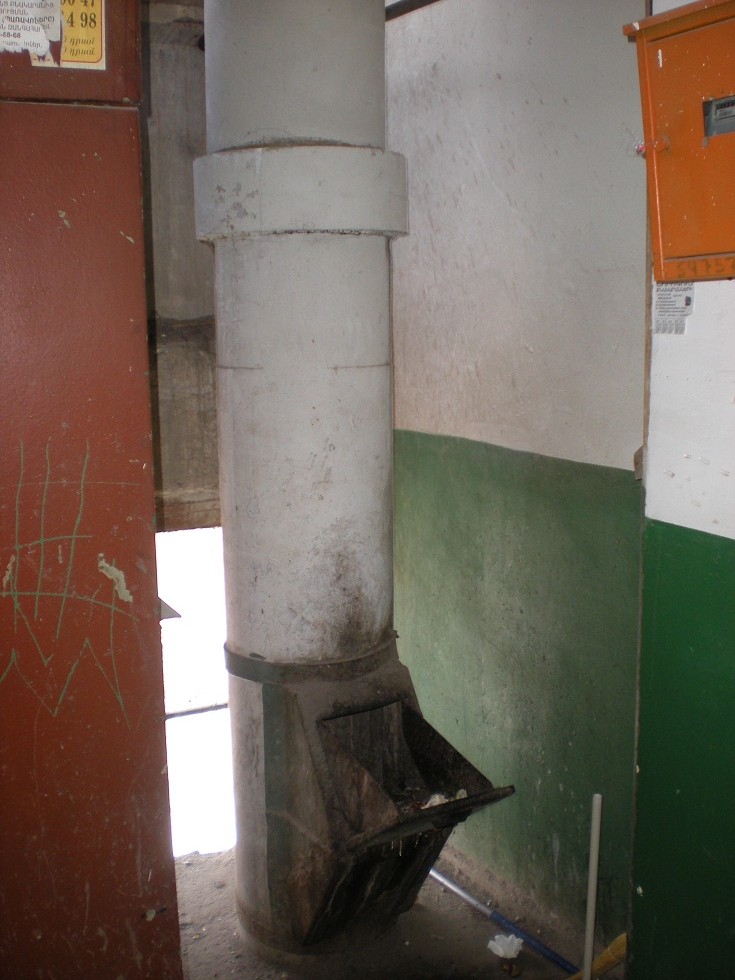
Here in Lithuania most older buildings have the same, but newer buildings typically just have garbage rooms in the basement. I guess the system reminds them of Soviet buildings, where the shoot is just a big pipe going down the stair well, so stinks up the corridors, is usually too small, and of course never cleaned. Here is a picture of a nicer looking one:
I've lived in new buildings in other countries that have the same system as you, and the (mild) smell is a lot nicer than having to walk downstairs to throw out trash.
The waste is still collected by truck from the terminal, and presumably driven to somewhere else in New York.
London tries to reduce large vehicle traffic by taking the waste away by barge; you can see the place in central London here [1] (I like the irony of "Smuggler's Way".) The Roosevelt Island waste terminal is at the edge of the island, so this is a missed opportunity -- if there's anywhere to accept it by barge. (London's used to go to [2], a quick search suggests it now goes to [3].)
I live in a neighborhood with this system installed. In fact you can see it at 3:28, pretty much all footage from that point on is from there.
When it works, it REALLY works. There is no trash in the streets, it's all in these tubes that you place your trash in. Some buildings have these tubes integrated, some have the tubes in the street kind of variety. Every now and then you'll see special trucks come in that quite literally suck the garbage out of the ground to empty out the underground storage.
Sometimes it doesn't work though. Maybe it's because people fill up the tubes with weird shit but I think mostly it's just because they don't empty the system often enough. When I first moved in this was a big issue, but now I haven't seen it in a while (actually years probably) so maybe they've figured out the a schedule better.
It is really nice, it works well and truly is an out of sight out of mind kind of thing. I'd imagine it's easier for garbage collection too since it's centralized, you don't have trucks coming around to each house or block.
There is some garbage that doesn't go in the chutes. Electrical appliances, glass, larger items that won't fit such as pots and pans and lighter furniture. They all go in special garbage rooms so still off the streets, but not quite as cool as giant tubes underground.
To your point of "out of sight out of mind" I wonder how much this impacts recycling programs. E.g. I'll just throw everyone in the trash because it's gone vs I'll recycle plastics etc separately which reduces "smelly" garbage.
Sounds nice - but I'd love to know what the cost of the system was and the annual upkeep/maintence repair expense, energy costs etc compared to regular trash pick up...can one make a compelling case that these should be more widely used?
I cringe at the thought of how more complex the underground utility system will become because of something like this. There are some streets in New York which hardly have any additional room left for more utilities.
Residential buildings in NYC need to separate their trash into three types: recyclable containers, paper, and general trash. How is this accounted for with a single tube system? Do they have exemptions from the law? Can they only drop certain things into the shoot on certain days?