Think of your product as part "content" and part "container". When I say "content" I mean "stuff that could fit on a content platform". When I say "container" I mean, the bundle of forces that your product exerts to bring the user in contact with the content.
Some learning products are just content with zero container. Books are the limit example. Karpathy's "Let's build GPT" is another.
Most learning products -- and all apps -- live or die by the container they create. (There is no reason to build a learning app other than to build a container. If you feel you have the best content, ship it on a content platform and save yourself a very painful distribution slog.
Duolingo is in the container game. Their container is made of every cheap trick in the book -- notifications, streaks, etc -- because they work. My startup was Hack Reactor, the coding bootcamp, and we did it with pair programming and fixed classroom hours. (We had great content, but our competitors with good containers and bad content did leagues better than vice versa.)
If you're building an app, you're in the container game. You can build a great container with no cheap tricks. I have done so! But you can't build a great learning app with no container, and you can't build a great container if you if you don't want to change your users' patterns of engagement and attention.
So, what is your container? How will you weave a powerful spell that meaningfully transforms the attention and engagement of the app's user? What will cause them to pull up your app again and again, when they would have churned from a simple anki deck or whatnot? Given that you find it distasteful to use the easy levers you mentioned (notifications, "streak" psychology), what alternatives can shift your users' patterns of attention and engagement towards the learning task?
If you have great answers to those questions, great! If you don't want to build a container, build content on a platform with easy distribution. If you want to build a container but you don't want to shape your users' attention or engagement, you are confused.
I don't understand this POV, can you explain what I'm missing?
Usually when people say "corporations aren't people" I think they are confused about the need for an abstraction. But you acknowledged the need for an abstraction.
I don't imagine you are confused about the status quo of the legal terminology? AFAIK, the current facts are: the legal term "person" encompasses "natural person" (ie the common meaning of "person") and "legal person" (ie the common usage of "corporation"). In legalese, owning shares of legal persons is not slavery; owning shares of natural persons is; owning shares of "people" is ambiguous.
I don't imagine you are advocating for a change in legal terminology. It seems like it would be an outrageously painful find-and-replace in the largest codebase ever? And for what upside? It's like some non-programmer advocating to abandon the use of the word "master" in git, but literally a billion times worse.
Are you are just gesturing at a broader political agenda about reducing corporate power? Or something else I am not picking up on?
The argument is that the need for abstraction doesn't mean we must reuse an existing concept. We should be able to talk about corporations as entities and talk about what laws or rights should apply, without needing to call them people.
But the existing concept by and large has the properties we want. The ability to form contracts, to be held civilly or criminally liable for misconduct, to own property, etc. That we say something is a juridical person isn't some kind of moral claim that it's equivalent in importance to a human, it's just a legal classification.
Corporations can be held criminally liable, but they can't go to prison. And while lots of countries have gotten rid of the death penalty, a corporation can actually be "executed" by getting dissolved.
At least for me, the problem is that making them completely equivalent in a legal sense has undesirable outcomes, like Citizens United. Having distinct terms allows for creating distinct, but potential overlapping sets of laws/privileges/rights. Using the same term makes it much harder to argue for distinctions in key areas
But they aren't completely equivalent. Natural persons can vote; juridical persons cannot. Natural persons have a constitutional right to avoid self-incrimination; juridical persons do not; etc. There's just a lot in common between the two, because it makes sense for there to be a lot in common. Citizen's United v FEC was a transparently terrible ruling, but it was in no way implied by the mere existence of corporate personhood. It was a significant expansion of the interpretation of corporate personhood that directly overturned a prior supreme court ruling on campaign finance regulation.
It was a major expansion, based solely on the reuse of the term. It’s why I used it as an example.
The main arguments boils down to that since corporations are people and have free speech, and that a natural persons financial activity is considered protected speech, that a corporate person should have the same freedom as there should be no distinctions about the rights afforded to a person.
The entire argument would have been moot if we used distinct terminology
There were then and still are now constitutional rights afforded to natural persons but not juridical persons. There is not some inability to distinguish the two. Look at the ruling that Citizens United overturned: https://en.wikipedia.org/wiki/Austin_v._Michigan_Chamber_of_.... It was very clear that it's fine (and necessary) to restrict corporations in some ways precisely because they are not people.
Perhaps the argument of Citizens United wouldn't have been made if we instead used the terms "Human Shmerg" and "Legal Shmerg", but exactly the same argument could apply to shmergness as to personhood when discussing the rights afforded to shmergs of one kind or another, and the conservatives in the US really want to deregulate everything.
Thats exactly my point, you do not have to use the exact same term for both types. You could literally just use “person” and “corporation” as wholly distinct terms with overlapping rights afforded to each and avoid the edge case semantic arguments that create legal situations that the majority takes issue with.
I'd venture to guess that whatever legal logic resulted in the SC deciding that corporations should have the same right to free speech as individuals presumably doesn't hinge on any semantic blurriness between different subsets of "persons", and even if they didn't use overlapping terms it would still have ruled thus.
That said, it certainly is nice free marketing for our corporate overlords.
The entire cry of "corporations aren't people!" is based and a complete misunderstanding of what a legal person is. You've done a great job at explaining.
Unfortunately, there are a lot of people who willfully propagate these misunderstandings. Because by saying "of course corporations aren't people, and everybody knows this except those dumb <other side>", it's an easy way to try to vilify the other side as dumb/evil. When the reality is that it's simply a tried-and-true necessary and useful legal concept, that virtually nobody but lawyers would even be familiar with in the first place, if it weren't for activists who thought it sounded scandalous.
> The entire cry of "corporations aren't people!" is based and a complete misunderstanding of what a legal person is.
> if it weren't for activists who thought it sounded scandalous
It wasn’t activists who first misunderstood the concept, it was the Supreme Court, who decided that corporate personhood gives corporations the same first amendment rights as real personhood. It’s not ridiculous to point out that if freedom of speech is implied by corporate personhood, it was insane to give corporations personhood in the first place.
The Supreme Court was going to decide whatever they wanted, regardless of which linguistic terms were used to describe the underlying legal concepts which remain the same.
If you look at the text of the first amendment, the word "person" doesn't appear in that part. It says "Congress shall make no law... abridging the freedom of speech." It doesn't say that the speech has to come from "persons". So I'd say you're the one misunderstanding here.
I think it was a dumb Supreme Court decision, but I'm not going to pretend it had anything to do with the fact that corporations are called a "legal person" instead of a "legal entity" or some other term that ends up meaning the exact same thing. Disagree with their decision, great. But arguing over legal terminology is a waste of breath.
> If you look at the text of the first amendment, the word "person" doesn't appear in that part.
This is irrelevant, but anyway it has the word “people” in it. Either way the bill of rights is a list of personal rights.
> The Supreme Court was going to decide whatever they wanted, regardless
The Supreme Court is also supposed to justify their position. It makes sense to protest their justification. That’s how the courts work.
Not a single activist would continue to protest if the ruling was overturned. Absolutely no one actually cares about what legal terminology is used beyond lawyers. It’s an effective slogan because it gets to the heart of why the ruling was so ridiculous. To change the slogan “corporations aren’t people” would either reduce accuracy or reduce understandability. It is the correct slogan, no matter whether the legal terminology continues to be useful
A few. But weighed against pretty much all of tort law and contract law, which heavily lean on the similar treatment, those are some pretty tiny edge cases that it's easy to say only apply to natural persons.
Is a corporation really a group of people? Of course people are involved with the corporation, but the corporation doesn't represent its employees, shareholders, management or customers. It's a separate legal entity with complex relationships with its employees, management, shareholders and customers, but with its own rights and responsibilities.
There are organisation forms that are a lot closer to being just a group of people working together, like co-ops and firms maybe. I'm not entirely up to date on all options in English-speaking countries (which will vary of course, but the Dutch Maatschap is probably as close as you can get to a company that's just a group of people.
Co-ops and firms sound like they are a subset of corporation. If they aren't, what makes them different in your mind? Corporations can take many forms and organize around many different principles.
Isn't a corporation incorporated or something like that? With limited liability and everything? Or does it also cover tiny 1 person outfits? I admit English isn't my first language, but I've always understood it to a be a specific form of company.
I believe it would be redundant to explicitly grant freedom of speech to an organization such as a union, as its individual members inherently possess this right.
And you will find similar reasoning in the Citizens United decision with respect to corporations:
> If the First Amendment has any force, it prohibits Congress from fining or jailing citizens, or associations of citizens, for simply engaging in political speech. If the antidistortion rationale were to be accepted, however, it would permit Government to ban political speech simply because the speaker is an association that has taken on the corporate form.
> The argument is that the need for abstraction doesn't mean we must reuse an existing concept.
but that's not what is happening, there are two concepts: "natural person" and "legal person". you could call them "foo" and "bar" if you prefer, those are just legal variable names.
Or you could just take the obvious and literally meaning of the phrase "corporations are not people" and not say that everyone who says it is confused. Corporations have different incentives, legal requirements, rights and responsibilities.
No, they don't! That's why the "5.5 million" deepseek V3 number as read by American investors was total bullshit (because investors ignored their astrik saying "only final training run")
Yeah, that's one of the most frustrating things about these published numbers. Nobody ever wants to share how much money they spent on runs that didn't produce a useful model.
As with staffing costs though it's hard to account for these against individual models. If Anthropic run a bunch of training experiments that help them discover a new training optimization, then use that optimization as part of the runs for the next Opus and Sonnet and Haiku (and every subsequent model for the lifetime of the company) how should the cost of that experimental run be divvied up?
This article is a midwit dismissal; it may contain valid corrections but it is ignorant on the core topic at hand. This is a shame, because it is extremely interesting and under-reported topic!
The core thesis of the book (per Claude) is: "Traumatic experiences become encoded in the body's nervous system, muscles, and organs, not just in conscious memory."
The perfect exposition of the concept is downthread, in a comment by 'neom, which I will excerpt: "[The acupuncturist] moved the needle, [I did] more crying, deeper, deeper crying, he kept moving the needle till I thought all the needles would burst out of me from how deeply I wanted to cry but he told me not to be scared and I thought I was going to die. Anyway, he left me alone in that room for about 35 minutes while I wailed, I mean, awkwardly wailed. After everything started to calm inside me, I slowly started to be able to think again, and the thought that was there was the memory of the guy who sexually abused me when I was a kid, moving his hand off my hip." (Thank you for sharing, neom.)
I've had two similar experiences myself in the last year. I haven't read the book and don't know how this subject shows up in the scientific literature, but the proprioceptive experience leaves zero room for doubt about what is happening.
People say lots of dumb and wrong things about trauma. Maybe the book contains some of that, but its titular observation is fascinating, true, and maybe even useful!
I'll close with a related theory of mine, also derived through proprioception: one of the functions of the full-body sob is to reorganize muscular patterns which share an origin with (are identical to?) the emotional origin of the tears.
> "and the thought that was there was the memory of.."
I haven't read the book; what's the distinction between "the brain has a painful memory which is making it tense muscles" and "the muscles are tense because the memory is encoded in the body and muscles"?
I mean, if someone sees a balloon and curls/cringes/flinches their body away because they hate balloons bursting, how would one tell apart "flinching is caused by brain memories of stressful noise" and "flinching is caused by body memories of stressful noise"?
Either can create the other. Thoughts can raise or lower the heart-rate. Bracing the body can restrict breathing. Shallow breathing changes the acidity of the blood which then activates the sympathetic system which changes thinking.
The thesis of TBKS is that the body can continue a feedback loop which encodes a prior strong emotion without active thought. Consider something as simple as a limp that persists after the acute injury has healed.
I have loved Cormac's books since I was a child, but never read Larry McMurtry until recently. If you're in the same boat, I implore you to give one of the below a try.
Lonesome Dove -- A great story about washed-up Texas Rangers with achingly beautiful writing.
The Last Picture Show -- More tonally similar to Cormac's stories. Coming of age in a dusty Texas town.
Leaving Cheyenne -- I have never in my life recommended a romance novel until this moment. I'm literally crying as I write this, remembering the closing scene.
Initially thought you may have meant revisionist as a slight, but I see that it's a sub-genre. For anyone else unfamiliar (from wikipedia):
> The revisionist Western is a sub-genre of the Western fiction. Called a post-classical variation of the traditional Western, the revisionist subverts the myth and romance of the traditional by means of character development and realism to present a less simplistic view of life in the "Old West". While the traditional Western always embodies a clear boundary between good and evil, the revisionist Western does not.
I think of you as a direct person, so it's strange to hear you dismiss "stablecoins are regulatory arbitrage" as misguided or incurious. Maybe I am wrong about something.
Would you agree that "actual regulatory evasion" has been a top-three use case across the history of stablecoins? (That is: hackers, money launderers, sanctioned entities, and crypto exchanges do things with stablecoins expressly because doing them with dollars in banks would be illegal in an enforceable way.)
And, would you agree that GENIUS is a formalization of the low-regulation status quo of stablecoins? (That is: the bank system does KYC, AML, and reporting on both sides of every transaction; the stablecoin system generally only does that for onramps and offramps.)
This is not to say "regulatory arbitrage" is the only thing going on with stablecoins. Existing payment rails are imperfect and rent-seeking for reasons that don't have to do with the above. I'm just surprised you're describing the arb as such a non-issue.
It does seem like there's something wrong with that data; I find it somewhat implausible that the average parent was only caring for their child for 1.7 hours a day in 1985; even if you assume that all of the tween and teens were free-range and only got an hour or two of parenting a day, little kids have always required nonstop attention to make sure that they're not actively dying.
Although... the infant mortality rate in the US has dropped by more than 50% since 1985, so who knows...
Yeah, I've wondered if there is some sort change in how people think about and label their activities. Would a 1950s parent even think of themselves as doing a defined activity called "childcare"? Or rather, the children are just around, as the parent is doing things. If I am cooking dinner while a toddler putters around the floor and a baby is in a high-chair eating scraps I give him, am I doing "childcare"? Would a 1950s parent think of that as doing "childcare"?
Toddlers don’t just putter around. They want to be wherever you’re at doing whatever you’re doing and opening all the cabinets and boxes and pulling everything out to look at it. I think people were more apt to put them to work around the house in the past whereas now people infantilize them more. My son doesn’t speak very well as a 19 month old but he understands a lot and pays attention, and right now we’re trying to figure out how to put him to work in the kitchen and around the house so he feels involved and we get what little help he is able to contribute.
I was born in '83 and I'd say this mostly describes my upbringing. We were left to our own devices the vast majority of the time. By the time I hit my teens, most days I'd barely see my parents at all. At some point you've got kids raising other kids as the parents are absent.
and less children per woman. I figure thats got to be the main driver. China actually a really good case study with the one child policy and rise of little kings.
As a matter of fact, the police return fewer stolen USD to rightful owners than the "financial system" (ie regulated banks, credit card companies, etc). If you report an identity theft (a theft of your USD via your CC or bank info) to the police, nothing will happen, even if they find the guy. The party that is going to return your money (if anyone) is your CC or your bank.
The "financial system" is even more central a player when you consider the universe of potential crimes. Why don't drug dealers put their illegal and ill-begotten money in the bank? It's because the bank is obligated to ask a million questions, and occasionally, to freeze accounts. Why don't North Korean hackers request payment by bank transfer of USD? Because those payments can be put on hold or reversed by the financial system, which is a tool of the "police" in a way that Bitcoin never can be or will be.
The "financial system" is literally a technical system which has been effectively deputized by the "police", and as a matter of technical reality the "financial system" enforces the laws in ways that bitcoin (and exchanges, custodians, etc) are designed to prevent. Financial systems sometimes return stolen money and enforce laws with the involvement of literal police, but mostly not.
Some may not like the laws, and they can argue for why bitcoin is great. But if you like the laws, you should grapple with the fact that Bitcoin was designed to robustly foil the laws. On purpose! This property is called "permissionless" or "censorship-proof" by people that like it.
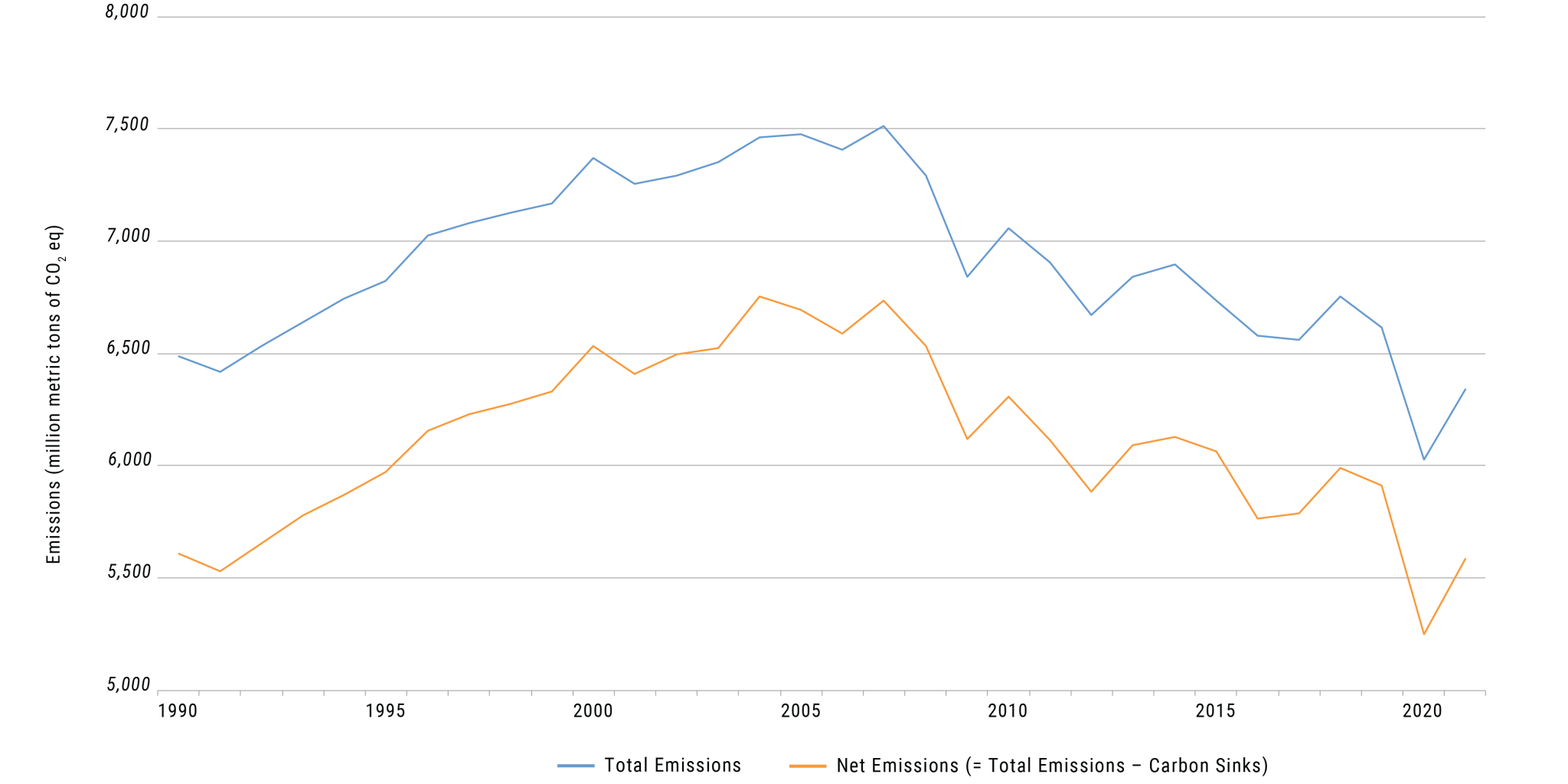
You have this extremely wrong. TLDR: LLMs singlehandedly reversed the secular decline in US power emissions, which were the only reason for climate optimism.
The story of US power sector emissions was a good story. Emissions appeared to be in secular decline from 2005 through 2022, through the crypto nonsense, and the ramp-up of EVs. In large part, this was due to stable power growth, the replacement of coal with natgas, and the adoption of wind and solar. We were on track to go to 0-10% of historical emissions by 2040. https://www.c2es.org/wp-content/uploads/2022/11/2024-GHG-Tre...
LLMs changed that story; it is now a bad story. Emissions are back on the increase. Natural gas power plants are sold out for six years plus. We are on track to go back to 100% of historical emissions by 2040. EVs are a factor but were a factor in 2018-2022 as well. In terms of popular narratives, it's pretty accurate to say that LLMs singlehandedly reversed the only reason for climate optimism in the US.
I'll read any source you have for this, but it seems unlikely given the low percentage of US energy consumption data centers account for. Your home air conditioning is most of American electrical consumption.
My statements about the recent history of declining US power sector emissions are pretty vanilla and I won't source them here, but they should be pretty easy to verify. What I'm asking you to take on faith (or to google) is that the positive trend was a mix of flat load growth and the energy transition (from coal to natgas, wind, and solar).
Load growth was flat 2005-2020, and now it's growing at circa 2%. Recent growth is almost all commercial and industrial, not residential [1]. There has been some manufacturing reshoring, etc, but the main driver is data centers [2].
"[D]ata centers consumed about 4.4% of total U.S. electricity in 2023 [and ~1.5% in 2014]." "[T]otal data center electricity usage climbed from 58 TWh in 2014 to 176 TWh in 2023 and estimates an increase between 325 to 580 TWh by 2028 [which would be circa 20% YOY growth]." [3]
Total US power use in 2023 was ~4000TWh. Compute power demand was at 4.4% of that and has been growing at ~20% YOY. (McKinsey forecasts 23% YOY growth and 2025 data center capex is growing 30%[4] but let's be conservative.) If 20% holds from 2023 through 2030 data center power demand will be at ~630TWh (16% of the size of the 2023 grid). If it holds through 2040 it will be at ~4000TWh (100% of the size of the 2023 grid). (No citations here, this paragraph is just analysis, and 630/4000 TWh are just 176*1.2^7/17. However these numbers are similar to the forecasts in [2] and [3].)
New data centers are more often powered by natural gas (and less by wind/solar) vs the grid at large, and will be true for the foreseeable future. I don't have a definitive citation for this but it's obvious to anyone close to this industry (as I am) and you can dig up any number of confirming citations about specific data center stories or utility IRPs (integrated resource plans). One concrete fact supporting this narrative is that gas turbines are sold out for the next ~6 years, which I don't believe has happened before in this century. Gas is on an absolute tear.
(Zero-carbon data centers that you read about, like Three Mile Island or next-gen geothermal, are specifically manufactured to disrupt the powered-by-gas narrative. They are about as common as data centers built in a way that revives coal plants; that is, they are a real but small phenomenon.)
So, that is the story. A) Power sector emissions were in decline, because of flat load growth and the replacement of coal with wind, solar, and natgas. B) This isn't true anymore; the grid is expanding quickly again, AI is the main culprit. C) At least for now, load growth is happening in a way that is dirtier than today's grid. C) If you believe that AI is going to continue to grow for 5-15 years like it is now, you also think that AI is (and especially, will be) a major driver of US greenhouse gas emissions.
And to add an anecdotal rebuttal to your earlier comment: sure, inference is just a few google searches worth of power. But now google searches have inference, so they are a few more times more power-hungry than they used to be. And when I code, I use way more inference than the number of times I used to google. And remember that when we say "inference", we are talking about last-gen LLMs; reasoning models (which are, as of a few months ago, the default in chatbots) are a chain of inferences which can be arbitrarily long. The current status quo is much more worrisome than your quip, and the problem compounds quickly if you extrapolate at all.
We have discovered a new and outrageously popular way to use compute, we built $455B worth of power-hungry data centers last year [4], and it is having (and will have) a huge effect on greenhouse gas emissions.
Your source [2] provides numbers (and a graph) only for total US electrical usage (4.4 TWh or so). The number you cite for data center usage exceeds 2023 estimates for all data center usage globally. Do you have numbers for data center usage in the United States? It's the US TWh number that tells us whether data center usage is merely rising (of course it is!) or whether it's actually a significant component of all US usage.
This snagged you as well with your "recent growth" claim; I have no trouble believing it's true, but what you're saying and what I'm saying can be true at the same time.
I don't think there's anything productive I can do with your "$455B worth of data center" numbers, as there's no transform that takes me from buildout cost to electrical usage.
Respectfully: you said I was not just wrong, but "extremely wrong", so this should be easy for you to spell out. I appreciate the effort so far!
The below DOE link substantiates my quotes about US data centers and power usage, which I'll reproduce here. "[D]ata centers consumed about 4.4% of total U.S. electricity in 2023 [and ~1.5% in 2014]." "[T]otal [US] data center electricity usage climbed from 58 TWh in 2014 to 176 TWh in 2023 and estimates an increase between 325 to 580 TWh by 2028 [which would be circa 20% YOY growth]."
These quotes are ~compatible with your 4.4TWh number. If you still think the below DOE link is wrong and "...exceeds 2023 estimates for all data center usage globally" could you share why you believe that?
(Note that my "extremely wrong" is not directed at the literal text "LLM inference has a carbon impact of, like, a couple Google searches" but with the implication that LLMs have negligible carbon impact. If you think DCs were using 4.4% of US power in 2023 and growing at 20% YOY, and are a sizable-and-fast-growing carbon impact -- but that one LLM call is a small carbon impact -- I'll concede the latter and soften "extremely wrong" to "your original comment carried implications you didn't want".)
The 58->176 TWh interval from 2014 to 2013 clearly wasn't driven by LLMs; ChatGPT wasn't released until 2022. There were of course AI/ML models that preceded it, but nothing used at the scale LLMs are now. If your whole case is that technology writ large is driving data center expansion, that's fine; my argument is simply that it doesn't make sense to single out LLMs.
I think at this point though we understand the contours of our respective arguments! We don't have to keep litigating. Thanks for this!
My argument is really not about the 58->176 transition (which was slower than 20% YOY) but the rapid datacenter deployment that started around 2022. It is basically all LLMs (McKinsey says ~75% IIRC).


Some learning products are just content with zero container. Books are the limit example. Karpathy's "Let's build GPT" is another.
Most learning products -- and all apps -- live or die by the container they create. (There is no reason to build a learning app other than to build a container. If you feel you have the best content, ship it on a content platform and save yourself a very painful distribution slog.
Duolingo is in the container game. Their container is made of every cheap trick in the book -- notifications, streaks, etc -- because they work. My startup was Hack Reactor, the coding bootcamp, and we did it with pair programming and fixed classroom hours. (We had great content, but our competitors with good containers and bad content did leagues better than vice versa.)
If you're building an app, you're in the container game. You can build a great container with no cheap tricks. I have done so! But you can't build a great learning app with no container, and you can't build a great container if you if you don't want to change your users' patterns of engagement and attention.
So, what is your container? How will you weave a powerful spell that meaningfully transforms the attention and engagement of the app's user? What will cause them to pull up your app again and again, when they would have churned from a simple anki deck or whatnot? Given that you find it distasteful to use the easy levers you mentioned (notifications, "streak" psychology), what alternatives can shift your users' patterns of attention and engagement towards the learning task?
If you have great answers to those questions, great! If you don't want to build a container, build content on a platform with easy distribution. If you want to build a container but you don't want to shape your users' attention or engagement, you are confused.