You could argue from the perspective of the server this is a true statement. The message does not exist. If the server stored a history of messages, current and deleted, it would not be in the logs. What you received is something different. Like a message but not a message.
I have built humans in the loop feedback models before and they are always very targeted to a specific task. This approach modular and intuitive. I think the scope is too small though.
I spent the weekend starting a project to use this approach using a GPT model and FlumeJs (https://github.com/chrisjpatty/flume) but now that I see noFlo i am excited to try it
As a hot take I’m not incentivized to respond seriously, but I will say that Carbon-based life as we know it on Earth is seriously antifragile. We’ve found life in the most inhospitable places we can imagine and the kicker is it’s all self-replicating and self-healing.
Yes, we’re meat sacks that pop when poked — that’s a very conserved trait of life on Earth — but for the most part, especially with a holistic view like at a species level, we’re ridiculously hardy.
> We’ve found life in the most inhospitable places we can imagine
...on Earth. Take away something as simple as the magnetic field of the planet and suddenly resilient life narrows down to a couple of bacteria, Archaea, or Tardigrades [0] which still die with enough exposure.
Anything above 120 degrees C will also cook our goose and every other form of life, again short of a few Archaea [1] which still die a few degrees later.
And then there's the most basic of all: water without which some life doesn't die but doesn't exactly "live" either. A handful of spores, spore-like forms, or completely dried forms of bacteria for example can go for eons without water but they're not functioning.
And the higher level and complex the organism (thus possibly easier to recognize as life), the higher the chances one of the "subsystems" is more fragile and its failure kills the organism.
I don't think life can be evaluated as a snapshot in a moment of time. Life is a process, and it affects a population. I think even the most conservative definitions may agree on that.
Antifragility plays well with this definition: it doesn't describe the state, but the potential and the ability to change. Taking into account the huge populations, and the fact that only a couple individuals must survive hardship in order for life to prevail, I can see the antifragility.
That "we can imagine" is doing a lot of the work, there. We humans are pretty limited in experience, operating parameters and yes, imagination. On but one dimension, consider the range of all possible temperatures and how narrow the band in which the lifeforms of which we have knowledge can survive. Consider the same along all other dimensions like radiation, gravity, pressure, particulate density, magnetic field intensity, perhaps others we have not even discovered yet.
Carbon life that we know about is "robust" only considering the relatively narrow ranges on our own planet.
The range of all possible temperatures is theoretically infinite. Life as we know it — without protection — can survive at everything from 0K to 386K (113C). As humans we have harnessed temperatures in the 100s of millions of degrees (fusion) safely and can build machines that reliably extend our operating parameters far beyond their normal bounds.
It’s easy to be dismissive, but the reality is that life as we know it is pretty freaking incredible.
enkid's people have had a remote outpost near the center for some time now. They have not reported finding any life so far there but can we really trust them after the Saturn 3 disaster?
I actually agree with 'QM/EM based life'. My current thinking goes as following..
- Intelligent life develops superfast AI
- - then develops even more advanced quantum version of it.
- Life slowly starts augmenting its meatspace with advanced replicable machinery
- Eventually everything starts becoming very predictable so it start absorbing the advanced AI in our minds, which slowly becomes our essence (assuming consciousness is 'computable' ie.. not some penrose-esq orchestrated reduction)
- It then builds a hypercomputer operating at very close to max efficiency and start harvesting all matter/stars to sustain it & migrates to it.
there is another path where just like light currently exists as an EM wave packet we discover other stable forms and migrate to that.
of course this does not means the pervious iterations of life do not continue to exist, just that they become increasingly irrelevant.
The expectation seems a little harsh for the setup. GPT just generates acceptable text. You still need to model and verify object relationships, use facts from a knowledge base and discriminate the generated responses at the very minimum.
Any GPT model is just one component inside of a chatbot, not a chatbot itself.
I think your rating system is too focused on food. The service, environment and food sourcing also play a large part in the rating. I bet you would see a difference if you try sparking a conversation with the staff from LeCinq.
I don't know, McDonalds over Starbucks on food? (Or any metric!) At least the latter has sandwiches. But I don't think I really understand any scale that has either of them as well as actual restaurants?
It's ages since I've been and I rarely ate then; I agree it's not great, but I personally I never expected anything more than decent supermarket sandwich level, except I suppose that they can toast it. Overpriced/more expensive for sure - but what're you going to do, bring cheaper food in to eat? They somehow prey on that being poor etiquette, even if you've bought coffee etc., I suppose.
Err, no? We may have an unexpected (to me) dialect barrier. To the best of my knowledge, McDonalds serves primarily burgers (is a burger what you're calling a sandwich?), Starbucks serves (coffee aside) mostly sandwiches, and also salads and stuff.
(It is about ten and three years since I've been to one, respectively, but I doubt that much has changed!)
Apparently there's significant dialectal variation on whether the "hamburger" is a sandwich, including the bread, or just the meat often used to form the filling of a sandwich: https://en.wikipedia.org/wiki/Hamburger
In my usage, you can eat just a hamburger, but McDonalds won't sell you one; they'll insist on putting it between slices of bread, thus making a hamburger sandwich of it. If you want to eat just the hamburger, you'll have to peel off the bread and throw it away. They also sell fried-fish sandwiches and, in an absurd attempt to seem "healthy", chicken sandwiches.
Around here Starbucks serves mostly desserts, but that might be a regional thing.
Ok, definitely a dialect thing. A burger (~ patty if you insist) in a bun is just a burger, I don't think anybody here (UK) would call that a sandwich.
You can definitely convince McDonald's to sell you a hamburger on a plate without bread. A hamburger isn't a sandwich, but it is commonly served on a bun in sandwich form. Like how spaghetti is common served with sauce, and if you see that dish you just call it spaghetti, but if you see a plate of just the pasta it's still spaghetti.
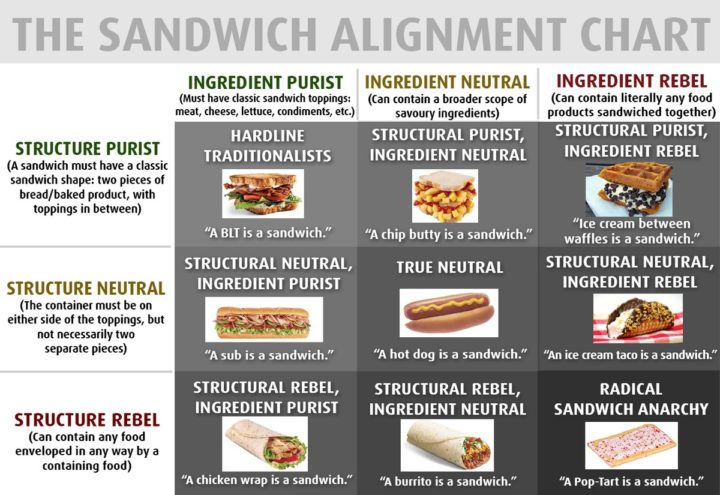
According to this graphic, all 9 groups would consider a McDonalds cheeseburger to be a sandwich, even the "hardline traditionalists": "A sandwich must have a classic sandwich shape: two pieces of bread/baked product, with toppings in between; must have classic sandwich toppings: meat, cheese, lettuce, condiments, etc."
Clearly there's an entire missing dimension to the graphic, because it totally denies the existence of the Hamburger Irredentist Youth League to which OJFord belongs!
I don't think I'm saying anything contrary or unusual for UK. The top left three (structure and ingredients pure/neutral, but not both neutral /hotdog) as pictured I would consider sandwiches.
But I think temperature is a better indicator than ingredients: 'a sandwich' is not cooked (it's ingredients might be, like meat obviously, but then cooled) or hot.
Of course you can have a 'toasted sandwich', but the qualifier's important, it's basically a different thing that happens to share a word - if you ordered a 'cheese sandwich' and it came out toasted you'd be surprised.
Which makes a hotdog trivially not a sandwich, but you could slice up some sausages the next day and have them between slices of buttered bread for a 'sausage sandwich' (which likewise is not a term anyone would use for a hotdog!)
In the US, toasted and hot "sandwiches" are commonplace. At Subway (the fast-food franchise with the largest number of franchises) the process for making many of their "sandwiches" routinely involves toasting them during the preparation process, notably the sweet onion chicken teriyaki. Similarly, a "club sandwich" has obligatorily toasted bread, although it also includes cold ingredients, and a Philly cheesesteak sandwich is always hot, as is a French dip, any other kind of roast beef sandwich, or a grilled cheese sandwich.
I'm curious if these "foods" exist in the UK, and if so, what they're called!
Not to split hairs, but I believe there is a distinct difference between a burger and sandwich -- and it's not a dialectal one. A burger always has a patty (which isn't just meat, but a piece of flattened ground up meat) whereas a sandwich does not. The burger patty is what makes a burger a burger and not a sandwich.
That's why you'll hear the term chicken sandwiches (because they don't contain patties), but you'll never hear burgers ever being called "beef" sandwiches. (Beef sandwiches exist -- like roast beef sandwiches, beef-on-weck, Italian beef, pastrami sandwiches, etc. -- these contain forms of beef that are not burger patties). Beef burgers and beef sandwiches are different things.
Similarly, chicken sandwiches ≠ chicken burgers. They're different things. The latter always has a (chicken) patty. The former almost always doesn't.
McDonald's and most other fast-food places are actually pretty consistent with their burger vs sandwich terminology and don't really mix them up.
It sounds like your concept of "sandwich" is ontologically incoherent. What kinds of generalizations apply to all or most sandwiches but not to a patty between slices of bread? We have "sandwiches don't contain patties", of course; but is there anything else? It sounds sort of like defining "Indian" to mean anyone from India who isn't from Goa, "British" to mean anyone from Great Britain who isn't from Cornwall, or "murder" to mean any event of one person killing another except when the first person is named Derek.
Such ontologically incoherent definitions are obstacles to clear reasoning (though less seriously than eargrayish definitions like defining "murder" to mean either one person killing another or stepping on the shadow of the King). Is there a reason your proposed definition of "sandwich" is not among them?
Since you mention India, would you consider curry to be a kind of soup? I believe the relationship is similar to that of burgers and sandwiches.
A curry is "just" a soup with spices. But if you walked into a restaurant and ordered "soup of the day" and got a vindaloo, you might feel deceived. If the waiter assured you that a vindaloo is ontologically a soup, I doubt that would be much consolation.
Sometimes in language, if you use a general term (A), when a more specific term exists (B subset A), then using that general term A carries the meaning A\B, because if you had meant B you would have said B instead.
It's an interesting question! I normally think of a curry as being a sauce placed on some solid food, while a soup is a liquid food with perhaps some solid chunks floating in it; but that's really just a difference in how it's plated and how much sauce you use; it doesn't make much difference to the flavor.
> In the past all observed emeralds have been green. Do those observations provide any more support for the generalization that all emeralds are green than they do for the generalization that all emeralds are grue (green if observed before now; blue if observed later); or do they provide any more support for the prediction that the next emerald observed will be green than for the prediction that the next emerald observed will be grue (i.e., blue)? Almost everyone agrees that it would be irrational to have prior probabilities that were indifferent between green and grue, and thus made predictions of greenness no more probable than predictions of grueness. But there is no generally agreed upon explanation of this constraint.
(This is somewhat mineralogically naive, because emeralds are just green beryls; a beryl that was blue would be called an "aquamarine" or "maxixe," not an "emerald," because greenness is part of the mineralogical definition of "emerald." But it's straightforward to change the riddle to refer to, for example, grass. The grass has always been grue; should we expect it to still be grue tomorrow?)
Fortunately, as Wikipedia explains, most people do not share the illogical convention you are advocating, though presumably most of the people you know do.
(...please God don't let him ask me about hotdogs...)
I'm pretty sure that they don't here, (though as I said it's been quite a while since I've been to one) since nobody in the UK would call a burger a sandwich.
Yeah, ambience and service are a huge part of top end restaurants. You're not gonna get your linen napkin folded for you each time you come back from the washroom at olive garden.
We talked with them at length. I always do no matter what the establishment. But that has nothing to do with my reaction to the food, which to me is the reason to go. Good point though.
For me, it's not even about talking to them, it's often about watching. I often go to a nice place when I visit NYC and I explain to friends that it's similar to why someone would go see a Broadway musical, but with food. The coordination, the way everything comes out in a choreographed way, the little rituals of how they pour wine or deliver new utensils, all of it is a practiced show.
Or sometimes it's not, and that can be interesting too. I went to Schwa in Chicago once and the service was good, but very barebones. They didn't have a liquor license, so it was all bring your own drinks unless you wanted water. I didn't have anything I'd brought, so the waiter kept bringing out cans of beer people had brought and left behind that he thought would pair with my next course and just cracking open a can and leaving it on the table for me. Completely wild dinner experience that I think back on to this day.
What I discovered, decades ago, was that posting questions, or even better, answers, even wrong ones (unintentionally) is a phenomenal way to learn things.
That still holds true. Though it helps profoundly to not insist on being wrong.
I mostly focus on finding people with the answers. One person here I invited to another place specifically because they asked exceptionally, good questions. Most of the time, their questions led to more good answers or just perspectives. I'd like to see more of that.
I'm as well a long time lurker. Whenever I contribute something, I feel that it should be helpful for many other people out there. This comment probably isn't...
Ha! Well you made this lurker laugh, and reply! Also, it is not uncommon for me to write out a reply and then delete it before submitting because I second guess that the comment has value.
Another reason why people avoid contributing: unwritten social rules. New members often step on people's toes and suffer the consequences. As a result, joining a new group can be intimidating. Better to lurk for a while and gain understanding of what is and isn't normal.
PDF is the perfect tool for maintaining document formatting but the worst tool for maintaining document data. The format is not concerned the the actual data of document. Programatically extracting data from the simplest PDF is an exercise in patience. I find it kind of odd that this was chosen as the standard all things considered