Hacker Newsnew | past | comments | ask | show | jobs | submit | n3t's commentslogin

+1 to "Thinking In Systems".

Looking for (maybe hidden) stocks in systems also changes how one sees the world.


I wonder what a specific example of this approach would be.


I'm intrigued and would appreciate further examples/explanations too.


It's an interesting approach.

To try to come up with an example, let's say we set as our goal to completely automate a process X, which consists of 10 subprocesses. Let's say we fairly quickly automated steps 1-9, but the 10th is tricky.

But we now realize the 10th step was only really necessary for certain edge cases, which we now realize we are fine not handling. So we "if" them away and now have a process that is 100% automated, even though it is different from what we originally wanted to achieve.


Thanks for responding!

Perhaps a bit of the magic and allure disappears by pulling back the curtain: it sounds like an instance of analyzing and breaking down the problem into smaller ones; solving those pieces as you go along; further breaking them down as necessary; and tossing aside the nuts that are too tough to crack.


What's your goal?


Kind of similar to error bars on error bars → https://xkcd.com/2110/


> house announcement system

Please tell us more!


Just some speakers hooked to an amplifier which is plugged into a computer audio output jack.


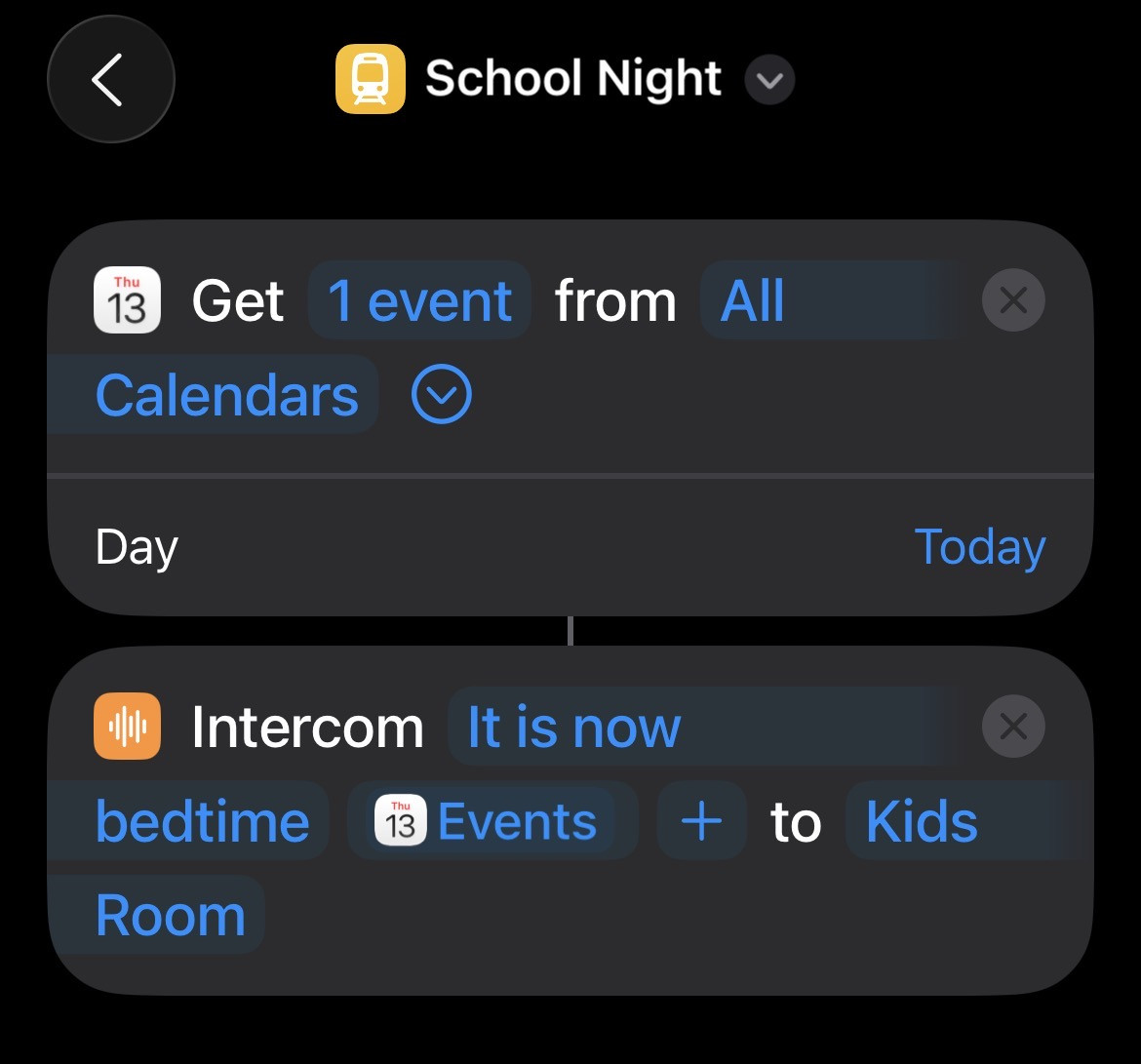
With Home Assistant (or even Apple HomeKit Shortcuts) it's relatively trivial.

Shortcuts: Intercom: Events: Get [1] Event From [All Calendars]

https://i.postimg.cc/X750NyjC/IMG-9677.jpg

People dump on Apple/HomeKit (deservedly!), but only because there is so much untapped potential!


You can already buy cheap but powerful old servers. But newer hardware tends to be more power efficient. So, depending on time horizon you consider, it might be cheaper to buy newer hardware.

Assuming that GPUs power efficiency will increase, the same will be true about them.


What's your cloud bill?


Most (some sources say ~80%) Linux contributors are paid by their employer.


I hope that's true. Do you have a source?


"About 80% of kernel contributors are paid – by their employer!" -- https://newsletter.pragmaticengineer.com/p/how-linux-is-buil... (from 2025)

Check out "Most active 5.10 employers" table (it's from 2020) on https://lwn.net/Articles/839772/

"Seventy-five percent of all kernel development is done by developers who are being paid for their work" -- https://www.linuxfoundation.org/press/press-release/the-linu... (from 2012)


This is actually a super encouraging thing. I wonder why it doesn't work as well for the Gnu apps.


Every coworker I know who use Windows have occasional issues with webcams, mics, Slack notifications, whatever.


Ya, something like "table stakes" would be closer to what they mean.


Guidelines | FAQ | Lists | API | Security | Legal | Apply to YC | Contact

Search: