Just building your own microprocessor from gates is an easier way to learn about designing microcode and understanding how processors work(ed). But it can't hurt to study a few simple old designs like RISC or Transputer. The 80386 is on the other side of that spectrum, needlessly complicated because they wanted to be backwards compatible with an old bad design.
There certainly is no need to go to university to learn chip design. Watching a few Alan Kay talks [3] or browsing Bitsavers computer designs [4] are good starting points.
We made an easier way (than FPGA) to simulate and convert your gate level design into transistors on a chip (for less than $200 in 2026). We call it Morphle Logic [1].
Eventually you grow into making the largest fastest and cheapest supercomputer wafer scale integration [2].
> needlessly complicated because they wanted to be backwards compatible with an old bad design.
It's not really needless complication of there is a reason for the complication. Obvioudsly in this case the need to be backward compatible with an old design made the implemtation more complicated than if they didn't need to do that. There were very, very strong business reasons why backward compatibility was a design requirment.
I am an outsider on the details of the Bambu software requiring users to go through their servers in China and the closing of their software.
Still I suspect it is about spying in wartime, Bambu printers are at the core of the Ukrainian war effort, the main reason even Ukraine is winning since januari 2026.
First China prevented Ukraine from using any of the drones that they sold in millions to Russia while exercising the built in kill switches in Chinese drones used in by Ukrainians.
Suddenly Bambu, another Chinese company started listening in on the 3D printing on a massive scale in secret factories all over Ukraine that make the drones to replace the Chinese drones. Very suspicious.
Whatever is the reason Bambu locks down software or firmware on their 3D printers, now is the time for programmers to change the situation. We need to put up money like Louis Rossmann did [1], not to fight legal battles but for a assembly language programmer to reverse engineer the Bambu firmware and make a free and open source version.
This firmware replacement will cost a couple of months to write so we all should send that programmer a little money so he/she can release it for free.
A free Bambu firmware will allow the Ukranians to continue producing another few million drones and save over a hundred thousands lives by ending the war.
Now is the chance for us outsiders to help Ukraine, by freeing Bambu firmware.
P.S. I would be willing to do the reverse engineering but I would need at least 35 euro per day (to eat) to build a new firmware for all Bambu models from scratch. I would need a few different models of printers on loan for a few weeks to test the new firmware. I estimate it would take 5-9 months to rebuild firmware for all models from zero and release it. Maybe Rossmann and Geerling could use their influence and coördinate this freeing of the firmware?
I just emailed Rosmann and Geering to see if we together can free the Bambu firmware. Anyone who wants to help, please contact me trough my HN profile.
There is still no hard requirement that you go through their servers. The printers support a mode where they can only be accessed from the local network.
Yeah. I just bought a new p1s last week and today hooked it up, never connected it to anything but power. Printing from the SD card worked first try, zero issues.
the Ukraine war started in 2014 technically. But even if we go to the "current" wave start, that was 24 February 2022[0].
Bambu Labs released their first printer (X1C, on kickstarter) on 31 May 2022, let alone their "must go through cloud service" restriction starting in early 2025[1].
> This firmware replacement will cost a couple of months to write so we all should send that programmer a little money so he/she can release it for free.
> A free Bambu firmware will allow the Ukranians to continue producing another few million drones and save over a hundred thousands lives by ending the war.
If that were true, it seems to me, that Ukraine would have already done it if it was somehow standing in their way.
I have informed a few 3D printer operators on how to do it themselves. But it is hard for these soldiers, they have other priorities.
It is not 'standing in their way', it is revealing the secret locations where the Ukranians drones are manufactured. Several of these factories where discovered and Russia bombed them.
Personally while I don't think what Bambu's doing is great, it's not like there aren't a dozen manufacturers that can generally match their printers at similar pricepoints, and don't have these issues
> A free Bambu firmware will allow the Ukranians to continue producing another few million drones and save over a hundred thousands lives by ending the war.
> Now is the chance for us outsiders to help Ukraine, by freeing Bambu firmware.
What you write sounds like an invitation to pro-Russia-minded people to sabotage these free Bambu firmware efforts. :-)
I couldn't find a source for China disabling drones it sold to Ukraine, but they did cut off drone exports to Ukraine, while still supplying them to Russia:
1) I have heard of the kill switches being used from several sources in the Ukraine ministry of defense. I advised them on how to remove the kill switches in two brands.
the kill switch is discussed in part 2 https://youtu.be/za62IvbfzXE?t=1061 by the fire department who got the drone donated by the interviewer from "Protrct Ukraine"
Lot of conspiracy theory and misinformation in this comment.
I'm not up to date with their latest printers, but the Bambu printers used during this timeframe have easy ways to enable LAN only mode. You can leave it disconnected from the network entirely and use an SD card, too.
The app lets you enable root access and install firmware mods. There are multiple efforts to reverse engineer the firmware.
In practice Ukrainians have long moved to custom built drones for pretty much everything.
Picking up 3D printers that don't spy on you, modding them or even building custom ones is much easier than designing and building millions of custom drones, so I am sure they solved this long ago.
Like, really - a FDM printer is just a MCU board with a bunch of stepper drivers, a power supply, some frame, motors, thermistors & heating elements.
Great work! I'll buy one for $250. Will it run AppleTalk?
I didn't correct for inflation but I wanted to buy the Lisa before it was released, it felt around 40000 Dutch guilders, maybe 80 times more expensive than this FPGA?
I did a few more back-of-the-envelope calculations of what I can do with these 2MB SRAMs:
Xerox Alto with Smaltalk-80 and Smalltalk-76 for $4. The Alto was the 1972 machine the Lisa tried to be the sucessor of.
Transputer T414/T800 for $50 but much faster than the original. You would make a supercomputer interconnecting hundreds of Transputers.
Vextrex without display but HDMI output for $50, $8 without the CRT/VGA/Oscilloscope, $100 with the cathode ray tube display built in.
200MB SRAM with 16000 cores 180nm WSI (Wafer Scale Integration) emulating most processors at $1000. It would outperform 2025 Blackwell NVDIA and Apple Silicon M3 Ultra Mac Studio because SRAM is faster than HBM or LPDDR5. It is much cheaper than the 2MB Sram on this Lisa FPGA (it costs around $25 per 2MB (16 Mbit) in batches of 1000 chips).
Yea it does look like 5 year old M1's are going for $300 on eBay, but man that's painful a 5 year old machine for that much when you could get a new Neo or Mini for $600, if only you could buy them. I probably should just get the M1, test and sell it back on eBay. Thanks.
If you're going to do any kind of work on it I'd choose a 5-year old 16 GB memory M1 over a Neo every single time. 8 GB is what's painful. The CPU difference is very small anyway.
Yeah but the base Mac Mini comes with 16GB. So getting that for $600 instead of a very clapped out M1 for $300 seems worth it. That's what I thought when I was browsing on ebay, anyway.
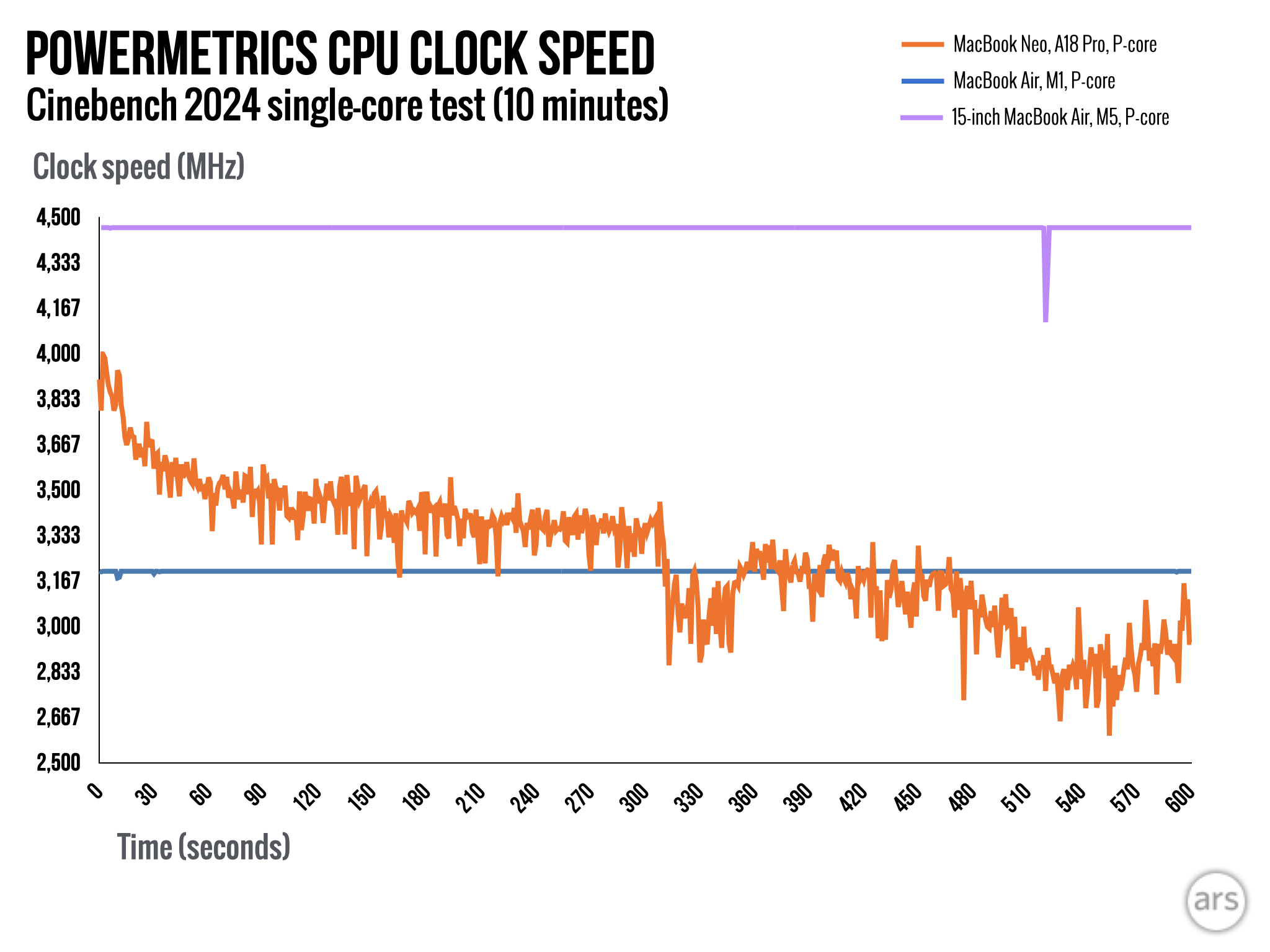
In my personal experience, 13” M1 MacBook Air, 15” M4 Macbook Air, M4 Pro Mac Mini, and MacBook Neo, the Neo is the fastest for single threaded and strictly CPU bound tasks. E.g. calculating 200x200, 1000 max iterations Mandelbrot fractals it does ~785 in ten seconds compared to ~760 on the M4s and somewhere in the 600s for the M1.
Given its RAM size I’m not going to be spinning up VMs, but in terms of general purpose computing it’s more than adequate. And, out of the box, you get a word processor, spreadsheet, presentation, video editing, digital audio, web browser, and a bunch of other things. Xcode is free. This is easily a laptop you can buy and use for years in 90% of settings.
Yes, all the M-series have more cores, they often have better thermal management, and they have more memory bandwidth. (The the Neo still has crazy high bandwidth.) But, for a single threaded, strictly compute task that runs in 10 seconds, it outperforms the M4 cores. I don't know why, I'm just sharing my experience.
If you literally just need to borrow one, I'd just buy an Air from Apple directly and then return it within the 14 day window. I'll sometimes do this if I need an extended repair on my personal one, or there's a new mac I want to try.
That's not what the employees say! Though it's a rare thing for me to do, it's not like I'm doing something shady, and they're quite happy to say things like "Well, give it a try, if it's not for you, return it", which I'm sure leads to customer comfort and increased sales. Usually I'm also genuinely trying a different product than the one I have, and get to evaluate whether it's any good.
As far as I'm concerned, if I can't work because they have my laptop for a week, especially because I pay for AppleCare and have to leave it with them, it's not much different than an insurance policy that lends me a rental car while mine's in the shop.
If the return policy explicitly allows "change of mind", I'd say it's in the gray area. Though ofc it isn't sustainable if everyone starts doing this. I assume there's a ((returns:buys)/payment identity) metric to ban the largest offenders.
Also, there should be some universally accepted way to have access to your data and a secure personal computer in the duration your device is getting repaired.
Also, there should be some universally accepted way to have access to your data and a secure personal computer in the duration your device is getting repaired.
Yes, exactly. When getting your car repaired there’s loaners or rentals to allow you to keep driving. Why isn’t a loaner computer a standard thing?
I don't think this situation qualifies, or maybe it's on the border. This seems more akin to using all of the bandwidth provided to me by one of a few companies coordinating together to extract as much as possible from their customers. Apple's had a policy like this for ages, if it wasn't more profitable than not for them, then they'd have done something about it under the miserly rule of the outgoing CEO.
Some people occasionally returning products—that they intended to keep or not—is not like all of the energy grid being consumed by data centers, nor is it like all of the wetlands being paved over for suburbs.
Im also against this practice but both of you can be understanding the facts the same and still coming to opposite conclusions. Thats the whole point of the tragedy of the commons!
The research into the origen of life looks at bottom up fundamentals (how they work) of all cells since the solar system was formed. You could start with the slides in this lecture and read the underlying papers and all the references in all those papers. You probably can find these references also in all the books he wrote. https://www.youtube.com/watch?v=vBiIDwBOqQA
Maybe an educational text for the laymen has summarised this recently but I'm not aware of one. Most Biology from your school days have been rewritten.
I will have to re-read Molecular Biology of the Cell, 7th Edition, 2022. I read the 3th edition and it has changed dramatically since.