The cost of living crisis is almost singularly caused by poor governance, not feudal tech lords.
NIMBYism prevents new houses from being built, driving up the cost of housing.
Healthcare is for-profit, yet not allowed to operate like a true competitive market, with heavy regulations restricting providers to a few that the government favors. Thus it's essentially an oligopoly, driving costs sky high.
The ‘cost of living crisis’ that most people refer to is about food, clothing, fuel, electricity, gas. Much of this is driven by feudal corporate lords, and their gouging business choices. Some is driven by geopolitics.
Issues with the affordability of for-profit healthcare is mostly an issue in the US, as far as first-world countries go. And the root cause there is decades of allowing money and big business to directly influence politics, rendering meaningful change close to impossible without a Bernie Sanders-esque president who’s strongly motivated to tear the whole system down.
The current pricing crises with food, fuel, electricity, and gas are currently being driven 100% by America's Caligula and his party of elected senatorial horses. And specifically his tariffs, but more generally his inability to comprehend anything beyond self-gratification.
There's been a 'cost of living crisis' discussed in many countries --not just the US-- since roughly the end of the pandemic. For obvious reasons, there are other factors responsible for this - not just Trump.
Trump's recent foray into Iran has indeed hit fuel/gas prices, the supply chain of some regional goods, and will have a knock-on impact on other goods subsequently due to rising fuel costs. The impact of tariffs on consumers is largely confined to the US.
Respectfully disagree. Food, clothing, fuel, electricity are too expensive, but they are comparatively much less of an issue compared to rent and healthcare costs.
Rent and healthcare are the 1A and 1B issues of our time.
As far as healthcare goes, the entire system is a mess. We already tried the Affordable Care Act to get more people covered, which only skyrocketed costs. The only way out is to increase the competition in the market, AKA supply side. Bernie Sanders is only familiar with demand-side solutions, which do not work. Sanders himself seems completely oblivious to the housing crisis in his own state of Vermont, which is being mitigated everywhere else through supply-side solutions.
I was mostly trying to make the point that the cost of living crisis is global, affecting many countries, and that your US-centric view doesn't scale. Healthcare costs hitting consumers directly isn't global as most countries have totally different systems.
---
That said, your suggestion that the answer to rampant capitalism making healthcare unaffordable is more rampant capitalism (which you call competition) is... interesting.
And I wasn't advocating for Sanders personally or his policies specifically, just using him as an example of a conviction politician who might have had the chutzpah to take on and dismantle the business-lobbying-politics establishment.
Ah ok sorry missed that you were talking globally instead of just US.
In the US, our problems stem from a lack of "capitalism," or healthy markets, or whatever anyone wants to label it. Bottom line, it's very much a supply side problem.
In housing, for example, NIMBY laws have for decades restricted all kinds of new housing being built. In capitalism, developers would be allowed to build. So we've very much had the opposite of capitalism.
Cities that are waking up to this and allowing new houses to be built are seeing rents fall across the board.
> In the US, our problems stem from a lack of "capitalism," or healthy markets, or whatever anyone wants to label it. Bottom line, it's very much a supply side problem.
I'd challenge whether for complex topics like healthcare, there truly ever could/would be a market that would deliver the savings you envisage.
When someone is diagnosed with cancer, you'd expect them to do everything in their power to give the best outcome, right? Wrong. Most people just go to their local hospital, and sadly the quality of physicians, surgeons, treatments offered, and overall care varies tremendously. There are various data to suggest that joining a clinical trial may offer improved outcomes (and of course, in extremis, clinical trial participation is the only way to access experimental treatments) and yet a very small percentage of patients ever do. Anecdotal experience suggests that many patients can barely understand the details of their disease and treatments (which are becoming more technical with time).
My point? For reasons that require further exploration, healthcare "customers" typically aren't sufficiently informed, discerning, engaged, or mobile in the way that would be necessary for a genuine competitive market composed of for-profit providers to function effectively to drive down prices and improve outcomes.
Note that this is CNBC and they're writing from a stock market line-go-up POV.
For everyone else, this is good news.
From the article:
"Huang was validating what the rest of the market has been witnessing. An independent developer, rather than a giant, richly valued lab like OpenAI or Anthropic, came up with the next big thing in AI and, in doing so, exposed a potential major flaw in the investment thesis behind the large language models: They may be getting commoditized."
Please don't tell people to RTFA. I have and it is still entitled rambling bollocks.
Is this really leading edge ... whatever it is supposed to be:
"The popular horse-switching fantasy answer is retraining. “Go back to school and become an engineer.” In theory, yes. In practice, rarely. The jump from an assembly-line worker to an engineer requires years of schooling and a different educational foundation."
They might as well pat the person who is losing their livelihood on the head and say "there, there, it will all come good in the wash".
The study doesn't say it went into the 1%'s pockets. It says it went to 2 places:
1) The salaries of corporate employees
2) Shareholders and capital owners
Regarding number 2: "Shareholders" would include anyone who owns any stock at all, including a lot of middle class people with a simple S&P 500 ETF in their portfolio.
And the increase in productivity allowed more people to become capital owners, AKA entrepreneurs. The explosion in software entrepreneurs, for example.
#2 only works if the public is allowed to invest when the new technology is in its early stages, which is currently not the case. Microsoft went public in 1986 at a valuation of $2.3 billion (in today's dollars). What's OpenAI / Anthropic going to be worth by the time they IPO? $1 trillion? $2 trillion?
> Regarding number 2: "Shareholders" would include anyone who owns any stock at all, including a lot of middle class people with a simple S&P 500 ETF in their portfolio.
Yes, but shares are not at all uniformly distributed. Tim Cook owns 3.28 million shares of AAPL. For comparison, the 50 million Vanguard customers have to divide 1.3 billion shares amongst them, averaging about 26 shares of AAPL each.
> And the increase in productivity allowed more people to become capital owners, AKA entrepreneurs. The explosion in software entrepreneurs, for example.
The majority of those end up getting bought by larger software companies.
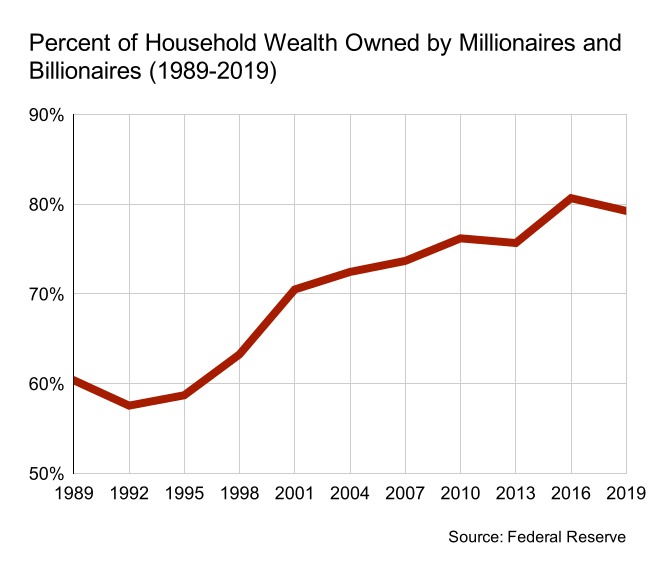
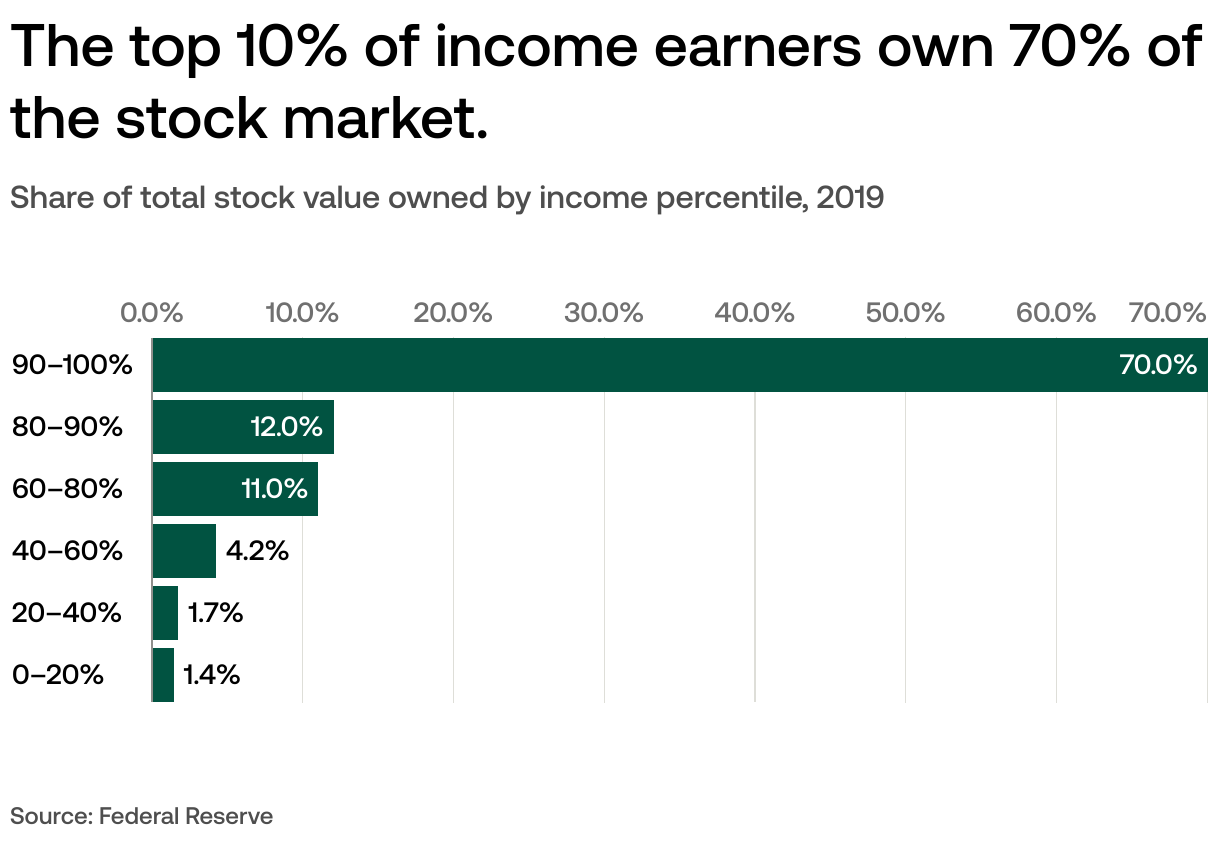
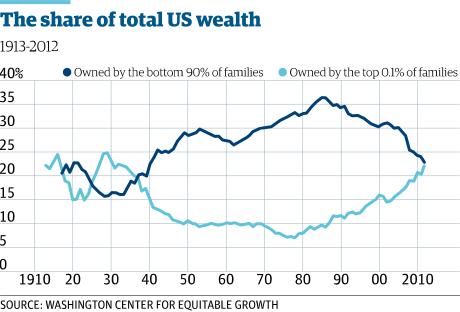
Overall capital ownership is increasingly concentrated among a small number of elites.
I think getting into the weeds on whether $80k or $100k or $120k/yr is a middle class sort of misses the point, but at least with my eyes it is hard to argue you're middle class if you're making more than about $150k at the most.
Even the GP, which I directionally agree with, says "upper-middle class is people making ~$200k/yr" but you're deep into the top quintile by that point, probably top 10%. I don't know what percentile I consider "upper middle" but it's definitely lower than top 10%.
A good indicator that someone is simply being dogmatic and not arguing in good faith (e.g. actually trying to understand someone's POV, and being open to being proven wrong in their assumptions) is when it takes them 5-20 minutes to reply until a particularly good point is made and then they disappear into the ether.
I didn't say A means B 100% of the time, just that it's an indicator. The same way having a car with a lot of dings and scratches and holes doesn't mean you're a bad driver, you could have just purchased it that way or they could have happened through no fault of your own. But it's still an indicator - one piece of evidence to be looked at holistically.
But I notice you haven't actually responded to the point that "the 1%" actually does mean "your neighbor with a nice house and a pool" because $800k income puts you in the 1%. That's two doctors in not-particularly-highly-paid specialties. That's two good attorneys at big firms. That's two FAANG software engineers. Definitionally there's not going to be a ton of people in that group, it's hard to get into that group, but they're everywhere not just billionaires twirling their mustache and trying to reroute rivers to sell the water like some caricature.
From this angle, what's the difference between Meta and a junk food company?
Both sell things that are bad for you, but that the consumer has complete control over whether or not to consume.
And not all of what Meta is selling is bad. There's a lot of information exchanged on Facebook, Instagram, etc. that are good for society. Like health/nutrition advice, etc.
Shop around and see what others are offering. I believe your anecdote, and I've also seen several other anecdotes about how rents have dropped - someone said as much as $1k.


NIMBYism prevents new houses from being built, driving up the cost of housing.
Healthcare is for-profit, yet not allowed to operate like a true competitive market, with heavy regulations restricting providers to a few that the government favors. Thus it's essentially an oligopoly, driving costs sky high.
reply