I agree with you, the infection hit quite a lot of older people very hard as well. I have problem getting some 40somethings to meet in person, even in professional contexts, they are just so soaked in a WhatsApp maelström of utterly irrelevant messages that they are conditioned to answer NOW!
That said, the core of the message should not be judgments between the young and the old, but the problem that we have introduced digital fentanyl into our pockets.
You're right, as is your parent comment, in saying that this isn't something only the young suffer from. In fact it's everywhere; the people with the worst smartphone addictions near me personally are an 11 year old and a 70 year old...
That said the message, when taken as a general progression between how life was then and how it is now, stands.
The same thing happened with TV in the 80s/90s. It will eventually fix itself, Gen Alfa will grow tired of smartphones when they will be in their thirties, I'm pretty sure.
(that doesn't mean that there should not be active campaigning to point out the risks of smartphone addiction)
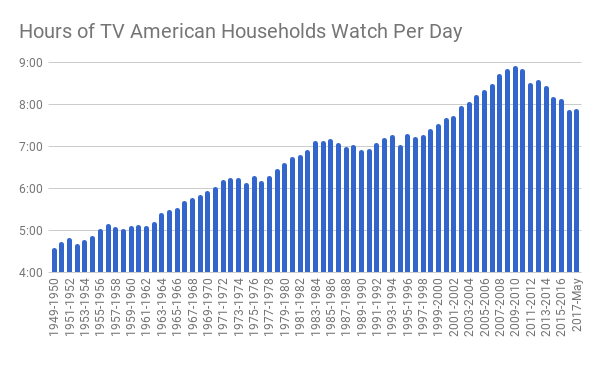
TV use was higher in the 2000s than it was in the 1980s/1990s. TV viewing hours steadily rose from 1949 until finally peaking in 2010.[1]
But when TV finally peaked in 2010, did overall screen time go down? No. It kept going up.[2] Obviously, this is when the masses went all-in on smartphones, social media, and the internet.
Screen usage basically never went down. It has only gone up.
So I only see anyone getting tired of smartphones and actually using them less if they've found something more addictive to replace them.
You have a good point I overlooked, thanks for the correction. I actually missed the "TV was just displaced" angle, which makes sense both statistically and anecdotally, if I think about family and friends.
TV also had a social aspect that internet does not have by construction: You had the same program on only a few TV channels and this was funneling people to talk about similar things or have discussions about the previous day show.
These things rarely happen organically anymore unless "forced" in one way or the other...
A friend of mine's kid (maybe 10 years ago) started crying when he watched regular TV for the first time. He literally thought the TV was broken when the commercials came on with the volume cranked up.
It's the same now with fb and these other old format social media sites. People just stop doing it. With that said I literally think fb will be with us for another 50 years as the people who are still on there are great marks and they won't be leaving until they 'age out'.
It seems we (America) are in some kind of “middle”, or at least a phase change in a larger wave of the addiction cycle, with different stages affecting different generations and countries based on arrival of what can be described as the addiction dealers, “Big American social media”. It reminds me of the effects of the crack epidemic rippling through different generations differently from the late 70s to this very day still.
I don’t have hard data to substantiate it and my theory is based on anecdotal conversations but it seems, e.g., where there is some recovery going on amidst something like American millennials, who have both dealt with their own addiction and were the first generation that is also dealing with the neglect of addicted parents, they are also to some degree recovering (“reparenting” themselves), to some degree probably also spurred on by realizations shot the deleterious effects of phones and SM that come from exhaustion and different life stages. On the other hand, other generations of Americans, like those now elderly parents of millennials, not only are still, but increasing number of them are entering the earlier stages of “phone addiction” (which encompasses many different things), with the most tragic part being that they are in the latter quarter of their life and are unlikely to even realize, let alone recover from the addiction.
I also see this cycle and these stages emerging in other western societies in particular. My theory is that it is a particular effect or amplifier of the underlying culture to some degree, i.e., adoption, degree, impacts. It seems particularly pernicious in America because the underlying culture (if you can call it that, after decades of it being poisoned and corrupted by corporations and the government) was and is fertile ground for the societal rot caused by social media and its amplifier, smart phones, to have taken hold and spread like the virus it is.
It was even all described as “viral”, and yet we still engaged in it as if unfamiliar and investigated viruses spreading in an uncontrolled manner are a perfectly acceptable thing that should not even give anyone pause, especially if money can be made, regardless of whether it is something like HIV, with a very long lead-time, a delayed ETA for the reaper.
What happens now that we are in some kind of middle stage of the “smartphone“/Social Media civilization wildfire, with the first to have been affected looking over the devastation it has left in their wake, Shell shocked by the neglect and destruction, as the inferno is still raging on off in the distance as it consumes their parents and new generations, and even toppling whole countries through the “Color Revolution” playbook?
English has ae in Maelstrom but the contemporary word in Danish, Swedish and Norwegian is Malstrøm/Malström. I wonder when it lost it's ae, I see Mahlströmn from 1698, reading the etymology it says dutch but I wonder if they just wrote it down first. Everything about the sea is always filled with mythology.
I think social media needs a less poetic word though.
I would say that the ae comes from Dutch, it was the way the open a sound used to be spelled before it became aa (maalstroom). You can still see it in place names (Aerdenhout which is pronounced Aardenhout).
It never had the ae in swedish and danish. Its from male/mala, to grind or to mill. English somehow changed it to ae, maybe through dutch where its maalstroom.
The OED agrees about the Dutch idea, giving the etymology as:
"early modern Dutch maelstrom (now maalstroom) whirlpool < malen to grind, to whirl round (compare meal n.1) + stroom stream n"
and also thinks Dutch is the origin, with Swedish/Danish etc taking it from Dutch too:
"The use of maelstrom as a proper name (also in French) seems to come from Dutch maps, e.g. that in Mercator's Atlas (1595). There is little doubt that the word is native to Dutch (compare synonymous German regional (Low German) Maling). It is true that it is found in all the modern Scandinavian languages as a common noun, but in them it is purely literary, and likely to have been adopted from Dutch."
Yes, it seems to be everywhere. Like an epidemic. When I pick up my daughter from school, I have to wait outside the entrance for about 10 minutes with other adult parents. Nine out of ten parents just stare at their smartphones and don't even look at me. In the past, people would have started a conversation out of boredom and gotten to know each other. We are really losing so much.
In the context of the above posts, which is young people eschewing dancing in favor of using smartphones, old is an adult that is expected to behave at or near peak maturity compared to a younger person whose is just coming into their own (presumably 20s).
One of the biggest problem of a two-party system is that the two parties are thoroughly captured by lobbyists.
In a PR system, fresh parties do arise over election cycles, and it takes some time for them to be thoroughly infested. These can then push for some reforms that threaten entrenched interests, and sometimes succeed.
Once upon a time I lived near the Prague city centre, and if the intent of such a corner shop is to rip off tourists and one-time visitors, the locals don't mind - at least as long as cheaper alternatives off the most notorious areas exist and are usable for them (Lidl etc.)
Quite to the contrary, the locals are sometimes happy to have such overcharged options at hand, for example if they are throwing a party and find out that they are short on vodka+cigs, and it is 1 am and all the regular shops are closed.
Theoretically, the donor could die before the rabies infection developed into a disease. For example, in a car crash. IDK if this was ever the case. The incubation period is definitely long enough for this to be a plausible scenario.
Going by wikipedia, the incubation period can be up to three months. That isn't a particularly significant span of time if we're measuring how likely someone is to suffer an unexpected death. It's long enough that the possibility exists, but that's about all you can say.
But the question isn't "what are the odds someone who dies in this period has rabies" it's "what are the odds someone who died after being infected with rabies died before they started showing symptoms" so the rarity of people incubating rabies is irrelevant.
Further, rabies incubation is highly variable - symptoms may not appear for years.
Ironically, if you feed the symptoms of the donor into an AI and ask for differential diagnoses, it will tell you: "Is there any history of animal contact? In that case, consider rabies."
Iran's situation with water has always been precarious, hence the massive ancient system of channels and aqueducts, which was mostly destroyed by the Mongols in the 13th century.
I wonder if, today, the overall brain drain is contributing to the situation. Iranian engineers don't have to put up with the regime's shenanigans if they don't want to. How many of the people who could have managed the situation are abroad?
It's a combination of internal and external factors. Internally - wasting water and overpumping underground water table. Externally - climate change and Afghanistan damming couple of rivers flowing into Iran.
Yes, but as a general attitude, this is unrealistic, like ignoring the effects of drugs because they are voluntary. All these things (food, substances, sex, social media, etc) exist on an invisible spectrum of willpower vs circumstances for each individual. In practice, there's some subjective line in that spectrum across which society can't afford to just say "it's your fault, so I don't care" (though wealthy/isolated people can!).
Then we need to solve the problem through regulation.
But just as with drugs we (not as single persons but as society) have decided that profits for some wealthy individuals are more important.
But as an individual you can just choose not to participate in social media, I wasn’t trying to invent some magic general attitude that solves all problems.
Also not sure if there is a “single” solution even possible, there is a lot more nuance and complexity to it.
> Am I alone in thinking that truck driving is an arduous job that ideally shouldn't be done by humans at all?
There are lots of people that do not have the capacity to move up the 'value chain'. All they are capable of doing are 'simple' jobs:
> To enlist in the Army, aspiring recruits typically must take the Armed Services Vocational Aptitude Battery (ASVAB) test and earn a passing score. The ASVAB, with a maximum score of 99, requires a minimum score of 31 for Army enlistment.
> The ASVAB test encompasses various subject areas or subtests, including general science (GS), arithmetic reasoning (AR), word knowledge (WK), paragraph comprehension (PC), mathematics knowledge (MK), electronics information (EI), auto and shop information (AS), mechanical comprehension (MC), and assembling objects (AO).
If all/many of those jobs are automated away, how are those people supposed to make a living? It's possible to be 'too stupid' to even be in the military (or at least be in it and have a useful role).
Ideally you would also think about what the truck drivers would do in this new reality where they aren't just unemployed but rather unemployable.
Truck driver is the most numerous blue-collar profession in the US, if I remember correctly it counts several million people. I wouldn't expect all of them to become automotive AI model trainers overnight.
I agree completely, and I think it's only a matter of time until the short haul is completely autonomous. The trucking industry is slowly working themselves out of a job, and it's not just deplorable working conditions, or terrible pay, outright fraudulent schools, or the predatory trucking companies, it's also the rising cost and antipathy towards the very, very very critical role that truckers play in modern society.
This is a bit complicated even in Czechia, with its densest network of railways in the world.
Trains are most efficient when they are long. 30+ cars, ideally. Capacity of railway lines is limited and lines tend to be shared by passenger traffic as well, so freight mostly moves at night and short freight trains are economically unviable.
It might take a long time to gather enough stuff/containers to fill 30 freight cars in one particular railway head (obvious exceptions such as Port of Rotterdam apply). Which means that you may have to wait for 10 days before your shipment actually starts to move.
>long hours and days spent in loneliness, away from family and friends
Calling bullshit here. If they weren't doing that work, they probably would not, in fact, get extra time with family/friends.
>the need of humans to sleep and relax means that the trucks cannot legally move for majority of the day, thus there is a need to have more of them,
Team drives can cover a majority of the day if need be for long hauling. Short hauling/last mile is capped not so much by miles traveled, but cargo load and unload times.
N == 1, but I used to live in a block of flats with three truck driver families. All three marriages collapsed over their fathers' frequent absence from home.
You can say that they would have collapsed over something else if they stayed at home, but this is what the people themselves told me.
Driving to Spain and back takes two weeks. After two weeks of his absence "I felt like a young widow already", said Hana, the youngest of the wives.


So are painkillers, or alcohol. Still we shouldn't simply shrug our shoulders over their abuse.
We need to find a rational way to treat smartphones. As of now, we are fully in the Gin Craze [0] phase of their use and moderation is badly needed.
[0] https://en.wikipedia.org/wiki/Gin_Craze
reply