>Is C the ideal language for vibe coding? I think I could mount an argument for why it is not, but surely Rust is even less ideal
I was really hoping you were going to make this argument, based upon the title of the piece! Still a good read, but if you have the inclination I hope you loop back around to weighing the pros and cons of vibe coding in different languages
Pipedream Labs is trying to implement a standard delivery tunnel + robotic delivery system, but yeah, I’m afraid they’re facing a serious uphill battle in terms of land use restrictions in the existing built environment
Yeah, depending on the speed of these vehicles, it seems like bike lanes are the appropriate place for them. A smart city could even offer companies an opportunity to fund the buildout of additional bike lanes if there aren’t any existing in the neighborhood in question
The point of infrastructure is to have a common substrate where members of society can provide services to each other. Sure, in some sense there are subsidies but we have to account for the positive externalities. After all, a tennis court has very low utilization of space so that's a "subsidy for rich guys to talk about crypto". And golf courses likewise.
It's just not a meaningful way to think of infrastructure. The point of infrastructure is that it benefits society, and it will benefit some people more than others. Nice sidewalks benefit the rich people who live there more than they do the poor people who have to drive from the suburbs to work there.
And this business about "have to move out of the way" is really a bit much. If they're impeding the disabled then that's of some significance, and ensuring that those who need wheelchair access can still get places is worth it, but any able-bodied person can easily step aside.
I find the online reaction to so much of this stuff hard to fathom. Occasionally, I'll walk by a Lime / Bird scooter that's fallen over and I just pick it up and place it on the side. The net gain to society of having easy-to-access last-mile transportation is probably much greater than this happening occasionally. I really think these things are far overblown. But if you go online, you'd think that sidewalks are completely unwalkable. I principally walk and bike (now e-bike) places and this has never been a problem either in San Francisco or London - both cities where a large contingent has constantly insisted that it is.
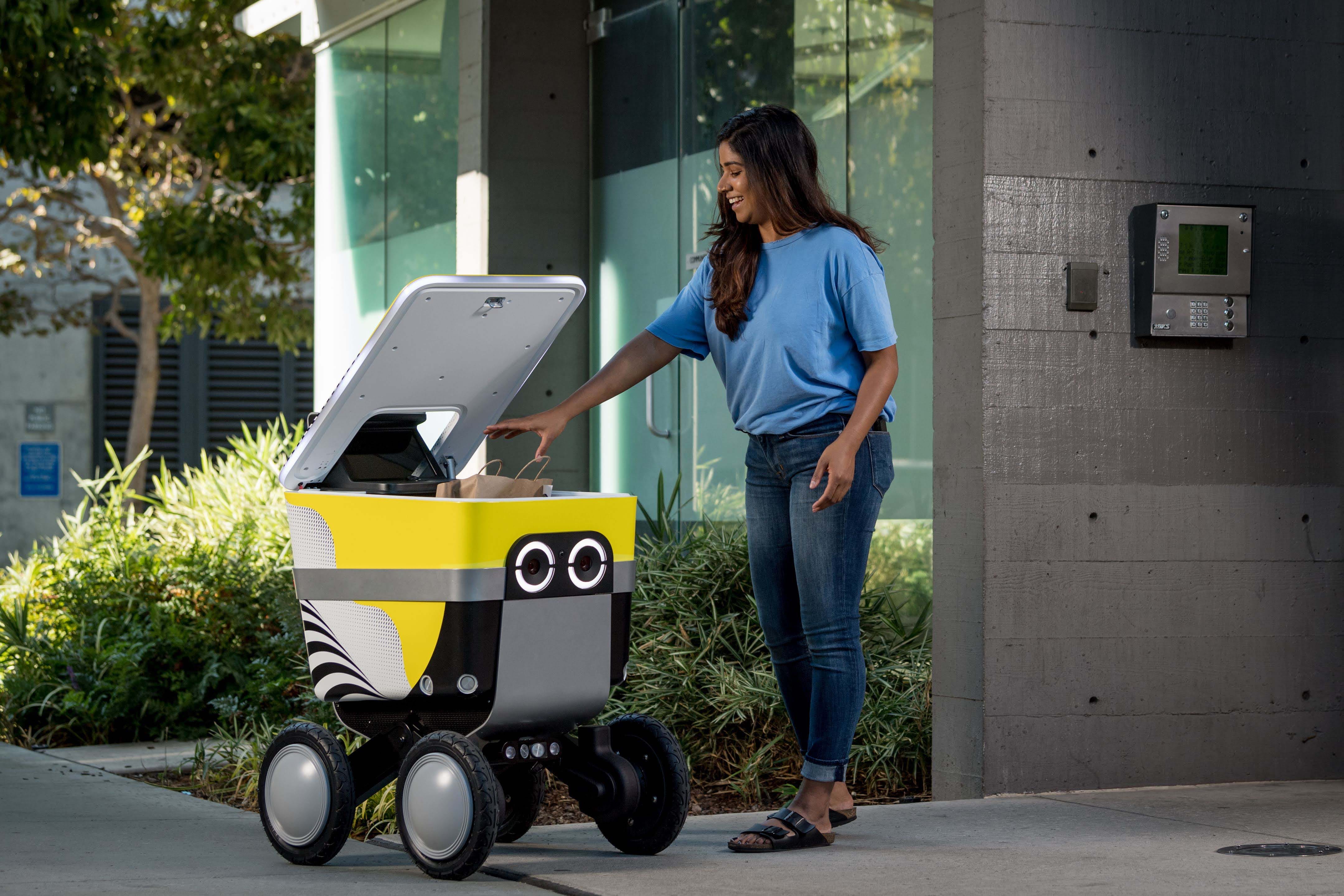
I think you’re right that liability concerns are probably what motivated companies to design for sidewalks instead of roads. That being said, I think it’s very unlikely that a robot weighing 100 lbs and moving 15 mph is going to kill anyone. Could certainly cause some property damage or break a bone, but is that worse than blocking a disabled person on a sidewalk or pushing deliveries into full cars?
I think the problem is that if they're in the road their liability and required smarts go up a lot. Right now it sounds like they're at least partially relying on being the largest thing on the "road" and everyone else will naturally get out of their way.
A slow-ass cooler-sized wheely boy filling up the entire bike lane and stopping randomly, that'll be super safe for cyclists, yep. On the bright side maybe some of them will get knocked into traffic by people who don't bother looking for bicycles coming up behind them when they open their car door, never mind low-riding bots that are much harder to see.
The US industrialized without much in the way of large scale state industrial policy. The federal government was quite weak in the 19th century and, excepting tariffs on British goods, I can't think of any explicit policies it established that were intended to foster industrial capacity. And I think it's debatable how much tariffs actually helped the US develop its manufacturing capacity
> The US industrialized without much in the way of large scale state industrial policy.
What? From funding the Lewis&Clark missions, to forcing japan open, to clearing out the natives for railroad companies, to helping found colleges ( check out many engineering/tech focused colleges like MIT was founded in the 1800s ). You can even argue that american independence and the civil wars were about expanding state industrial policy.
> The federal government was quite weak in the 19th century
So "weak" that we went from 13 small states on the east coast and expanded 3000 miles all the way to the pacific? What the hell are you talking about?
> I can't think of any explicit policies it established that were intended to foster industrial capacity.
The US became the dominant industrial power in the 1800s and you can't think of any policies that helped? You think all the territories in the ohio valley, texas, oklahoma, california, etc chock full of oil were just given to americans by overly generous natives, brits or mexicans? Are you a moron?
If the US didn't have state industrial policy, the US would have never become and industrial power. We'd have just gone down the jeffersonian agrarian paradise road.
Having access to large tracts of land is not a necessary precondition to industrialization (see South Korea). Did the capital accumulation from the exploitation of resources in the American West make it easier to industrialize? Probably. But America would have industrialized if it never expanded beyond the Ohio River valley (access to coal probably was necessary).
Also, as an aside, yes, most of the American West was largely lucked into. America was lucky that France and Spain were dirt broke, that Britain was distracted by continental conflicts with France and Russia, and that native societies had been decimated by disease and a subsequent collapse in governance. That's not to say that there wasn't smart, farsighted leadership in American government, but it was a weak power.
> Having access to large tracts of land is not a necessary precondition to industrialization
But having access to large tracts of land with resources ( like oil ) is. I guess you missed the "chock full of oil" part.
> (see South Korea).
Perfect example. How did Korea industrialize? By being annexed by the japanese ( who went about acquiring tons of land with resources ) and then being annexed by the US with our global network of resource links.
> Also, as an aside, yes, most of the American West was largely lucked into.
It wasn't "lucked into". We won wars against the british and spanish and mexico. And we intimidated the french. And we fought wars against the natives.
> but it was a weak power.
Yes. Because major world powers cede a continent sized piece of territory with an infinite amount of resources to a "weak power".
If the US was a "weak power", then the french, british and russian empires in the 1800s must have been a joke.
I think steaming just represents such a small share of revenue for professional musicians that negotiating over it isn't worth the headache for the most part. For Swift in particular, touring definitely represents the overwhelming majority of her income.
I wouldn't tbh, though I'll admit I'm speculating solely on public information. During the 2023 strikes, SAG-AFTRA and the WGA negotiated additional residuals based upon whether 20% of the streaming services subscriber base viewed the content within 90 days of release.[1] So, streaming platforms are evidently willing to share subscriber viewership data with 3rd parties if it's a contractual requirement.
I would be surprised if content licensors haven't negotiated an as good or better deal for themselves.
I certainly believe that if you want to be a successful musician, not even a pop star necessarily just one that's able to draw crowds large enough to sustain you financially, you probably are bound by certain norms and expectations. Not necessarily because audiences hate women (or men for that matter) that break the mold, but they're not as easy to digest. It adds friction. And when there are thousands of other artists out there to listen to, that friction can be the difference between success and failure.
I agree with you though, if you're willing to live a small life where you only need the love and respect of a small handful of people, you can do almost anything and very few people will genuinely hate you.
Other people might have other preferences. Maybe we could have a price system where people can express their preferences by paying for things with money, providing more money to the product which is in greater demand?
Sure.. Except some people / companies have so much more money, they can demand impractical things and pay above-market rates for them, causing all others to scramble to live day-to-day with the distorted market.


I was really hoping you were going to make this argument, based upon the title of the piece! Still a good read, but if you have the inclination I hope you loop back around to weighing the pros and cons of vibe coding in different languages
reply