Loved this. Thought it was perfect for my skill level (I know what an .svg is; that's about it). I think what I learned will actually come in handy the next time I'm trying to adjust / optimize an icon.
I really liked the sound effects! Spent perhaps too long just picking up and dragging stuff.
To those arguing that this is irrelevant, I urge you to search for a video of this "culling" yourself.
All the logic in the world can't ease my stomach after watching a conveyer belt of chicks get dumped directly into a meat grinder. It's simply not right. And while there are still many issues remaining in the meat industry (arguably its existence at all), this is one less.
I've seen it: It's gruesome, but I'm not sure if in-ovo sexed roosters have a better end, or if its just more palatable to watch.
Eggs take 21 days to hatch, in-ovo techniques work at 9 - 15 day post laying, depending on the technique used. Couldn't find any details on how developed the embryo is at 15 days, but 2/3's done feels pretty far along.
> All the logic in the world can't ease my stomach after watching a conveyer belt of chicks get dumped directly into a meat grinder. It's simply not right.
Where on the evolutionary scale do you draw the line and why, though?
Remember that the feeling you experience is a very messy heuristic that exists to perform a basic evolutionary function. People have similar feelings when Boston Dynamics robots (or similar things) are kicked/'abused', even though they would never attribute any awareness or even the experience of pain to them.
A feeling should always be the starting point of a rational appreciation of the situation; things are rarely "simply not right" and feelings are often wrong.
> conveyer belt of chicks get dumped directly into a meat grinder.
I haven't seen it, and correct me if this is not the case, but it doesn't strike me as a bad way to go. Getting macerated beats most of the ways humans and wild animals die. Do these chicks have any idea "what hit them"?
It's mercifully fast but it's still absolutely mass wholesale slaughtering of chicks because they're economically inconvenient. Also as quick and near painless as the death is it's hard to get the image of the chicks going into the grinder if you've seen it, no matter how much you know that it's fast and the chick doesn't have time to feel anything it's pretty affecting.
There's an effect where the visceral emotional response to an execution method overrides the actual cruelty of the act. Lethal injection, for example, is probably horribly painful for at least some of those that experience it[1] but it looks humane to observers. Meanwhile, the trusty guillotine would be my chosen way to go since it's nearly instant.
Nitrogen suffocation any day of the week in my opinion. Your brain lives long enough after the guillotine you definitely have time to feel the pain of the cut while your brain can't even register the hypoxic effects from N2 suffocation.
There's plenty of time to feel excruciating panic walking up to bend over and lose your head. The cut itself may be instantaneous but that's not really all there is to it.
Are these crushed chicks also processed and sold (for example, as animal / pet feed)? If not, (I am wondering) why can't you just release them in the wild - in some park or forest and let nature take care of it - it's less cruel (in my opinion) if the chick becomes food for some other wildlife.
Chickens learn from their mothers how to scrounge for food when they grow up free range. Releasing 1000s of tiny yellow chicks into the wild with no mother is way more cruel than current practises I reckon.
I reckon the chicken industry also generates way more male chickens than what a park can reasonably handle. People eat lots of chickens.
The answer is probably, unhelpfully, "it depends".
I attended a fairly large high school, and we probably had a dozen shop class offerings. A much smaller school just a few miles away had no infrastructure to support any shop classes.
It's probably even more nuanced than that, though. My parents both attended very small schools in small towns, and both offered shop classes. All four schools mentioned were / are located in the Midwest, though, and none in large cities.
If I had to guess, I'd say probably the majority of schools in the US offer some form of shop class(es). But I don't believe any would necessarily be part of the standard curriculum. Generally, these classes are elective.
I'll say something unrelated to my question before, but damn if I don't envy you for electives.
I had zero elective classes up through my entire pre-uni education. At my uni, I had one or two elective classes - at fifth and sixth semester, and that's all.
It is an aspect of American education I do like a lot.
(here we choose our profile, which assigns us to extended classes - i.e, Maths/English/Physics, Maths/Biology/Chemistry, Polish/Geography/History and so on, but then we don't get to choose anything after.)
I actually struggle to think of something "less-junk" than potentially providing tens of millions with cheap(er) access to the Internet. Who otherwise would be exploited for it. Or plain just wouldn't have it. Seems like one of the best-possible uses for orbit IMO.
Plus (and I'm no expert), I believe that since these satellites specifically require a rather low orbit, they're by-design quick to de-orbit in the case of disaster or destruction.
> quick to de-orbit in the case of disaster or destruction.
In case of destruction, the satellite breaks up into many individual pieces each having a potentially very different orbit. Many of those parts might then stay up longer than the satellite would have if it remained intact. The parts can also cause a chain reaction which eventually breaks everything in low earth orbit.
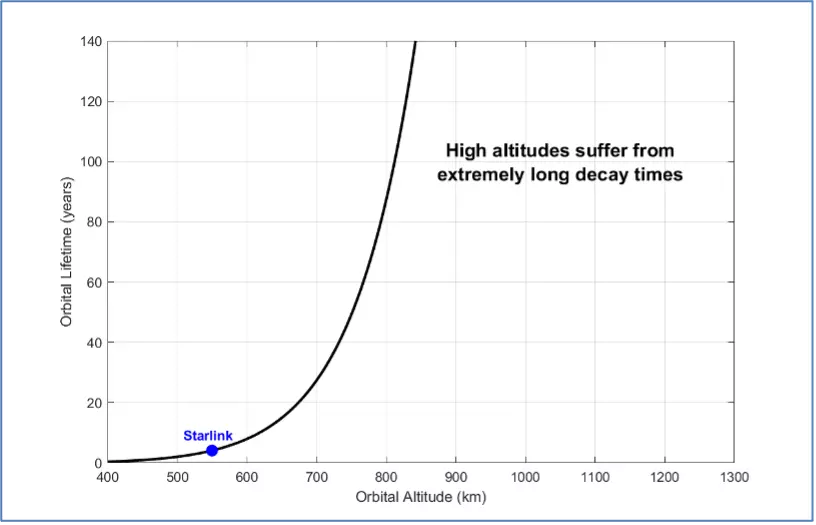
Starlink satellites are placed in extremely low orbits specifically to avoid their becoming dangerous space-junk — their orbits are intended to decay after around 5 years, at which point they burn up in the atmosphere and leave no debris behind in LEO. Future iterations of the satellites may have even shorter lifetimes as launch costs get cheaper.
Starlink V2 already started deployment back in 2023, and they actually requested lower orbits (~350km) in order to reduce latency.
Moving to 2000km would be a massive downgrade in performance, I'm not able find any source for that, everything points to the next generation (V3) being deployed via Starship at that lower altitude of 350km.
Apologies, I got 2000km confused with another megaconstellation, later rollouts / V2s+ are suppose to be up to 1200km, which was initially filed / granted with FCC. They did request/allow to move some of of larger v2s to lower orbits, but the full megaconstellation plan won't be constrained to <350km simply because there aren't enough orbit slots (as managed by UN/ITU) for the constellation size star link envisions. Below is recent image of current starlink distribution. Most are 400-500km and above, i.e. much longer decay times. My understanding is they're throwing v2 "minis" which still weight 3x more to lowerish orbits because that's most economical for F9 delivery, but once they have more payload via starship, full size v2+ is going 500km-1200km. 500km more altitude as like ~4 milliseconds of latency, which is not nothing, but still minor vs economic benefits of more coverage with less hardware. IMO current low LEO focus isn't ... starlink being responsible, it's result of cost optimization of coverage:payload for F9. Starship will come with different set of cost optimizations, likely for higher orbits using larger hardware, but less of it.
AFAIK Starlink does not plan to put satellites in 1200 km orbits. All Starlink satellites are in orbits of 600 km or less, where any debris naturally decays in less than 5 years:
> Starlink satellites operate in a low Earth orbit below 600 km altitude. Atmospheric drag at these altitudes will deorbit a satellite naturally in 5 years or less, depending on the altitude and satellite design, should one fail on orbit. SpaceX proactively deorbits satellites that are identified to be at an elevated risk of becoming non-maneuverable. This proactive approach minimizes the number of non-maneuverable satellites in space.
> In case of destruction, the satellite breaks up into many individual pieces each having a potentially very different orbit.
Depends on what you mean with "potentially very different orbit". Each piece still has to be at least on some elliptic orbit that eventually again passes through the spot where where it broke up*. If it was on a low orbit to begin with, it'll still burn up soon-ish as it decays. You cannot increase the perigee of some formerly circular orbit with only a singular application of force, nor can you increase the perigee of an elliptic orbit higher than its old apogee through the same means.
It'll take a lot to get pieces into orbits where they avoid decaying within a reasonable time span.
*Disregarding external factors like the gravitational pull of a third object, and assuming no drag and perfect point masses.
During China's ASAT test, almost all of the debris remained in the same LEO orbit. The amount of energy needed to climb over 1000km to reach MEO or over 35000km to reach GEO is significant, and even then, to reach a stable orbit after the climb is very unlikely. Kessler Syndrome is always a consideration, but with Starlink it's still minimal, especially since Starlink's elevation is only 340km, while China's ASAT test targeted a satellite at 900km.
Next gen starlink v2s are going to be 1000-2000km with starship. Low LEO v1s was more limitation of F9. Shooting high LEO ery expensive (PRC has HQ19s for 3000km), but realistically once US/PRC rolls out starship tier reusable payload vehicles at scale, we're goign to start seeing enough co-orbital asats being launched to guarantee kessler.
> On December 1, 2022, the FCC issued an approval for SpaceX[66] to launch the initial 7500 satellites for its second-generation (Gen2) constellation, in three low-Earth-orbit orbital shells, at 525, 530, and 535 km (326, 329 and 332 mile) altitude. Overall, SpaceX had requested approval for as many as 29,988 Gen2 satellites, with approximately 10,000 in the 525–535 km (326 to 332 mile) altitude shells, plus ~20,000 in 340–360 km (210 mile to 220 mile) shells and nearly 500 in 604–614 km (375 to 382 mile) shells.
Was not aware they scuttled 1,200km ka/ku band constellation and corrected in another reply. Either way, per your citation, the current plan still puts 10k+ objects in 400km+ orbits where debris hangs around for much longer. Primary point still stands - starlink isn't limited to sub 400km constellation and kessler syndrome risk for higher orbits is real (risk increase not linear). Especially, if starlink plan to go to 42k above currently planned 30k, most are going to be 400km+ since sub 400km orbits are taken. Unless UN/ITU increase slots, the amount of sub 400km slots are fixed, and expanding megaconstellations including future starlink expansion is going to be satuating orbits with multi year / multi decade decay.
> SpaceX operates its satellites at an altitude below 600 km because of the reduced natural orbit decay time relative to those above 600 km. Starlink operates in \"self-cleaning\" orbits, meaning that non-maneuverable satellites and debris will lose altitude and deorbit due to atmospheric drag within 5 to 6 years, and often sooner, see Fig. 1. This greatly reduces the risk of persistent orbital debris, and vastly exceeds the FCC and international standard of 25 years (which we believe is outdated and should be reduced). Natural deorbit from altitudes higher than 600 km poses significantly higher orbital debris risk for many years at all lower orbital altitudes as the satellite or debris deorbits. Several other commercial satellite constellations are designed to operate above 1,000 km, where it requires hundreds of years for spacecraft to naturally deorbit if they fail prior to deorbit or are not deorbited by active debris removal, as in Fig. 1. SpaceX invested considerable effort and expense in developing satellites that would fly at these lower altitudes, including investment in sophisticated attitude and propulsion systems. SpaceX is hopeful active debris removal technology will be developed in the near term, but this technology does not currently exist.
It is perigee, not apogee, that matters for the lifetime of a satellite. In case of collision, it is near impossible for any object ejected to have a higher perigee than that of the original satellite. Some energetic particles might have higher apogees, sure, but that will not affect their time to deorbit.
> Less junk? Weather satellites, climate monitoring satellites
These typically operate at higher orbits. From a strictly space junk perspective, that makes them more of a debris risk than even multiple Starlink fleets in LEO.
Is there a reason firearm manufacturer's aren't pursuing the creation / sale of 'coil guns' as actual products? I get that you're introducing reliance on a battery, but you're also gaining (I assume) near silent operation. And most incidents involving a firearm don't extend past one or two magazines anyways.
Seems to me like a cleaner, more "futuristic" weapon. The "hobby" version of this weapon photographed in the article already looks quite clean.
The energy density and expense of capacitors, along with the efficiency of the electromagnetic coils makes them impractical.
Coil/rail guns that achieve velocities comparable to real firearms are actually quite loud, as the air is compressed and superheated in front of the projectile, which creates a report at the muzzle. However, most man portable variants are limited to around the energy of a .22 LR. Even air guns are more powerful and practical.
As an example of a weapon that's practical yet not portable, take a look at the Navy's 155mm rail gun. https://youtu.be/O2QqOvFMG_A
"Silent" is going to be relative. Yes there's no pop of the propellant, but you've still got to accelerate an interesting mass to interesting speeds in a very short barrel. That's going to make a noise in its own right just from the mass reaction.
Firearms need to be practical and reliable first (you only expect to use them in a worst case scenario), the technology required to make a coilgun lethal is neither practical nor reliable, and its more complex to operate and maintain.
It’s the same reason why we don’t use coilguns anywhere else, why fix what isn’t broken?
Not particularly powerful and it's unclear that any amount of engineering can make it deliver more power to each round while still keeping it man-portable.
That's interesting, I wonder if you could have a hybrid weapon that uses the first stage gas from gunpowder like a normal gun, but uses the rest to drive a cylinder that rakes a magnet down a coiled cylinder to supply the jolt to boost the projectile using EM force?
The advantage would be better efficiency, similar to how hybrids are more efficient than ICE, which are only 35% efficient on a good day.
Hybrids and trains don't get their efficience from the conversion. They both lose a lot in the conversion itself.
They get their efficiency from smoothing out upscs & downs and letting the power source run more steadily and spend more time in it's own sweet spot. IE the ice engine is less efficient when changing and when running at any rpm other than the peak of it's curve. The battery lets the the ice run steady at it's one best rpm and the battery does all the stop & go.
There is very very little opportunity for "flattening out peaks & valleys" in a single pulse, and no chance at all to do it enough times to regain so much energy that way that it more than pays for the conversion loss.
And in any event, coils are just super super fundamentally inefficient at bursts. The term is literally called impedance, because it litetally impedes energy flow. It's similar to resistance and is even measured in ohms. It's like a spring. You put the energy in and it doesn't immediately come back out, it eventually comes back out, slower and a bit less of it than went in. Converted to mechanical energy instead of picked up by another coil or bounced right back out the same wires where it went in and you you almost none of the energy back out.
The problem is that their efficiency at converting electricity into projectile kinetic energy is really bad (like single digit percentages bad), getting electrical energy and power density is quite difficult in the first place (capacitors have abysmally bad energy density compared to gunpowder), and coils absolutely hate having their current changed quickly (which you need for this to work).
The problem with coil guns in particular is the ferrous slug is drawn to the center of the magnetic field. The field has to be collapsed at the right time to avoid sapping velocity from the slug, counterproductively.
Many designs that achieve respectable velocities use a multi-stage coil, which requires precise timing for each magnetic field, a lot of power, and high current capability. Generally, that means large batteries for a power source and large capacitors to feed the coils, which becomes heavy and expensive.
Even rifle variants rarely make more energy than a .22 LR, a feat which is easily overshadowed by air guns several hundred years old.
The electromagnet isn't the issue, it's the capacitors to power the magnets. A coil gun capable of matching a small handgun would be too heavy to reasonably carry. At the scale where they could become competitive with a conventional gun, you have an artillery piece.
I think there's at least one commercial maker (if still in business anyway), but they aren't anywhere near as accurate or powerful as traditional chemically powered guns while being a lot heavier, so more of a novelty than anything.
Nice conglomeration of headlines/links from lots of different sources. Lots of tech and science, but also a good mix of global news. Includes HN actually.
I've read a bit into this subject before; Matthew Walker's book 'Why We Sleep'[0] discusses it at length.
A lot of it boils down to blood pressure. High blood pressure is a serious contributing factor to cardiovascular incidents (as well as a slew of other negative health risks), and getting a good night's sleep will help keep blood pressure down. This is also why the amount of heart attacks are up around 24% after daylight savings[1]; an hour less sleep means higher blood pressure means higher risk of heart attack (relative to any other 'normal' day).
I can definitely see how the same logic could apply to Mondays. Less sleep, more stress = higher blood pressure = higher risk of heart attacks.
The important consideration here is that these people are on the cusp of death already, and this is typically just the straw that broke the camel's back. You don't get a heart attack from one bad night of sleep, of course, unless there are significant underlying conditions.
High blood pressure is often refereed to as the "silent killer". It's not like these individuals present sick/ill in their daily lives. Basically the only symptoms of high blood pressure are sudden traumatic events like Heart Attack and Stroke. If you meet one of these people hours before their heart attack you often wouldn't describe them as 'on the cusp of death'.
> If you meet one of these people hours before their heart attack you often wouldn't describe them as 'on the cusp of death'.
I disagree. It's not that the symptoms aren't there, but that they have become normalized due to obesity, smoking, etc. being commonplace. Shortness of breath, sleep apnea, feeling weak, upper body tension/pain, etc. are usually present for quite a while in most people before it finally happens. People don't check their blood pressure often enough despite it being so cheap and easy to do.
I see your point, although some of the symptoms are quite subtle. Most people with sleep apnea don't know they have it until they get tested. Same for other symptoms.
What's really normalized is metabolic syndrome. 88% of adult americans have some degree of metabolic dysfunction. High blood pressure, obesity and other ailments are very often a direct result of that. So much so, that the 'normal' range of indicators such as uric acid has been revised and adjusted over the years, because "normal" people had higher levels and still appeared to be fine. Thankfully, we are starting to question that (eg. https://pubmed.ncbi.nlm.nih.gov/24867507/)
First order of business for anyone watching their blood pressure creeping up over the years (even more so if A1C, triglycerides, liver enzymes and uric acid are rising too): cut sugar in all forms. Not just the sugar you personally add to food, not only what's specified as 'added sugar', but all food containing sugar - which is basically all ultra processed foods. It does include sliced bread which is easily broken down into sugar( and is often laced with additional sugar, check ingredients). Leave your sugar 'allowance' to be used by a reasonable amount of fruits.
That may not reverse the problem (although, in my case, it did) but should help tremendously.
>First order of business for anyone watching their blood pressure creeping up over the years: cut sugar in all forms.
No, first order of business is consulting your doctor and/or a nutritionist and otherwise adhering to common sense of having a reasonably balanced nutritional diet.
If your first order of business is taking random advice from the intertubez, you have bigger problems than high blood pressure.
I mean I get what you're saying. But most doctors have normalized refined sugar intake. Cutting out refined sugar and simple carbs is not harmful at all and carries not risk whatsoever. So I don't see how listening to some modern wisdom in a HN comment is dangerous. Our understanding of nutrition in the western medical theatre is woefully incomplete and outdated.
Sugar is 50% fructose and 50% glucose. The user you mention advocates for a higher amount of fruit which has mostly fructose so my take on this is that he prefers his pancreas over his liver.
I have to agree, while there is a lot of people who say there were no symptoms - it generally was normalized over decades of decline.
It was once I lost 100lb that it became apparent just how bad condition I was in even though at the time I thought I felt fine. It doesn't help when you mention a lack of energy, or poor sleep to the doctor and they just say "Everyone is tired!".
No this is completely wrong. Over the age of 40, a perfectly healthy, functioning and complaint-free individual can have alarmingly high blood pressure. Often it's hereditary. They can even have an obese sibling who's just fine.
Unsure why folks are hating on you. I have had hereditary high BP since I was 13. I was underweight at that point. I was never overweight until COVID. COVID launched me from a normal weight into 'obese' territory pretty fast, but I am now a 'normal' BMI with 9.5% body fat.
This is entirely unrelated to this article and discussion, but something I've been wondering: what makes you say folks are hating on them? Is there a mechanism for downvoting that I'm unaware of?
You’re wrong. A young person with borderline hypertension (130/80) can present in perfect health. Blacks for instance have a genetic predisposition to hypertension, obesity and diet don’t have to be involved. Besides genetics, other health conditions like insomnia or other medications can cause hypertension. Some people are just salt sensitive.
Black African Americans seem to have that predisposition, but not all Black populations do. There is a theory that ability to retain salt improved your odds of surviving a slave ship journey.
The #1 marker you should be checking is blood pressure.
Cholesterol, Fasting Insulin levels, and (if male) free Testosterone are other good ones. Cholesterol and Insulin should be checked by all adults annually, and BP should be checked at least annually. T isn't checked as routinely, but it's worth knowing where you fit and has an impact on your metabolics and the test isn't a big deal.
Buying a cheap little glucose meter is really valuable IMO. You can get them for close to nothing, and you can use them to check your fasting glucose, or your glucose response after meals.
Also, resting heart rate is very easy to measure, especially if you have any kind of fitness/smart watch, and that's a good marker of health too.
I'm a fan of getting lab work done, but it's definitely more of a hassle.
I have high BP due to my insomnia coupled with sleep apnea.
I have insomnia ~5 nights a week. and for some reason I can no longer take naps in my older age. I used to be able to Nap-on-command when I was younger. It SUCKS
> High blood pressure is often refereed to as the "silent killer".
True but checking your blood pressure is painless, basically free and so easy that one can do it at home with no loss of precision.
Speaking as someone with mild high blood pressure, I see people obsess over diets, physical activity, looks, that never go to the doctor or check for their health conditions and "cure" every discomfort/pain with painkillers or ibuprofen.
And they of course all have some advice to give to me to improve my condition based, of course, on some diet they read online or to try yoga or acupuncture (or whatever is fashionable at the moment) and totally ignore the fact that I've been checking my blood pressure for over 20 years, I know a thing or two about it, because doctors. Yeah... I am that crazy! I see doctors!
Once a year is more than enough for people that have never been diagnosed with anything and yet very few people regularly do it, even here in my Country where medical checkups are virtually free.
Yep! You're correct. I didn't mean to imply that they look sickly or anything, just that their body is literally on the verge of failing, even if it looks perfectly fine.
It's actually not very hard to know at all, at least if your question is "what kind of lifestyle will generally lead to the best longterm health outcomes?" Sure, there's minor distinctions to be made and important medical questions, but generally it's pretty clear.
Everyone knows it, I don't need to list it: eating clean, getting good sleep, plenty of exercise, etc.
And furthermore, though our healthcare system seems only configured to deal with things once they become emergencies, metabolic disorder takes your whole life to take root. The time to start making positive changes is now.
This is a very important thing to consider when interpreting this statistic.
"Heart attack rates go up 24% after daylight savings changes" is not the same thing as "There are 24% more heart attacks due to daylight savings". You can't really know the weight of magnitude vs distribution without actually stopping daylight savings.
I feel really good with a sleep rhythm going to bed later each day and getting up later the next day.
I think many people do the same sort of thing, and then monday -- they have to cut their sleep short to get up early and sync with the rest of the world.
I can see how this would be the stressor you allude to.
> In the Northern Hemisphere, the switch to daylight savings time in March results in most people losing an hour of sleep opportunity. Should you tabulate millions of daily hospital records, as researchers have done, you discover that this seemingly trivial sleep reduction comes with a frightening spike in heart attacks the following day. Impressively, it works both ways. In the autumn within the Northern Hemisphere, when the clocks move forward and we gain an hour of sleep opportunity time, rates of heart attacks plummet the day after.
I don't see a specific study cited, but my ebook copy doesn't seem to have all the footnotes.
> The incidence of acute myocardial infarction was significantly increased for the first 3 week-days after the transition to daylight saving time in the spring (Fig. 1A). The incidence ratio for the first week after the spring shift, calculated as the incidence for all 7 days divided by the mean of the weekly incidences 2 weeks before and 2 weeks after, was 1.051 (95% confidence interval [CI], 1.032 to 1.071). In contrast, after the transition out of daylight saving time in the autumn, only the first weekday was affected significantly (Fig. 1B); the incidence ratio for the whole week was 0.985 (95% CI, 0.969 to 1.002
Sure. I'll start by prefacing that I'm not necessarily wholly attributing these as faults of Walker's book. I don't doubt I have a higher propensity for certain anxious responses, or perhaps my personality made me more susceptible to the sort of thinking I'll discuss.
Walker's book—and his accompanying Ted talks and podcasts—instilled a deep sense of sleep anxiety in me, which led to episodes of chronic insomnia (still occurs today). I had never experienced these issues before reading the book. Unfortunately, his message ensures that the insomnia is self-exacerbating, causing a vicious cycle.
Essentially, I find it very wrong for Walker to focus on and overhype the negative aspects of sleep loss as much as he does. Guzey's article [0], also linked above, goes through much of this. Why We Sleep turns into a horror book if you aren't able to sleep for whatever reason. It implies that, from just one bad night's sleep,
    1. your immune system will deteriorate significantly

    2. the chance that you develop a cancer will increase

    3. your mental health will suffer

    4. you are more likely to develop anxiety or depression

    5. the probability you hurt yourself will increase

    6. your mental faculties will be destroyed, you will be unable to reason well

    7. you are at higher risk of mortality (!)

    8. you are literally closer to death, which the book supports by mentioning fatal familial insomnia (FFI)... a flawed analogy
... and much more.
I was initially ok after reading the book, but the problems really started after I had a bad nights' sleep. I was absolutely terrified the following night, remembering all the awful things that will happen to my body and mind if I do not recuperate the next night. And we all know how easy it is to lose sleep when you are worried. I stayed up until 6 AM that night. Every passing hour made it harder to sleep.
Naturally, this started a cycle. Grumpy and even more anxious the next day ("two days? wow, am I now DOUBLE the chance of cancer and depression?"), sleep began evading me more and more often. The bed became a place of anxiety. Every minute I spent awake, I remembered Walker's book and the terrible things he told me was happening to my body due to the insomnia. This caused an infernal, unending loop of insomnia. Morning birdsong became hell to my ears.
I still sometimes suffer from it to this day, but Guzey's essay really helped. I think some quotes can do my point more justice:
> Your essay on Why we sleep - I can’t thank you enough. I’m a sleep doctor in Oregon and have seen many many patients who have developed severe sleep anxiety and insomnia. Two friends in the sleep field and myself weekly have talked about people that slept well until reading this book.
> I wanted to drop you a line to thank you for all the time and effort involved in debunking Matthew Walker’s book. As someone who works with individuals with insomnia on a daily basis, I know from firsthand experience the harm that Walker’s book is causing. I have many stories of people who slept well on less than eight hours of sleep, read Walker’s book, tried to get more sleep and this led to more time awake, frustration, worry, sleep-related anxiety, and insomnia.
> My patients are coming to me after reading this alarmist book, with insomnia that they did not have before, and worse, harder to treat because although the book has caused these anxieties - they can’t shake their newly built alarmist beliefs they learnt from the very same book.
> Scott slept well his entire life until he listened to a podcast that led him to worry about how much sleep he was getting and the health consequences of insufficient sleep. That night, Scott had a terrible night of sleep and this triggered a vicious cycle of ever-increasing worry about sleep and increasingly worse sleep that lasted for ten months.
I had the same experience. Very often, I couldn't fall asleep until 6-7am. I felt like I was losing my mind. I got professional help from sleep psychologists but it didn't do much. They told me all the same stuff that comes up when you google it, and it terrified me even more that even professionals didn't know why I couldn't sleep. I never had this much of a problem sleeping before I read the book.
After a year of this, a therapist pointed out that you can have bad days on good sleep and good days on bad sleep. That finally made it click that it wasn't logical to worry about bad sleep so much. I just stopped caring and that mostly got me over it, but I still have more bad nights than I ever used to.
If I see people reading the book, I warn them about it even though it feels a bit rude to tell someone not to read something.
I went through a similar thing where I had some trouble sleeping due to external stressors and then started to get freaked out that I was having trouble sleeping, having always been a great sleeper. I developed a lot of anxiety around it and it was pretty awful, though I'm mostly over it now. To me, the key was accepting that I might sleep poorly and being okay with that. That true acceptance allowed me to relax. (The larger context for me fwiw is trying to overcome my perfectionism.)
I actually found Hacker News through https://brutalist.report/ . Nice conglomeration of headlines/links from lots of different sources. Lots of tech and science, but also a good mix of global news.
Thanks for sharing this. I've got their point about keeping the website as simple as possible using HTML, CSS and no JS, but hey, why not make an exception around UI theming? I'd love to see it in a sepia background color and serif types. That black BG with a blue sans type is doing evil to my retina.
Thanks a lot for sharing this, I've been procrastinating doing an aggregated news feed with the simplest html possible for years and seeing this live just made me happy. Thank you!


I really liked the sound effects! Spent perhaps too long just picking up and dragging stuff.
Thanks!